GeMarkt Blog · Practical guide
Can a Business Use an Art Print? Display vs Commercial Use
Hanging a purchased print, making extra copies and showing art in advertising raise different questions. Plan business use with a clear, specific permission brief.

The short answer
A business can often display an art print, but buying a print is not a general licence to reproduce its image. Hanging a lawfully purchased copy in a café, making twelve more copies for guest rooms and turning the picture into a website banner are different actions. Start by naming the action, not by deciding that everything a business does must be either prohibited or unrestricted.
This is a practical guide to asking the right questions, not legal advice or a worldwide permission statement. The legal examples below concern specified countries and were checked on 12 October 2026. Local law, the actual source and any applicable agreement matter.
For a straightforward purchase, first establish what you are buying: a physical object, a downloadable file, or a licence for specified uses. Those can accompany one another, but none should be silently substituted for another.
Buying the object is not buying the copyright
Under section 202 of US copyright law, ownership of a physical object is distinct from ownership of copyright in the work embodied in it. Transferring the object does not by itself transfer that copyright. A receipt for a framed print therefore answers a different question from an agreement allowing you to reproduce the image.
Imagine buying one contemporary illustration for a reception desk. You receive one finished print. If you want the same picture in every meeting room, ask about additional prints or reproduction permission. Scanning the first purchase is not simply another way of hanging it.
The distinction applies even when the artist sells directly. Friendly correspondence saying that an image will look good in your office is not a precise answer about printing quantities or advertising. Nor does a label saying “original” automatically mean that reproduction rights accompany the object. Ask what the sale actually includes rather than interpreting the price as a measure of the rights transferred.
Hanging the copy you own
The United States provides a useful specific example. Section 109(c) permits the owner of a particular copy lawfully made under US copyright law, or someone authorised by that owner, to display that copy directly to viewers present where it is located. That is not an unrestricted right to transmit the image online. Someone who only rents or borrows the copy does not automatically receive those privileges; section 109(d) preserves the copyright owner’s authorisation requirement.
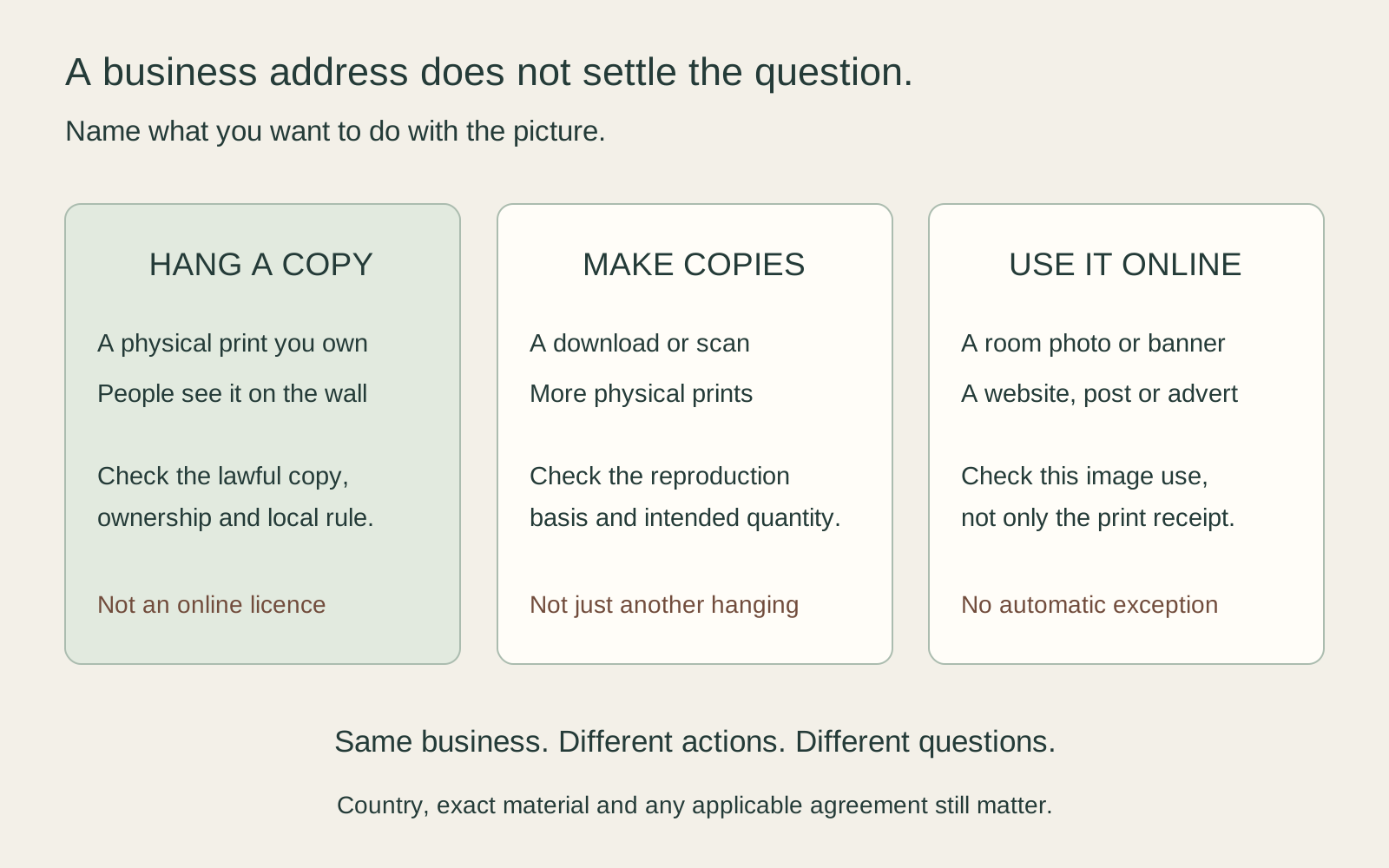
For an office buying finished prints, this is a reason not to panic simply because customers will see them. It is also a reason to buy from an identifiable source and keep the order record. “I paid for it” does not establish that a counterfeit was lawfully made.
If the art is hired, supplied through an interior designer or owned by a landlord, clarify the arrangement instead of assuming that the rules for an owned print answer it. Check any relevant display agreement and obtain local advice where necessary. The US example should not be pasted into a contract for another country as if it were universal law.
Printing a download for several rooms
A digital purchase needs a different reading. Look for what the terms permit: the number of copies, who may print them, whether business premises are included, and whether the file may be shared with a print provider. Do not assume that paying once authorises an unlimited hotel, office or franchise rollout.
Equally, do not assume every download carries a one-copy limit. An exact file appropriately released under CC0 is different from an illustrator’s restricted download. CC0 allows commercial reuse, while leaving matters such as trademarks and privacy outside its waiver. Our guide to museum image licences helps distinguish those statements.
A CC BY-NC licence defines its noncommercial restriction by the use, not simply by whether the user calls themselves a business. Do not assume it covers a commercial decorating project; assess the specific use or ask for permission. Public-domain elements and applicable legal exceptions remain separate, as the deed itself explains.
Once the permission question is settled, file suitability still needs checking. A legally usable image may be too small for the intended print or may include a border you did not expect. Printing a digital art download covers that separate practical step. Neither resolution nor a printer’s willingness to accept a file proves that your proposed copying is permitted.
When the picture enters your advertising
An artwork on a wall can become part of a room photograph, a virtual tour, a social post or a paid advertisement. Plan that use before commissioning a large campaign. In the UK, section 17 includes reproduction and electronic storage within copying. Owning the print does not itself settle the separate act of making an online image of it.
There are exceptions, not a simple rule that any visible artwork requires a new licence. The UK’s section 31 provides for incidental inclusion in specified media. Whether a particular inclusion qualifies is fact-sensitive. Calling art “background” is not a reliable decision method, especially when you deliberately make it a prominent selling point.
Separate two hypothetical photographs. One shows a whole dining room, with a small print among many objects. The other fills the frame with that print and adds the café’s slogan. They do not present the same facts. Do not treat the first as automatically cleared or the second as automatically unlawful; identify a suitable licence, applicable exception or other legal basis for the actual use.
If permission is uncertain, a different camera angle or an image with clear reuse terms may be a simpler choice than building a campaign around an unresolved artwork. Removing a credit or blurring a signature does not resolve the underlying question.
Merchandise and branding need a separate question
Printing the image on a takeaway cup, tote bag or item for sale is another proposed reproduction, not just business decoration. Ask about those products explicitly. An agreement for reception-wall prints should not be stretched into a merchandise licence by changing the meaning of “commercial use”.
Branding raises a further issue. The USPTO explains trademarks as identifiers of the source of goods or services. A museum’s logo on your packaging may suggest a relationship that a factual artwork credit does not. Do not claim sponsorship merely because an image was downloadable.
Public-domain artwork can offer a useful route, but check the exact file and relevant country first. Institutional procedures may matter too: the Uffizi publishes a commercial image-use process grounded in Italian cultural-heritage law. Keep that specific issue separate from ordinary copyright duration rather than turning it into a blanket rule about every old picture.
Send a brief the seller can answer
Replace “Can I use this commercially?” with a short description of the job. Name the exact image, country, business premises, physical quantity and any online or product uses. Say whether you want to buy finished prints or print a supplied file yourself. If someone grants permission, establish that they are authorised to grant the rights you need.
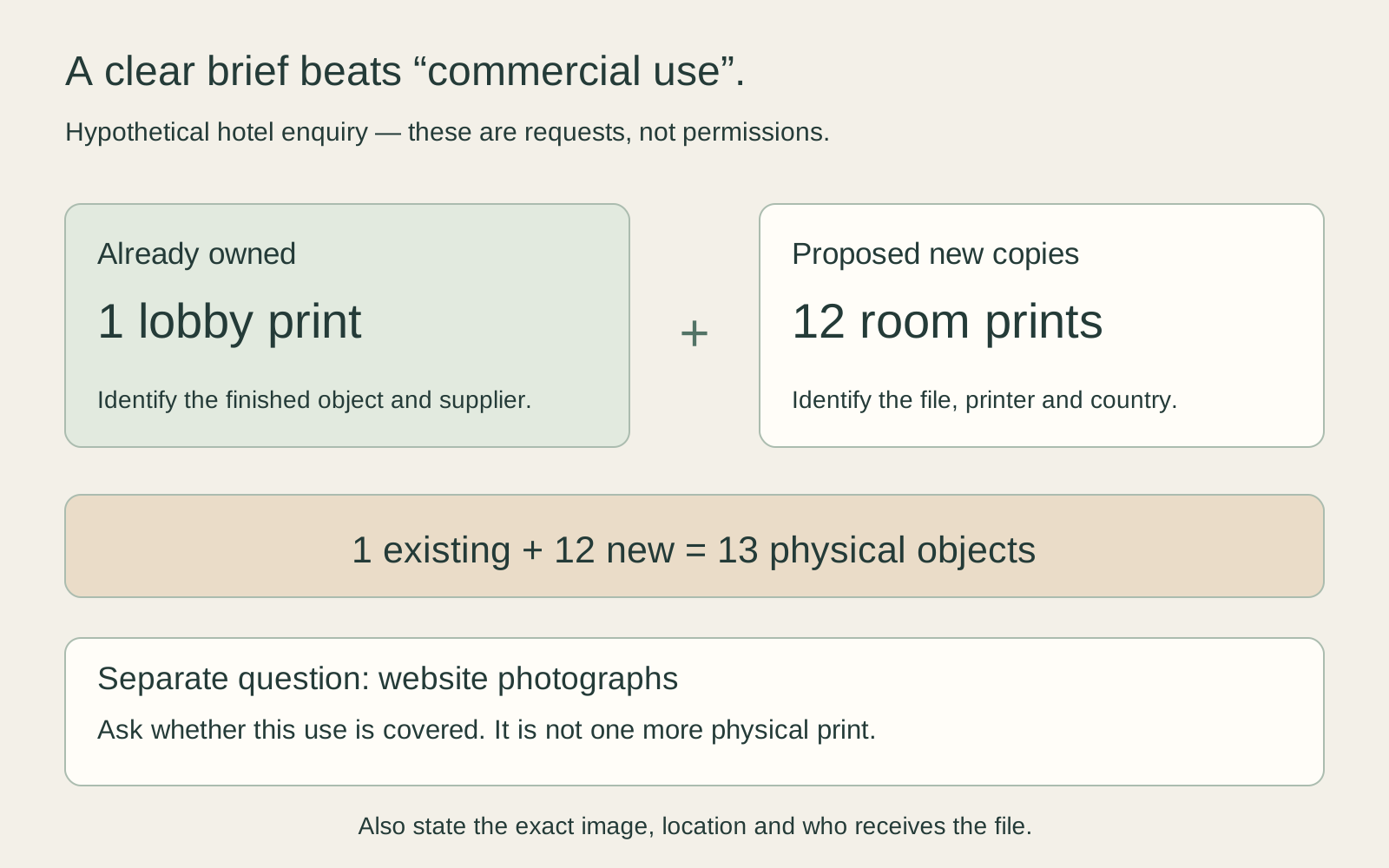
A useful hypothetical enquiry is: “We own one finished print in reception. We want twelve additional room prints in this country, made by our local printer, and photographs of the rooms on our website. Does your offer cover each use, and may we give the printer the file?” That lets the supplier answer concrete questions or quote for the missing permission.
Save the reply with the applicable terms, source and order details. If the business later adds branches or starts selling merchandise, revisit the record. A clear, modestly scoped permission is more useful than a reassuring but undefined phrase on an old receipt.
Editorial record
About this article
- Author
- Publisher
- GeMarkt
- Published
- Reviewed
- Internal source & rights check. Conducted by GeMarkt Research Review. This is an internal editorial check—not independent peer review.
- Source standard
- Rights guide source standardSeparates the underlying work from the source file, records the review date, and links the evidence used for the conclusion.
Found a claim that needs checking? Report a factual error.