GeMarkt Blog · Reference
Is Modigliani’s Reclining Nude Public Domain? Nude on a Blue Cushion
An exact-work check of Nude on a Blue Cushion, 1917, NGA 1963.10.46: the museum’s CC0 image, ordinary author terms and the limits of publication evidence.

The short answer
For this exact example, the National Gallery of Art supplies a public-domain image under its CC0 Open Access policy. Modigliani’s ordinary life-plus-70-year author term has also expired. We mean Nude on a Blue Cushion, 1917, accession 1963.10.46, not every painting described as Reclining Nude or Nu couché.
This check is current to 12 October 2026. It records the institution’s assessment and its available image; it is not an independent worldwide clearance of every underlying right. The painting’s early publication history offers specific leads, but those original documents have not all been examined here.
Which Reclining Nude?
Nu couché means “reclining nude”. It is a description that can fit more than one Modigliani, not a unique accession number. A title search can return different poses, surfaces and collections while appearing to answer the same question.
Our selected National Gallery of Art record identifies Nude on a Blue Cushion, 1917, oil on linen, 65.4 × 100.9 cm, Chester Dale Collection, 1963.10.46. That combination fixes the object more securely than a translated title alone.
This is not a claim about whichever Nu couché happened to appear in an auction headline or another museum. If your picture has both arms raised around the head or an entirely different pose, first find its own record. The file permission discussed here does not move across with a shared title.
Recognising the blue cushion
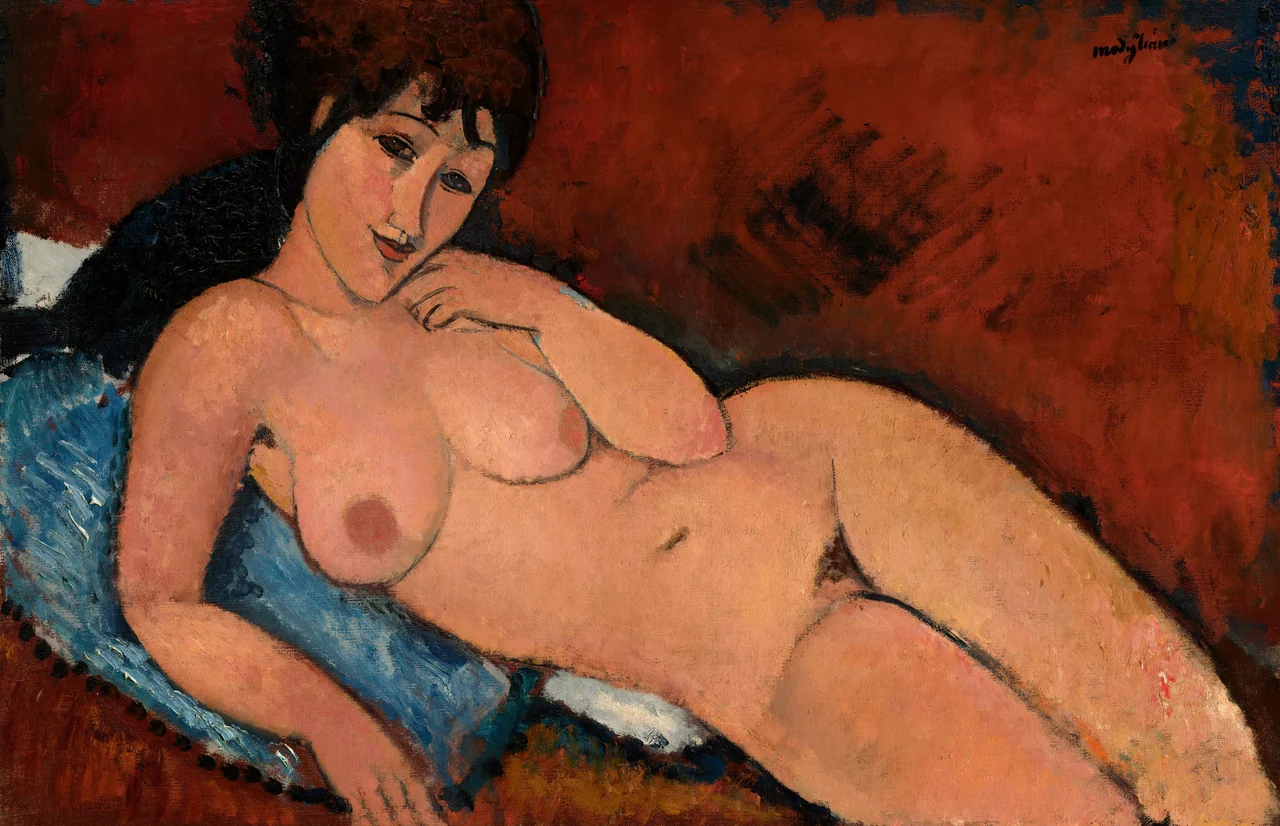
In this image, the blue is not a thin decorative accent. It occupies a substantial area at the left, beneath the upper body, with pale strokes interrupting it. The rougher warm background above gives the figure a different setting from the smoother, darker surfaces found in other reclining nudes.
Look at the hand near the face. It is drawn with a few small marks, whereas the curve running from the shoulder into the torso travels much farther before changing direction. A reproduction that sharpens every edge equally can make those different sorts of mark look mechanically similar.
The lower body continues towards the bottom right edge. There is no reason to invent the missing continuation outside the painted rectangle. Cropping and extending are different choices: the first removes part of the supplied composition, while the second adds something the original image does not contain.
The dark signature is near the upper right. Keep it in view when matching a source, and check that a repost has not flipped the entire image. These are practical identification checks, not a method for authenticating an unknown physical painting.
What has expired and where?
Modigliani died in 1920. Under the ordinary UK duration rule, his life-plus-70-year term is long past. The standard calendar-year calculation in French article L123-1 reaches the end of 1990: 1920 plus seventy years.
That is an author-term calculation, not a finding about every national exception, later photograph or first publication. The age of the artist cannot answer every question about a particular digital file.
France also preserves rights concerning the author’s name and respect for the work under article L121-1. Expired economic rights should not be described as the disappearance of every possible legal concern. A substantial use in a particular market should be checked for that market rather than described as universally safe.
The National Gallery’s exact image
The selected object page explicitly identifies its media as public domain and provides a download. That is a work-specific signal, not an inference from the fact that a museum image happens to be visible online.
The Gallery’s Open Access policy makes qualifying images available under CC0, including commercial use without a separate permission request. It also says that it can speak only for rights it holds and does not warrant the absence of third-party rights under every country’s laws. Keep both parts of the policy, not just the attractive opening sentence.
Our illustration uses that linked institutional file, proportionally reduced with the composition intact. No room scene, frame or newly invented paint has been added. The courtesy credit makes it straightforward for a reader to return to the source.
CC0 is a waiver of the affirmer’s rights to the extent legally possible. It is not an exclusive licence: another person may use the same openly supplied image. It also does not authorise an implication that the Gallery approves a product or project.
How early history helps the U.S. check
The NGA reports a 1917 purchase directly from Modigliani by Paul Guillaume, followed by Chester Dale’s purchase in April 1928. Its bibliography lists reproductions in Art News on 20 October 1928 and Maud Dale’s 1929 catalogue, number 101.
These are concrete leads, but our statement is deliberately attributed: the Gallery records them. We have not inspected the cited originals and their full authorisation or distribution circumstances. A museum bibliography can guide that next step without being represented as research we have already completed.
The U.S. Copyright Office distinguishes display alone from publication; authorised sale or distribution of the original or copies can matter. Historical facts must be assessed under the rules applicable to them.
The duration statute treats older published and previously unpublished works differently. Thus, our usable file route is the NGA’s explicit institutional release. We do not manufacture an independent U.S. publication opinion from the painting date.
Why another Nu couché needs another check
There is a real example of why this caution matters. The Met’s different 1917 Reclining Nude, 1997.149.9, currently has an API record marked isPublicDomain: false, despite an earlier Met-attributed CC0 file appearing on Commons.
We did not resolve that discrepancy and do not use that image here. An old dedication can address only rights held by the party making it; it cannot, by itself, settle a conflicting signal about the underlying work. The NGA picture is a different, explicitly identified example with its own current release, not a way to erase the Met’s question.
For the same reason, do not attach the NGA permission to a better-looking download from an unrelated shop. The source, image and permission need to remain matched.
Choosing a reproduction without changing the work
For an illustrated article, keep the full image near the discussion and identify the accession. For a close detail, label what has been isolated and provide a route back to the complete composition. Neither use needs an invented account of the sitter’s identity or feelings.
For a print, inspect the source at the intended output size. A web display can show the broad relationship of blue, skin and background without proving that the file is suitable for every large format. Look particularly at the hand, face and lightly drawn contours before accepting aggressive enlargement.
Keep the downloaded original and its source record together. The answer then stays specific: Nude on a Blue Cushion has a current documented NGA Open Access image; other reclining nudes require their own identification and rights check.
Editorial record
About this article
- Author
- Publisher
- GeMarkt
- Published
- Reviewed
- Internal source & rights check. Conducted by GeMarkt Research Review. This is an internal editorial check—not independent peer review.
- Source standard
- Rights guide source standardSeparates the underlying work from the source file, records the review date, and links the evidence used for the conclusion.
Found a claim that needs checking? Report a factual error.