GeMarkt Blog · Practical guide
Art for Small Spaces and Studio Apartments
Make room for art in a small home: measure usable wall space, compare one picture with a pair, and plan around furniture, light and everyday movement.

A small room does not automatically need small pictures. Start with one usable wall or one piece of furniture, and choose art that fits that place and your normal view of it. In a studio, a single well-positioned picture can be more satisfying than a collection squeezed into every remaining gap. Measure the finished frame, leave doors and storage free to work, and test the arrangement before buying.
Choose one place to begin
Stand in the entrance and notice where your eye goes. It might be the wall behind a sofa, the space beside a desk or the end of a narrow room. Choose one of those places first. You do not need to decorate the whole apartment in one order.
Then think about the picture you would like to live with. A favourite landscape, a botanical print or a portrait can each work in a compact home. There is no compulsory “small-space” subject. What matters is whether you enjoy the image and can see it from the places where you spend time.
Nor must art match every object in the room. If your shelves are already visually busy, you might prefer one image with space around it. If you enjoy a collected look, a modest group can be equally intentional. Empty wall is an option, not an unfinished task.
Measure the space you can actually use
Measure between real obstacles rather than from corner to corner. Include the arc of an opening door, the full height of a raised desk, cupboard doors, curtains and any furniture you move regularly. A space that exists only when everything is shut may not be a useful display space.
Write down the usable width and height, then compare them with the outside dimensions of a finished frame. Paper sizes alone leave out moulding and any mat around the image. A deep frame also projects into the room, which deserves attention beside a frequently used route.
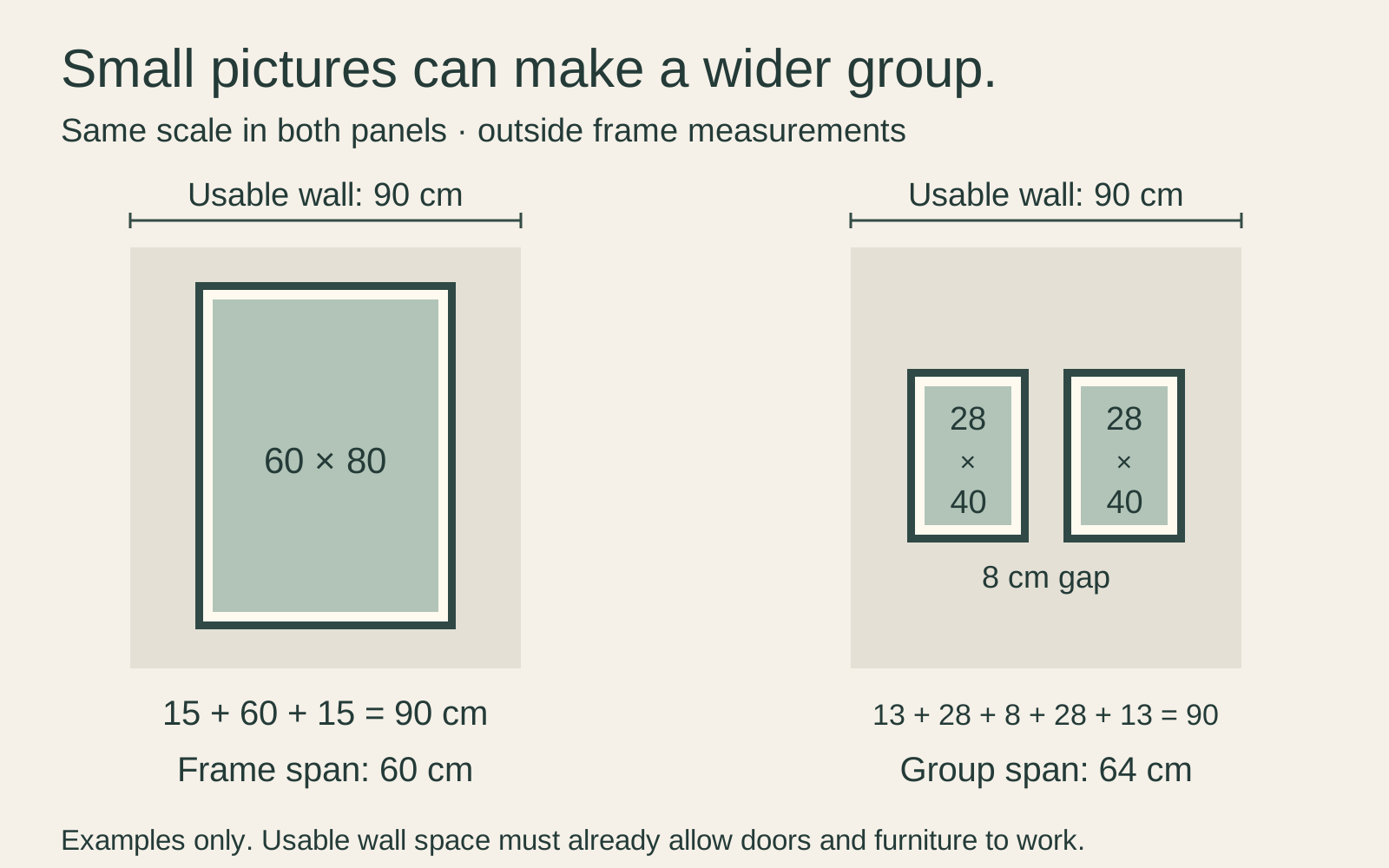
For example, a 90 cm wall span between two fixed features could hold a 60 cm wide frame with 15 cm of space at each side when centred. Those are visual margins within the available wall, not required clearances for doors, heaters or circulation. Establish those practical constraints separately before measuring what remains.
Compare one picture with a small group
On that same 90 cm span, two frames each 28 cm wide with an 8 cm gap occupy 64 cm altogether. Centred, they leave 13 cm at each side. The pair is wider than the single 60 cm frame even though each individual picture is much smaller.
Height changes the impression as well. In our illustration, the single outside frame is 60 by 80 cm; each of the paired frames is 28 by 40 cm. The pair does not fill the same area. It offers two smaller images across a similar width, which might suit a close view beside a desk rather than a focal wall across the room.
If neither option looks right, try a different orientation rather than simply shrinking everything. Our portrait-or-landscape guide compares the footprint of those shapes without changing the proportions of the artwork itself.
Let art belong to an area
In a studio, the bed, desk and sofa may share one room. Art can help give each area a point of focus without requiring a picture above every piece of furniture. A print near the desk might reward close looking; the main wall might hold something you enjoy from farther away.
Choose which area should receive attention first. If the same wall is visible from the bed and the desk, one picture may serve both. You do not need to construct two separate displays because a floor plan gives the spaces different names.
Consider the rest of the wall when choosing frames. Repeating a simple frame finish can connect different subjects; varying frames can emphasise their differences. Neither approach creates additional physical space. Judge the actual arrangement, rather than assuming a colour or style will reliably make a room look larger.
Test the view at real distances
Paper templates make size decisions easier, but add a small printed image or a screen preview when judging the subject. A blank rectangle tells you how much wall is occupied; it does not show how busy, dark or detailed the artwork will appear.
IKEA suggests testing picture-wall arrangements with paper templates. In a compact home, try yours from the entrance, the usual seat and the work surface. Open the cupboards and move the chair while it is in place. Our paper-planning guide explains how to keep a multi-frame plan to scale.
Check daylight as well as evening lighting. The Canadian Conservation Institute’s care advice for paper identifies sunlight, heat and prolonged high humidity as risks. In a studio with a kitchenette, that is a reason to consider cooking steam, splashes and nearby heat before choosing the last bare patch of wall.
Make the hanging plan suit your home
If you rent, check what your agreement allows before drilling or using adhesive products. “Removable” does not mean suitable for every surface, every load or every position. Follow the exact product’s preparation, weight, surface and removal instructions rather than borrowing a limit from a different package.
For example, 3M’s instructions for Command picture-hanging strips exclude use over beds and on wallpaper. That restriction matters when one room also contains your sleeping area. It is not a judgement that all adhesive products have identical instructions.
Leaning art is not automatically a safer substitute. A low shelf may be reachable by a child or pet, and a picture can slide or be knocked over. Choose a secure arrangement appropriate to the object and location; ask an installer if you cannot establish a suitable fixing.
Leave room to change your mind
Start with the strongest arrangement and live with it before adding more. You may discover that the second wall is better left clear, or that a print belongs beside the desk rather than above the sofa. A small home benefits from decisions that accommodate everyday life. The aim is not to fit the maximum number of pictures into the room, but to give the ones you choose a place where you can enjoy them.
Editorial record
About this article
- Author
- Publisher
- GeMarkt
- Published
- Reviewed
- Internal source & rights check. Conducted by GeMarkt Research Review. This is an internal editorial check—not independent peer review.
- Source standard
- Buying guide source standardSeparates measured or first-hand evidence from general guidance and keeps practical limits visible.
Found a claim that needs checking? Report a factual error.