GeMarkt Blog · Practical guide
Portrait or Landscape: Which Orientation Suits Your Wall?
Choose portrait, landscape or square art by comparing the usable wall, the original composition and the finished frame—not by cropping until it fits.

A landscape-shaped picture is a useful first test for a wide space, and a portrait-shaped picture for a narrow one. But start with an artwork that already has the shape you want. Turning a landscape painting into a portrait crop can remove the very parts that made you choose it. A square picture or a small group may be the better answer.
Orientation describes a shape, not a subject
In print sizing, portrait means taller than it is wide. Landscape means wider than it is tall. A picture of a person can be landscape-shaped, and a view of the countryside can be portrait-shaped. The word on a size selector does not tell you what is in the picture.
For a concrete comparison, Monet’s Woman with a Parasol—Madame Monet and Her Son measures 100 cm high by 81 cm wide in the National Gallery of Art’s record. Van Gogh’s The Starry Night is 73.7 cm high by 92.1 cm wide according to MoMA. One is vertical; the other horizontal. Those are original-object measurements, not a promise that a reproduction will be sold at the same size.
Draw the usable shape of your wall
Imagine a wall beside a bookcase with 70 cm of clear width. A finished frame 50 cm wide leaves 20 cm to distribute at the sides. A 90 cm-wide frame will not fit, however attractive its image. That simple check comes before any advice about what makes a room feel taller or wider.
Above a broad sideboard, you may have the opposite problem: plenty of width but limited height between the furniture and another feature. A horizontal frame can make sense there. Two vertical frames could also work as a horizontal grouping.
Include doors, switches, lamps and curtains in the sketch. Do not use the full room width if the actual place for the picture is smaller. Measure the frame’s outside edge, not just the print’s paper size. Those numbers are different.
Compare equal areas when the choice feels confusing
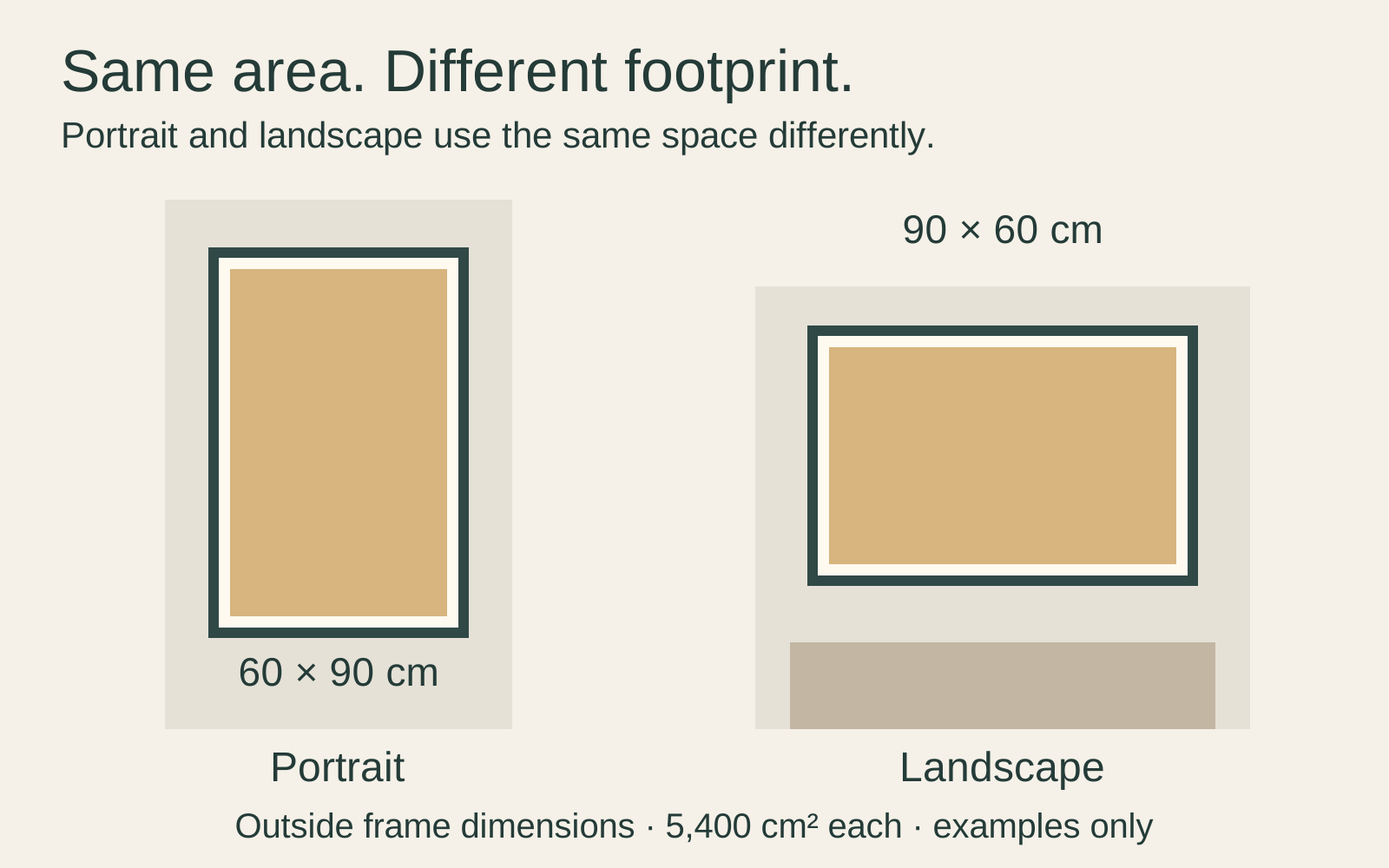
A 60 × 90 cm rectangle has the same area as a 90 × 60 cm rectangle: 5,400 square centimetres. Yet the first needs 90 cm of height and the second 90 cm of width. Orientation changes where the space is used, even though the area is unchanged.
Cut both shapes from paper and place them in turn within your proposed wall area. You are testing two hypothetical outside frame dimensions here, not assuming that a 60 × 90 cm sheet produces a frame of that size.
Do the test from the place where you spend time. A frame that seems balanced while standing beside it may feel awkward from the sofa. An arrangement near a reading chair deserves a seated view as well as a view from the door.
Preserve the artwork’s own direction
Once you have a suitable wall shape, compare the actual pictures. Where do branches, a horizon, a figure or a column lead your eye? What sits close to the edges? This is your own visual assessment; no orientation rule can answer it for you.
Do not rotate a recognisable painting simply to make the rectangle fit. And do not assume cropping is harmless because the central figure survives. Empty sky, a strip of water or a patch of floor can be part of the composition’s balance.
If a listing offers different shapes, compare the previews for the precise option you are considering. A photograph of another size is not enough. The GeMarkt Monet product page is one existing place to examine size-specific previews; it is a first-party shop link, not independent evidence about the painting.
A border is different from a crop
Consider a hypothetical horizontal image in a taller sheet. Fitting the complete image keeps its proportions and leaves unused space, which may become a printed white border. Filling the sheet enlarges the image until the whole sheet is covered, cutting off whatever falls outside it.
A mat, also called a mount, is a separate board around the picture; it is not the same thing as white ink-free paper. Its window can also hide edges. A wide border can give a small image more presence on the wall, but it does not make the image itself larger.
The Canadian Conservation Institute’s framing guidance explains how a frame must accommodate the mat, backing and glazing. In other words, the outside appearance and the space needed for the actual framed assembly are separate decisions.
A square or a pair can solve the mismatch
Not every wall needs a strongly vertical or horizontal statement. A square image is worth testing when the usable area is roughly square or the furniture below is visually busy. Klimt’s The Kiss, for example, is recorded as 180 × 180 cm by the Belvedere. Keeping a square reproduction square avoids a shape change purely for the wall.
For a wide area, two 40 cm-wide portrait frames separated by an example 8 cm gap span 88 cm. That provides a horizontal arrangement without cutting either picture into a horizontal image. The 8 cm is a trial spacing, not a standard you must follow.
Leave space to adjust the result. A pair that works on paper may need a different gap once dark frames and bright images are present.
Choose in this order
First identify the usable wall area. Then test a frame shape and outside size. Choose a picture you enjoy in its original orientation, and check the exact reproduction preview for borders or cropping. Finally, confirm the frame measurements and hanging requirements before ordering.
If the only way to make a picture fit is to remove a part you love, the wall is not giving you an instruction to cut it. Try another size, another arrangement or another wall.
Editorial record
About this article
- Author
- Publisher
- GeMarkt
- Published
- Reviewed
- Internal source & rights check. Conducted by GeMarkt Research Review. This is an internal editorial check—not independent peer review.
- Source standard
- Buying guide source standardSeparates measured or first-hand evidence from general guidance and keeps practical limits visible.
Found a claim that needs checking? Report a factual error.