GeMarkt Blog · Practical guide
Art Above the Bed: Size, Height and Safety
Choose the scale and position of bedroom art using the headboard, real sitting clearance and the complete frame, with safety checks before hanging.

Art above a bed should belong to the bed’s proportions without entering the space people use when they sit up, reach or change the bedding. Begin with a paper outline and the finished frame dimensions, not a fixed number of inches above the headboard. Then decide whether that object can be installed appropriately in that location at all.
Leaving the wall above the pillows clear is a valid choice. A picture on the opposite or adjacent wall may be easier to enjoy from bed and avoids putting that object directly over the sleeping position. A convincing bedroom does not depend on filling every blank rectangle.
Decide whether this is the right wall
Look beyond the familiar photograph of a bed with a centred picture. Does the headboard move? Is the bed adjustable? Does someone regularly sit against tall pillows, lift their arms to stretch or reach behind the headboard? Start with those ordinary uses before selecting a height. Check the intended area with a lightweight paper outline, not a loosely balanced frame.
Read the exclusions for the proposed hanging product. For example, 3M’s instructions for Command Sawtooth, Universal, Canvas and Wire Back Picture Hangers expressly exclude hanging over beds. A picture being below a product’s weight limit does not cancel that location restriction. Do not assume another adhesive product is suitable without its own instructions.
Earthquake exposure also changes the decision. The USGS Bay Area earthquake handbook advises soft rather than rigid framed art above beds. In an earthquake-prone home, follow relevant local preparedness advice rather than treating a decorative layout as evidence of a secure installation. A heavy frame elsewhere in the room still needs appropriate restraint and positioning.
Size the group against the headboard
Use the headboard’s actual outside width as a starting reference. Mattress names such as queen and king are less useful here: the headboard may be wider, narrower or built into a larger upholstered panel. Include nearby wall lights in the drawing, but do not automatically extend the picture group across both bedside tables.
Imagine a headboard 180 cm wide. A picture with an outside frame width of 120 cm leaves 30 cm on either side when centred: (180 − 120) ÷ 2. Two 55 cm frames with a 10 cm space between them also occupy 120 cm. These are options to compare, not a required two-thirds proportion or a claim that those sizes are available to buy.
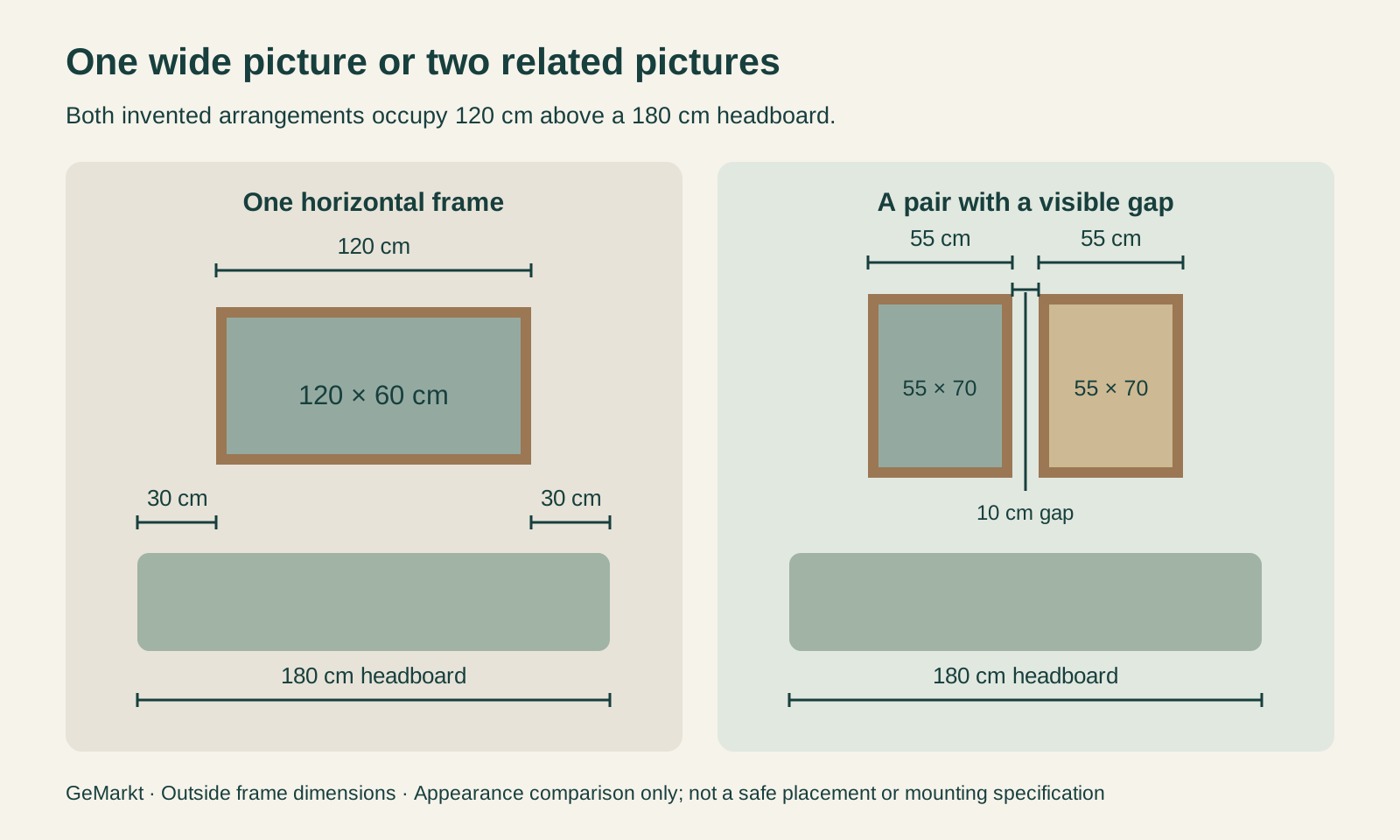
A single horizontal image gives the bed one broad focus. A pair can suit two related pictures, but its central gap becomes a visible part of the composition. Compare both with the duvet and lamps in place. A detailed headboard may need more empty wall around it than a simple one. For wider choices, use our print-size guide without turning its starting points into obligations.
Find the height with the bed in use
Mark the top of the headboard and try the bottom edge of a paper outline above it. Look from the doorway, then sit on the bed normally. Check the people who actually use the room, including the tallest seated position and an adjustable bed’s intended positions. No universal gap can certify clearance for those different arrangements.
Suppose a headboard ends 110 cm above the floor and a proposed frame is 50 cm high. Testing a 25 cm gap places the frame’s bottom at 135 cm, centre at 160 cm and top at 185 cm. Testing a 45 cm gap instead gives a 155 cm bottom, 180 cm centre and 205 cm top. Neither gap is a safety recommendation; the example shows why the same picture changes character when moved upward.
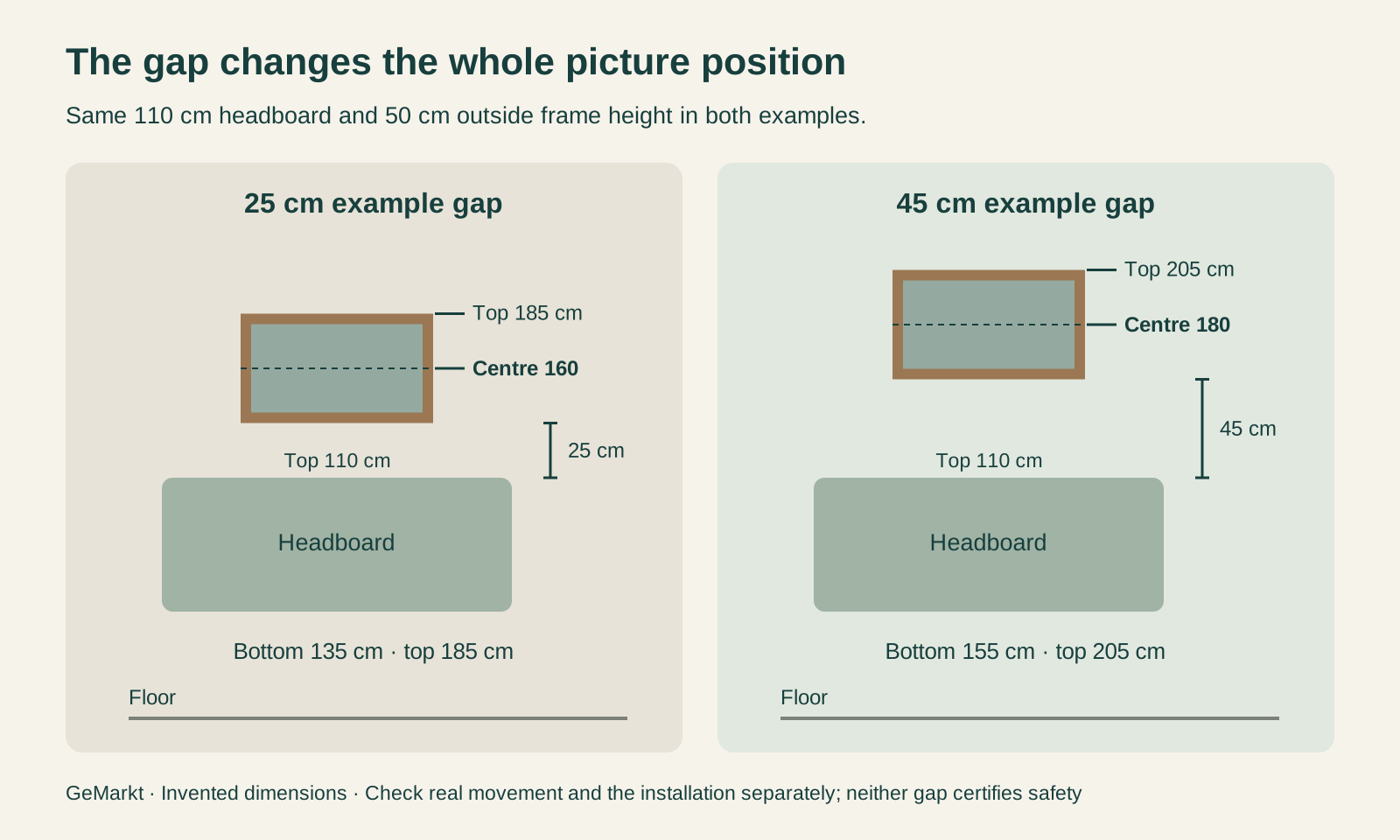
If adequate clearance makes the image feel stranded near the ceiling, choose a shorter composition, a different wall or no overhead picture. Do not solve the visual problem by lowering a rigid object into someone’s usable space. The chosen frame position also is not the screw position; the hanging-height calculation explains that separate measurement.
Count the whole object before choosing fixings
The relevant object includes its frame, glazing, backing and artwork. The Canadian Conservation Institute’s display guidance treats the combined weight as the load the hanging devices must support. The loose paper’s weight or a description such as lightweight canvas cannot settle the question.
Have the wall construction, frame fittings and complete attachment system assessed for this position. Ask a qualified installer when the wall is uncertain or the object is heavy, fragile or awkward. Do not infer capacity from the apparent strength of a hook, double a rating by adding a second hook, or assume an old fixing suits a new frame. Our hardware guide explains what information to gather.
Avoid treating a picture ledge above the pillows as an easier substitute: it introduces the shelf, its fixings and the possibility of objects moving on it. Changing glass to acrylic or omitting glazing may change the assembly, but does not make an overhead arrangement automatically safe. Decide with the actual framer and installer, rather than selecting materials by a general reassurance.
Choose an image you can enjoy from the room
Consider where you will see the picture most. Above the headboard, it may be mainly a doorway view. A small engraving whose interest lies in tiny marks might be more rewarding beside a reading chair. A broad landscape, flower study or abstract composition can offer a clearer overall shape at a distance, although this is a visual preference rather than a rule about subject matter.
Try a modest printed reference inside the paper outline or use a scaled room sketch. Keep the full image visible unless you deliberately want a detail print. Stretching a square composition to fill a panoramic space changes the artwork; a wider mount, a different picture or a pair may solve the fit without distortion.
You also need not match every colour in the bedding. One repeated tone can connect an image to the room while leaving its other colours alone. Keep the choice personal: a bedroom picture is something to live with, not a colour chart required to produce sleep or calm.
Check light and the view from the pillow
Open the curtains and turn on the lamps you normally use. A reflection that is unobtrusive from the doorway can cover the image when viewed from bed. Test the proposed position at those real viewpoints before paying for a particular glazing finish. Moving the picture may be more useful than trying to remove every reflection through a material upgrade.
For works on paper, the Canadian Conservation Institute advises avoiding sunlight from windows or skylights and placement near radiators or heating ducts. Check how the sun moves across the wall, not just how the room looks at the time you decorate. A replaceable modern print and a valuable original call for different preservation decisions, but neither receives a guaranteed lifespan from a frame label.
Make a plan that can change with the bedroom
Keep a note of the final outside dimensions, assembled weight, installation method and position. If you later change the headboard or mattress, raise the bed or add an adjustable base, reassess the arrangement rather than assuming the original clearances still apply. Follow the hardware maker’s inspection and reuse instructions when moving anything.
For a rental, check permission before making holes and do not bypass an adhesive product’s restrictions to avoid asking. A finished room can have an upholstered headboard, a clear wall above it and one excellent picture elsewhere. The best result is the arrangement you enjoy and can install appropriately, not the one that most closely resembles a staged photograph.
Editorial record
About this article
- Author
- Publisher
- GeMarkt
- Published
- Reviewed
- Internal source & rights check. Conducted by GeMarkt Research Review. This is an internal editorial check—not independent peer review.
- Source standard
- Buying guide source standardSeparates measured or first-hand evidence from general guidance and keeps practical limits visible.
Found a claim that needs checking? Report a factual error.