GeMarkt Blog · Practical guide
When You Need a Custom Print Size
Find out when a custom print solves a real fit problem, and when a standard sheet, border or mat can preserve the image with less complication.

Choose a custom print size when a specific image, frame or wall space cannot be served well by the available standard options. Before paying for a special format, check whether a standard sheet with a border or a separately cut mat solves the problem. You may need a custom-sized image without needing custom-sized paper, glazing and framing as well.
Identify what has to fit
“I need a 50 by 40” is not yet a complete specification. It could mean a sheet of paper, the visible image, a window in a mat or the finished frame’s outside dimensions. Those measurements are not interchangeable.
The image is the printed picture. The sheet includes the picture and any unprinted border. The mat opening is the window through which you see the work; its edges may overlap it. A frame has an internal space for the contents and a larger outside footprint on the wall. Its visible opening may hide part of the sheet’s edges.
Start by naming the constraint. If you are filling an existing frame, inspect that frame before ordering. If you are fitting between shelves, start with the maximum outside dimensions of the finished object. If you want the whole painting without a crop, start with the image’s proportions. Our print-size guide helps compare the familiar inch and centimetre labels.
Try a border before ordering a new format
Suppose you want a landscape image 45 cm wide by 30 cm high. That is a 3:2 ratio. Centred on a 50 by 40 cm sheet, it leaves 2.5 cm of paper at each side and 5 cm above and below: subtract the image dimension from the corresponding sheet dimension, then divide by two.
The result has unequal horizontal and vertical borders, but that is not an error. It preserves the image on a different-shaped sheet. You can decide whether you like those borders visible or would prefer an appropriate window mat. A printed white border and a separate mat board are different things, even when a small photograph makes them look similar.
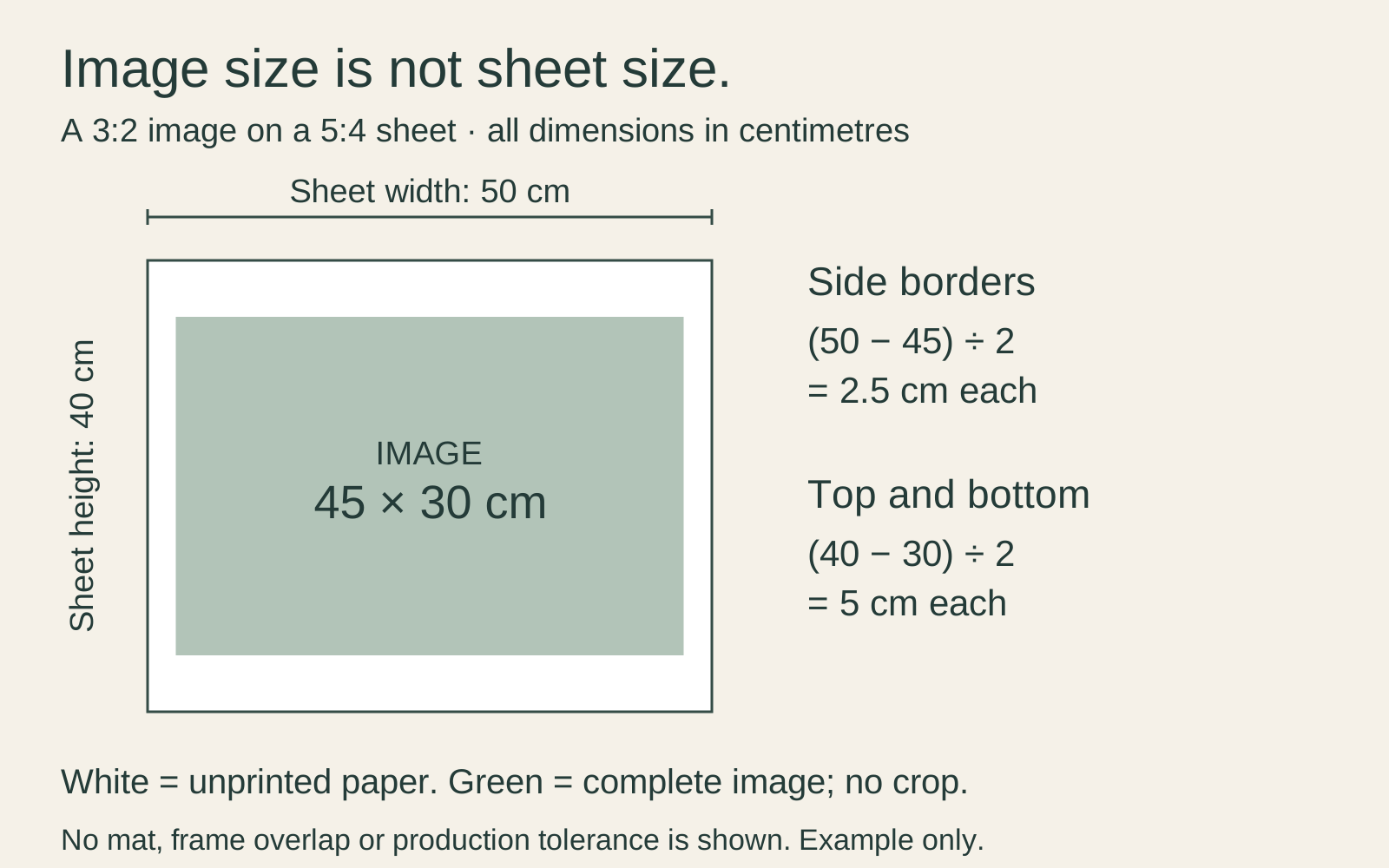
Before assuming this combination is available, ask the printer whether it accepts separate image and sheet dimensions. Some products use fixed layouts or include borders within the advertised size. The worked example is a way to state your request, not a promise that every shop offers it.
Keep the image proportions
If the original image is 3:2, a 45 by 30 cm print preserves that shape. Filling 50 by 40 cm without a border would require a crop or a change of proportions. A custom order should make that decision explicit rather than leave it to the print operator.
For an unusual panorama, a custom width may be exactly what you want. For an almost-standard rectangle, a small border may be simpler. Compare both layouts using the full composition. Important lettering at the edge of a poster can make a seemingly minor crop unacceptable.
Do not stretch the artwork to satisfy two incompatible dimensions. Specify either a proportional image size or an approved crop, and ask for a preview that shows the edges. Our painting-proportions guide explains why a size label alone cannot tell you how much picture remains.
Check the file at the new size
A larger custom print needs more than a larger sheet. Suppose the actual image file is 4,500 by 3,000 pixels. At 45 by 30 cm, it provides 254 pixels per inch. At 60 by 40 cm, the same file provides 190.5 pixels per inch. Both preserve the 3:2 shape; the larger print spreads the same pixels over more space.
These figures follow from pixels divided by the print dimension in inches, with 2.54 cm to an inch. They are not automatic pass or fail grades. Ask what resolution the printer requires for the process and viewing distance, and examine a representative proof if the enlargement is important.
Adobe distinguishes image dimensions, resolution and resampling: changing a resolution setting is not the same as acquiring a better source. Do not judge suitability from the file’s “300 dpi” label or download size alone.
Measure an existing frame with the framer
An old frame can be a good reason to commission a custom print, but measure the space that holds the contents rather than the outside moulding. Check whether the current mat, backing and glazing will be reused. A label left on the back may describe a standard photo size rather than the actual visible opening.
The Canadian Conservation Institute’s framing note explains that a frame’s recess must accommodate the complete framing package, not merely its width and height. Ask the framer to specify the required fit and allowance; an exact arithmetic match is not a reason to force paper into a tight opening.
Send an unambiguous order
A useful request might say: “Landscape image, 45 cm wide × 30 cm high, centred on a 50 cm wide × 40 cm high sheet; retain the full composition, with no stretching or crop.” If you also want a mat and frame, request their dimensions separately. State units and write width and height rather than relying on a pair of numbers.
Confirm paper, border colour, finish, edge handling and the approved preview before production. Also check the total price, lead time and return terms for that particular custom order. Do not assume they match the seller’s standard items.
Decide whether custom is worth it
Custom sizing is worthwhile when it solves a clear problem: a valued existing frame, an unusually shaped composition or a carefully measured space. It is less useful when it simply replaces one arbitrary size with another. Compare the entire finished arrangement and cost, then choose the option that keeps the picture you want to see without making the rest of the job unnecessarily complicated.
Editorial record
About this article
- Author
- Publisher
- GeMarkt
- Published
- Reviewed
- Internal source & rights check. Conducted by GeMarkt Research Review. This is an internal editorial check—not independent peer review.
- Source standard
- Buying guide source standardSeparates measured or first-hand evidence from general guidance and keeps practical limits visible.
Found a claim that needs checking? Report a factual error.