GeMarkt Blog · Practical guide
Famous Paintings’ Proportions vs Standard Frame Sizes
Why an 8×10, 12×18 or square print can crop the same painting differently, with worked fit-versus-fill examples and frame measurements explained.

A famous painting does not automatically fit a familiar frame size. If the image and its destination have different proportions, you must accept a crop, leave a border, or choose another size. The right answer depends on what you want to preserve. Do not stretch the picture simply to make the numbers match.
Compare the shape before the size
An aspect ratio is width divided by height. A portrait image 8 inches wide and 10 inches high has a ratio of 0.8, usually written 4:5. A 16 × 20 inch portrait has the same ratio. Enlarging one into the other changes size but not shape.
A 12 × 18 inch portrait has a ratio of about 0.667, or 2:3. It is narrower relative to its height. An image that fills 8 × 10 without much cropping may lose considerably more at 12 × 18.
Use the same order for both dimensions. This guide gives width × height in its calculations. Museum records commonly list height first, so read the record rather than copying its two numbers into a width field.
Three paintings, three starting shapes
| Painting | Recorded original dimensions, height × width | Width ÷ height | What that tells us |
|---|---|---|---|
| Monet, Woman with a Parasol—Madame Monet and Her Son | 100 × 81 cm | 0.810 | Close to portrait 4:5, not identical |
| Van Gogh, The Starry Night | 73.7 × 92.1 cm | About 1.2497 | Close to landscape 5:4 |
| Klimt, The Kiss | 180 × 180 cm | 1.000 | Square |
The measurements come from the National Gallery of Art, MoMA and Belvedere. Museum dimensions are recorded measurements, not infinitely precise instructions for printing. The downloadable file may also include a border or a slightly different crop.
Before ordering, inspect the actual image boundaries. A photograph including the museum frame has a different ratio from the painting inside it. Check that the file shows the intended picture area before calculating a crop.
Worked example: Monet on an eight-by-ten-inch sheet
Take a hypothetical image with the painting’s 81:100 width-to-height ratio. For this calculation only, assume no added margins, mat overlap, production bleed or canvas wrap.
To fill an 8 × 10 inch portrait sheet, set the image height to 10 inches. Its proportional width becomes 8.1 inches. The sheet can show only 8 inches, so a centred crop removes 0.1 inch in total: 0.05 inch from each side. That is about 1.23% of the image’s width.
To fit the whole image instead, set its width to 8 inches. Its height becomes about 9.88 inches. A centred placement leaves about 0.12 inch of unused height altogether, or roughly 0.06 inch above and below.
The difference is small, but small is not the same as irrelevant. A signature close to an edge can matter more than the percentage suggests. Check the image, not merely the number.
The same image on a twelve-by-eighteen-inch sheet
Now fill a 12 × 18 inch portrait sheet. At 18 inches high, the proportional image is 14.58 inches wide. Cropping it to 12 inches removes 2.58 inches of width in total—about 17.70%. If centred, each side loses 1.29 inches.
Fit the whole image by width instead and it becomes 12 × 14.81 inches. There is about 3.19 inches of unused height: roughly 1.59 inches above and below in a centred layout.
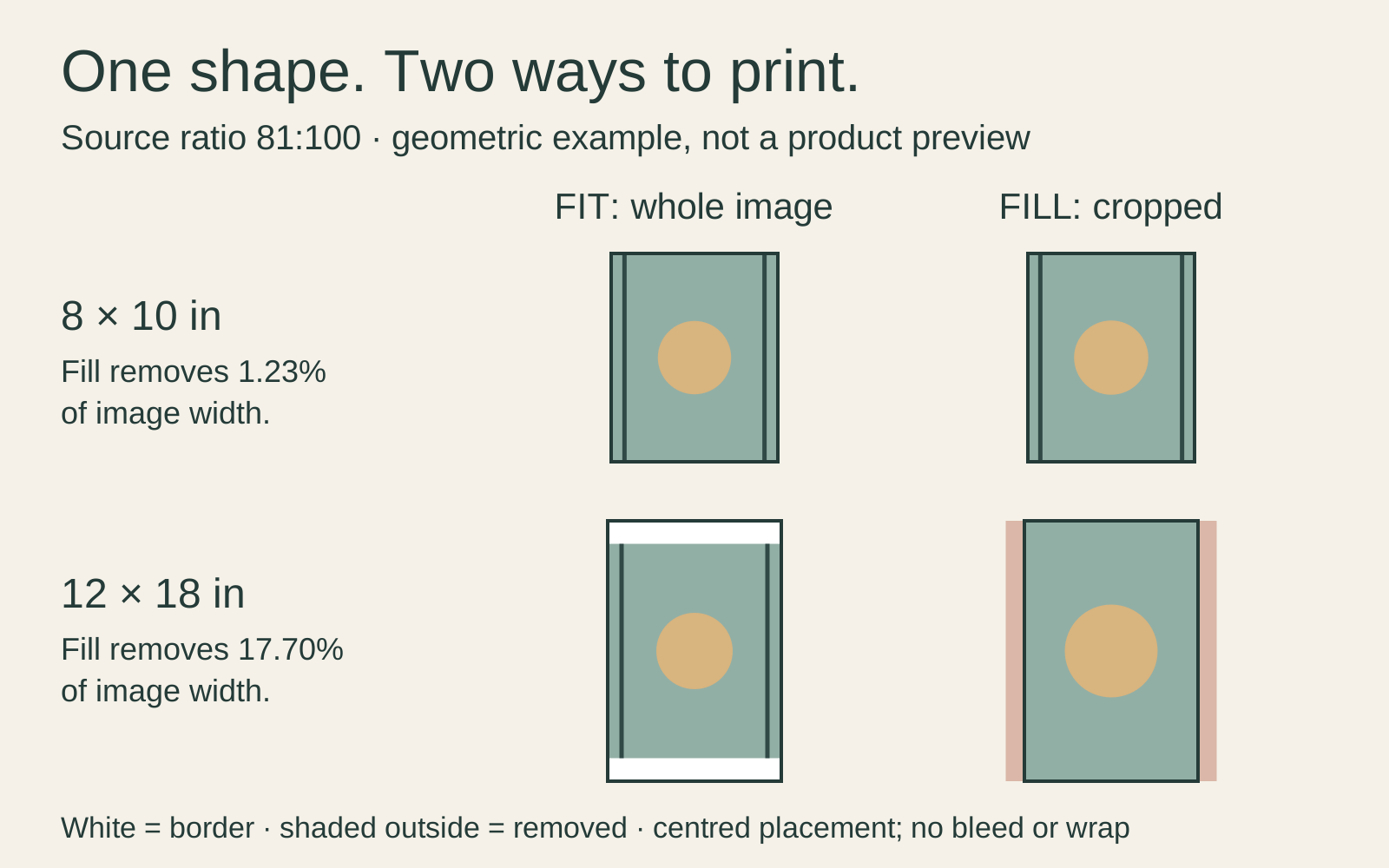
These are geometric examples, not the settings of a particular GeMarkt product. A supplier may position a crop off-centre, add a border or account for material hidden by a frame. Use the actual selected-size preview to judge the purchased object.
Keep the original, image and frame measurements separate
The artwork is the physical original. The image is the reproduced picture area. The sheet is the entire piece of paper, including any border. The mat window is the opening through which you see the image. Finally, the frame outside is the footprint on your wall.
A frame’s nominal 8 × 10 inch size often refers to what it can hold at the back, not its outside measurements or precisely visible front opening. Confirm the manufacturer’s specification. The Canadian Conservation Institute describes the frame rebate as the space accommodating the mat, backing and glazing; the label alone does not describe the whole assembly.
Do not trim a sheet to its visible image dimensions before checking how it will be mounted. Equally, do not assume a matching paper and frame label guarantees that every painted edge will remain visible.
Choose what you want to keep
A border is often the straightforward answer when the complete composition matters more than edge-to-edge printing. A different frame shape may avoid the conflict altogether. A deliberate detail crop can also be worthwhile, but it should be identified as a detail rather than passed off as the complete work.
For canvas, check the visible front separately from material used on the sides. A flat paper calculation does not explain a wrapped edge. For framed paper, inspect the window that remains visible, not only a loose-sheet preview.
When checking a listing, ask three questions: Does this size preserve the whole image? If not, what is removed? Do the stated dimensions describe the image, sheet or finished frame? Our print-size reference can help interpret the answers.
The best fit is not always the closest mathematical ratio. It is the option whose visible composition you actually want, with any crop or border understood before the print arrives.
Editorial record
About this article
- Author
- Publisher
- GeMarkt
- Published
- Reviewed
- Internal source & rights check. Conducted by GeMarkt Research Review. This is an internal editorial check—not independent peer review.
- Source standard
- Buying guide source standardSeparates measured or first-hand evidence from general guidance and keeps practical limits visible.
Found a claim that needs checking? Report a factual error.