GeMarkt Blog · Reference
The Uffizi and The Birth of Venus: What the Heritage Dispute Means
What the Uffizi’s dispute with Jean Paul Gaultier shows about copyright, cultural heritage, image files and permission—and what it does not establish.

How can a museum object to a painting appearing on clothes when the artist died centuries ago? The Uffizi’s dispute over Botticelli’s The Birth of Venus makes more sense once you stop treating every permission question as copyright.
The documented 2022 complaint concerned Italy’s cultural-heritage rules and an unauthorised commercial use alleged by the museum. It was not a claim that Botticelli had suddenly acquired a new copyright term. Nor does a report that the museum sought compensation establish that a court awarded it.
This guide separates the reported dispute from the permission system you can consult today. As of 13 October 2026, the sources examined for this article do not establish a final judgment or settlement in that particular dispute. It is an explanation of the documented claim and current institutional guidance, not a report of a verified litigation victory or personal legal advice.
What happened in 2022
The Uffizi identifies The Birth of Venus as a work by Sandro Botticelli. The familiar figure was used in a very different setting in Jean Paul Gaultier’s clothing collection.
In its 14 October 2022 account, the European Commission’s IP Helpdesk reported that the Uffizi had taken legal action over the fashion label’s Le Musée collection, launched that April. It described the image appearing on garments and being advertised online. The account said that the museum had sought withdrawal or a commercial arrangement and compensation of €100,000.
That figure was a reported demand, not an award established by the source. The same account located the complaint in Italy’s cultural-heritage legislation, distinguishing it from copyright. Its value is to document the dispute and the museum’s position at that time; it is not the text of a final court decision.
A demand is not a final judgment
When reading a headline about a museum lawsuit, first ask what kind of document is behind it. A demand letter states what one party wants. An interim order can impose a temporary measure. A final judgment resolves identified issues between identified parties, subject to the relevant appeal position. A negotiated permission agreement may settle a particular use without creating a general rule for everyone else.
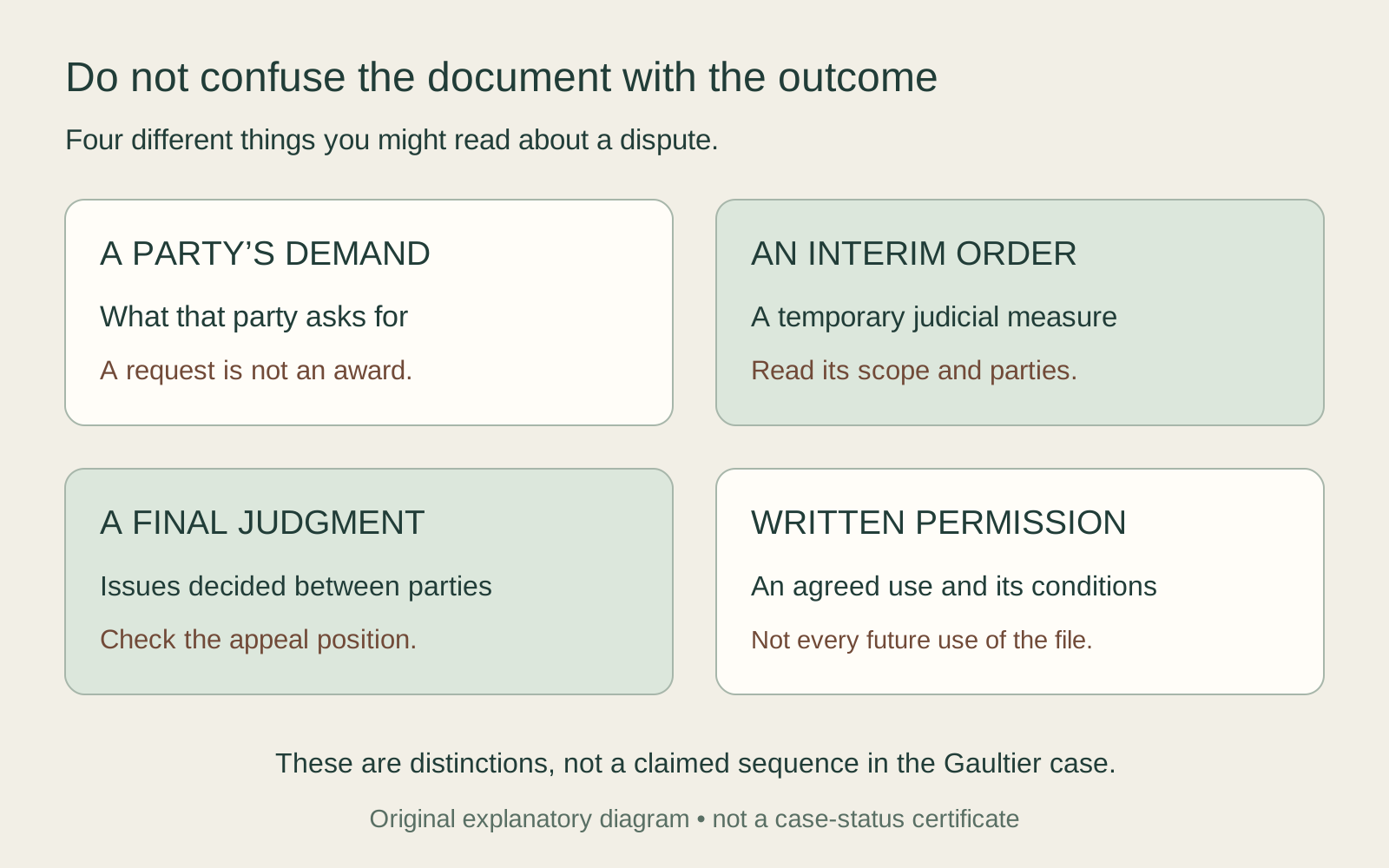
This is a reading method rather than a reconstruction of missing case papers. If an article links only to the original announcement, do not fill the gap with an imagined outcome. Equally, the absence of a decision in this guide is not evidence that the parties did nothing afterward. It simply limits the conclusion we can responsibly offer.
Why expired copyright is only one question
Article 14 of the EU’s 2019 copyright directive addresses reproductions of visual artworks whose copyright has expired. It excludes copyright and related-right protection for the resulting material unless that material is itself original. That is a rule about protection in the reproduction, not a general order to release every museum file or permit every activity inside a museum.
Italy’s Article 32-quater implements that distinction and expressly preserves the cultural-heritage code’s provisions on reproducing cultural property. In other words, removing one potential copyright obstacle does not answer every separate heritage question.
For a fuller explanation of those layers, see Italy’s cultural-heritage permission guide. For this dispute, the practical point is narrower: “the old painting is public domain” and “this proposed reproduction requires no further authorisation” are different propositions.
Which Uffizi permission route fits
The Uffizi’s current professional-services directory separates publications, promotional and commercial reproduction, and requests to film or photograph. That division is useful before you compose an enquiry: requesting a supplied file is not necessarily requesting a photography session, and a book illustration is not necessarily a clothing design.
Its commercial-reproduction page refers to cultural-heritage code Articles 107 and 108 and the fee framework amended by Ministerial Decree 108 of 21 March 2024. Its publications page describes a separate application route for editorial use, including applications where the requester already possesses an image.
These are the museum’s published procedures, not proof that every conceivable use in every country attracts a fee. Describe your actual project and ask which route applies. Do not choose “editorial” simply because your merchandise page contains a paragraph of art history.
Having the image is not the same as having permission
The Uffizi’s commercial image-request form asks for information about the artwork and the proposed publication or use. It distinguishes supplying an image from authorising reproduction and provides a route for applicants who already have the file. It also identifies categories eligible for free use, including qualifying scientific or academic publications and open-access publications, while treating supply costs separately.
The sensible response is not to assume that anything free to read qualifies automatically. Explain the project and obtain an answer about the applicable category. A file you downloaded elsewhere cannot, by its presence on your computer, answer a question about institutional authorisation. Conversely, paying for a file should not be mistaken for purchasing every possible future use.
Three uses that need different questions
Consider three hypothetical projects. A researcher needs a figure in an academic article. A clothing company wants a repeated Venus motif across a product line. A visitor wants to take a photograph in the galleries. These examples illustrate how to frame an enquiry; they are not individual clearance decisions.
For the researcher, the useful description includes the publication, publisher, distribution method and proposed image. For the clothing company, it includes the object being sold, territories, marketing channels and whether the image will be altered. For the visitor, access and photography conditions come first; a later plan to sell the photograph introduces another use to consider.
The work might be the same in all three examples. The activity is not. Avoid transferring an answer received for one project to another simply because both mention Botticelli.
Make the request specific
A good enquiry allows the recipient to see exactly what you intend. “Can I use Venus?” leaves almost everything important unstated. “We propose this image, on this product, in these markets, with this crop” is a question someone can assess.
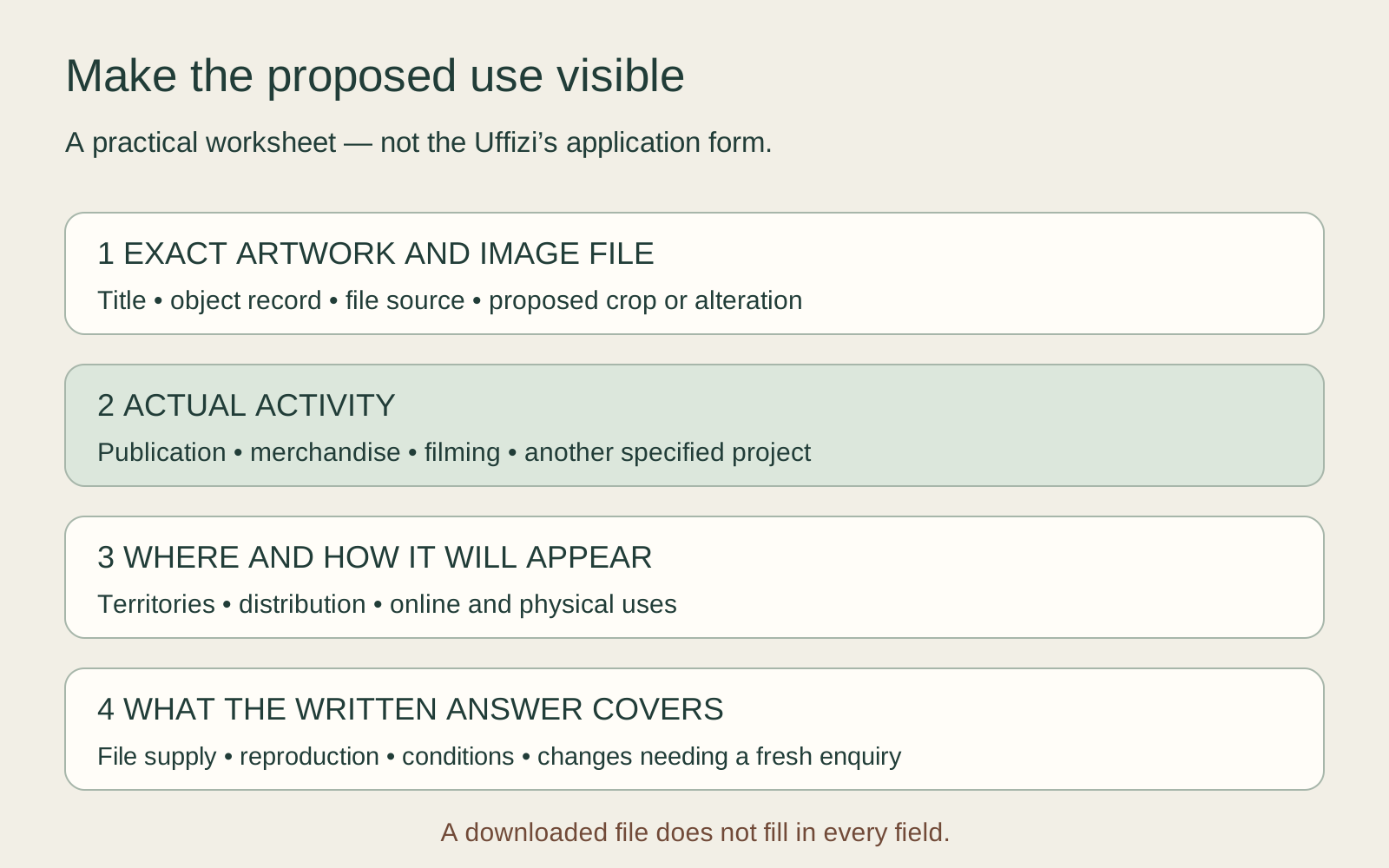
Keep the response with the project files. Record which image it covers and whether the answer addresses supply, publication, merchandise or some combination. If the intended use changes materially, revisit the question rather than relying on the subject line of an old email.
What this dispute does and does not tell you
The Uffizi story demonstrates why a copyright-only checklist can miss the basis of a museum’s objection. It does not establish that every museum owns new copyright in every photograph of old art, or that an Italian institution’s request automatically settles the law everywhere.
For an actual publication or product, identify the work, trace the exact file, describe the use and investigate the relevant territory. Where an important point remains unresolved, record it as unresolved. A qualified answer is more useful than treating either “public domain” or “the museum sued” as the end of the enquiry.
Editorial record
About this article
- Author
- Publisher
- GeMarkt
- Published
- Reviewed
- Internal source & rights check. Conducted by GeMarkt Research Review. This is an internal editorial check—not independent peer review.
- Source standard
- Rights guide source standardSeparates the underlying work from the source file, records the review date, and links the evidence used for the conclusion.
Found a claim that needs checking? Report a factual error.