GeMarkt Blog · Reference
Italy’s Cultural Heritage Rule: When Old Art Still Needs Permission
Why public-domain art can still raise Italian cultural-heritage questions, what the reproduction rules cover, and how to ask about an exact image and use.

The short answer is not a new copyright term
An old painting can be out of copyright while its reproduction still raises a separate Italian cultural-heritage question. That does not mean Italy has simply extended the artist’s copyright forever. It means copyright is not the only legal framework involved.
The distinction matters when you want to put an image on a shop page, publish a book, make a poster or commission photography inside a museum. A download button may solve the problem of obtaining pixels without answering all the questions about using them.
This guide explains the framework and a practical way to investigate it, checked on 13 October 2026. It is general information, not legal advice or permission for a particular reproduction. A cross-border commercial project may need advice about applicable law and the precise circumstances, not just a calculation based on the artist’s death.
Four questions about one image
Start by separating the artwork, the photograph, the cultural property and the conditions of access. These may overlap in practice, but they are not interchangeable.
Italian copyright law itself makes the distinction. Article 32-quater of Law 633/1941 says that a reproduction of a visual work whose protection has expired does not acquire copyright or related rights unless the resulting material is original. The same provision expressly preserves the cultural-property reproduction rules in Legislative Decree 42/2004.
The European starting point is Article 14 of Directive 2019/790, which excludes non-original reproductions of public-domain visual art from copyright and related rights. Italy’s express heritage reservation is why reading only the reproduction-copyright rule leaves an important question unanswered.
So “this is a faithful reproduction of public-domain art” can be relevant to the copyright analysis without settling the heritage analysis. Conversely, paying an institution for permission does not necessarily clear a living photographer’s or artist’s separate rights.
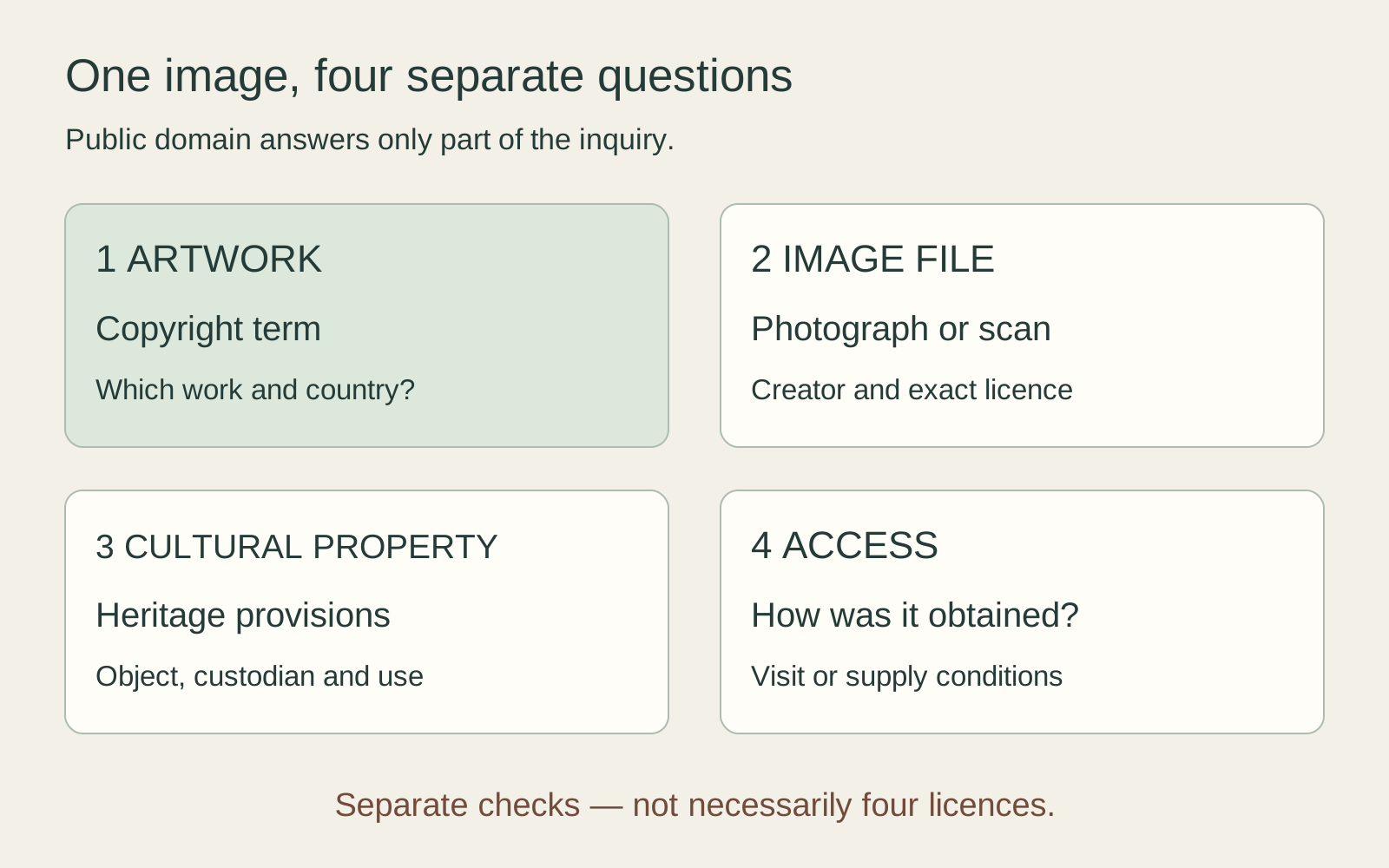
A useful research note has separate answers: the artwork’s status in the relevant country; the exact file’s creator and licence; the institution’s applicable reproduction rules; and any conditions accepted when obtaining access. Do not write “cleared” across the whole note when only one answer is known.
Which objects and institutions are involved?
This is not a rule that attaches automatically to everything painted by an Italian artist, wherever it is held. Identify the particular object and custodian first.
Under Article 107, as reproduced on the Ministry of Culture’s procedure page, the Ministry, regions and other territorial public bodies may permit reproduction of cultural property in their custody, subject to the stated qualifications and copyright law. “An Italian painting” is therefore an inadequate description of the legal situation: a named object in a named collection is much more useful.
For an image found on an aggregator, follow the record back to the collection. Record the inventory number, not only a familiar title. Copies, workshop versions and later photographs can share almost identical labels. If the object is on loan, ask which institution deals with the proposed use rather than assuming the building displaying it controls every permission.
Free use is part of the law too
The code is not a blanket requirement to pay for every photograph. Article 108 includes fee exemptions and activities that are free under specified conditions.
Paragraph 3 addresses reproductions requested or made for personal use, study and qualifying non-profit purposes, while retaining reimbursement of expenses. Paragraph 3-bis covers specified non-profit activities, including study, research, free expression and creative expression, and promotion of knowledge of cultural heritage. Its reproduction branch has conditions concerning copyright, physical contact, lighting, equipment and restricted archival material. Its dissemination branch concerns lawfully acquired images and limits on further reproduction for profit.
Those qualifications matter. “Educational” is not a magic label for an otherwise unspecified project. Explain whether an image will appear in a private research folder, an openly available article, a paid publication, advertising or merchandise. A project can also have more than one use: an exhibition catalogue and the poster selling that catalogue need not be treated as the same request.
Why a free use can still involve a file cost
Distinguish permission to use an image from the work of supplying it. An institution may need to retrieve a file, prepare a reproduction or arrange a new photograph. That is a different question from whether your proposed use falls within a fee exemption.
The Ministerial Decree of 21 March 2024, no. 108, replaces the annex to the 2023 guidelines. Its scope is property entrusted to the Ministry’s cultural institutions and places; it is not a single price list for every collection in Italy. The annex separates acquisition of reproductions from their use, and reimbursement from tariff cases. It also states that the amounts do not include third-party copyright rights.
Avoid calculating a fee from an old screenshot. Ask the institution which current category applies and whether the reply concerns file supply, reproduction permission or both. A zero fee is not necessarily an unrestricted, transferable licence; an invoice is not necessarily proof that every right was included.
Ask the custodian about the actual project
The Tuscany national museums’ reproduction page is one current example of an institution directing users to its authorisation process and the 2024 decree. Use the equivalent official page for the collection you are researching, not a form borrowed from an unrelated museum.
Prepare a short, specific description. Give the object identifier and link, explain where your file came from, and state whether you need a new file. Then describe the publication or product, territory, distribution, duration and proposed crop or alteration. If you do not know a detail yet, say so rather than inventing a print run to complete a form.
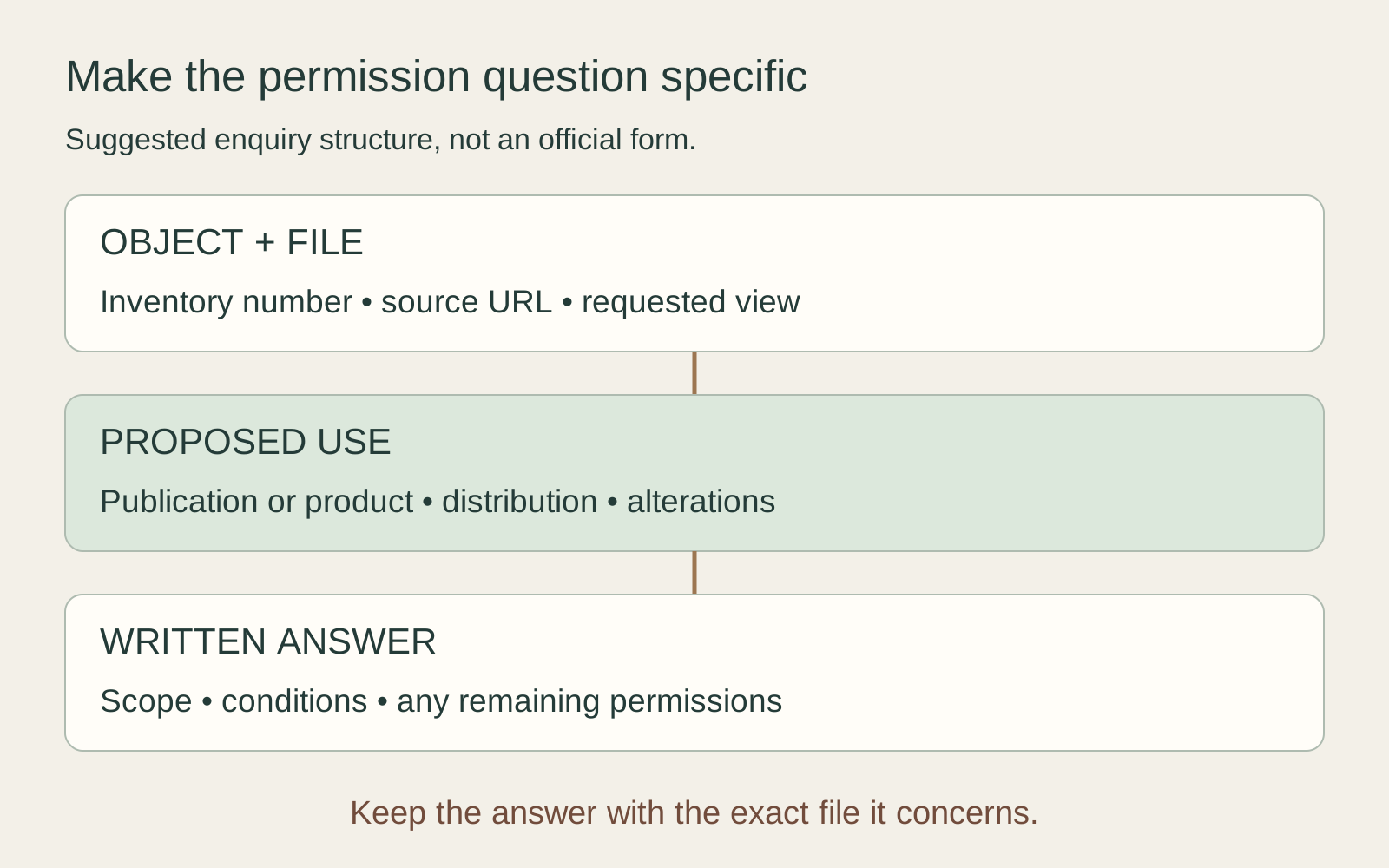
Ask explicitly whether additional permissions are needed. Keep the answer with the exact image it concerns. A general reply about a museum’s collection should not silently become approval for a different file, product or campaign.
Three situations that need different answers
These are illustrative research scenarios, not legal determinations.
A student’s reference image: the practical starting point is the relevant study or non-profit provision and the rules for making or obtaining the reproduction. The question is not the same as a manufacturer’s packaging proposal.
An illustrated article on a commercial website: describe both the editorial purpose and the surrounding business context. Do not hide advertising, subscriptions or product links, and do not assume their presence automatically decides every legal issue either. Ask how the exact use is treated.
A print offered for sale: explain that the image itself is part of the product, not merely an illustration accompanying criticism. An open licence from a photographer addresses that photographer’s contribution; it does not, by itself, answer a separate heritage claim.
None of these examples establishes how an Italian claim would be resolved in every foreign court. The countries involved, applicable law and facts need their own assessment. Changing your server location is not a substitute for that analysis.
Keep a record you can use later
Before publication, keep the object record, file source, relevant policy version and written response together. Note any approved territory, edition, credit line or modification. If the project changes substantially, revisit the permission rather than relying on the original email subject line.
Our guide to CC0, Public Domain Mark and museum licences helps distinguish file labels from wider permissions. The practical lesson here is equally simple: neither “everything is forbidden” nor “the artist died centuries ago” is a sufficient answer. Identify the object, the file, the authority and the use, then resolve the questions that actually apply.
Editorial record
About this article
- Author
- Publisher
- GeMarkt
- Published
- Reviewed
- Internal source & rights check. Conducted by GeMarkt Research Review. This is an internal editorial check—not independent peer review.
- Source standard
- Rights guide source standardSeparates the underlying work from the source file, records the review date, and links the evidence used for the conclusion.
Found a claim that needs checking? Report a factual error.