GeMarkt Blog · Reference
Ravensburger and the Vitruvian Man Puzzle: What the Courts Decided
The 2025 Stuttgart ruling separated an Italian heritage claim from uses abroad. Understand its parties, territorial limits and unresolved file questions.

A puzzle showing Leonardo’s Vitruvian Man became the subject of a dispute between Ravensburger companies and Italian public authorities. The interesting question was not whether Leonardo had been dead long enough. It was whether Italy’s cultural-heritage reproduction rules could support the claimed restrictions on uses outside Italy.
The German decision is worth reading through three questions: who was asking, what restriction was claimed and where it was supposed to apply. A favourable headline alone cannot answer them.
As of 13 October 2026, this guide reports that documented decision. We have not verified a later final disposition or appeal outcome. It is not permission to reuse any image file of the drawing, nor individual legal advice for an international business.
A puzzle, a drawing and a territorial question
The dispute concerned a reproduction of the Renaissance drawing held by the Gallerie dell’Accademia in Venice. The parties did not reach a licensing agreement, and proceedings took place in Italy and Germany. An Italian Ministry of Culture notice published in February 2023 identifies the dispute and a Venice interim order dated 24 October 2022.
That history matters because there was not one court answering one question for the entire world. Think of three separate enquiries: what the Italian proceedings required, whether the German court could hear each claimant’s case, and which law could support the claimed restriction outside Italy. Combining them into “the puzzle was banned” or “the puzzle was cleared” loses the issue the German case actually examined.
What Stuttgart decided in June 2025
The court’s 11 June 2025 announcement identifies appeal 4 U 136/24. For the German claimants, the asserted Italian heritage basis did not support the claimed restriction abroad. The Italian subsidiary’s claim was dismissed for lack of international jurisdiction.
The decision was not yet final when announced: a challenge to the non-admission of revision remained possible. That is a dated procedural statement, not confirmation of what happened next.
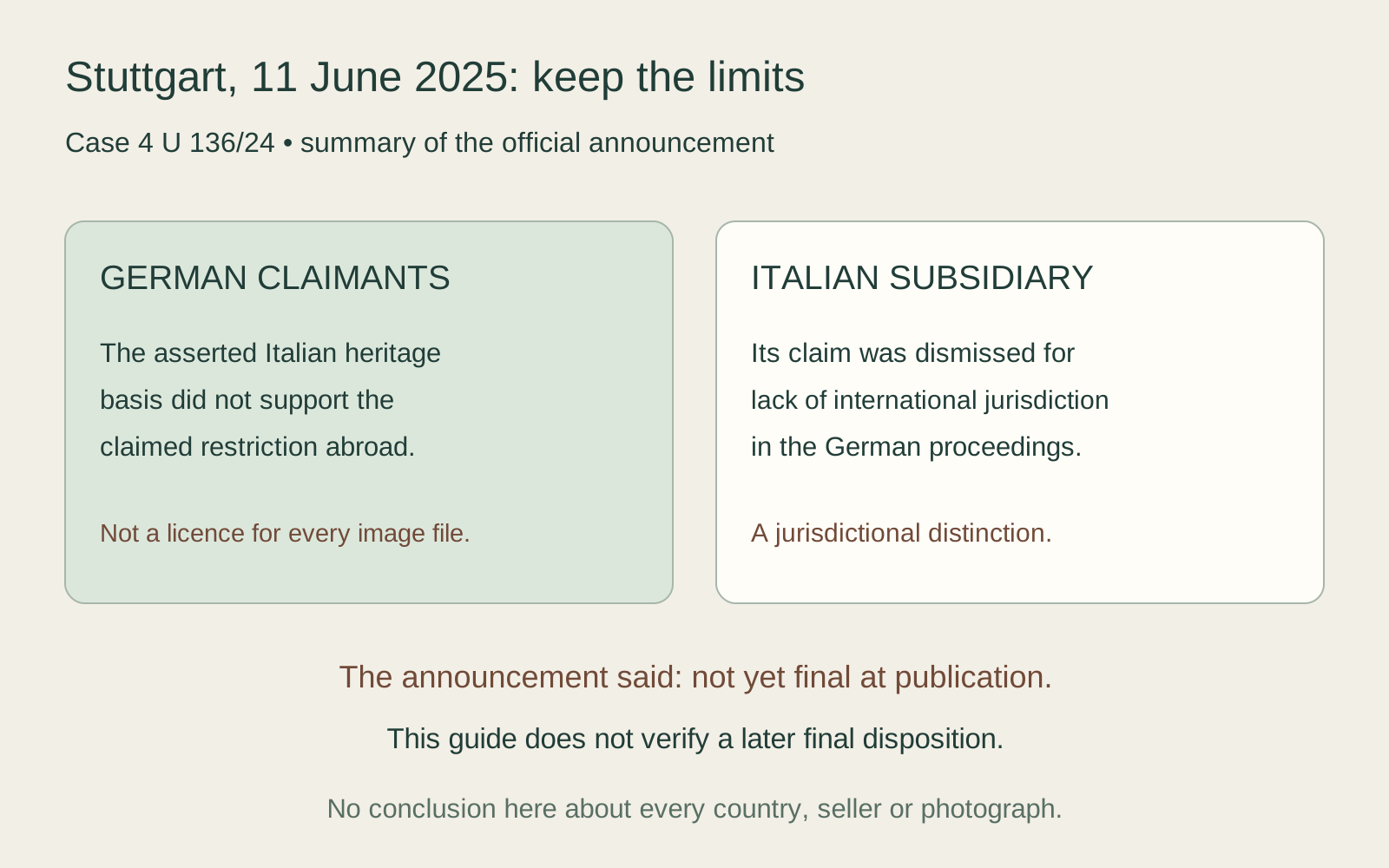
Why the Italian subsidiary was different
Before deciding a dispute’s substance, a court must be entitled to hear it. That procedural question is easy to miss when several related companies sell a similar product. A shared brand does not make them one legal person for every jurisdictional purpose.
For a reader planning cross-border activity, the practical lesson is to name the actual entity involved. The company producing an item, the company selling it and the company receiving a legal demand may not be identical. This is an explanation of why the party distinction matters, not a suggestion to change a business structure to evade obligations.
Nor should a jurisdictional dismissal be paraphrased as an adverse decision on every substantive argument. “This court cannot decide this claimant’s request here” and “this use infringes a right” are different conclusions.
Germany was not an appeal court for Venice
The judgment reproduced by the Max Planck Institute’s IPRspr database separates the Italian interim proceedings from the German action on the underlying claimed obligation. Its reasoning explains why deciding the German declaratory action was not a review of the correctness of the Italian interim order.
This distinction prevents a misleading account of one country “overturning” another country’s court. The judgment also distinguishes a commercial licensing dispute from sovereign activity for the immunity question before it. These are explanations of the proceedings’ legal route, not declarations that every dispute involving a state museum belongs in the same court.
If you are comparing reports, look for the remedy each court was asked to grant. A temporary measure, a declaration about a claimed obligation and a final award of damages do not have identical functions. A headline that uses the same word—“ruling”—for all three can make a complicated sequence appear contradictory when the questions differ.
The rule about the country for which protection is claimed
Article 8 of the Rome II Regulation provides a choice-of-law rule for non-contractual obligations arising from intellectual-property infringement: the applicable law is that of the country for which protection is claimed. That is not itself a new copyright or a licence. It tells a court which law to apply within its scope.
In the Stuttgart judgment’s reasoning, the heritage-based reproduction restriction was considered within that framework. The court did not treat the Italian provisions as supplying the claimed protection for use outside Italy. This is the territorial point to retain—not a blanket assertion that an image can never be subject to any other law or claim abroad.
For a hypothetical publisher, “available online” is an incomplete geographical description. Where is the activity directed? Which use is challenged? Which country’s protection is being asserted? These questions explain why a territory-specific conclusion cannot simply be relabelled “worldwide permission”.
Not a new copyright term for Leonardo
There is a separate reason to keep the categories clear. EU copyright Article 14 addresses non-original reproductions of visual works whose copyright has expired. Italy’s Article 32-quater preserves the cultural-heritage code’s reproduction provisions alongside that copyright rule.
These are distinct legal layers. The heritage dispute does not demonstrate a revived copyright in Leonardo’s drawing. Equally, a finding about the geographic reach of a heritage claim does not identify the photographer, licence or contractual conditions attached to the file on your computer. Our guide to Italy’s heritage rules explains that separation in more detail.
Use the case to ask better questions
Imagine that you are considering an illustration in a book, a puzzle or a promotional website. Before applying this case to your project, write down the exact image and its source. Then describe the activity and the entity undertaking it. Finally, identify the territories and the particular rights or restrictions that still need assessment.
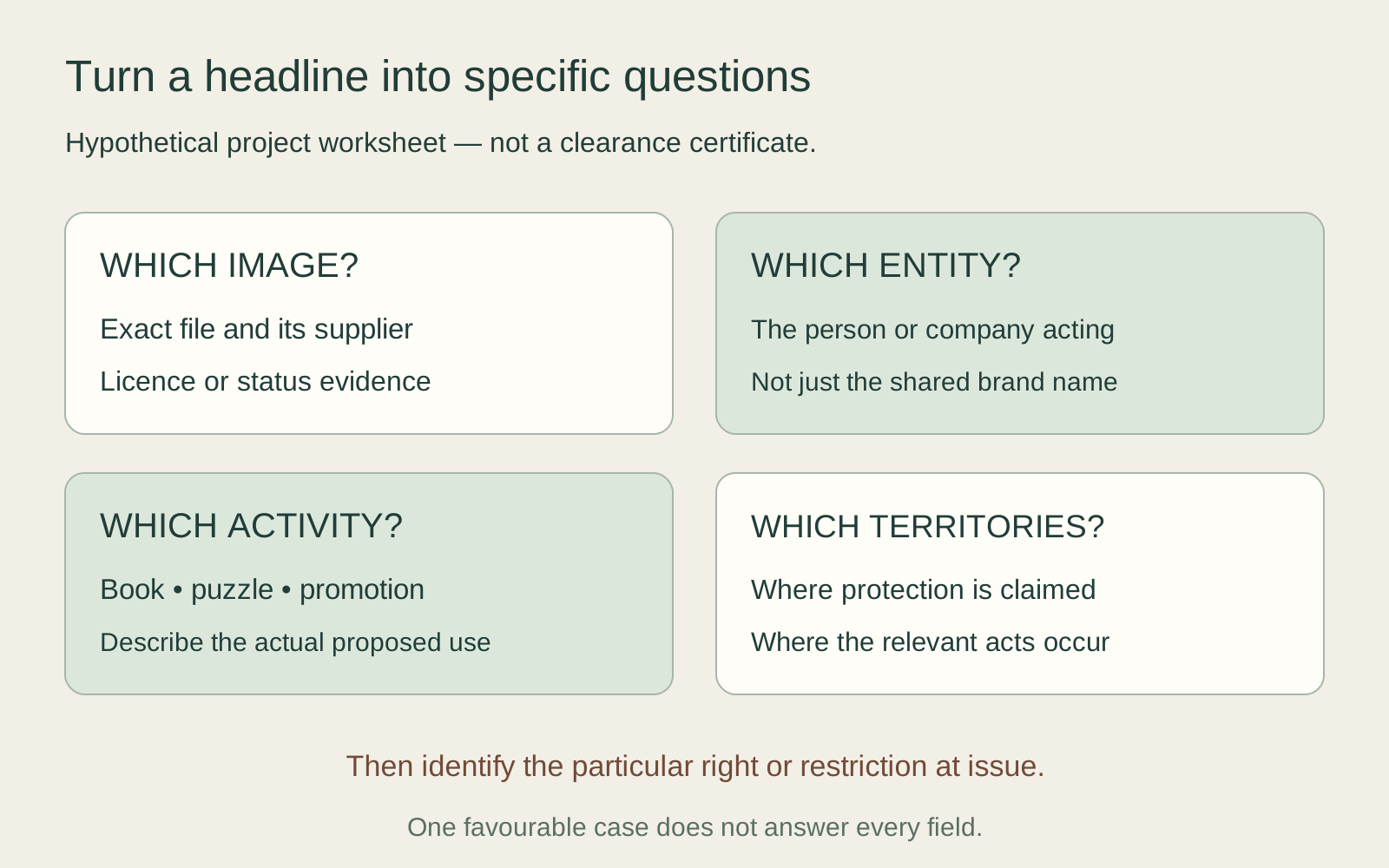
These are practical preparation steps, not a substitute for advice when a substantial commercial use is proposed or a demand has arrived. They help avoid a common mistake: saving a favourable headline while never saving the licence for the actual file.
Check the status before relying on the headline
Before using a case note to support a decision, ask what the note actually checked. An accessible announcement may establish what was said on its publication date without establishing the position months later. That gap should stay visible.
If the case is material to a decision, obtain the relevant judgments and check later procedural developments. Record the date of that check. A useful case note should help you understand the question decided; it should not turn a bounded ruling into a promise that every picture, seller and country is covered.
Editorial record
About this article
- Author
- Publisher
- GeMarkt
- Published
- Reviewed
- Internal source & rights check. Conducted by GeMarkt Research Review. This is an internal editorial check—not independent peer review.
- Source standard
- Rights guide source standardSeparates the underlying work from the source file, records the review date, and links the evidence used for the conclusion.
Found a claim that needs checking? Report a factual error.