GeMarkt Blog · Reference
Photographing Art in the Vatican Museums: What’s Allowed
Understand Vatican Museums visitor photography rules, the Sistine Chapel exception, and the separate permissions for publishing or commercially using images.

Taking a picture and publishing it are different questions
A museum visit, an image download and a licence for publication are three different things. Before planning a photograph for a blog, book or product, decide which one you actually need.
For a visitor, the immediate question is what may be photographed in the room. For an editor, it is which exact file can be reproduced in a particular publication. For a designer selling a product, the proposed commercial use needs to be described clearly rather than treated as an extension of a holiday photograph.
This guide follows the Vatican Museums’ official information checked on 13 October 2026. It is general guidance, not legal advice, a filming permit or a verdict on a disputed photograph. The practical scenarios below are our examples; they are not reported museum decisions or promises that an application will be approved.
The visitor rules to know before you go
The Museums permit photography for personal and domestic use outside the Sistine Chapel. Flash is prohibited. Tripods, stands, drones and professional equipment require authorisation; telescopic selfie sticks are forbidden. In the Sistine Chapel, photographs and filming are prohibited with any electronic equipment, and guards may require deletion of material made in breach of that rule. These are the current visitor instructions.
That exception is not solved by switching off the flash or using a phone instead of a camera. Check the official instructions again before your visit and follow staff directions. Do not make the success of a publishing project depend on obtaining a photograph that visitors are not allowed to take.
If a particular detail matters to your research, make a note of its title and location for later identification. You can investigate available authorised images without turning the visit into an attempt to work around restrictions.
Three routes to an image
Imagine that you need an illustration for an article discussing a painted ceiling. Start with where the file would come from, rather than how famous the ceiling is.
A photograph you made during a visit raises the conditions of that visit. A file supplied for publication raises the scope of the permission accompanying the supply. A photograph from an independent archive raises that archive’s evidence about the file and its creator. None is interchangeable with the others merely because the same artwork is visible.
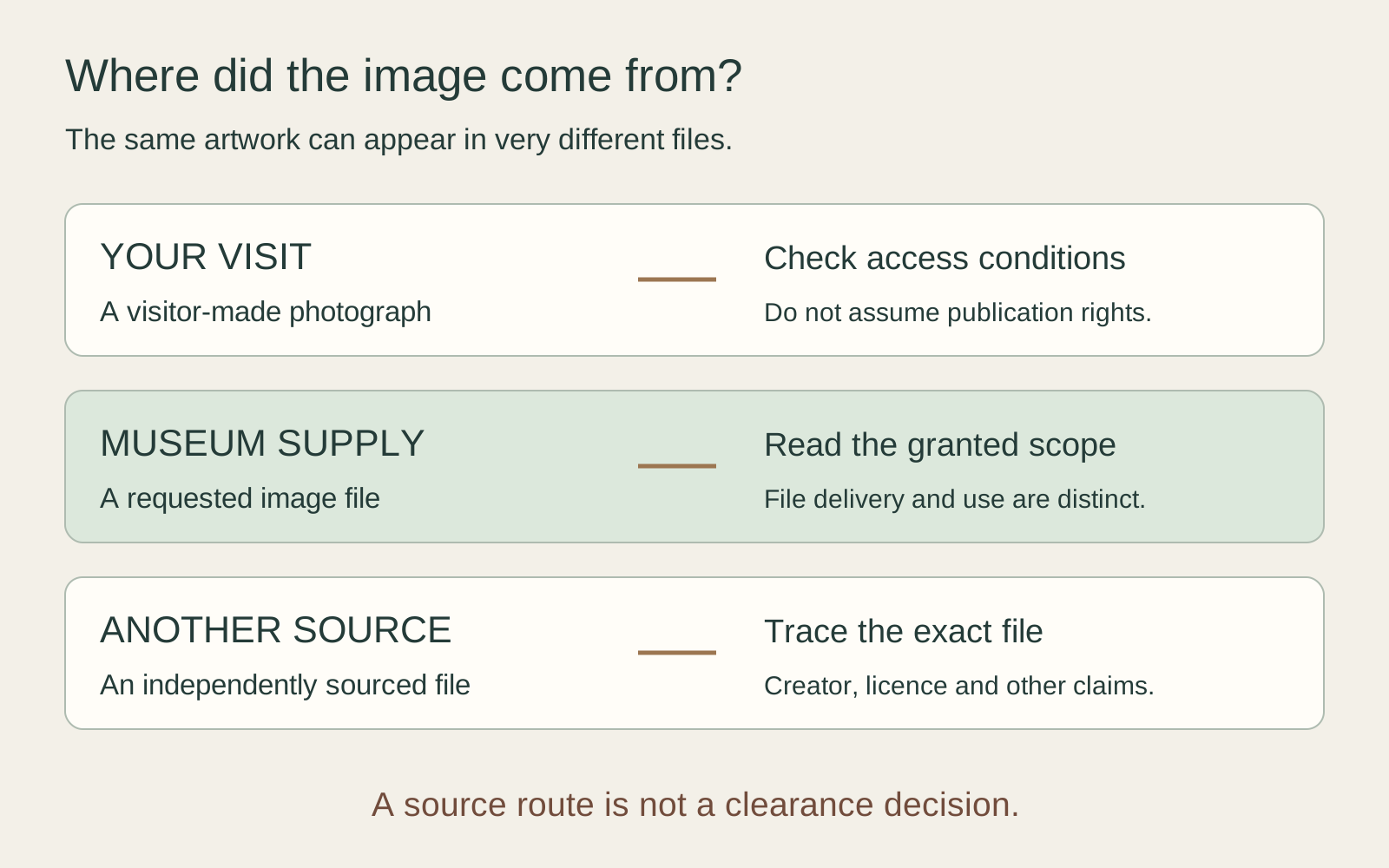
Give each candidate file its own note: exact source URL, photographer if identified, image identifier, stated licence and intended use. “Found online” is not enough to distinguish an authorised download from a copy separated from its conditions. Nor is a photograph’s resolution evidence that someone had permission to publish it.
The official website is not an open image library
The Vatican Museums’ website copyright notice reserves rights in its published material and prohibits unauthorised reproduction and distribution. It does not present the site’s photographs as a CC0 collection. Being able to view or save a web image is therefore not evidence of an open licence.
That statement describes the institution’s notice; it does not decide every possible copyright exception in every country. If you intend to rely on an exception, assess its conditions for the specific use rather than treating this guide as a substitute for that work.
For an ordinary publishing workflow, use the collection page to identify the artwork and then investigate a permitted file. Avoid building a finished cover around an unlicensed screenshot and asking about rights only when the print deadline arrives. That reverses the useful order of decisions and can leave the entire design dependent on an unavailable image.
How to ask for a publishing image
The Images and Copyright Office provides reproductions for purposes including publishing and communication. Its official description also covers requests for study, exhibition and private use, and the possibility of arranging new photography when existing material is unavailable. Supply and use follow economic and regulatory procedures; the page is not an automatic grant of permission.
The administrative contact directory lists the office at id.musei@scv.va. Check that official directory before writing in case the contact changes.
Identify the artwork precisely. Give its title, artist or attribution, museum record or inventory number where available, and the part you need to show. “The Raphael picture” is not a reliable file request. If you want a detail, explain which detail instead of assuming you may crop whatever file is supplied.
State whether you need a publication-ready file, permission for a file you already possess, or authorisation for new photography. Those requests solve different problems. Ask for the terms in writing before paying for production or promising an image to a client.
Describe the use, not just the project title
The following is a suggested planning checklist, not the Museums’ prescribed application form. It helps you ask a question the recipient can actually answer.
Explain the medium, audience, distribution and commercial context. An illustrated article, a book cover and a product package can all be described as “a design project,” but that phrase hides the important differences. Include your proposed crop, text overlay or colour treatment, if any. Do not assume a permission to reproduce the whole image includes every alteration.
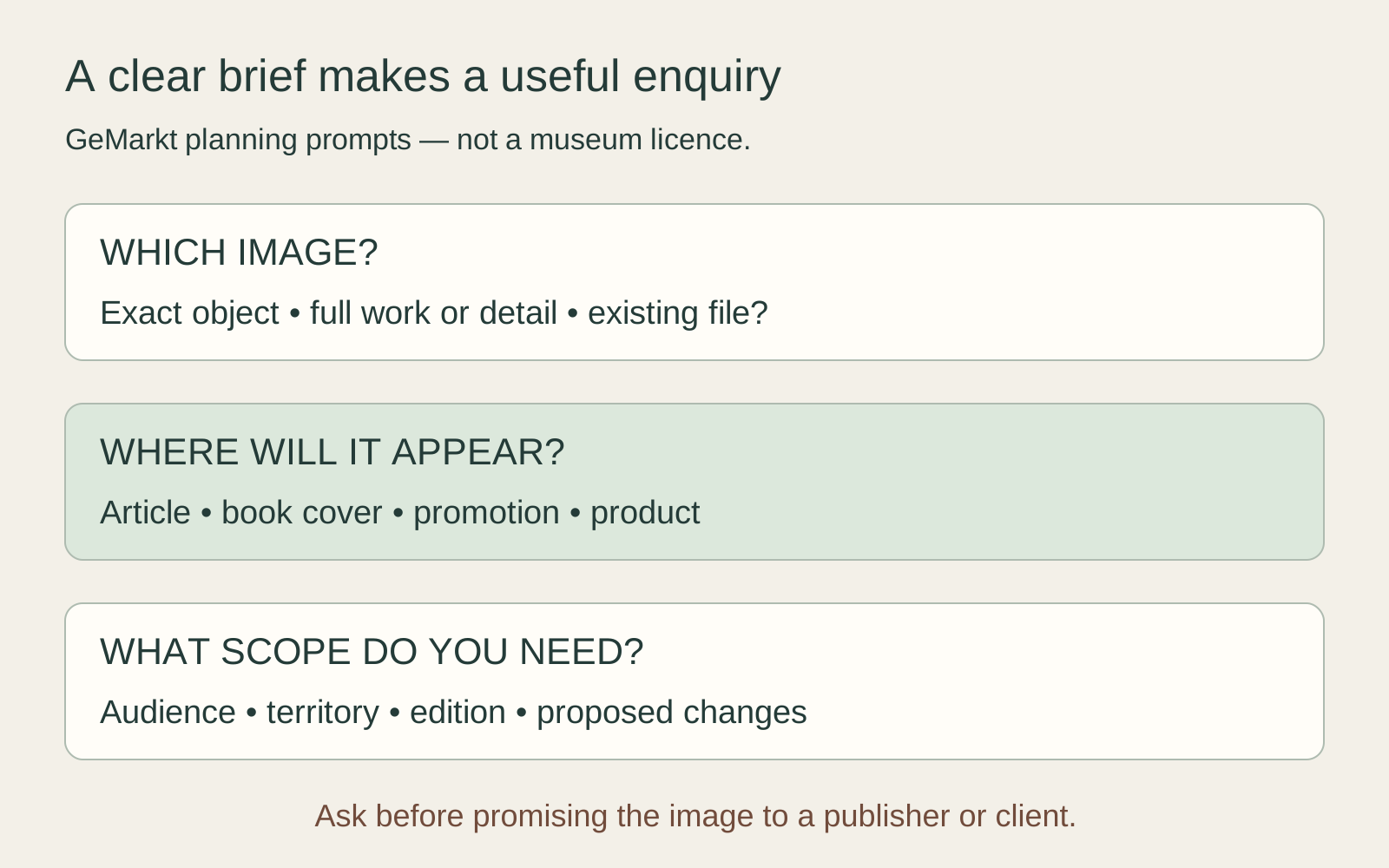
Here are three hypothetical examples. A researcher needs one detail inside a paid scholarly book; an editor wants a full image in a freely readable article on an advertising-supported site; a retailer wants the image printed on objects for sale. Write the real description in each case. Neither “scholarly” nor “free to read” should conceal the surrounding use.
For social media, describe the account and purpose rather than assuming every post is domestic or every post is commercial. This guide does not declare a universal answer for personal sharing, criticism, sponsorship and advertising together. Where the policy does not resolve your case, ask before publishing.
Public-domain art does not answer every question
An old artwork’s copyright status is only one part of the inquiry. A photograph may introduce separate authorship or licence questions; obtaining it may involve access conditions. Country-specific law also matters. A conclusion reached for a faithful reproduction in one jurisdiction should not silently become worldwide permission.
For example, the US Copyright Office’s photography guidance describes protection for original photographic expression, not ownership of whatever subject appears in the photograph. That is a US distinction to investigate where relevant, not a Vatican visitor permission or a ruling that any particular museum file is unprotected.
Nor should “Vatican art” be treated as synonymous with Renaissance art. The Museums’ Modern and Contemporary Art collection includes artists such as Bacon, Chagall and Matisse. Identify the particular work and applicable term rather than guessing from the institution’s historic setting.
For the vocabulary behind file labels, see our CC0, Public Domain Mark and museum-licence guide. It explains why an attribution, a download and a reuse licence are not equivalent evidence.
Read the permission before building the page
When an answer arrives, compare it with the intended use. Does it identify the correct file? Does it cover the relevant publication, territory, edition and promotional appearances? Is there a required credit? Are crops or modifications addressed? These are questions to resolve, not assumptions about what every licence contains.
Keep the response, conditions and supplied file together. If a publisher later requests a cover use instead of an interior illustration, revisit the scope. A record that lets another editor understand the permission is more useful than a folder simply called “approved.”
You can enjoy the collection without licensing an image, and you can research publication images without taking them yourself. Keeping those activities separate makes both the visit and the publishing decision easier to plan.
Editorial record
About this article
- Author
- Publisher
- GeMarkt
- Published
- Reviewed
- Internal source & rights check. Conducted by GeMarkt Research Review. This is an internal editorial check—not independent peer review.
- Source standard
- Rights guide source standardSeparates the underlying work from the source file, records the review date, and links the evidence used for the conclusion.
Found a claim that needs checking? Report a factual error.