GeMarkt Blog · Practical guide
Ottoman and Turkish Art for the Home: Osman Hamdi Bey and Miniatures
Choose an Osman Hamdi Bey painting or an Ottoman album image for your room, with practical advice on scale, patterned borders, colour and accurate sources.

Start with a painting you want to look at, rather than trying to give the whole room an “Ottoman” theme. A richly patterned scene, a direct portrait and a small album painting make very different demands on a wall. You can enjoy one of them without buying matching textiles, lamps and furniture.
This guide considers three specific images: two paintings by Osman Hamdi Bey and an earlier Ottoman costume-album picture. They are starting points, not a complete account of Ottoman or Turkish art. The practical question is what you want to notice at home: people making music, a distinctive face, or the small details of a painted page.
Choose a picture, not a complete theme
“Ottoman” describes a historical context; “Turkish art” is not a single palette or decorative style. Keep the artist, date and kind of object in view. A nineteenth-century oil painting and an eighteenth-century album leaf need not be presented as interchangeable examples of the same tradition.
Begin with the room you already have. Is the intended wall seen from across a sofa, or can someone stand close to it? Do patterned curtains occupy the same field of view? A picture with a large, clear figure may remain readable at a distance, while a page with fine borders rewards closer attention.
Choose the part of the image that interests you before choosing its colours. You may like the exchange between two musicians more than the blue tiles behind them. That gives you a better reason to keep the whole composition when a framing preview offers an attractive but destructive crop.
One specific connection is enough: a shared interest in music, a family association, or simply a face you find compelling. You do not have to make the room resemble the setting inside the painting.
Musicians for a room with colour and pattern
Osman Hamdi Bey’s Two Musician Girls, 1880, is in Pera Museum’s collection. Pera records the canvas at 58 × 39 centimetres and connects its architectural setting with the Green Mosque in Bursa. It is not an interior view of an Istanbul home.
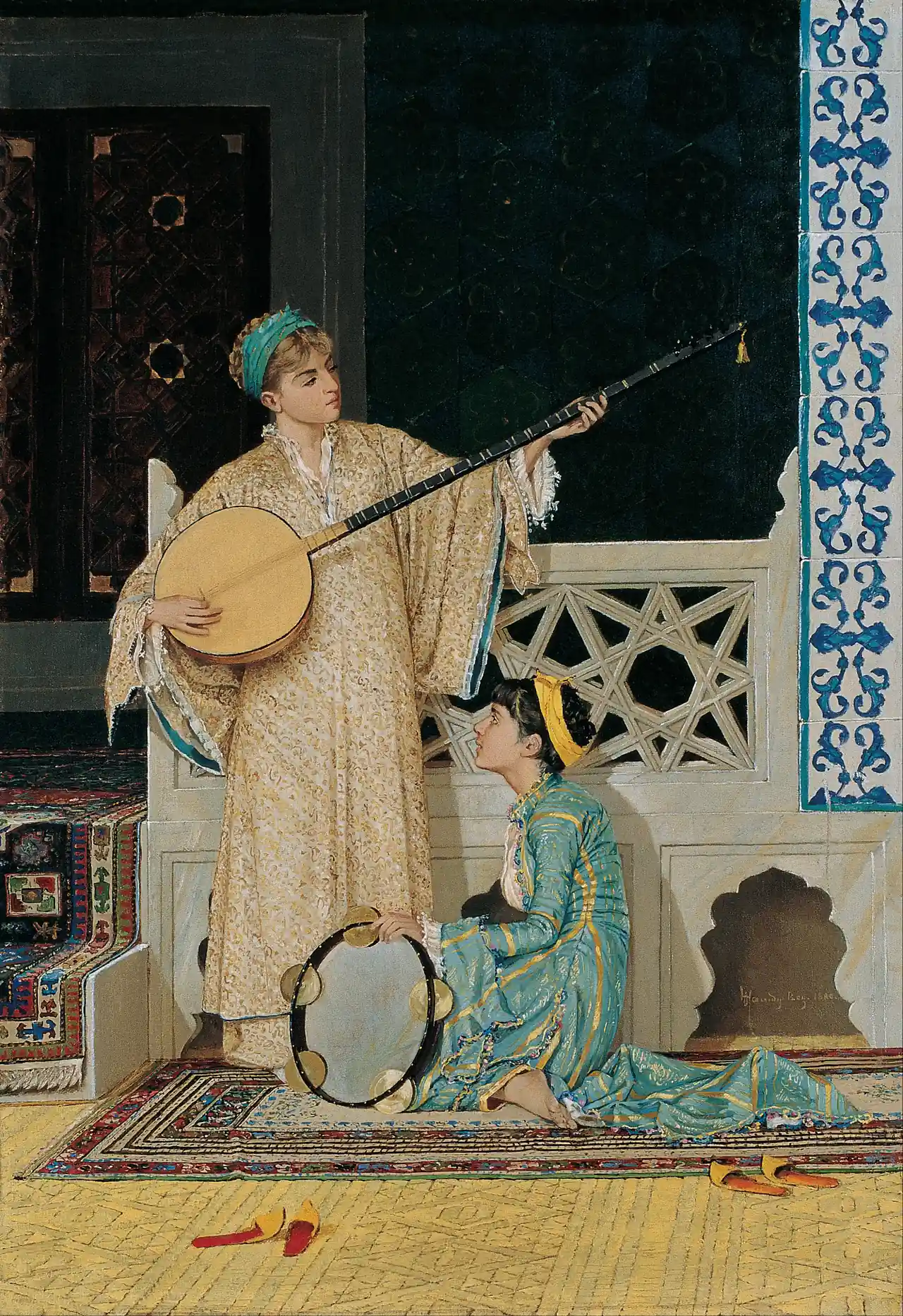

The long instrument creates a diagonal across the dark upper space. Below it, the round tambourine and the seated figure make a lower focus. Blue repeats in the dress and tile strip, while cream clothing stands out against both. These visible connections give you several ways to relate the painting to a room without matching everything.
For example, beside a plain sofa, a blue cushion could echo one small part of the image. If the room already contains a busy rug, try the picture on a quieter adjacent wall rather than surrounding it with more small patterned prints. That is a styling option, not a rule about which cultures or periods belong together.
Retain the shoes, rugs and lower figure when comparing reproductions. Cropping this vertical painting into a square can change a scene of two people making music into a portrait of only one.
A portrait for a more concentrated display
The Sakıp Sabancı Museum identifies Portrait of Naile Hanım as undated. Naile Hanım was the artist’s wife. Keeping the museum’s dating is preferable to adding a confident year from an unattributed image listing.
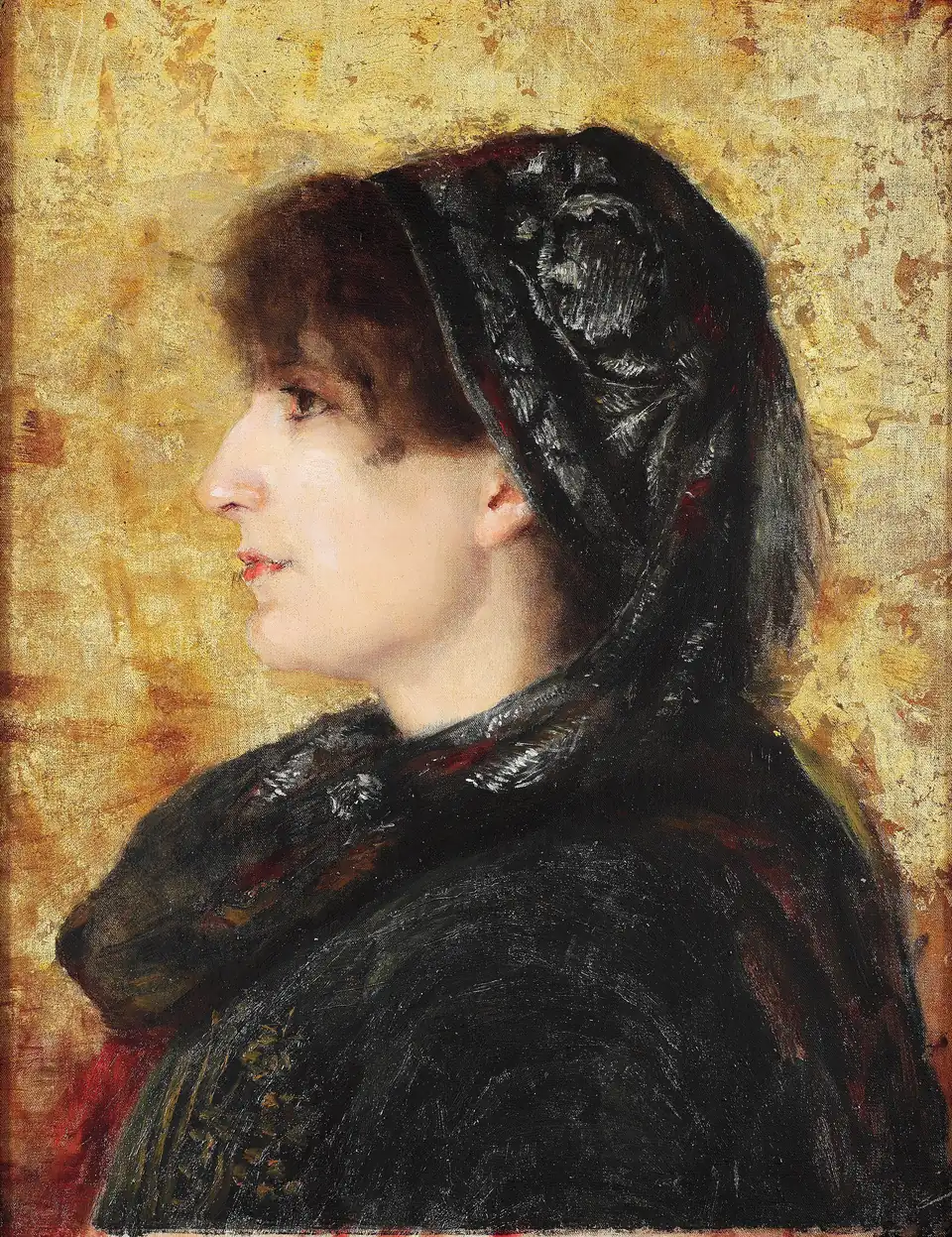

Here, the face meets an almost uninterrupted gold-coloured field. The black clothing forms a broad lower shape, with small red accents appearing near the edges. Compared with the musicians, there is less architecture to explore and a much stronger single silhouette.
That can suit a narrow wall beside a desk or a small grouping around one portrait. Try a dark frame and a pale frame in a mock-up: the first may continue the clothing’s dark shape, while the second may separate the portrait from a dark wall. Neither needs to imitate a museum frame.
Look at the image at the proposed physical size before enlarging it substantially. An intimate portrait does not automatically become more effective when it occupies the whole wall. It may work better where the profile and brushwork can be noticed at an ordinary reading or working distance.
An album painting that keeps its borders
The Met’s A Youth in a Hammam Smoking a Pipe dates to the first half of the eighteenth century and was made in Turkey, probably Istanbul. The museum places it within Ottoman costume-album painting. No named artist is supplied in the object record.
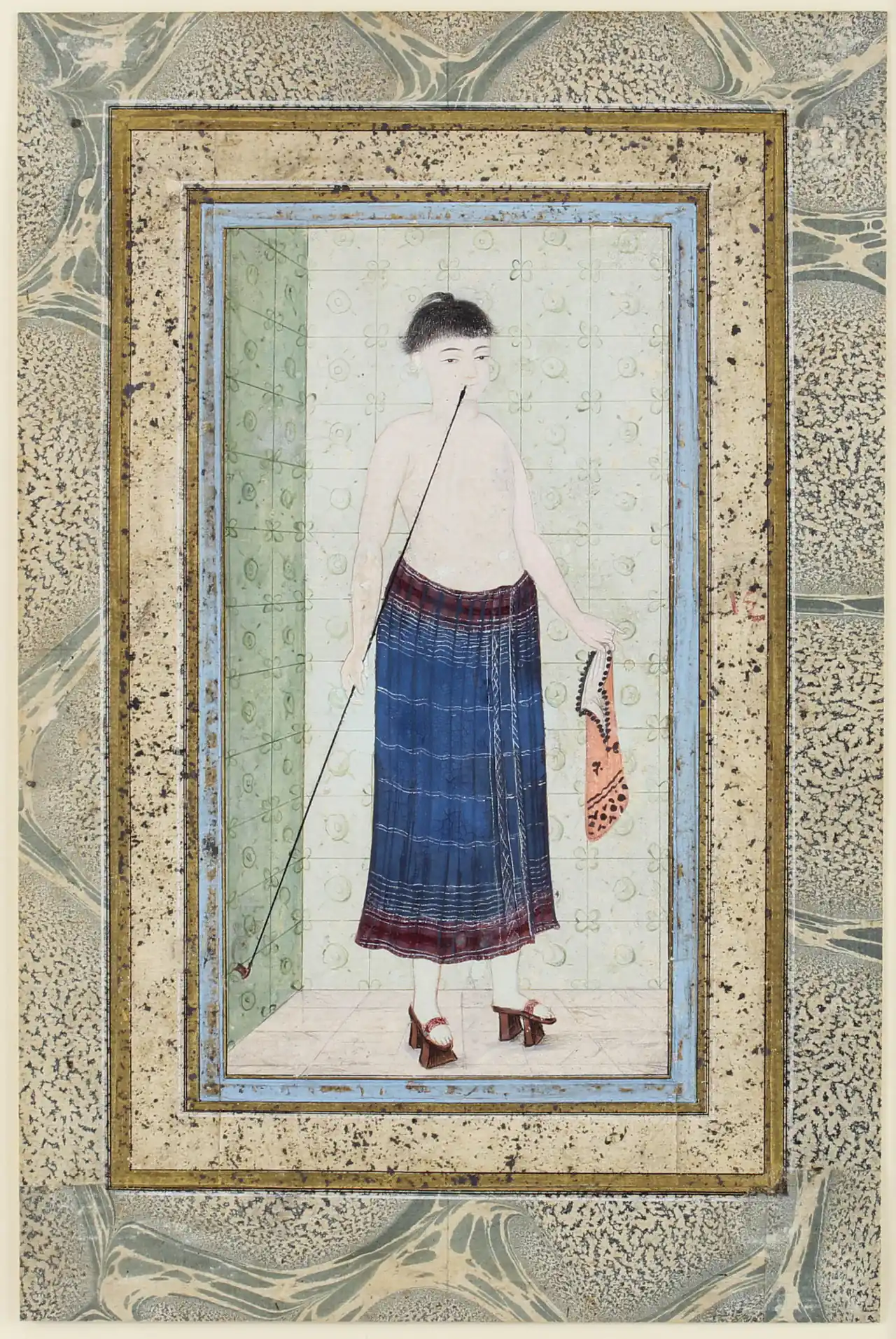
The central painting measures 16.9 × 8.9 centimetres; the full folio measures 26.2 × 17.1 centimetres. That distinction matters when a print is advertised by its “image size”. The picture inside the borders and the whole page are not the same rectangle.
The marbled outer area, speckled bands and thin coloured lines already form an elaborate surround. A restrained modern frame can let those borders do the decorative work. Do not mistake the painted surround for an actual frame included with a reproduction.
The pipe and partly bare figure are visible parts of the subject. Choose the image because you are comfortable living with the complete scene, rather than cropping away details you did not notice in the thumbnail. An album painting can be small and decorative while still depicting a particular activity.
Give small details a close viewing place
A dense page can disappoint when hung where nobody gets near it. Try the image at its likely display size, then step back to the real viewing distance. If only a coloured rectangle remains visible, either accept that distant effect or choose a more approachable position.
For a practical size example, a complete page with a 17.1-to-26.2 width-to-height ratio would be about 30 × 46 centimetres at a 30-centimetre image width. That is the reproduced page, before any added paper margin, mount or outer frame. It is a calculation, not an available product size or a recommendation to enlarge this particular web image.
Compare the full composition with the printer’s preview. A “fill” setting may remove borders; a “fit” setting may leave unprinted space. Neither stretches the picture correctly into another shape. Our custom-size guide explains the choices when a standard frame and the source proportions disagree.
Relate the pictures without making them match
If you want two works together, choose one relationship: similar outer frames, related colours, or a shared interest in figures. The musicians and Naile Hanım do not need to be printed at the same image height simply because they have the same artist.
Two outer frames measuring 36 and 44 centimetres across, separated by a 7-centimetre gap, occupy 87 centimetres in total. Draw that whole arrangement on paper before ordering. The amount of wall left around it matters more than whether both products carry the same nominal print-size label.
Allow different densities too. A portrait can sit beside a patterned album page without forcing their backgrounds to the same shade. Avoid recolouring the historical images to create an artificial set. Adjust the surrounding frame or mount instead, and keep the image itself identifiable.
If only one work holds your attention, stop there. A small, considered display can say more than a wall filled to complete a theme.
Keep the title and file history
The Met labels the selected album image public domain and releases eligible images through its Open Access CC0 programme. The two Osman Hamdi reproductions here instead carry Commons PD-Art / Public Domain Mark designations. They are not museum-issued CC0 files.
For downloading or commercial reuse, check the exact file and relevant conditions rather than applying one artist-wide label. Our Osman Hamdi Bey guide records the remaining publication and file distinctions. This decorating guide does not turn them into a new worldwide clearance.
Keep the artist or attribution, title, collection and source link with your chosen image. That information remains useful after the frame arrives: it lets you explain what you selected, find the complete composition again and avoid confusing a painted room in Bursa with an Istanbul city view.
Editorial record
About this article
- Author
- Publisher
- GeMarkt
- Published
- Reviewed
- Internal source & rights check. Conducted by GeMarkt Research Review. This is an internal editorial check—not independent peer review.
- Source standard
- Buying guide source standardSeparates measured or first-hand evidence from general guidance and keeps practical limits visible.
Found a claim that needs checking? Report a factual error.