GeMarkt Blog · Essay
Oil vs Tempera vs Fresco
See how oil, egg tempera and fresco differ, using real paintings by Duccio, Van Gogh and Tiepolo. Learn why canvas is a support, not a paint.

Oil paint binds colour with oil; egg tempera uses an egg-based binder; true fresco places colour into fresh lime plaster. The difference concerns how a painting is made, not whether its subject is religious, realistic or modern.
A second distinction saves a great deal of confusion: canvas is not an alternative to oil paint. Canvas is the cloth that can carry the paint. Wood, paper and a plastered wall are other supports. A museum label saying “oil on canvas” gives both the paint and what lies beneath it.
First separate paint from support
Pigment is the material that gives paint its colour. A binder holds those coloured particles together and attaches them to a surface. In oil paint and egg tempera, different binders affect how the artist can work. In fresco, the setting lime plaster is central to fixing the colour.
| Label | What it tells you | What it does not tell you |
|---|---|---|
| Oil on canvas | Oil paint on a woven support | Whether the painting is smooth, rough, old or recent |
| Tempera on wood | Tempera paint on a wooden support | That every passage uses exactly the same recipe |
| Fresco | A technique associated with fresh plaster | That every wall painting is a fresco |
| Fresco transferred to canvas | A fresco later given a different support | That the original artist painted it in oil |
These are useful questions to bring to the pictures below. Instead of trying to guess the medium from the subject, compare the record with something you can actually see: an edge, a stroke, a surface or the shape of the object.
Tempera and oil side by side
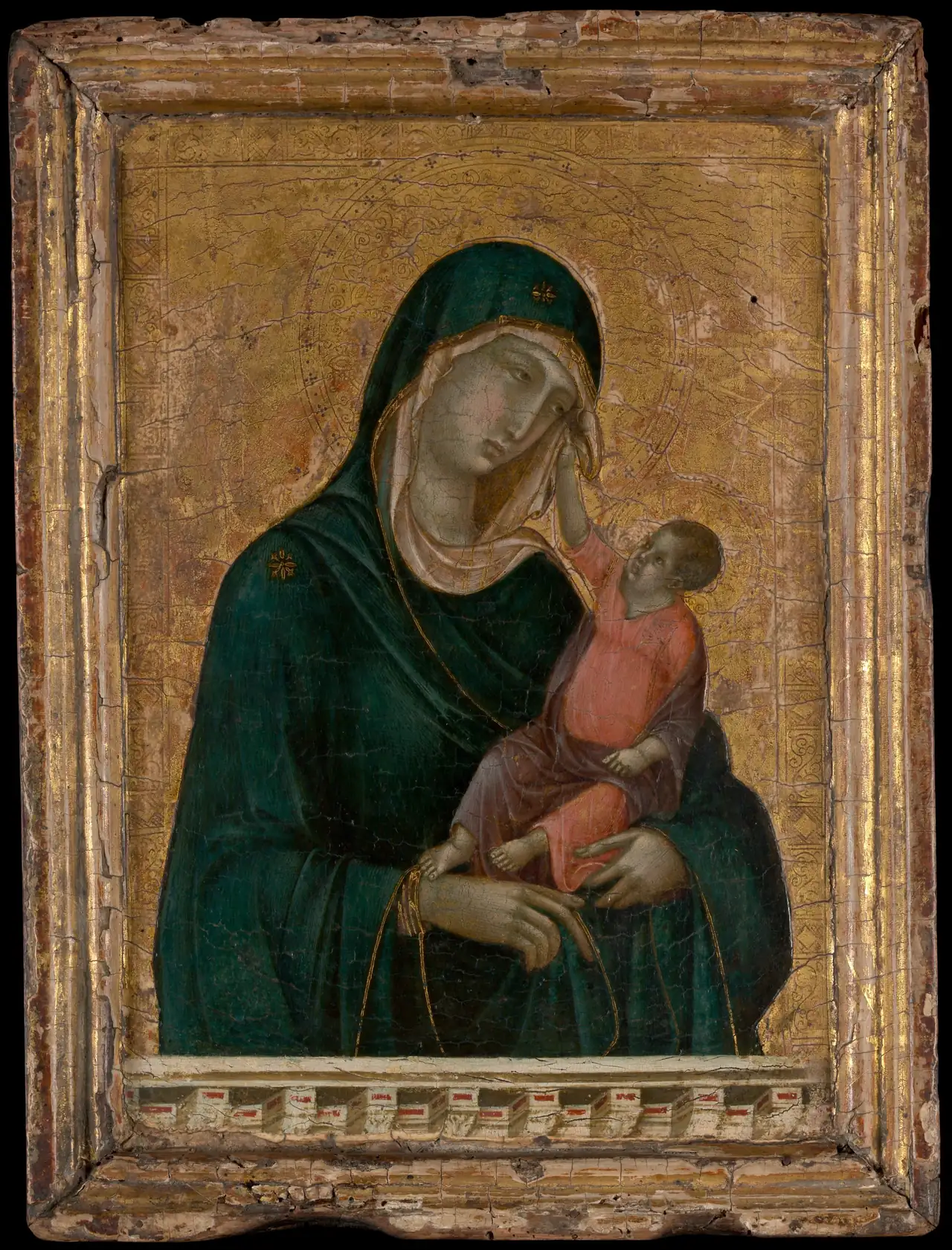
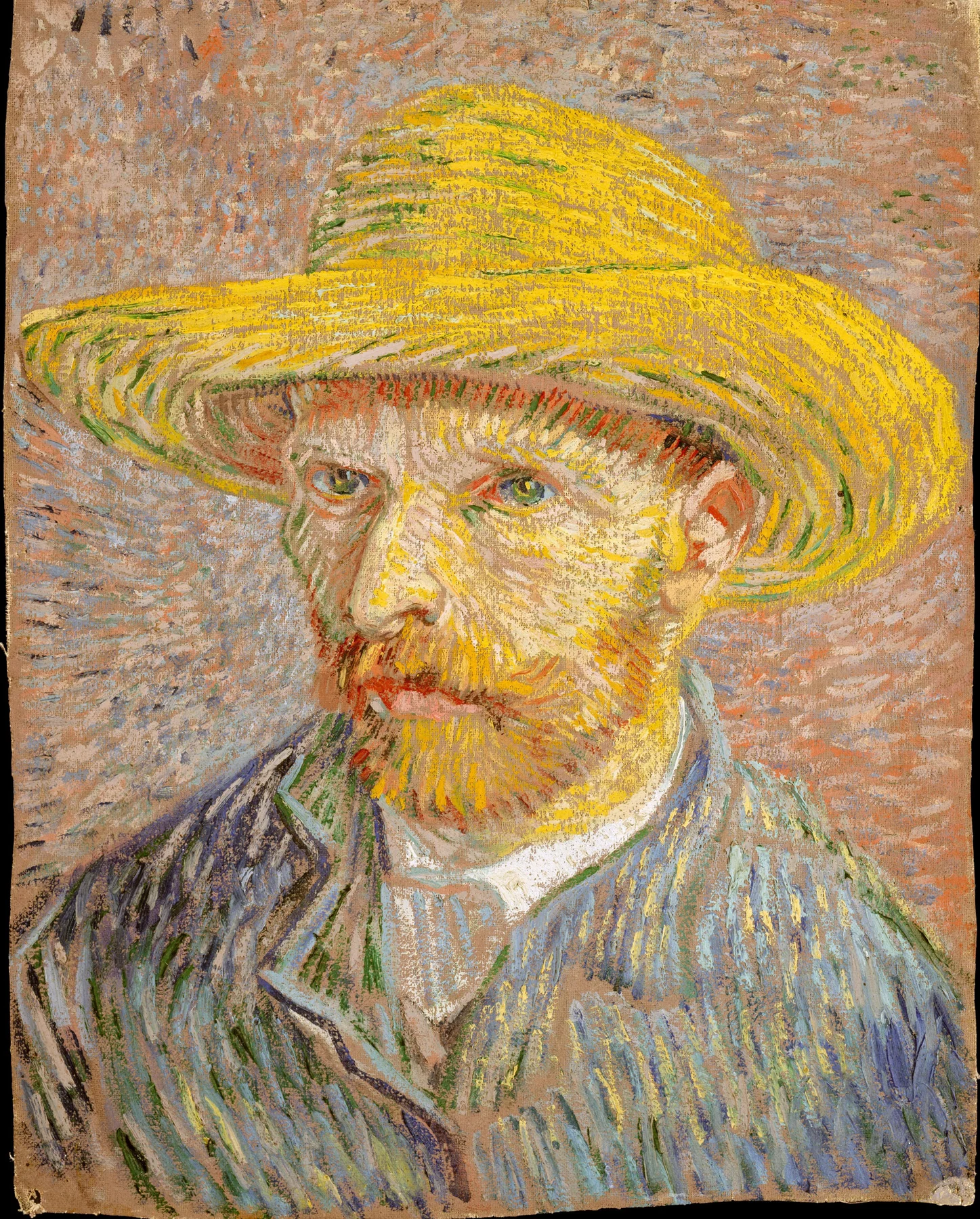
Look first at the clothing. Duccio’s dark mantle forms a broad, enclosing shape around mother and child. Van Gogh’s jacket breaks into separate blue, green and pale marks. Then compare their faces: quiet transitions in one, a visible network of coloured strokes in the other.
That contrast is real, but it is not a laboratory test. Oil can be applied smoothly, and tempera can show individual marks. These two artists also lived centuries apart and wanted different things from their pictures. The museum records establish the materials; looking shows what each artist did with them.
Tempera in Duccio’s small panel
In museum usage, “tempera” often means paint bound with egg yolk, though the word has had broader meanings. It was especially important in early Italian panel painting. The National Gallery’s tempera definition also notes that artists combined tempera and oil: the history is less tidy than one technique abruptly replacing another.
Duccio’s Madonna and Child is an intimate object, not a giant altarpiece. Including its frame, it measures only 27.9 × 21 centimetres. The child’s reaching hand creates a small human action within the solemn arrangement. The Met’s record identifies both tempera and gold on wood; the luminous gold ground is therefore not simply a passage of yellow paint.
The surviving object is also aged. Its worn frame and interrupted gold surface are visible in the photograph. Do not mistake every crack or colour change for an effect Duccio deliberately designed. “What the painting looks like now” and “how it originally looked” are related but different questions.
Oil in Van Gogh’s self-portrait
Oil paint can use drying oils such as linseed, walnut or poppy oil. Its relatively slow drying gives painters opportunities to adjust, blend and layer colour. Contrary to a familiar shortcut, Jan van Eyck did not invent oil painting: the National Gallery’s account records earlier uses. His achievement cannot be reduced to discovering a new ingredient.
Van Gogh’s 1887 self-portrait puts the separate stroke on display. Follow the marks around the cheek, then look at the diagonal strokes in the jacket. They change direction as they describe different parts of the body. The yellow hat also has its own pattern rather than a single flat yellow fill.
Compare that handling with Duccio’s mantle. Here the eye keeps registering small units of colour before assembling a person. This is a looking observation, not a claim that the binder alone produced the effect. Van Gogh could make these decisions in oil; the material did not make them for him.
Fresco begins with the plaster
In buon fresco, pigment carried in water is applied to fresh lime plaster. As the plaster sets, the colour becomes bound into its surface. A day’s workable patch is called a giornata. Painting on dry plaster is called a secco and involves a different method of attachment. A wall painting can contain more than one technique. The National Gallery’s fresco glossary explains these distinctions.
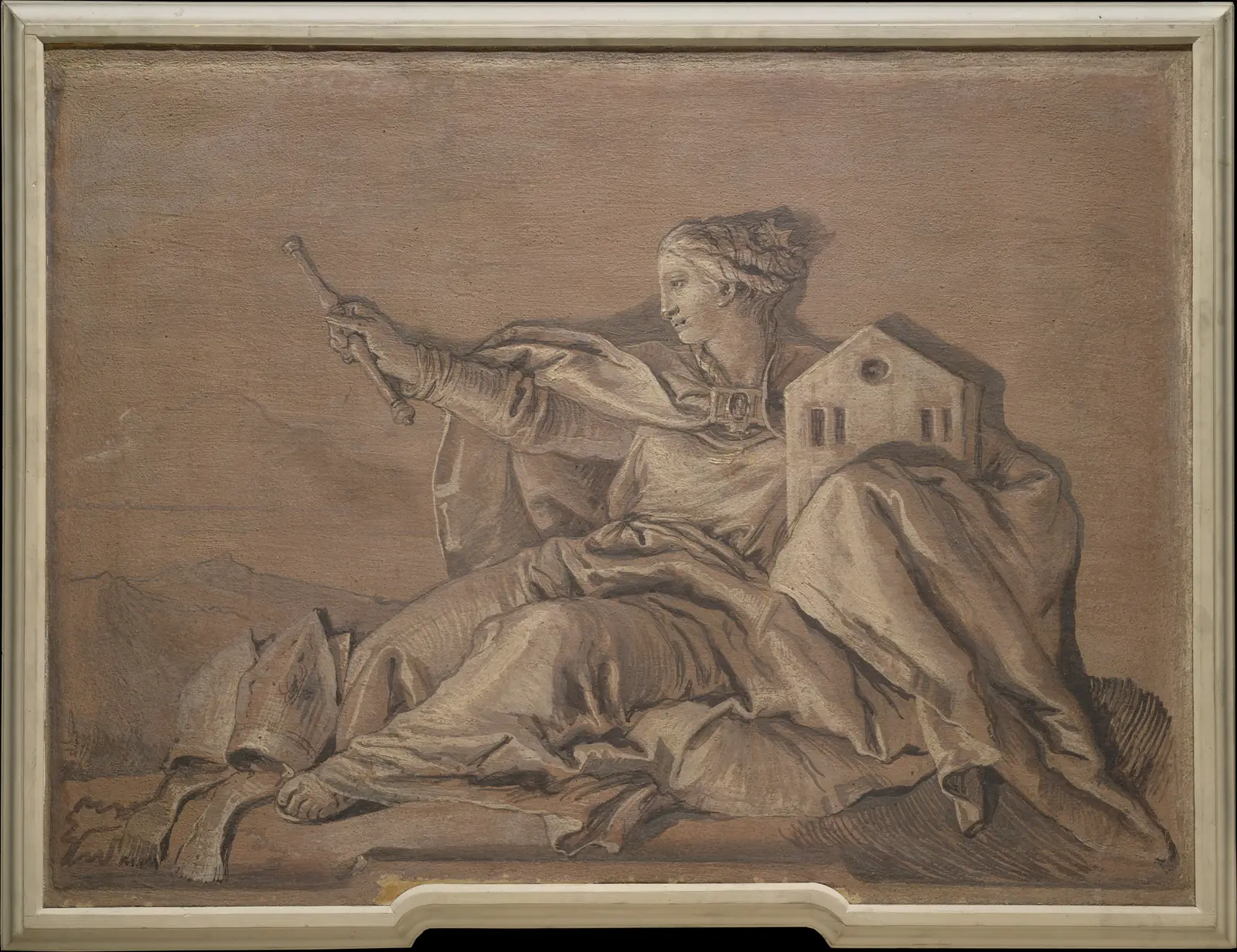
Tiepolo’s figure gives us an especially useful label: fresco transferred to canvas. The picture began as architectural decoration, but its present support is different. Look at the shaped lower edge. It does not have the ordinary rectangular outline we expect of a painting selected for a frame.
The colour is restrained, but that is not a definition of fresco. The important distinction is the relationship between paint and plaster. For the question of moving such a work, see our comparison of fresco and canvas.
The techniques do not form a progress ladder
It is tempting to read these examples as “simple tempera, improved oil, monumental fresco”. That ranking does not help explain them. Duccio’s small gesture, Van Gogh’s separate strokes and Tiepolo’s architectural shape solve different pictorial problems.
Nor does one technique guarantee durability or artistic quality. An attractive reproduction can conceal the original’s scale, surface and condition. On a screen, a twenty-centimetre panel and a section of wall may occupy exactly the same space.
Start with a more productive question: what does this particular painting ask you to notice? Then let its materials explain some of the choices, without treating them as the whole explanation.
How to read a museum label
Read the medium and support together: oil / on canvas, tempera / on wood. If you see “transferred”, the object has a material history beyond the artist’s initial work. If you see a list of materials, resist reducing it to just the first one.
Finally, keep the original separate from the reproduction. A printed image of a fresco is not itself a fresco, and a canvas reproduction of Duccio is not tempera on wood. Our guide to originals, reproductions and prints explains those names. The useful label tells you what the object actually is, not just which famous picture appears on it.
Editorial record
About this article
- Author
- Publisher
- GeMarkt
- Published
- Reviewed
- Internal source & rights check. Conducted by GeMarkt Research Review. This is an internal editorial check—not independent peer review.
- Source standard
- Art history source standardPrioritises object records and research sources, distinguishes evidence from interpretation, and states material uncertainty.
Found a claim that needs checking? Report a factual error.