GeMarkt Blog · Essay
Original vs Reproduction vs Print
A print can be an original artwork or a reproduction. Compare a Monet painting and a Hokusai woodblock to understand the object behind the image.

A print is not automatically a copy. Some artworks were created to exist as prints, including Hokusai’s Great Wave. Other prints reproduce an image that first existed as a painting, such as Monet’s Woman with a Parasol. Both can be beautiful things to live with, but they are different kinds of object.
The easiest way to separate the terms is to ask two questions: How was this particular object made, and what is its relationship to the artist’s work? The picture you recognise does not answer either question on its own.
Three words that answer different questions
An original artwork is the work itself, rather than a later representation of it. With a painting, that usually means the specific painted canvas or panel. With printmaking, it can mean an impression produced as part of the artwork’s original printing history. Original does not always mean unique.
A reproduction presents an existing artwork again: for example, a photograph of a painting printed on paper. Its subject may be Monet’s painting, but the physical object is a later print, not Monet’s painted canvas. Calling it a reproduction describes that relationship; it does not mean the object is fraudulent.
Print describes a broad way of making an image. The V&A’s introduction to printmaking explains why the printed impression, rather than the block or plate used to make it, can be the original work of art. A reproduction can also be printed. That overlap is why a listing that says only “art print” needs more explanation.
A painting and an original print side by side
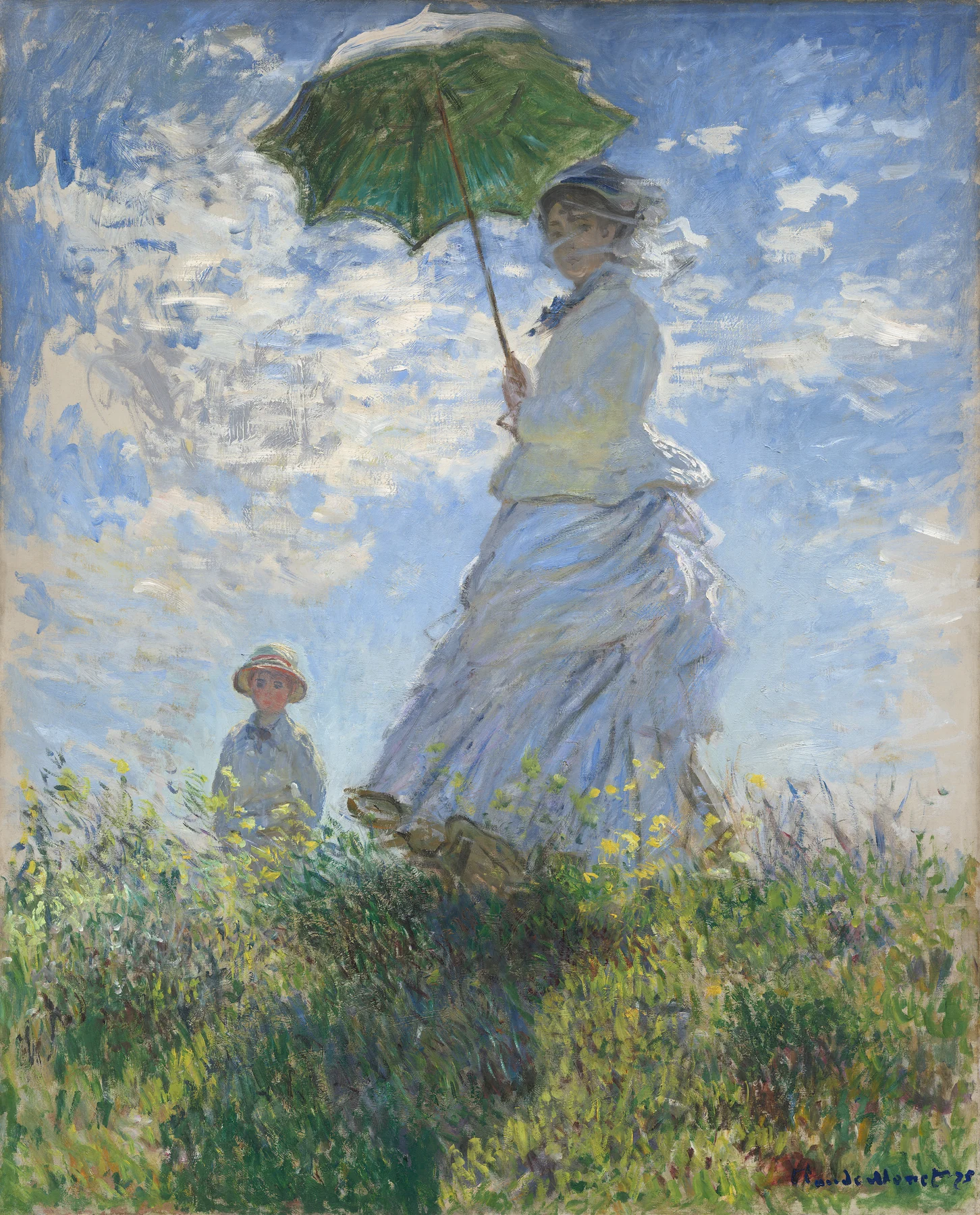
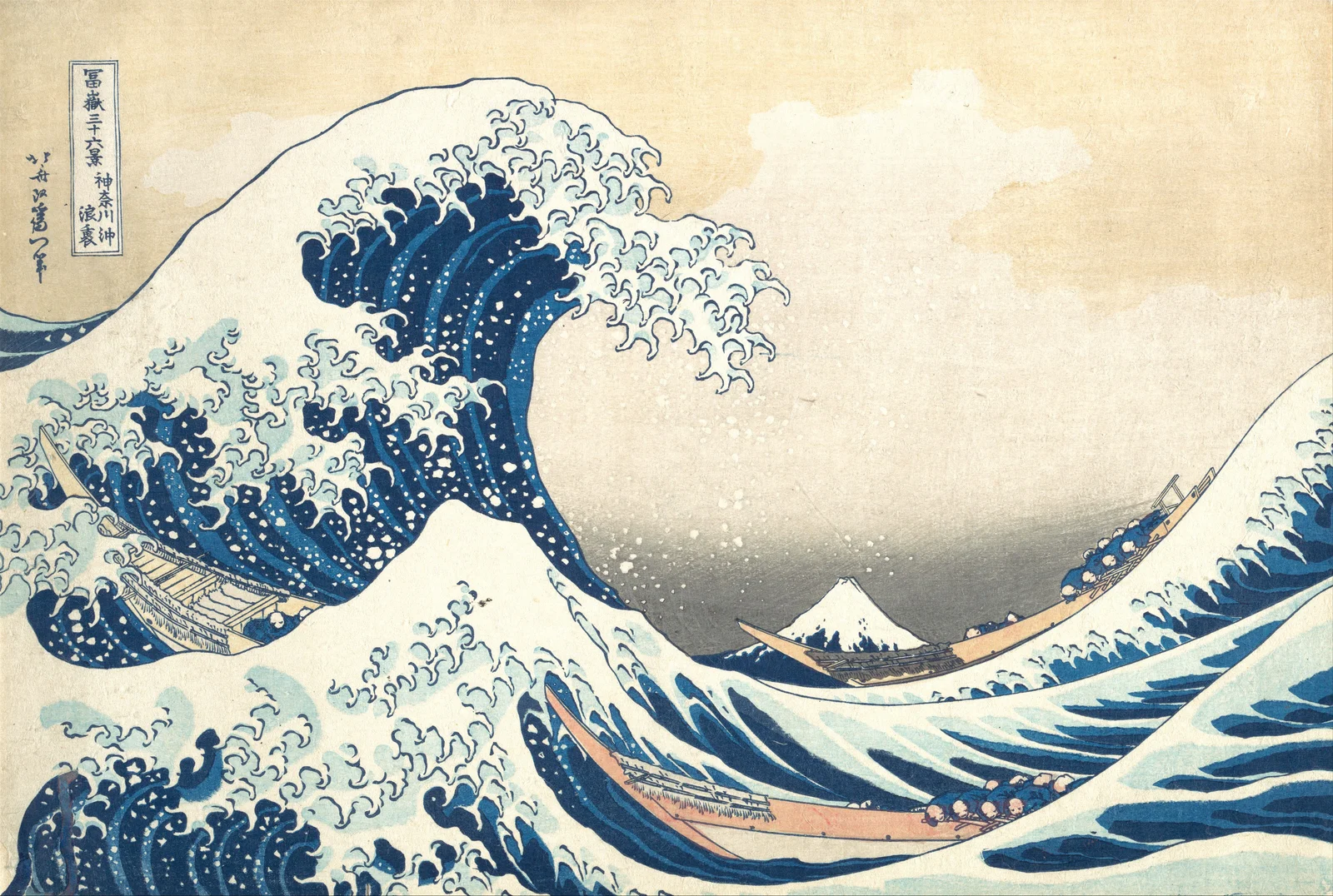
Monet’s work is a painted canvas measuring 100 × 81 cm, according to the National Gallery of Art. Look at the separate touches that make the clouds and the long strokes across the skirt. In the original, these marks are deposits of paint. In a photographic reproduction, they are an image of those deposits.
The Met’s Hokusai impression is a much smaller sheet, 25.7 × 37.9 cm, printed from woodblocks. Its clean contours and coloured areas belong to a design made for printing. It is not a reproduction of a lost Great Wave oil painting.
Both pictures on this page are digital reproductions. The comparison concerns the museum objects they show, not a claim that a screen can display an original sheet or canvas. This distinction becomes useful whenever the same famous image appears in a museum catalogue, on a poster and on a product page.
Why more than one original can exist
Printmaking allows an image to be transferred repeatedly. Each resulting sheet is called an impression. An edition is a group of impressions issued together; a block or plate is the surface used to produce them. MoMA’s printmaking guide introduces these terms alongside woodcut, etching, lithography and screenprinting.
Those names describe different processes, not quality grades. A woodcut transfers ink from raised areas of a block; an etching uses lines bitten into a metal plate. An artist may also work with a specialist printer. Making the artwork collaboratively does not turn it into a reproduction of something else.
Do not reverse that reasoning and assume every sheet with the same image has the same status. “A woodblock print by Hokusai,” “a later woodblock version after Hokusai” and “an inkjet reproduction of a Hokusai print” are different descriptions. For the famous wave, our artwork story explains the design and its printed form.
What a reproduction preserves and changes
A reproduction can make the arrangement, colours and small details of an artwork accessible at home. It cannot transport the original object’s complete physical presence. A flat printed image of thick oil paint does not recreate the same raised surface; enlarging a small print changes the scale at which its marks meet your eye.
Try this with the images above. Look first at Monet’s dress as a whole, then at the strokes that build it. A reproduction needs enough detail for both readings to work. With the Hokusai, follow the narrow outlines around the foam. If those turn into soft, broken edges at the intended print size, a recognisable thumbnail has not become a convincing larger print.
The right comparison is therefore not simply “original good, reproduction bad.” Ask whether the reproduction serves its purpose accurately. Does it show the whole image or a stated crop? Is the colour credible? Is the source clear? Do the paper and dimensions suit the way you intend to display it?
What edition numbers can tell you
An edition number is information about an issue, not a complete account of how the image was made. A numbered reproduction remains a reproduction. A seller should be able to explain what is limited: a particular size, printing process or entire release.
You may also encounter proofs, prints outside the regular numbered edition. MoMA distinguishes working and trial proofs from impressions reserved for the artist or printer. An artist’s proof need not show a different image from the edition. The abbreviation alone does not establish a different composition or an earlier stage.
For an expensive historical print, these distinctions lead to questions about the specific impression’s date, condition and history. A famous artist’s name on a listing cannot answer them.
Read the description before the label
Before choosing a print, look for plain answers to these questions:
- What am I receiving? An original painting, a historical print impression, a contemporary original print, or a reproduction?
- How was it made? The process should describe this object, not merely the medium of the artwork it depicts.
- What do the dimensions measure? Image, full sheet and framed size can differ.
- What supports the attribution? Who made, printed or published it, and what documentation is supplied?
If you want the composition of a beloved painting on your wall, an honestly described reproduction may be exactly right. If you want to collect an artist’s printmaking, the particular impression matters as well as the image. Knowing which question you are asking makes the label far less confusing.
Editorial record
About this article
- Author
- Publisher
- GeMarkt
- Published
- Reviewed
- Internal source & rights check. Conducted by GeMarkt Research Review. This is an internal editorial check—not independent peer review.
- Source standard
- Art history source standardPrioritises object records and research sources, distinguishes evidence from interpretation, and states material uncertainty.
Found a claim that needs checking? Report a factual error.