GeMarkt Blog · Essay
Fresco vs Canvas: Why the Sistine Ceiling Is Part of Its Building
Frescoes can be transferred by specialists, but they are not portable canvases. See what the Sistine ceiling and a detached Tiepolo fresco reveal.

A fresco can be detached and transferred by specialists. What it cannot do is come off the wall as casually as a framed canvas. Its painted surface belongs to a system of plaster and architecture. Moving it is a conservation intervention, not ordinary picture hanging.
That is why the Sistine ceiling is better understood as part of a building than as an enormous portable painting. The difference is not simply weight. It involves what carries the colour, how the artist planned the image, and where a viewer is meant to stand.
Canvas is a support; fresco is a technique
The terms are not exact opposites. Canvas is woven cloth, often stretched over a wooden framework and prepared to receive paint. It can support different painting materials. “Oil on canvas” identifies both paint and support. The National Gallery’s canvas glossary describes the cloth and its preparation.
Fresco describes painting associated with fresh lime plaster. In buon fresco, colour is applied while that surface is wet and becomes attached as the plaster sets. Dry-plaster painting, or a secco, works differently. “A painting on a wall” is therefore not enough information to identify the method. See the National Gallery’s fresco definition.
| Question | A typical oil painting on stretched canvas | A fresco made for a building |
|---|---|---|
| What carries the image? | Prepared woven cloth | Plaster associated with the architecture |
| Was it necessarily made where it is displayed? | No | Usually, in its original setting |
| Can it move? | Often, with appropriate handling | Sometimes, through specialist intervention |
| Does moving it change its setting? | Yes | Yes, and potentially its physical support as well |
Neither column is a handling instruction. Large canvases also demand trained care; “portable” does not mean safe to roll up or move yourself.
What Michelangelo painted
Michelangelo signed the Sistine ceiling contract in 1508. What began as a more limited plan developed into nine central Genesis scenes, surrounded by an elaborate painted structure and additional figures including prophets and sibyls. The ceiling was completed by the end of October 1512, according to the Vatican Museums’ account.
A photograph of The Creation of Adam can make it appear to be a self-contained rectangular picture. In the chapel it belongs to a sequence, above the viewer and surrounded by other painted forms. An isolated reproduction is useful for seeing hands or faces, but it removes that relationship to the room.
Imagine studying one page torn from a book, except that here the position, height and shape of the building are also part of the arrangement. Knowing where a scene sits changes how you connect it to its neighbours. The original is not merely an image that happens to occupy a convenient ceiling.
A drawing before the plaster
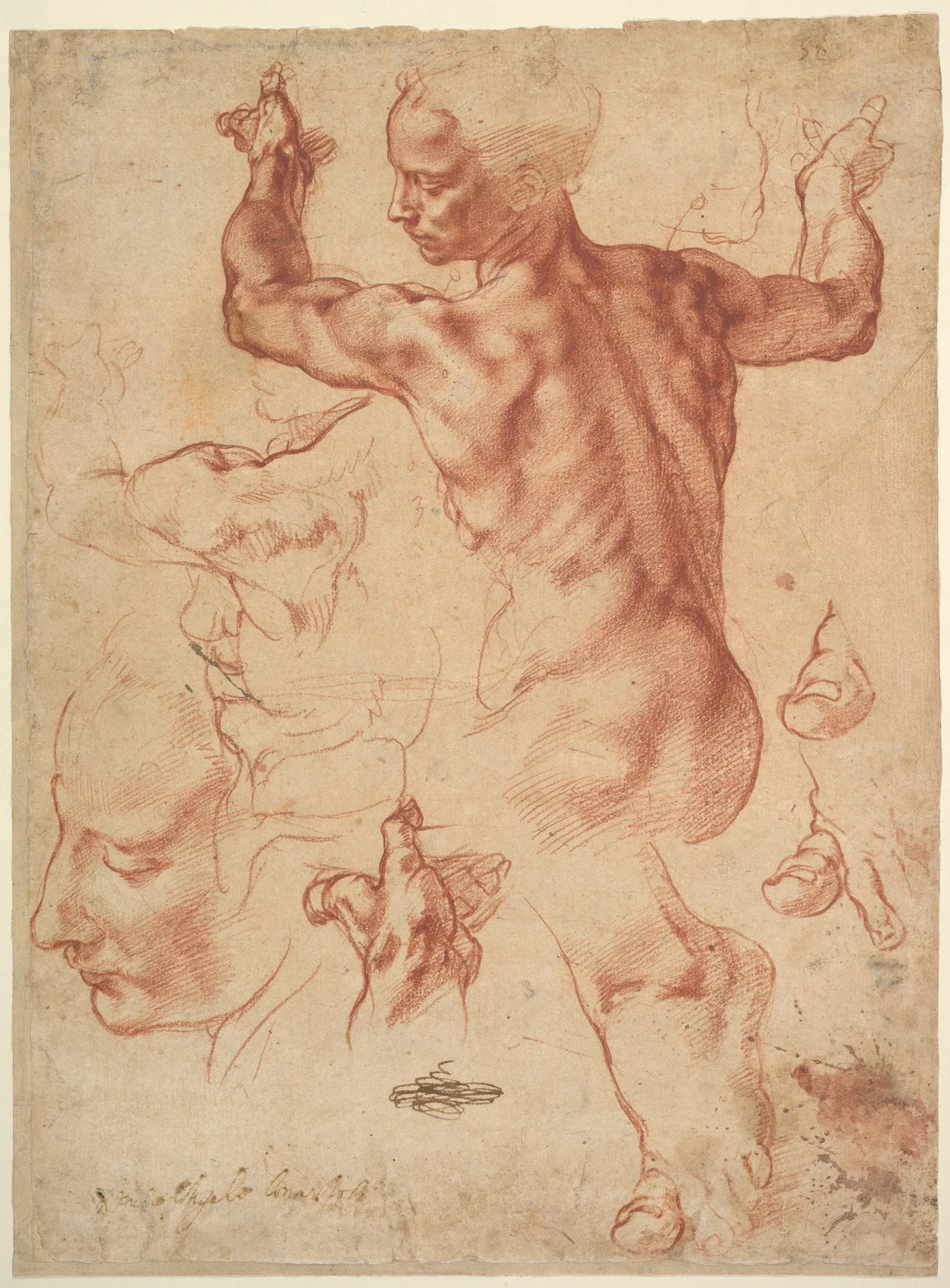
This sheet makes the planning tangible. A large turning torso occupies the centre, while separate studies try out details around it. The figure does not yet wear the painted Sibyl’s costume. The Met’s research identifies the principal study as drawn from a male model for the female figure on the ceiling.
The museum also explains that the finished Libyan Sibyl, her throne and attendants occupied about twenty giornate: separate working sections of plaster. A giornata literally refers to a day, but the useful idea here is a workable patch, not an entire ceiling painted continuously before everything dries.
Compare the sheet’s different stages of attention. The back is densely modelled; some fingers and outlines are barely indicated. Planning allowed the artist to work through problems before committing the design to another surface. For a fuller distinction between preparatory work and completed pictures, see sketch, study and finished painting.
Yes, a fresco can be moved
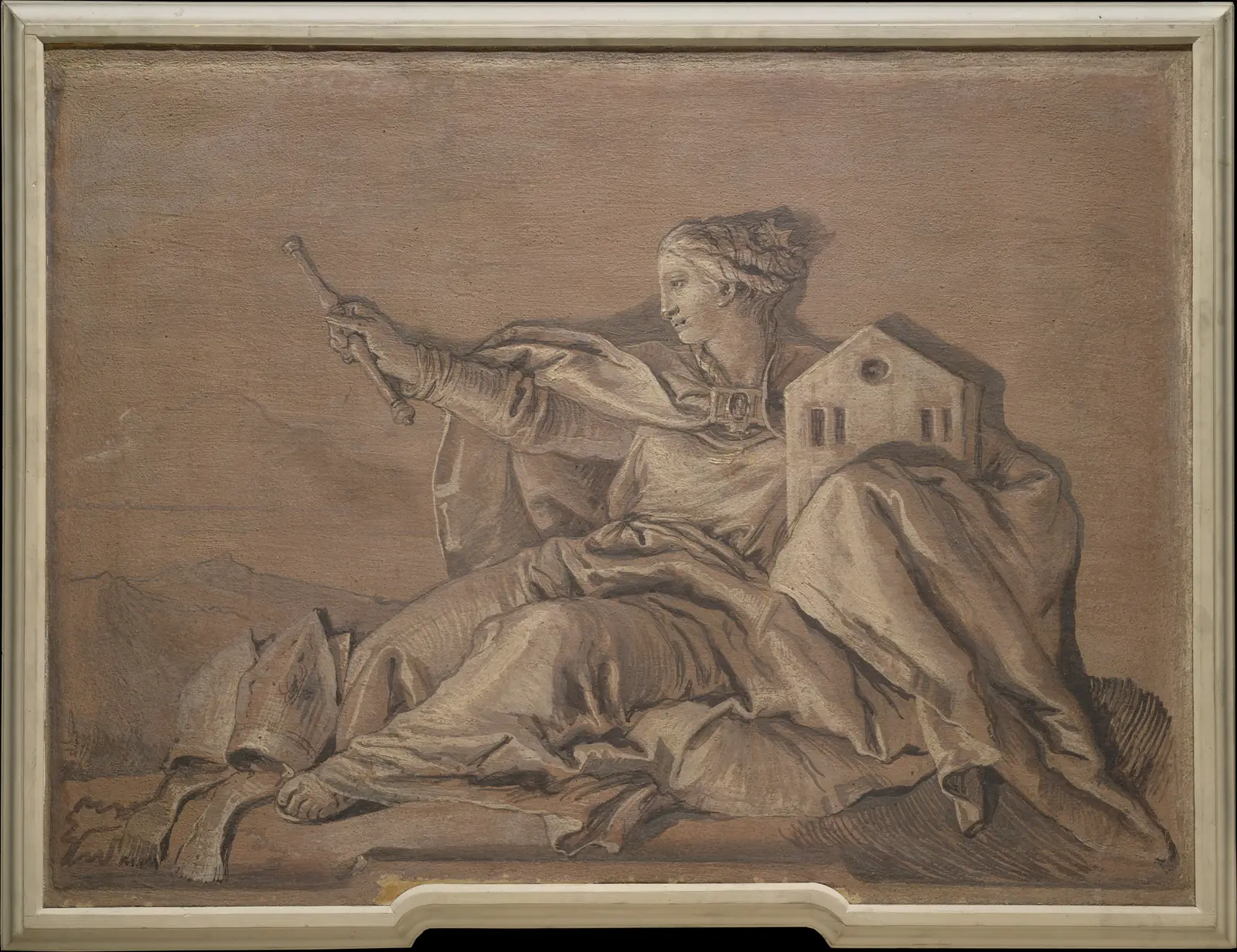
This is a real example, not a hypothetical solution for the Sistine Chapel. Tiepolo’s Europe originally formed an overdoor decoration in a palace in Vicenza. The Met identifies it as fresco transferred to canvas and cautiously dates its detachment to around 1900. Its shaped outline remains a clue to a former architectural setting.
Different transfer methods remove different layers. In explaining the historical transfer of Catalan murals, the Museu Nacional d’Art de Catalunya describes strappo as taking the paint layer while leaving the plaster behind. It records transfers carried out between 1919 and 1923. That history establishes that transfer is possible; it does not make it an everyday or universally appropriate treatment.
What a transfer does not preserve
Look again at Tiepolo’s picture, then imagine it above a doorway. You would approach it from below, at a particular distance, with a door and room around it. A museum wall gives it a different neighbour, background and viewing height.
The painting can survive that change while its experience changes. This is an interpretive distinction, not a verdict that all historical transfers were right or wrong. A treatment decision belongs to the particular object’s condition, location and conservation history.
The same distinction applies to the Sistine ceiling at a much larger scale. Moving an individual section, even if technically conceivable, would not move the chapel’s whole arrangement. “Could some painted material be detached?” and “Would we still be encountering the same architectural work?” are different questions.
Not every painted wall is a fresco
Leonardo’s Last Supper is the useful counterexample. It is a wall painting, but Leonardo worked on a dry surface rather than following the normal wet-plaster fresco method. The Cenacolo Vinciano museum connects that choice to his desire to revise and develop the image over time.
So “mural”, “fresco” and “canvas painting” should not be interchangeable search labels. One names a wall-based work, another a technique, and another a support. Ask how the specific work was made before drawing conclusions about its behaviour or care.
What this means for a reproduction
A print of a ceiling scene offers something valuable: a view you can study closely at home. It does not reproduce the original plaster, working patches or relationship to the chapel. A canvas print of that scene remains a print on canvas, not a movable fresco.
The honest description does not make the reproduction less worthwhile. It tells you which experience you are choosing: a readable image of a detail, rather than a claim to own the material surface or setting of the original.
Editorial record
About this article
- Author
- Publisher
- GeMarkt
- Published
- Reviewed
- Internal source & rights check. Conducted by GeMarkt Research Review. This is an internal editorial check—not independent peer review.
- Source standard
- Art history source standardPrioritises object records and research sources, distinguishes evidence from interpretation, and states material uncertainty.
Found a claim that needs checking? Report a factual error.