GeMarkt Blog · Practical guide
Nursery and Kids’ Room Art from the Public Domain
Choose animal studies, bird prints and decorative patterns for a child's room, with practical advice on placement, growing interests and finding the right image file.

Start with one picture someone in the household actually enjoys, not a complete nursery theme. An animal study, a bird print or a pattern can belong in a child’s room without being made specifically for children. Older art offers plenty of choices beyond pastel alphabets and coordinated sets.
For a nursery, adults make the first selection. As a child grows, let their interests change the display. A fascination with one bird or a dislike of a particular face is more useful information than a colour scheme chosen before they arrived. These examples are possibilities for looking and decorating, not claims about sleep, intelligence or development.
Choose the place before the picture
Health Canada advises hanging artwork and other wall decoration away from the crib, because it may fall into the sleep space or be pulled down as a baby learns to stand and climb. Do not use the wall above the cot as the starting point for the arrangement. A light frame or alternative glazing does not settle the placement question.
Look elsewhere in the room, taking account of furniture that a child could climb and how their reach will change. Follow the requirements for the actual frame, fixings and wall; ask a competent installer when you cannot assess them. A leaning frame on furniture is not an automatic solution. Leave art uninstalled if there is no suitable place.
Once a location has been assessed, consider how it will be seen. A picture opposite an adult chair has a different audience from one near an older child’s desk. Neither needs to fill every available surface. Make room for books, everyday belongings and the child’s own drawings rather than treating all of them as interruptions to the scheme.
A hare for looking closely
Albrecht Dürer’s Young Hare, 1502, offers a recognisable animal without a crowded setting. The Albertina identifies the original as a work in watercolour and bodycolour, inventory 3073. It is not a photograph of a pet or a page from a modern children’s book.
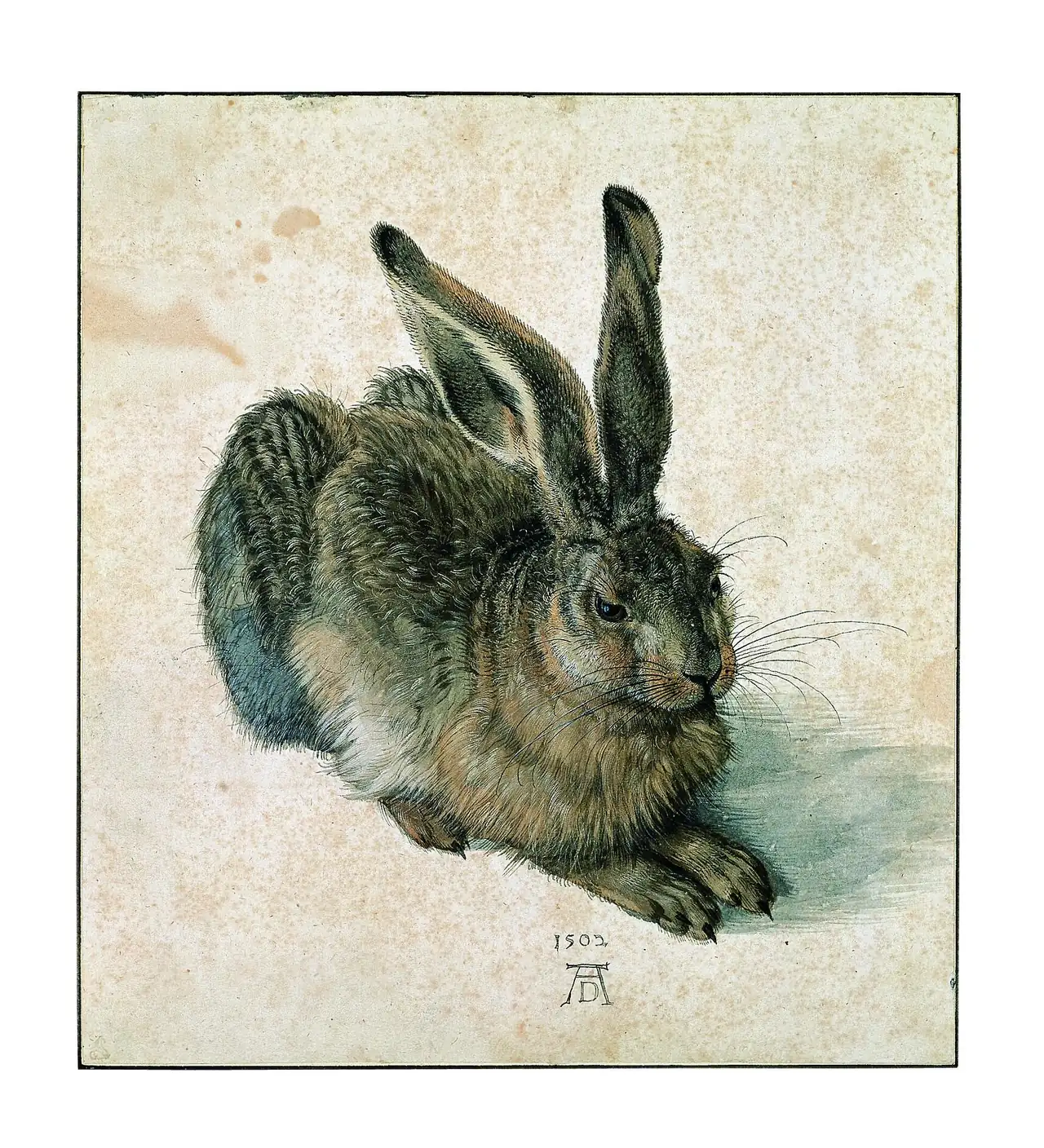

The pale surrounding space lets the ears, whiskers and different patches of fur stand out. In a room already containing patterned curtains or colourful toys, that separation may be useful. Try a small reproduction on the screen alongside a photograph of the room: can you still recognise the hare immediately, or does it need more space?
For an older child, the picture can invite an uncomplicated question: which marks look soft, and which look sharp? There is no need to turn every encounter into a lesson. Their answer might be about the paws rather than the artist.
Keep the complete animal and the space around it when comparing print options. A close crop can make the hare look larger, but changes the relationship between the body and its pale surroundings. Choose that deliberately, not because an automatic preview has trimmed the ears.
A flamingo that keeps its whole page
The National Gallery of Art’s American Flamingo is an 1838 hand-coloured print by Robert Havell Jr. after John James Audubon. The large bird dominates the sheet, but there are also smaller birds, lettering and anatomical details. It was not designed as a pink nursery poster.
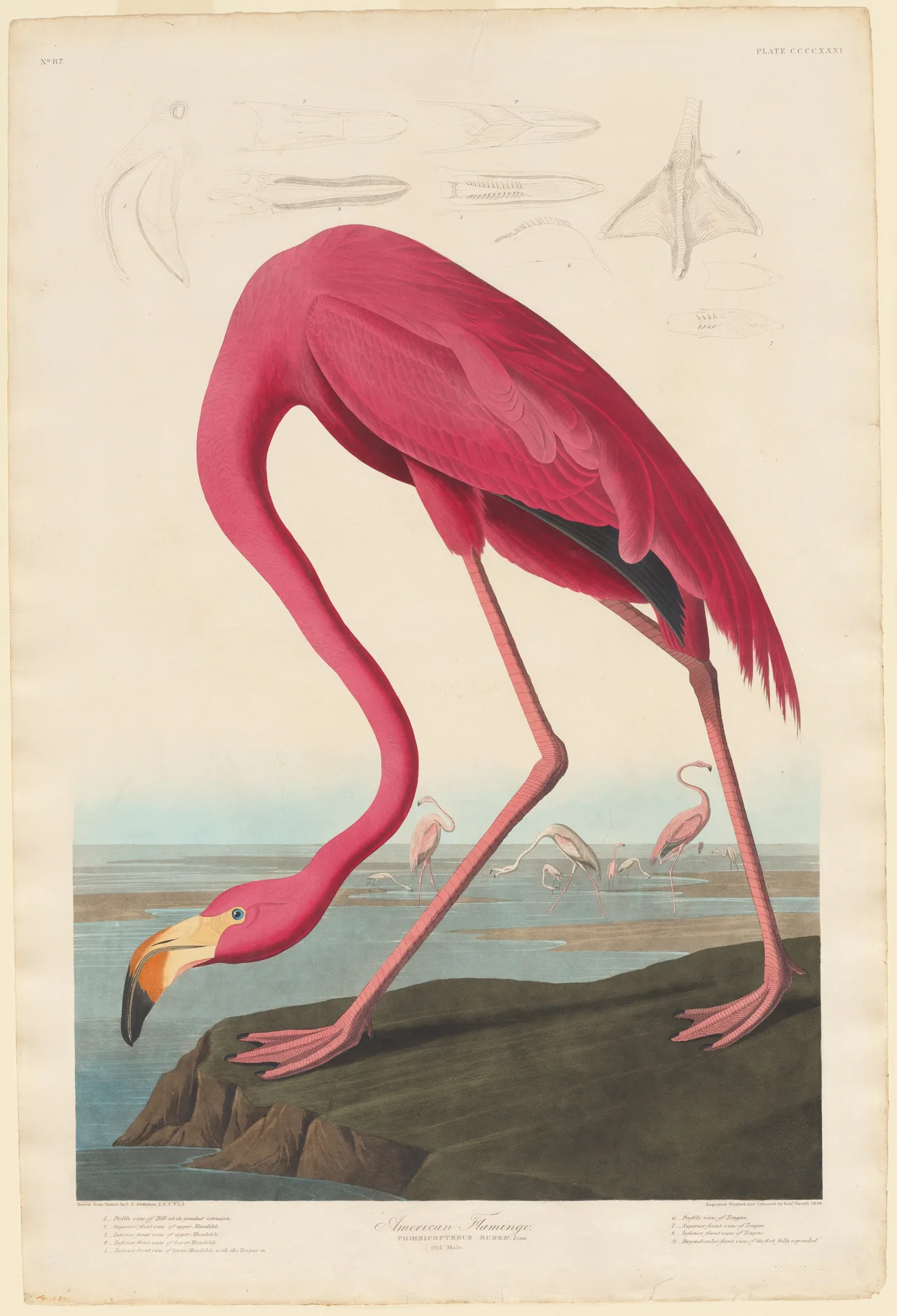
This is a stronger, more concentrated colour statement than the hare. You might let that pink be the room’s only large pink area, rather than matching every cushion and container to it. The bird does not need a gendered theme around it.
Check what a reproduction includes. A listing may show the whole sheet, only the main image or an isolated bird on a newly coloured background. Those are different visual choices. Here the page remains visible, including the smaller studies above. At a modest size, the bird’s pose will read before the fine lettering; do not assume every small inscription will remain legible.
For a child interested in birds, a modern field guide can sit alongside this historical image. The print need not serve as the household’s current scientific reference. Its form, scale and history offer a different reason to keep looking.
Birds and berries without a single main character
William Morris’s Strawberry Thief offers another approach: a repeated pattern rather than one animal portrait. The Art Institute of Chicago’s record dates the design to 1883 and this textile to 1883–1917. Morris designed it; Morris & Co. produced the furnishing fabric.
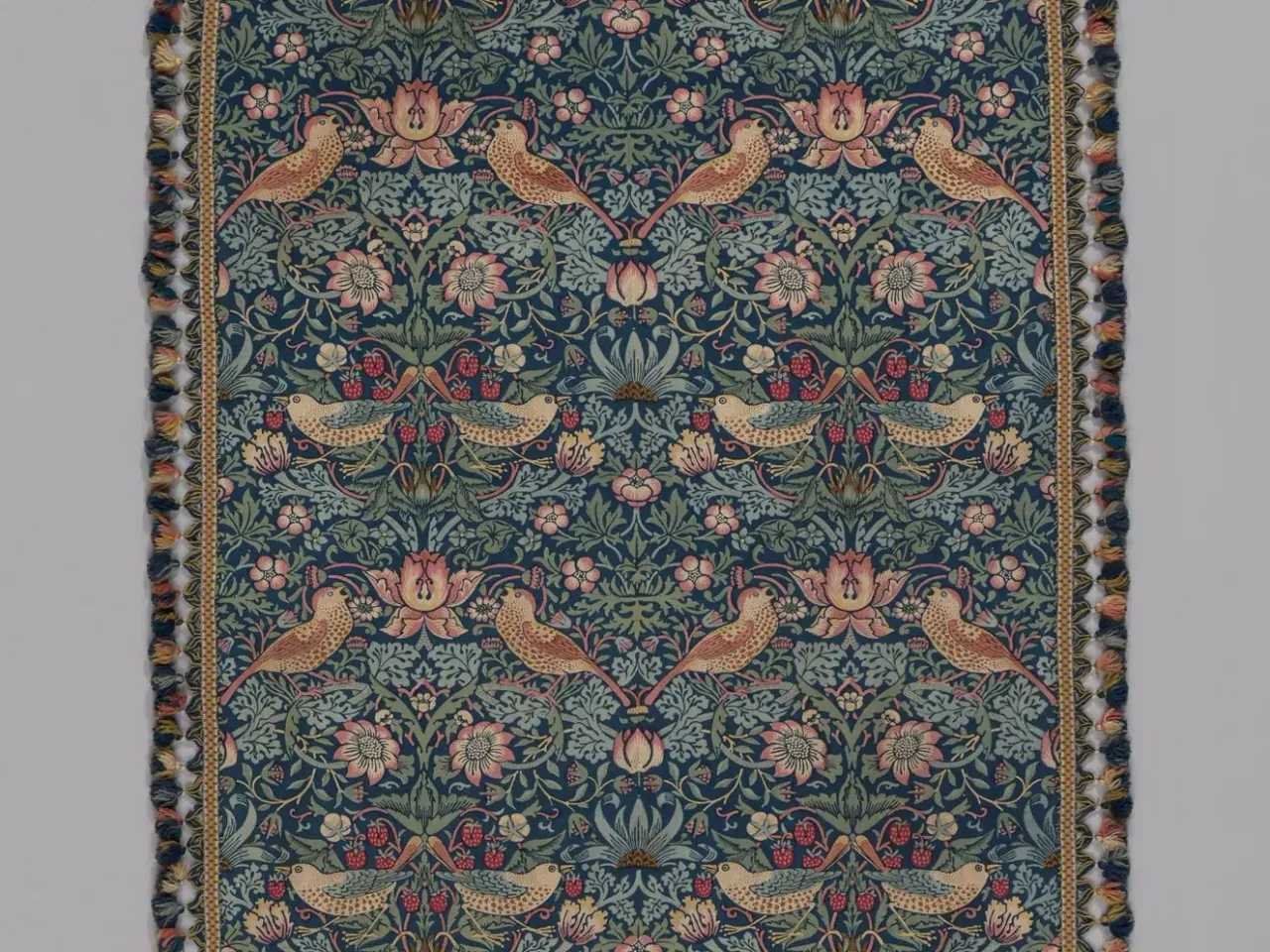
The birds face different ways, berries repeat and stems connect one patch to another. You could use a framed detail as a compact area of pattern while leaving the rest of the wall relatively plain. It is not necessary to add matching wallpaper and bedding to make the choice look intentional.
A detail of a textile should be described as a detail, as it is here. It is not a complete historical painting. If a child enjoys finding repeated shapes, look for them together; if they prefer a single clear animal, the hare or flamingo may be the better choice. Complexity is a preference, not a measure of sophistication.
Give an older child a real choice
Offer a small shortlist, then listen to the reason behind the choice. “I like the long legs” or “that bird looks cross” tells you something that a favourite-colour question might miss. A child may enjoy a strange detail that an adult had overlooked.
Look at the whole image together before buying. Animal subjects can include hunting, dead prey or threatening encounters. A familiar title is not an age rating. Ask whether any part bothers them, and allow a change of mind without treating it as a failure to appreciate art.
A shared room needs agreement too. One child might choose the main picture while another chooses a smaller companion, or each could have a distinct area. They do not have to share an artist or subject. Similar outer frames can relate the pieces without making the children agree on the pictures inside them.
Leave space for their own work. A museum reproduction should not automatically receive the best position while a drawing made at home is relegated to a temporary corner. Both can matter in a room that belongs to a child.
Plan the group at its finished size
Measure the outer frames, not just the advertised print sizes. As a layout example, three frames each 30 centimetres wide, with two gaps of 8 centimetres, need 106 centimetres overall: 30 + 8 + 30 + 8 + 30. Centred in a 140-centimetre-wide area, that leaves 17 centimetres on each side. These are sample layout dimensions, not a safe-clearance rule or product specification.
Try paper outlines before ordering. Include any mount and frame width in the outline, and check the arrangement from the positions people actually use. Our paper-planning guide explains that process without requiring all the pictures to be the same shape.
A coordinated set is optional. One good-sized image may be clearer than three small pictures that disappear among shelves and storage. Equally, a small hare need not be enlarged to dominate a wall. Start with the viewing distance and the amount of detail you want to see, then choose the arrangement.
Keep the picture and its source together
Public-domain art does not mean that every file found online has unrestricted reuse terms. The historical artwork and the particular photograph or scan are separate checks. For example, the hare image shown here carries a credit and a CC BY-SA licence; the NGA flamingo file is released through that museum’s Open Access programme.
Save the artist, title, source link and any file licence with a downloaded image. Before printing, check the actual file dimensions and what the printer will crop. A small web preview is not necessarily a printable master. Our digital-printing guide covers the practical choices.
You do not need to finish the room all at once. Keep the first selection small enough to revise. As interests change, a familiar picture can move elsewhere and another can take its place, with the location and installation reassessed each time. The aim is a room its occupants enjoy, not a display they have to grow into.
Editorial record
About this article
- Author
- Publisher
- GeMarkt
- Published
- Reviewed
- Internal source & rights check. Conducted by GeMarkt Research Review. This is an internal editorial check—not independent peer review.
- Source standard
- Buying guide source standardSeparates measured or first-hand evidence from general guidance and keeps practical limits visible.
Found a claim that needs checking? Report a factual error.