GeMarkt Blog · Essay
Myth and Literature in Art: Venus, Ophelia and the Lady of Shalott
Explore eight paintings of myth and literature, from Venus and Pygmalion to Ophelia and the Lady of Shalott, looking at the moments each artist chooses to show.


A painting can put an entire story into a hand holding someone back, a body changing colour or a boat about to leave the bank. Knowing the story helps, but the artist still decides which instant to show and what to leave outside the frame.
These eight paintings draw on classical mythology and later literature. The distinction matters: Venus, Danaë and Oedipus belong to ancient traditions; Ophelia is a character in Shakespeare’s Hamlet; the Lady of Shalott comes to these paintings through Tennyson’s poetry and its Arthurian setting. They share a history of being reimagined, not one origin or a single meaning.
Look first for the action. Is someone arriving, leaving, changing or unable to move? Then compare that visible event with the larger narrative. A beautiful surface can contain danger, unequal power or an approaching death. Recognising those tensions makes the pictures more interesting than treating every mythological figure as a decorative symbol.
Venus in a dressing room and on the sea
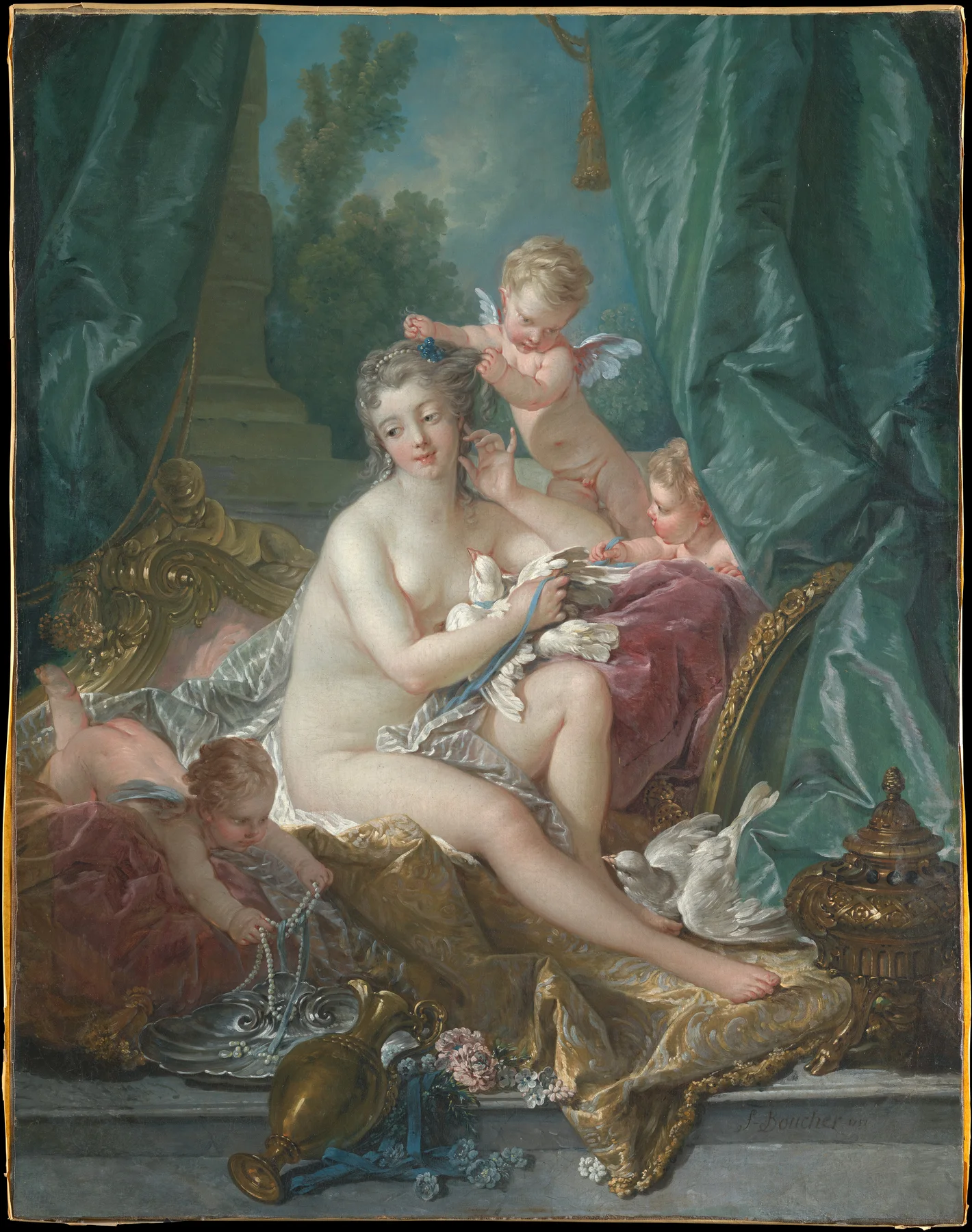
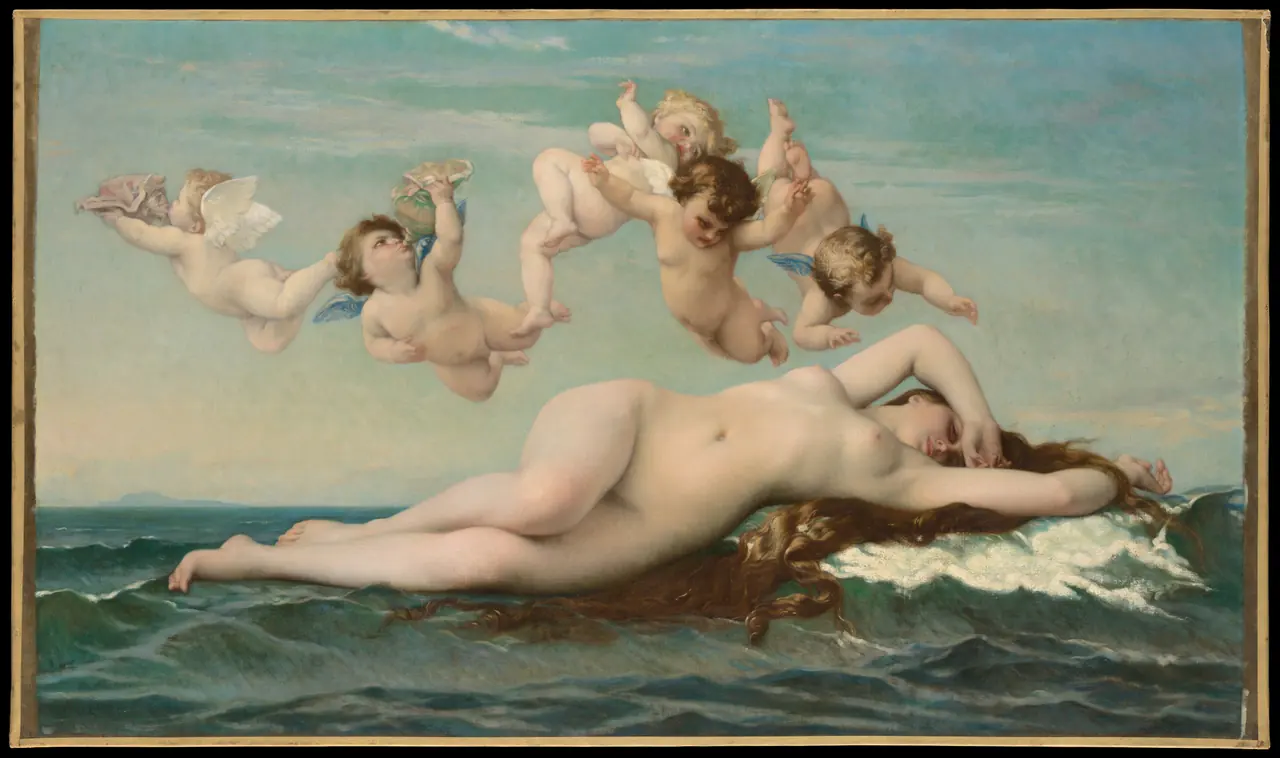
Venus, the goddess of love, does not look the same whenever she appears. Boucher surrounds her with the equipment of luxurious preparation: fabrics, a mirror, pearls and attendant putti, the small childlike figures familiar in European art. The doves sit close to her body rather than becoming distant birds in a landscape.
The Met records the painting’s original setting: Madame de Pompadour commissioned it for the Château de Bellevue, where it was incorporated into wood-panelled walls. That context connects the goddess to an eighteenth-century interior. Boucher is not reconstructing an archaeological room from antiquity; his mythology works through the pleasures and materials of his own time.
Cabanel makes a very different space. His Venus extends almost the width of the canvas, resting on water as though it could support her weight. The small flying figures continue a lighter rhythm above her. Smooth transitions across the body contrast with the broken white edges of the waves.
This is the Met’s 1875 painting, commissioned by John Wolfe as a replica of Cabanel’s successful 1863 composition. It is not a photograph of the earlier Musée d’Orsay canvas. The distinction gives us two dates to keep apart: the first composition’s public success and this particular object’s making. Even familiar mythological images can exist in more than one artist-made version.
Titian: a departure with a tragic future
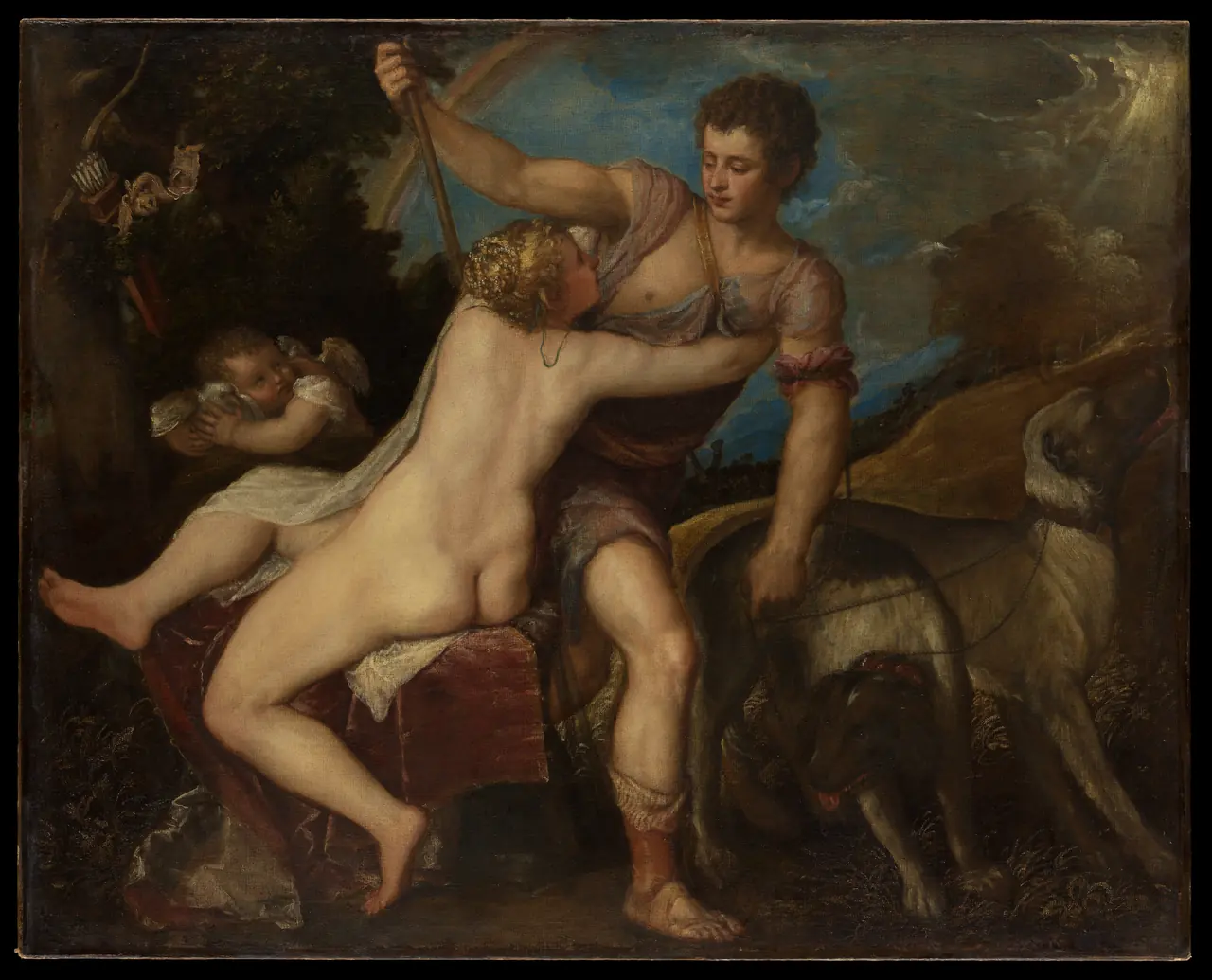
In Titian’s painting, Venus is neither preparing herself nor being born. She tries to prevent a departure. Her arms reach across Adonis’s body while his raised arm, spear and dogs make movement towards the hunt seem imminent.
The Met relates the scene to Ovid’s Metamorphoses: Venus fears that Adonis will be killed, as the story ultimately confirms. Titian chooses the moment before that outcome. The picture contains no attacking boar, so a viewer unfamiliar with the tale could mistake it for a playful struggle.
Look at the conflicting directions. Venus turns upwards and across, Adonis looks back while moving away, and the dogs pull our attention towards the right. The impending separation is built into those lines. This is the Met’s canvas, dated to the 1550s; Titian and his workshop made other versions. Its particular arrangement should not be silently substituted for the different painting made for Philip II.
Gérôme: the statue between stone and life
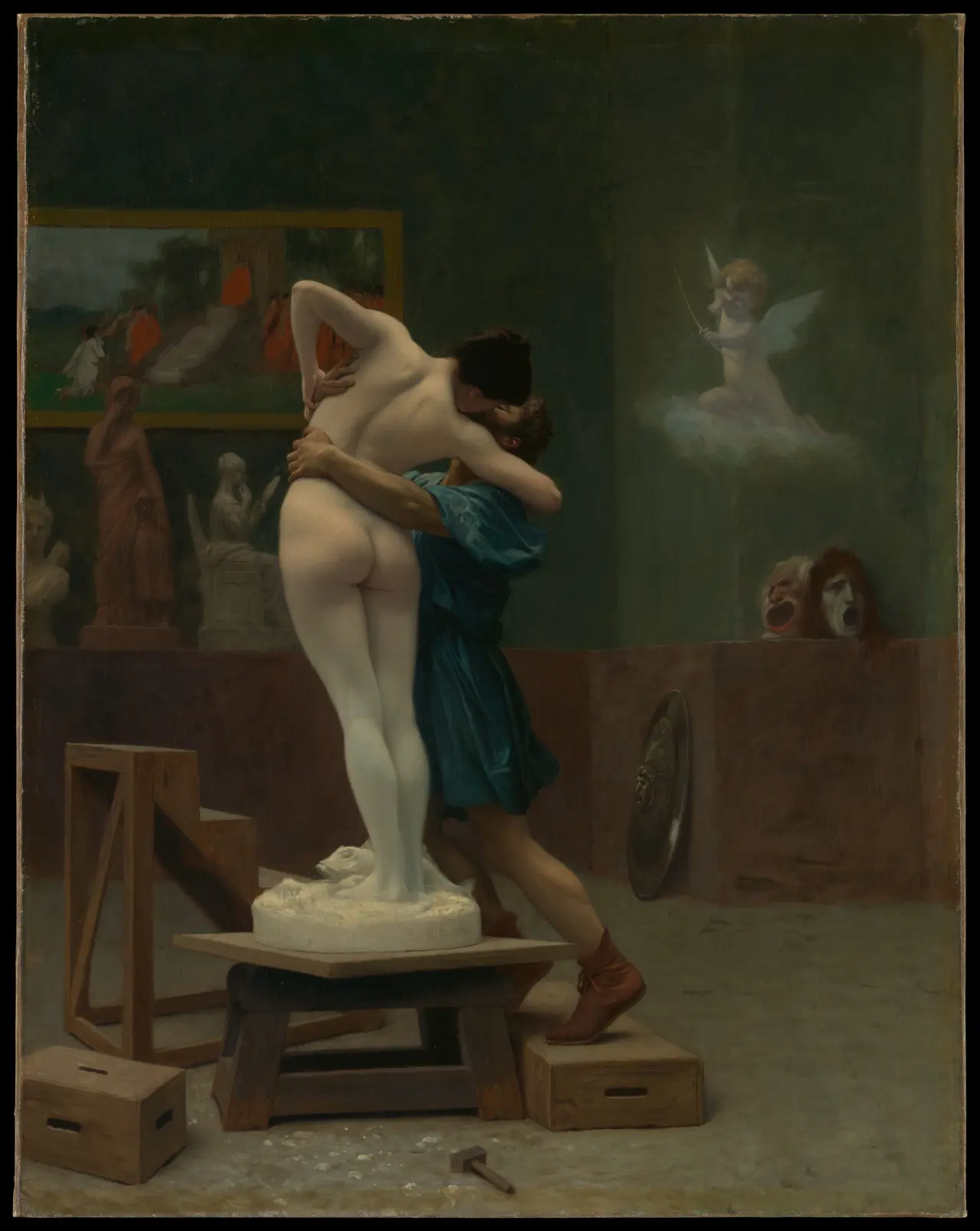
Gérôme makes transformation visible as a difference within one body. Galatea’s upper half bends towards the sculptor; her lower legs remain pale and seemingly fixed to the carved base. Pygmalion has stepped onto a box to meet her, and the studio’s other objects stay stubbornly inanimate around them.
The Met identifies this as one of three known painted versions associated with Gérôme’s treatment of the story. In the tale, Venus brings the sculptor’s ideal figure to life. The different paintings show the encounter from different angles, much as a sculpture can be examined from more than one side.
Here we see Galatea largely from behind. That choice lets the turn of her back explain the change without a written label. It also leaves a question worth keeping open: is our attention on the sculptor’s fulfilled wish, the newly living figure or the astonishing conversion of material into flesh? A painting can make all three available without resolving them into one moral.
Moreau: a riddle made physical
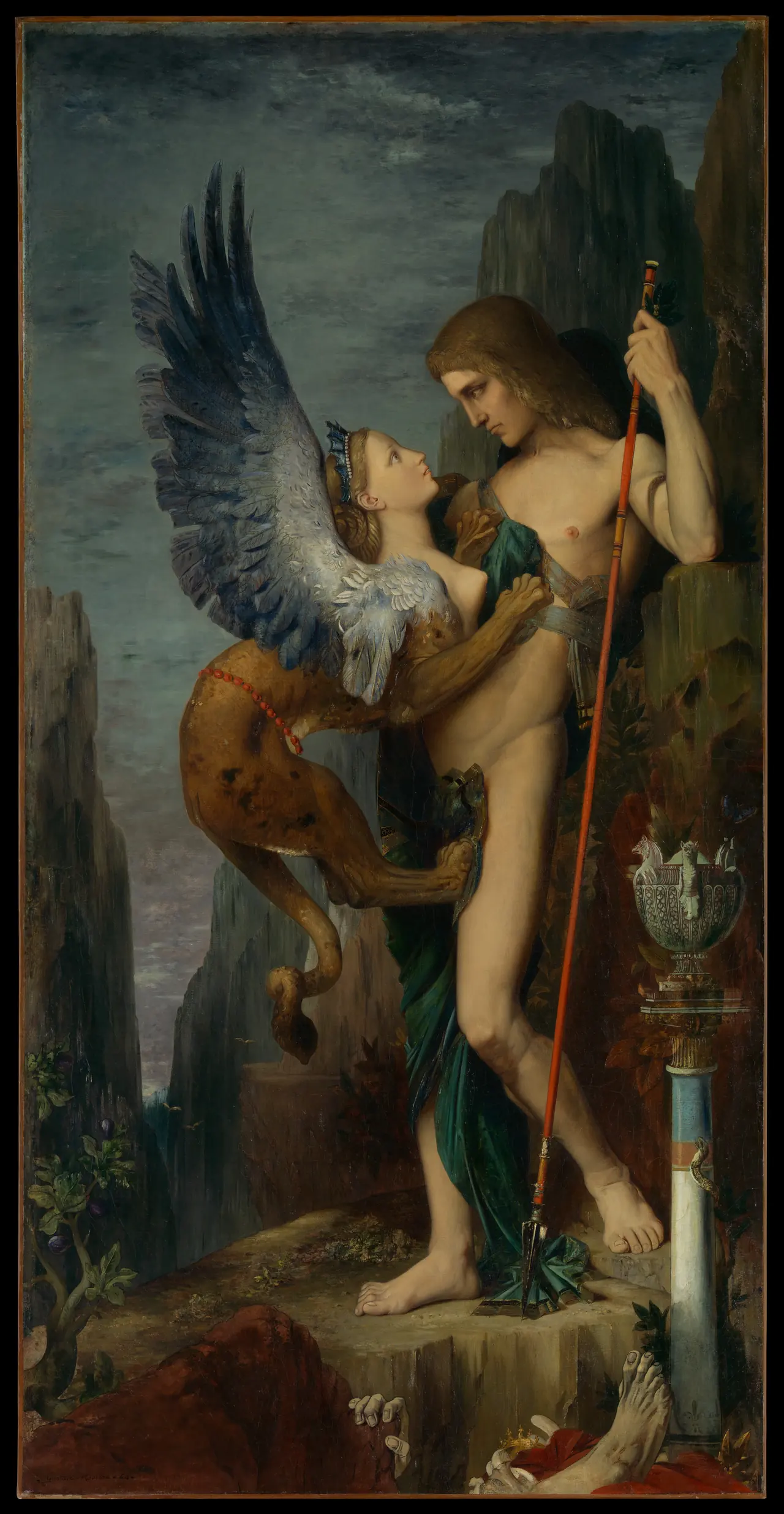
The encounter looks almost like an embrace until the claws and discarded remains become clear. Moreau presses the Sphinx against Oedipus, reducing the distance between questioner and threatened traveller. Their steady eye contact becomes the centre of an unusually tall, narrow composition.
The museum’s account explains the contest: the Sphinx kills those who cannot answer her riddle about the stages of human life. Oedipus must use understanding rather than the physical weapon he holds. Moreau exhibited the painting at the Paris Salon of 1864.
Notice how much remains outside the exchange of looks. Jewelled details, rocks, the column and a victim’s foot make the setting dense with things to examine. Yet the story depends on an answer we cannot see or hear. Painting turns a verbal test into bodily proximity and sustained attention. Reading the figures simply as lovers would miss the threat that gives the pose its force.
Klimt: a myth without a visible male god
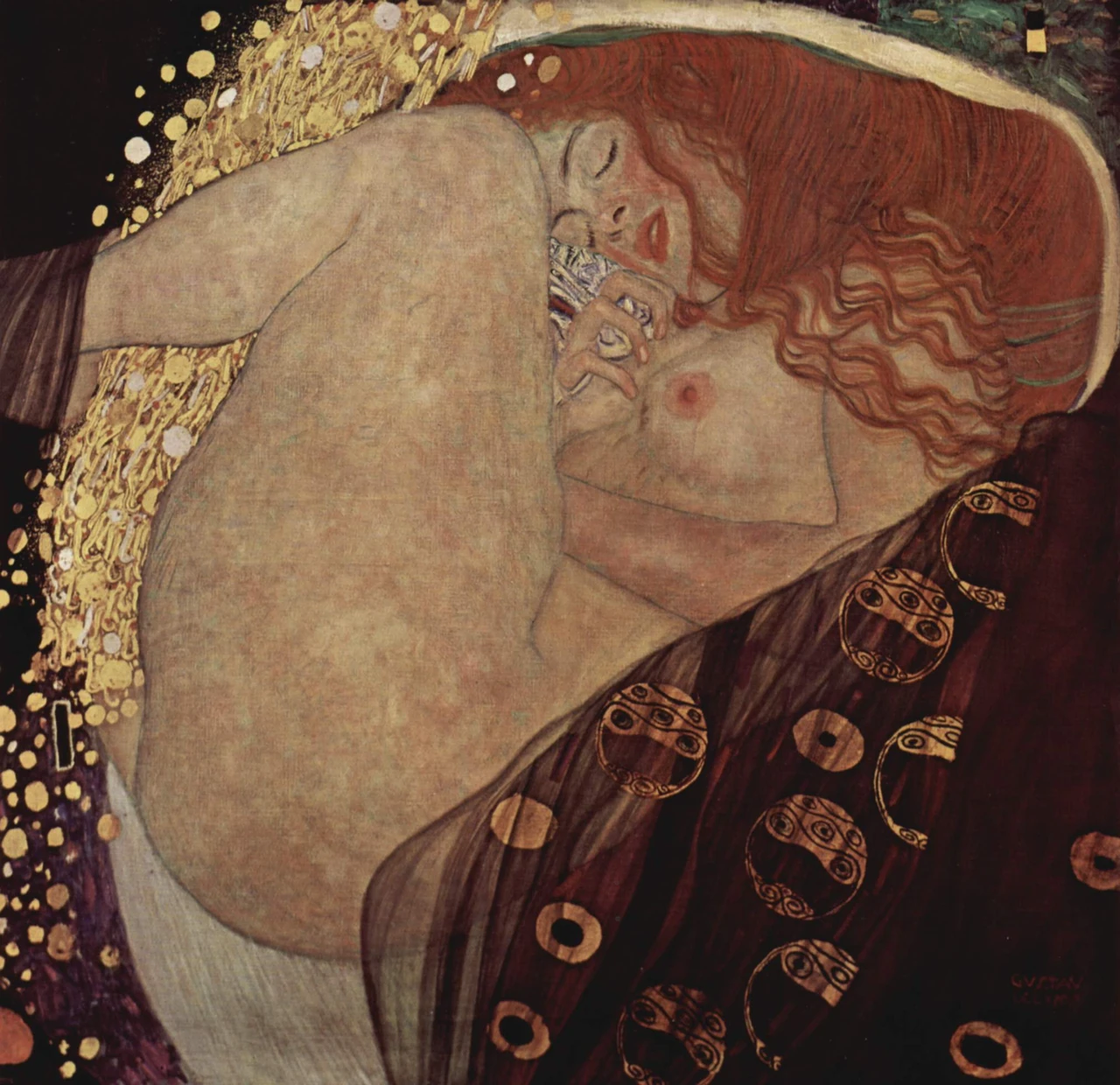

Klimt replaces a standing male figure with a stream of gold. Danaë’s large bent knee, head and red hair create a folded shape, while the dark patterned fabric nearly closes the surrounding space. There is no broad landscape to explain where the event occurs.
The Klimt Foundation dates the painting to 1907–08 and connects it to Zeus approaching Danaë as a shower of gold. The subject involves divine power and sexual violation; the painting’s sensuous treatment should not turn that narrative automatically into a consensual romance.
The change from story to image is especially concentrated here. Gold becomes an active participant rather than merely a background decoration. We need not assign a fixed biological meaning to every pattern on the cloth to see that transformation. Our Klimt guide provides a wider route into the artist without making this privately owned painting a museum visitor destination.
Ophelia and Shalott: two literary waters
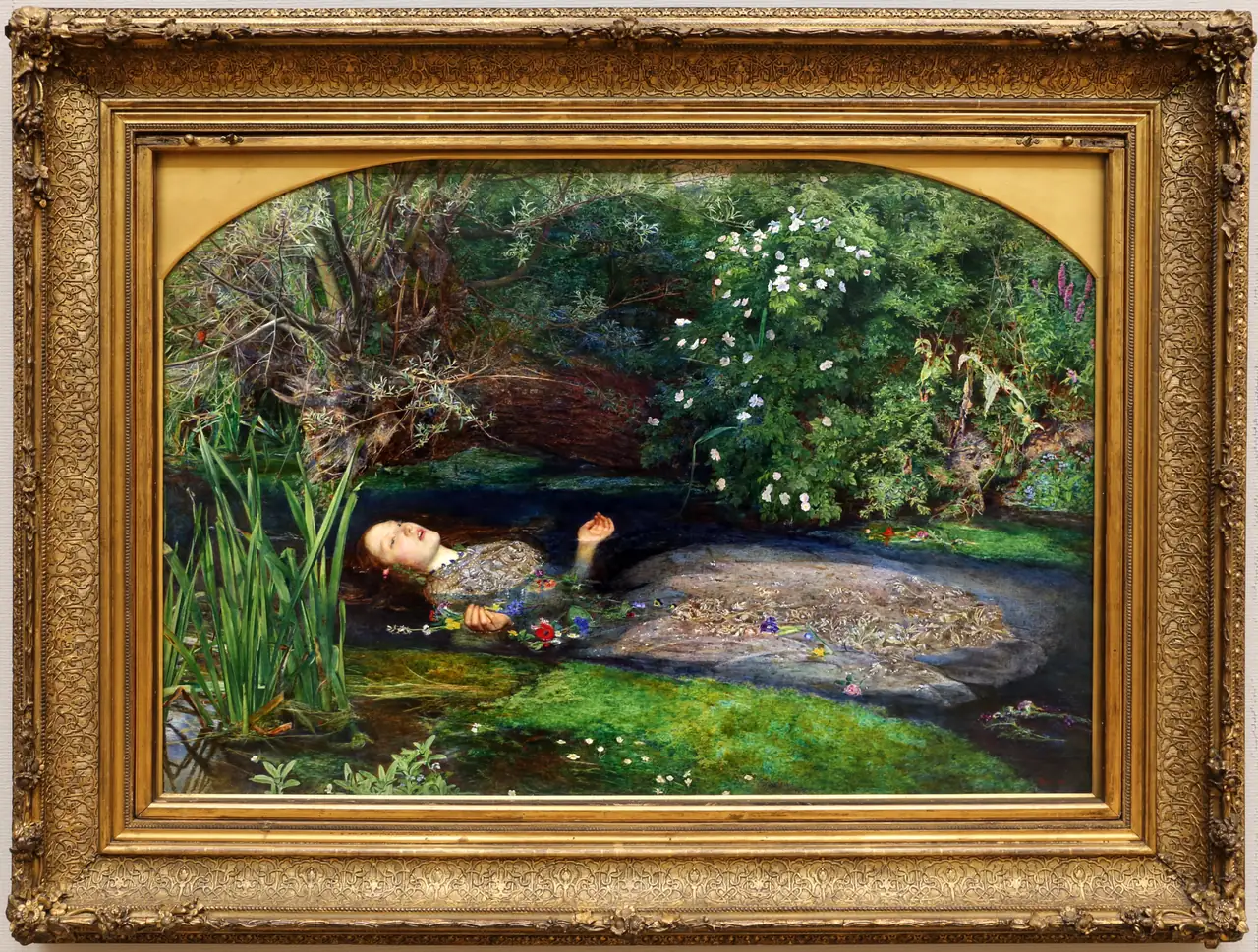

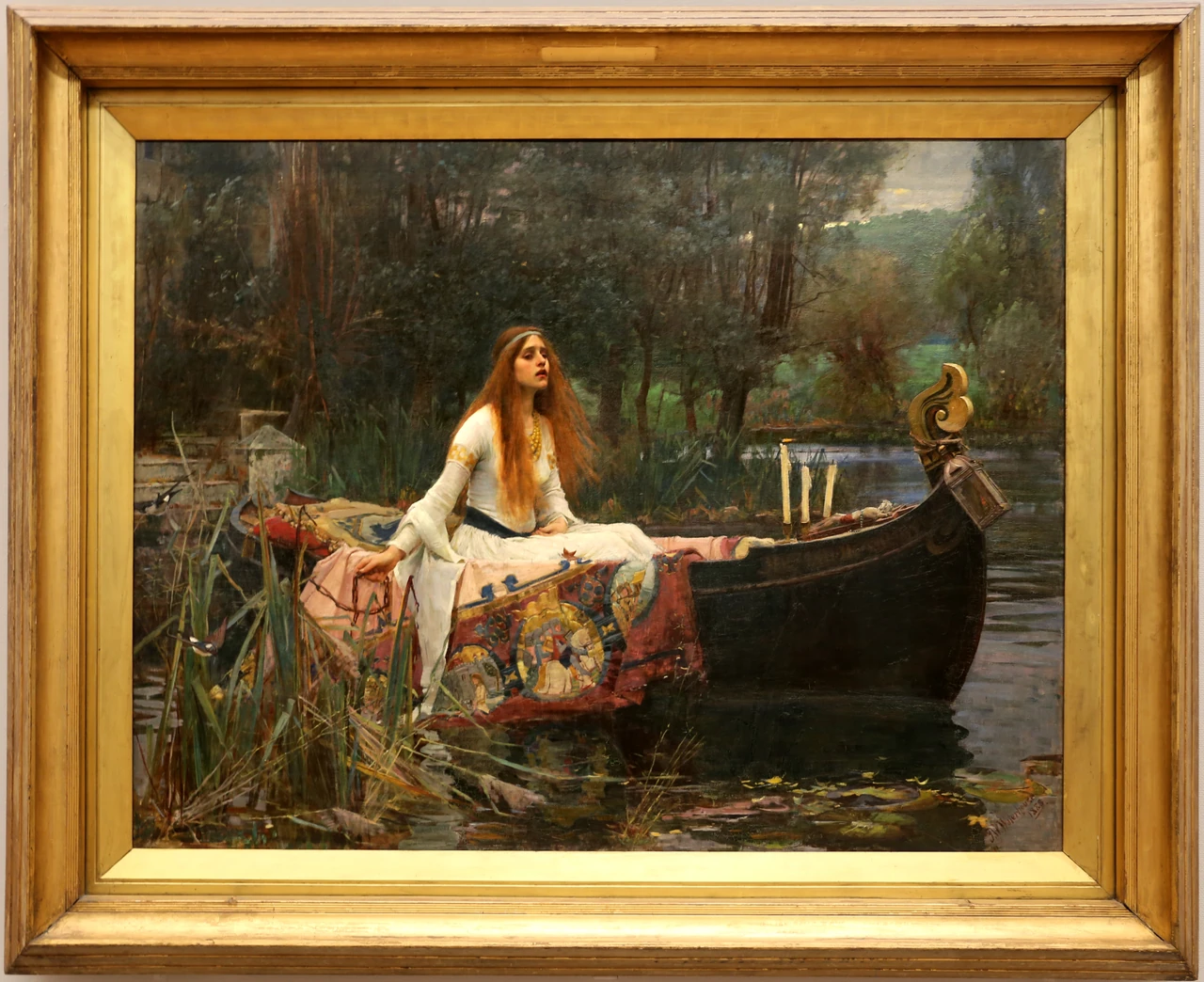
Neither woman is an ancient goddess. Millais paints a scene described in Shakespeare’s Hamlet: Gertrude recounts Ophelia’s drowning, including her briefly floating garments and singing. The event is reported in speech rather than enacted before the audience. Millais gives that account a visible landscape.
His riverbank competes with the figure for attention. Flowers, branches and leaves crowd the upper half, while the spreading dress connects Ophelia to the water below. The Tate identifies the painting as 1851–52. Its beauty does not remove the death at the centre of the scene, and the painting alone cannot settle every question about the character’s state of mind.
Waterhouse chooses an earlier instant in another fatal journey. In Tennyson’s 1842 poem, the Lady leaves her isolated life after the mirror cracks and travels towards Camelot. The Tate’s account of the 1888 painting identifies the moment when she releases the boat’s chain.
The upright figure still occupies a vessel, unlike Ophelia’s body already held by the stream. The textile spilling over the boat carries the visual memory of her weaving, while candles and the dark hull keep the scene from becoming a simple excursion. Compare Millais and Waterhouse through these different choices of moment, not just their shared greenery and water.
Read the picture and return to the story
These paintings are interpretations, not transparent windows onto a single original narrative. A goddess can inhabit a fashionable room; a danger can resemble an embrace; a reported death can become a densely observed landscape.
When another mythological or literary picture catches your attention, identify the exact work, find its narrative source and ask what the artist has chosen to withhold. Our collection directory offers routes for further looking, but a familiar title is only the beginning. The most revealing detail is often the one that changes how the story unfolds in front of you.
Editorial record
About this article
- Author
- Publisher
- GeMarkt
- Published
- Reviewed
- Internal source & rights check. Conducted by GeMarkt Research Review. This is an internal editorial check—not independent peer review.
- Source standard
- Art history source standardPrioritises object records and research sources, distinguishes evidence from interpretation, and states material uncertainty.
Found a claim that needs checking? Report a factual error.