GeMarkt Blog · Essay
Morisot vs Cassatt: Women of Impressionism
Compare Morisot's Reading with Cassatt's Little Girl in a Blue Armchair: brushwork, pose and everyday spaces without reducing either painter to a stereotype.

One woman reads in a field; one child sprawls across a blue armchair. Nothing spectacular is happening. Yet the first picture makes you notice light moving through a white dress, while the second makes a whole room seem arranged around an unceremonious little body.
Berthe Morisot and Mary Cassatt both made everyday life a serious subject for painting, but they did not paint it in the same way. Compare Morisot’s Reading with Cassatt’s Little Girl in a Blue Armchair: the difference lies in brushwork, pose, pattern and the relationship between a figure and the space around her.
They deserve comparison as artists making decisions—not as two interchangeable examples of “women who painted women”.
Two artists at a glance
| Berthe Morisot | Mary Cassatt | |
|---|---|---|
| Life | 1841–1895; French | 1844–1926; American, with a career based in France |
| Impressionist exhibitions | Participated from the first exhibition in 1874 | First participated in 1879 |
| Work examined here | Reading, 1873 | Little Girl in a Blue Armchair, 1878 |
| A useful starting point | Watch the dress and field exchange touches of colour | Watch the body sit awkwardly within the furniture |
The National Gallery’s Morisot biography records her earlier success at the official Paris Salon and her participation in 1874. The Met’s Cassatt biography records her move to Paris in 1874 and participation in four Impressionist exhibitions, beginning in 1879.
The independent exhibitions offered a different route from the Salon, the established annual exhibition system. These were consequential professional choices, not informal gatherings where the artists merely showed pictures to friends.
Reading and restlessness side by side
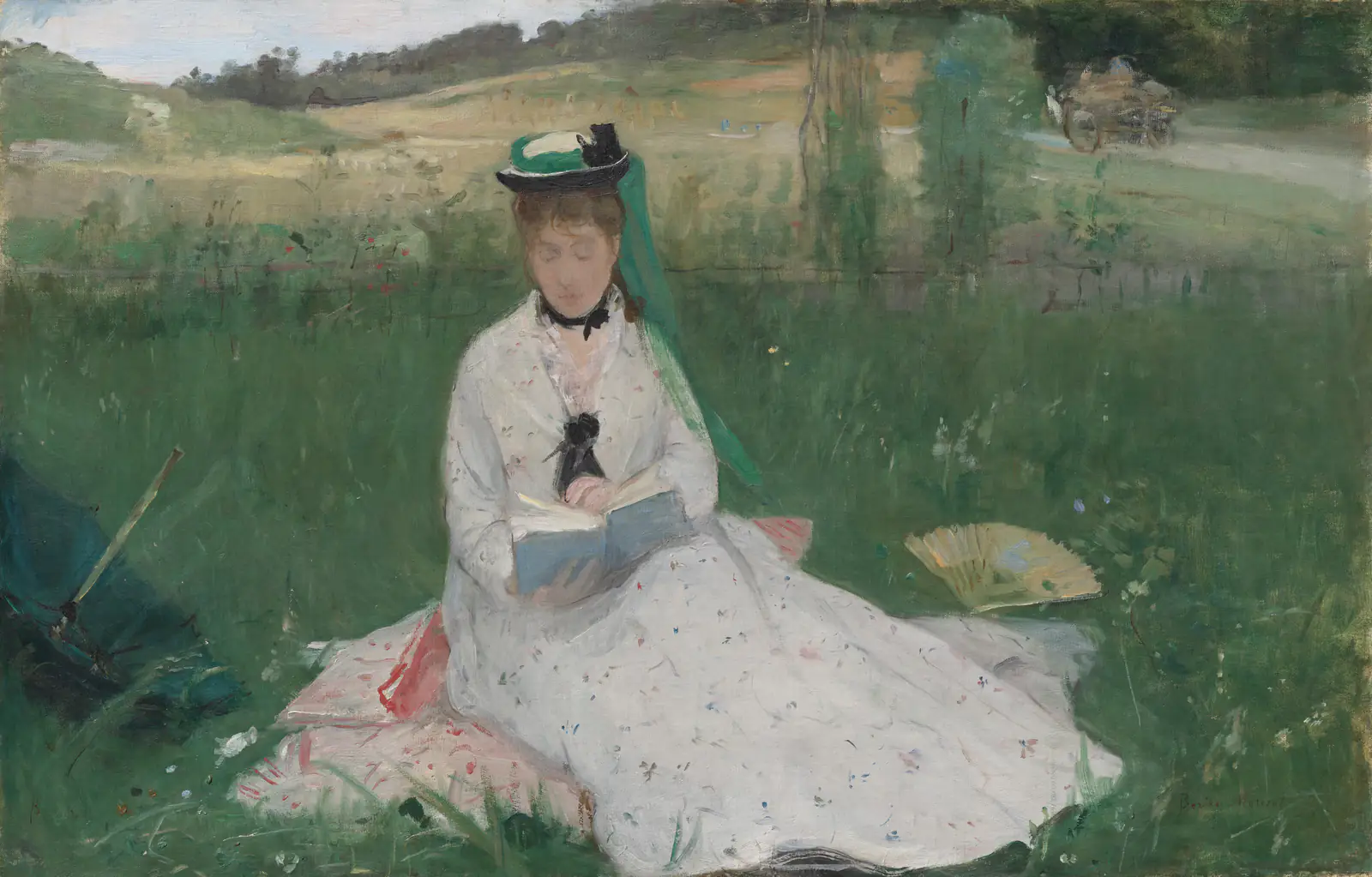
Morisot lets the figure share the outdoor light
In Reading, the white dress creates the largest bright area. It is not a blank shape. Small coloured marks interrupt it, and its lower edges meet the grass without every fold receiving a firm outline.
Look from those marks to the surrounding field. Flowers, fabric and vegetation are not identical, but the touches of paint make them feel part of the same light-filled setting. The head and book give you a more concentrated point of attention within the wider spread of the skirt.
The Cleveland record identifies the model as Morisot’s sister Edma. It also reports that an X-ray revealed an earlier arrangement of her eyes looking towards the viewer. The gaze was revised to face the book. That is useful evidence of a decision beneath the apparently immediate surface.
Knowing about the revision changes the question from “Did Morisot quickly catch someone reading?” to “How did she choose to represent absorption?” The answer involves work and adjustment, not only speed.
Cassatt makes the chair part of the story
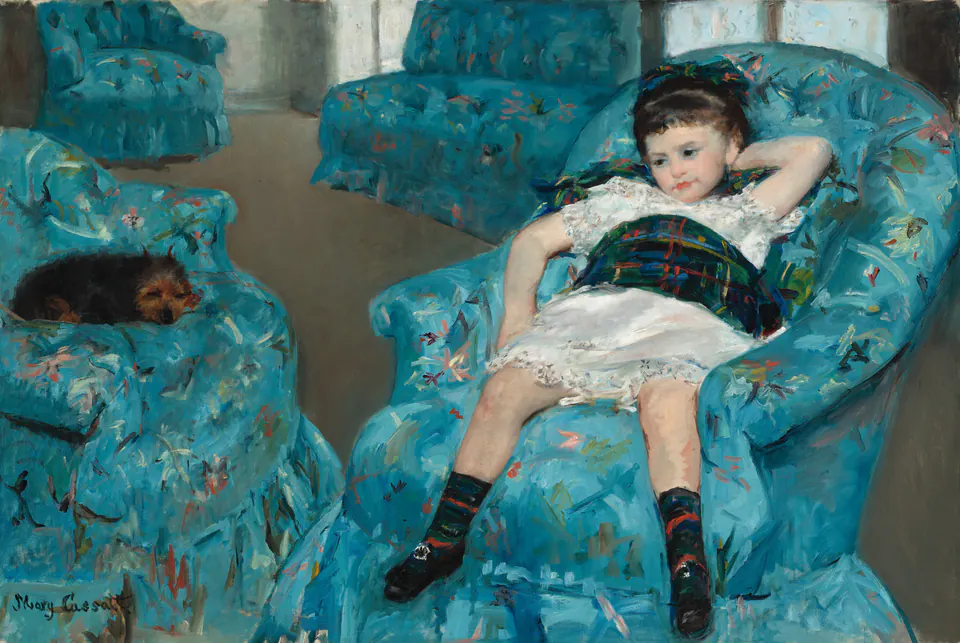
Cassatt’s child occupies a large blue chair without adopting a formal sitting pose. Her legs spread, one arm stretches along the chair and the other bends behind her head. The dark sash, stockings and shoes make her body easy to follow against the blue upholstery.
The chairs do more than provide furniture. Their repeated colour spreads across much of the canvas, while their different angles make the room feel uneven and inhabited. Empty seating takes up substantial space. The girl is not simply placed in the middle of a neutral background.
A small dog rests on the neighbouring chair. The two occupied seats offer different kinds of bodily relaxation, while the empty chairs make those poses stand out. You can notice that relationship without deciding exactly what the child is thinking.
The National Gallery’s account cites a letter in which Cassatt said Degas helped with the painting. It suggests his contribution probably concerned the background corner. The qualification matters: acknowledging help is not a reason to reassign Cassatt’s whole composition to him.
Compare how they use pattern
In Morisot, the dress pattern is small relative to the broad white skirt. The surrounding green field gives those scattered touches room to breathe. In Cassatt, blue patterned upholstery repeats from chair to chair and occupies a much larger share of the picture.
Try looking at each image for a moment without concentrating on the face. Morisot’s pale skirt still holds the scene together. In Cassatt, the arrangement of blue furniture remains immediately recognisable. Neither painting depends solely on a facial expression to make its figure interesting.
This is one reason “Morisot is soft, Cassatt is firm” is an inadequate summary. Morisot can set strong dark accents against white; Cassatt can use loose, visibly lively strokes in a piece of fabric. The useful distinction is how particular marks work in each arrangement.
The figures also sit at different angles to us. Morisot’s reader offers a relatively upright centre within the spread of her skirt. Cassatt’s child cuts across her seat. Their postures help organise the shapes around them, rather than simply illustrate two types of mood.
Everyday subjects are not minor subjects
Neither picture needs a battlefield, a ruler or a mythological event. A reader and a seated child give the painters enough material to explore attention, bodily presence, colour and pictorial space.
That does not make the settings socially neutral. A dress, a book, an outdoor excursion or an upholstered room belongs to a particular way of life. The Musée d’Orsay’s Morisot exhibition discusses both the spaces available to a woman of her background and her use of them for bold formal experiments.
There is a balance to keep: social restrictions mattered, but they do not explain every brushstroke. Nor does familiar subject matter automatically make the painting conservative. An ordinary setting can host an unusual way of seeing.
Professional peers, not supporting characters
Connections to Manet or Degas belong in the history, but they should not replace Morisot’s and Cassatt’s own work. Their decisions about exhibitions, media, subjects and composition are the main story here.
Morisot’s apparently unfinished-looking brushwork was deliberate, not evidence that she lacked confidence or technique. The Orsay exhibition explicitly challenges that old assumption. Cleveland’s evidence of revision in Reading offers a concrete reminder that a light touch can sit on top of sustained judgement.
Cassatt likewise cannot be reduced to a painter of charming children. Even in the image shown here, the arrangement of a room and an unposed-looking body matters as much as the child’s age. The picture asks to be taken seriously as a composition, not only enjoyed as a cute subject.
What the two pictures cannot tell us
These examples do not summarise two whole careers, and neither is a mother-and-child scene. Treating the pair as proof of an instinctively “maternal” style would introduce a claim the images do not support.
Their dates and sizes also differ. Cassatt’s canvas is substantially larger than Morisot’s, although a screen can make them seem equivalent. We are comparing two specific works made five years apart, not a controlled experiment with identical models, lighting or aims.
Looking beyond the first impression
On the next painting, look at what surrounds the figure before deciding what kind of person the artist was. Follow an edge, find a repeated colour, and notice whether the subject meets your gaze or remains absorbed elsewhere.
The Morisot and Cassatt guides offer further works and source records. Compare another pair and the balance may shift. That is not a failure of the comparison; it is how two substantial artists gradually become more than a convenient label.
Editorial record
About this article
- Author
- Publisher
- GeMarkt
- Published
- Reviewed
- Internal source & rights check. Conducted by GeMarkt Research Review. This is an internal editorial check—not independent peer review.
- Source standard
- Art history source standardPrioritises object records and research sources, distinguishes evidence from interpretation, and states material uncertainty.
Found a claim that needs checking? Report a factual error.