GeMarkt Blog · Reference
Mexico’s 100-Year Copyright Term: What It Means for Frida Kahlo
Why Frida Kahlo’s death in 1954 does not give worldwide permission: Mexico’s term, transitional rules, exact files and practical reproduction requests.

Do not turn a death date into worldwide permission
Frida Kahlo should not be treated as a globally public-domain artist simply because she died in 1954. Mexico’s present general term is the author’s life plus 100 years, not 70. But a responsible answer also asks which work, which country and which version of the law applies. A term calculator alone cannot resolve a historical work’s entire legal history.
This guide therefore does not label every Kahlo image either free everywhere or protected everywhere. It explains the Mexican rule, the transitional question that a simple calculation leaves out, and how to investigate a proposed reproduction. It was checked on 13 October 2026 and provides general information, not legal advice or a work-specific clearance certificate.
The Frida Kahlo Museum’s chronology records her death on 13 July 1954. That is an important fact. It is not, by itself, permission to download a portrait, reproduce a painting on merchandise or use a museum’s scan.
What the current Mexican term says
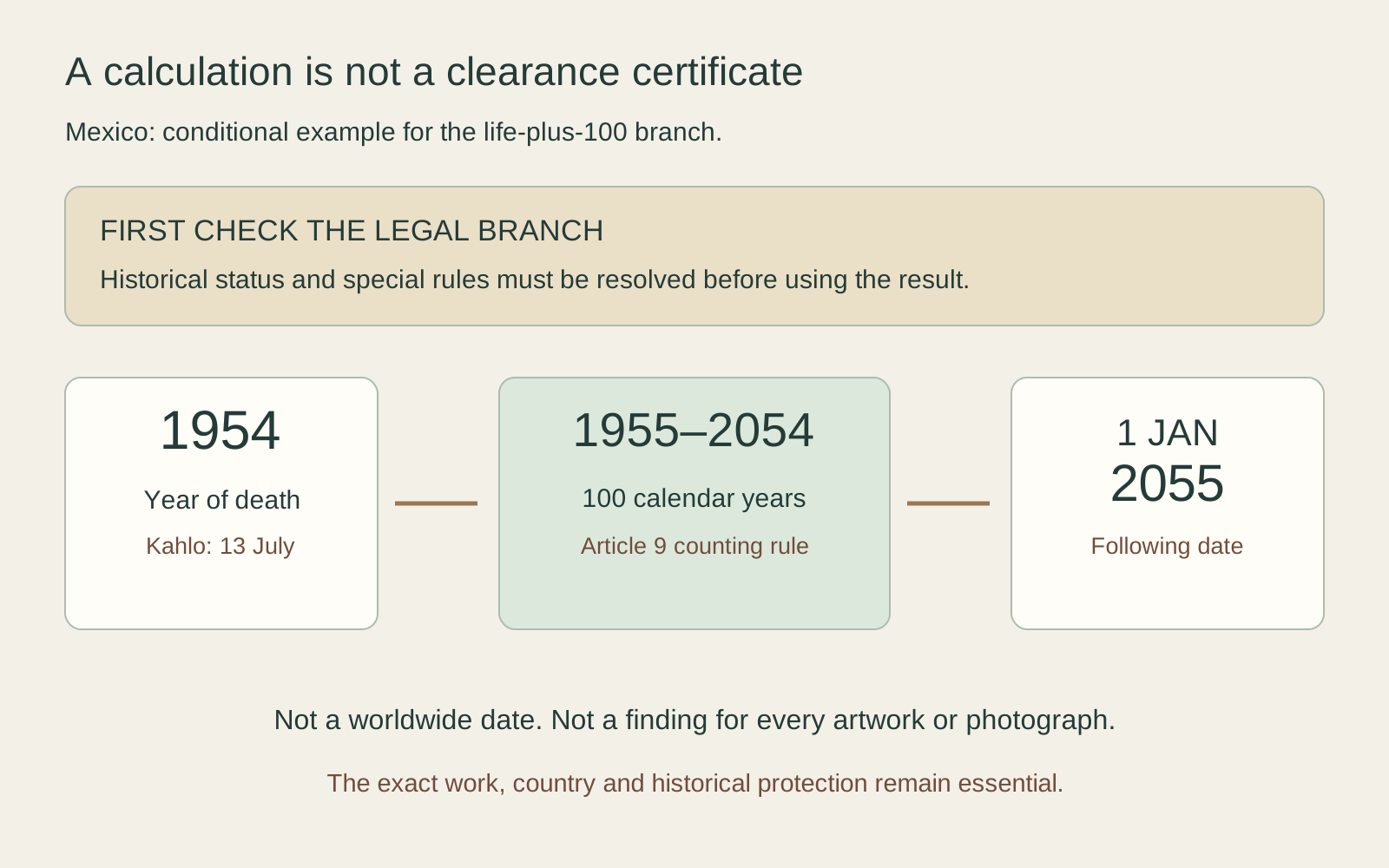
Article 29 of Mexico’s Federal Copyright Law gives economic rights a term of the author’s life plus 100 years. For joint authorship, its life-based provision runs from the death of the last co-author. Article 9 generally starts the calculation on 1 January following the event that begins the term.
On that life-plus-100 branch, a death in 1954 produces a term running through the end of 2054, with 1 January 2055 as the following date. The calculation concerns economic rights under the specified rule. It is not a declaration that every item connected with Kahlo shares that date.
Article 29 also contains a disclosure-based provision. Unpublished material, posthumous releases and other special facts should not be squeezed into a general painting example without examining them. A diary page, a lifetime painting and a later photograph of the artist are different objects of research, even if a search engine presents all three under her name.
Why the earlier laws still matter
Mexico has not always used 100 years. The 1996 law preserved by WIPO Lex stated life plus 75 years in Article 29. The amendment published on 23 July 2003 changed that provision to 100 years; its first transitional article made the decree effective the following day. The decree and transitional articles appear in the current official compilation.
There is a crucial difference between extending a right that is still running and reviving a right that has already expired. Mexico’s Constitution, Article 14, prohibits retroactive application of a law to a person’s detriment. That is a reason to investigate the sequence of laws, not permission to assume either universal revival or universal exemption.
A proper historical check asks whether protection existed immediately before each relevant extension, what the new enactment actually changed, and how its transitional provisions affect the particular work. Earlier legislation and, where necessary, authoritative interpretation belong in that check. Applying today’s number directly to every Mexican artist who ever lived would erase precisely the question that needs answering.
For Kahlo, this article does not claim to establish the uninterrupted protection history of every painting, letter, diary page and edition. Nor does it assert that any named work had already expired before an extension. Both conclusions require evidence about the actual item. The narrower conclusion is useful: neither “1954 plus 70” nor “the painting looks old” establishes permission in Mexico.
What the 2055 calculation does and does not prove
The date is an explanation of the current life-based calculation, conditional on that provision applying. It should not be presented as a single worldwide release date, a guarantee about unpublished material, or the end of every other relevant right.
Economic rights and moral rights are also distinct. Articles 18–21 of the Mexican law address moral rights, including attribution and protection against certain prejudicial alterations. Article 152 allows use of public-domain works while preserving the relevant moral rights. “Economic term expired” therefore does not mean that falsely attributing a new picture to Kahlo becomes acceptable.
For a practical research note, write the assumption beside the calculation: “Mexico; identified work; life-plus-100 branch, subject to historical and special-rule checks.” That sentence is more useful than a green public-domain badge with no country or explanation attached.
One work can have different results in different countries
Copyright is not governed by a single worldwide countdown. A life-plus-70 rule cannot simply be imported into Mexico; Mexico’s general term should not automatically be exported to every other country either. National rules, international obligations and the work’s history need to be considered together.
The United States is a particularly important reason not to stop at the artist’s death date. The Copyright Office’s Circular 38B on restoration explains that some foreign works regained US protection under the URAA if specified conditions were met. Its discussion includes the work’s source country, protection there and the relevant US history. It does not supply a single verdict for an artist’s entire output.
For a US use, identify actual publication evidence and the applicable legal branch rather than treating the year painted as the year published. Our US publication-rule guide explains that distinction. For a project distributed in several countries, record the intended territories instead of selecting whichever country’s answer seems most convenient.
A painting, a portrait and a file are different things
A self-portrait painted by Kahlo is her artwork. A photograph showing Kahlo is someone else’s photographic work unless she made it herself. A modern photograph of a painting introduces a further source-file question. The subject’s death date is not a substitute for identifying the photographer or the file’s terms.
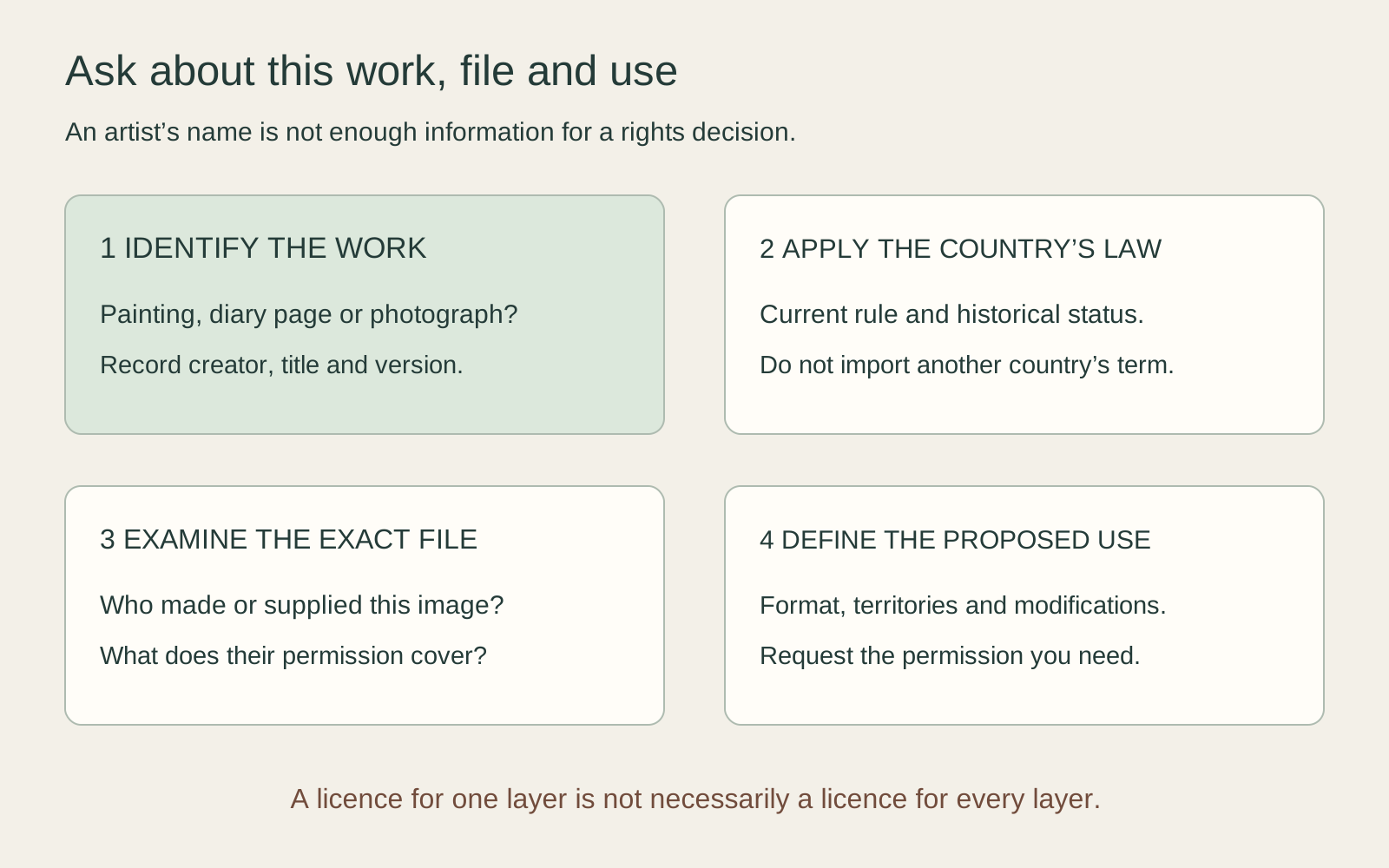
A Creative Commons label on a photographer’s page should therefore be read for what that person is actually licensing. It is not proof that they control rights in the underlying painting. Likewise, a museum credit line identifies a source or rights assertion; it is not automatically a grant to reproduce the file commercially. Read the linked conditions, not just the thumbnail label.
Avoid replacing an unverified file with a traced or colour-adjusted copy and assuming the question has disappeared. A different file can still reproduce the same underlying work. It also risks making the source less transparent.
What to do if you want to reproduce a work
Begin with the exact title, date, holding collection and proposed image. Then describe the use: an article, printed book, downloadable file, advertising or a product; the intended countries; the duration; and any crop or modification. This gives a rights contact something concrete to assess.
The museum’s reproduction-request information directs requests from Mexico to the Banco de México trust for the Diego Rivera and Frida Kahlo museums, and requests from abroad to Artists Rights Society. Banco de México’s own public service also describes a route for requests to reproduce the artists’ works. These are institutional permission channels, not court decisions about every possible use.
Ask what the proposed permission covers: underlying artwork, supplied photograph, territories and commercial format. Keep any written answer with the exact file. A permission request is not an approval, and this guide makes no promise about availability, fees or response times. If a possible statutory exception is central to the project, seek advice about that use rather than assuming all educational or editorial use is exempt.
Keep the answer specific
The useful question is not merely “Is Frida Kahlo public domain?” It is “Can I use this work, through this file, for this purpose, in these countries?” Mexico’s 100-year rule is a major part of that inquiry, but transitional law and the other layers cannot be skipped.
Until those questions are resolved, do not advertise an unverified Kahlo reproduction as freely reusable. You can still discuss her work and link readers to museum records. That is why this guide uses explanatory diagrams rather than treating the article itself as permission to reproduce a disputed painting or portrait.
Editorial record
About this article
- Author
- Publisher
- GeMarkt
- Published
- Reviewed
- Internal source & rights check. Conducted by GeMarkt Research Review. This is an internal editorial check—not independent peer review.
- Source standard
- Rights guide source standardSeparates the underlying work from the source file, records the review date, and links the evidence used for the conclusion.
Found a claim that needs checking? Report a factual error.