GeMarkt Blog · Reference
Is The Third of May 1808 by Francisco Goya Public Domain?
Check Goya’s 1814 painting, its Commons image and the difference between the 1808 event, copyright duration and permission to reuse a particular file.


The short answer
Goya’s historical painting is beyond its ordinary author copyright term in Spain and the UK. The image used here is a particular faithful reproduction that Wikimedia Commons marks as public domain. That is not a licence for every Prado photograph, recent art book or altered version of the scene.
This page concerns the Prado’s P00749, painted in 1814, and the exact Commons file linked below. Checked 12 October 2026, Commons assesses that file as public domain, including in the United States. This guide has not independently completed the painting’s U.S. publication history; it reports the repository’s assessment rather than inventing an early reproduction date.
1808 is the event, 1814 is the painting
The date in the title can be misleading. Goya painted the picture in 1814, looking back to the French reprisals following the Madrid uprising of May 1808. It is not a canvas completed on the night it depicts.
The Fundación Goya en Aragón catalogue identifies the oil painting as 268 × 347 cm, in the Museo Nacional del Prado. It is the companion to The Second of May 1808 in Madrid, which represents the uprising rather than this execution scene.
Keep those two works separate when downloading images or checking a caption. A search result headed “Goya, Madrid, 1808” may refer to either painting, a detail, a print after it or a discussion of the historical events. The subject date alone is not an adequate identifier.
The precise location has also been debated. The foundation notes both the familiar Príncipe Pío identification and another proposed setting near the Puerta de la Vega. You do not need to resolve that debate to identify the canvas. Nor should a caption convert the painting into a claim that Goya personally witnessed this exact arrangement of people and buildings.
Read the whole scene, not only the white shirt
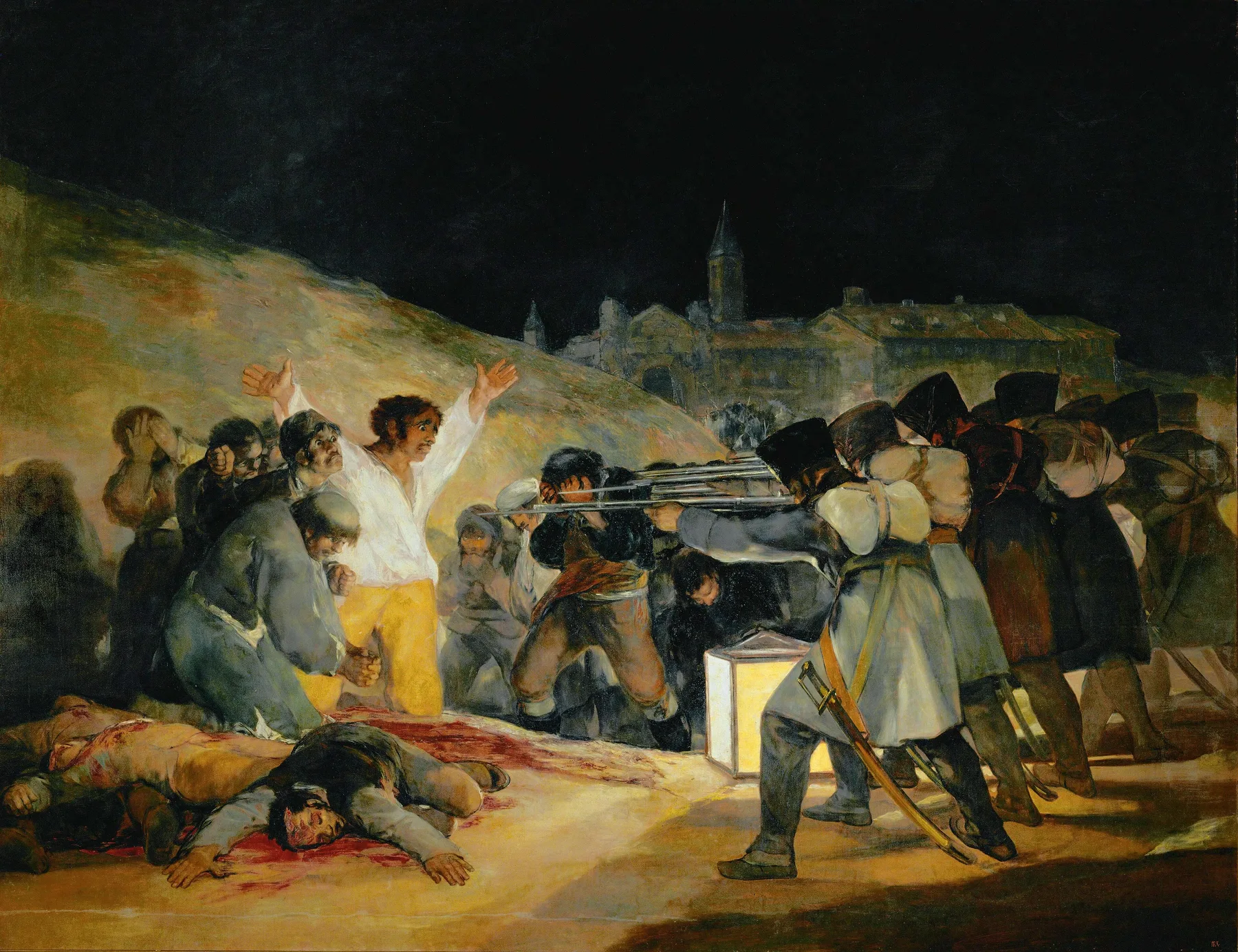
The white shirt is the strongest light shape, but the painting does not stop there. Below it, bodies lie across the foreground. Behind it, other men wait. The repeated line of rifles leads from the soldiers’ bent bodies towards the exposed group, while the lantern stands between the two sides.
Look at the difference between faces and backs. The condemned men show several responses: raised hands, clasped hands, a face concealed. The soldiers are turned away from us and compressed into a repeating formation. We can read individual distress on one side and coordinated force on the other without identifying every person.
The foreground gives the scene a terrible sequence. What has already happened lies close to the viewer; what is about to happen occupies the centre; those still waiting extend farther back. A tight crop around the man in white keeps the famous gesture but removes much of that sequence.
These are observations about the visible composition, not proof of the exact historical staging. They are also reasons to preserve the whole picture when the subject of an article is Goya’s treatment of collective violence. An isolated figure may be useful as a labelled detail, but it should not silently replace the painting in a source record.
What has expired and what still needs checking
Goya died in 1828. Spain’s historical term for authors who died before December 1987 is longer than the modern general term: the Biblioteca Nacional de España explains the applicable eighty-year rule. Even that longer author term has long elapsed here.
Spanish law nevertheless preserves requirements concerning authorship and integrity when public-domain works are used. That distinction appears in Article 41 of the copyright statute. Public domain is not a reason to pass off your changes as Goya’s work. His ordinary UK term has likewise expired under the UK artistic-work framework.
The U.S. analysis is not simply “1814 plus a number.” Its copyright duration provisions distinguish old published works from works that remained unpublished, with special rules for some later publications. A painting’s creation or museum display is not, by itself, a documented publication of copies.
The Commons page supplies a public-domain assessment, but it does not replace a separately checked chain of early authorised reproductions in this guide. For a project requiring a formal territorial clearance, keep that limit visible instead of turning the repository’s label into a worldwide legal guarantee.
The exact file used here
The illustration comes from the Commons file named El tres de mayo de 1808 en Madrid (2008).jpg. Its file history identifies the current large upload as a 5,903 × 4,539-pixel image. The year in that filename is not the year Goya painted the canvas.
Commons describes it as a faithful reproduction of a two-dimensional public-domain work and applies Public Domain Mark 1.0. A Public Domain Mark communicates a status assessment; it is not a new copyright licence issued by the Prado. Its usefulness depends on matching the pictured work and file rather than transferring the label to a different download.
GeMarkt’s displayed derivative preserves the full supplied composition. It is an existing, unchanged reading image, not a newly retouched “restoration.” Its source credit identifies the Prado through Commons; it should not be read as a claim that the museum supplied permission directly to GeMarkt.
A museum credit is not museum permission
Ownership of the physical painting, authorship of the painting and rights in a photograph are different questions. A museum can hold the canvas and provide authoritative catalogue information without every file on its website carrying the same reuse terms.
For that reason, this page identifies the Commons reproduction rather than inviting you to take any image from the Prado website. If you choose a different file, check that file’s source and terms. A modern installation photograph can include a frame, gallery, people or other creative photographic choices that are absent from a flat reproduction.
The same care applies to a recently published book. An old painting reproduced on a page does not make the accompanying essay, page design or newly created illustration available for copying. Use the historical source you have checked, rather than lifting a convenient page and assuming its entire contents share the painting’s status.
Using the image without changing its meaning
Start by asking what the image is doing in your project. For a historical explanation, the complete scene gives readers more evidence than an anonymous crop. For a detail study, name the detail and provide a route back to the whole composition.
Avoid treating brightness as a test of accuracy. Raising the dark background until every building is easily visible changes the contrast with the lantern and white shirt. An aggressively sharpened file may make edges look crisp while exaggerating surface marks. Neither adjustment becomes Goya’s original intention because software can perform it quickly.
A source credit also should not imply endorsement. Naming the Prado identifies the collection; it does not suggest that the museum approved a product, political message or interpretation. This is especially important for a picture whose violence can acquire a very different meaning when combined with advertising or a slogan.
A practical source record
Keep five things together: Goya’s name, the title, the painting date 1814, Prado P00749 and the exact image-source link. Add the repository’s rights statement and record any crop or colour change you make. That short record is more useful than a folder labelled only “free Goya.”
For more context, see the Goya artist guide and our guide to checking a particular work. The answer for this image is bounded and traceable; it is not permission for every modern version of the painting. This is general source-based information, not individual legal advice.
Editorial record
About this article
- Author
- Publisher
- GeMarkt
- Published
- Reviewed
- Internal source & rights check. Conducted by GeMarkt Research Review. This is an internal editorial check—not independent peer review.
- Source standard
- Rights guide source standardSeparates the underlying work from the source file, records the review date, and links the evidence used for the conclusion.
Found a claim that needs checking? Report a factual error.