GeMarkt Blog · Reference
Is Mucha’s The Seasons Public Domain? Check the Edition
Identify Mucha’s Seasons series, inspect its 1899 printed reproduction and distinguish the old designs from the rights and quality of a modern download.

The short answer
Yes for the historical Seasons designs reproduced in the October 1899 issue of The Poster: there is visible nineteenth-century publication evidence, and Mucha’s ordinary life-plus-seventy-year term has expired. That is not permission to take any modern image called The Seasons.
This guide, checked on 13 October 2026, focuses on the reduced, ornamentally framed group printed on page 58 of The Poster, volume 3, October 1899. Its four figures derive from Mucha’s first Seasons series. The illustration below is cropped from a scan of that periodical page, not a colour photograph of four original lithographs. Later series, individual impressions and modern adaptations need their own identification and file checks.
Which Seasons you are looking at
The Mucha Foundation identifies the first series as 1896, names F. Champenois, Paris, as printer and explains that further sets followed in 1897 and 1900. Its account describes four seasonal personifications, rather than four stages in one continuous scene. The Mucha Museum chronology also records the first decorative Seasons panels being printed in 1896.
That repeated title matters. A woman among blossoms, a reclining summer figure and a cloaked winter figure can sound similar in a caption while belonging to visibly different designs. Compare the pose, foliage, border and inscriptions before relying on a date copied from a search result.
The periodical’s arrangement has Summer first, followed by Spring, Autumn and Winter. French labels identify the panels. Their joined ornamental surround differs from four unbordered image files placed side by side today. Neither the order nor the surrounding decoration should be silently reconstructed from a more familiar modern montage.
An accurate description would be “The Seasons, reduced group reproduced in The Poster, October 1899.” Calling it simply “the original 1896 poster” would hide the particular form you are showing. A design date, an impression’s date and the date of a later reproduction can all differ without any of them being a mistake.
The 1899 page is evidence you can see
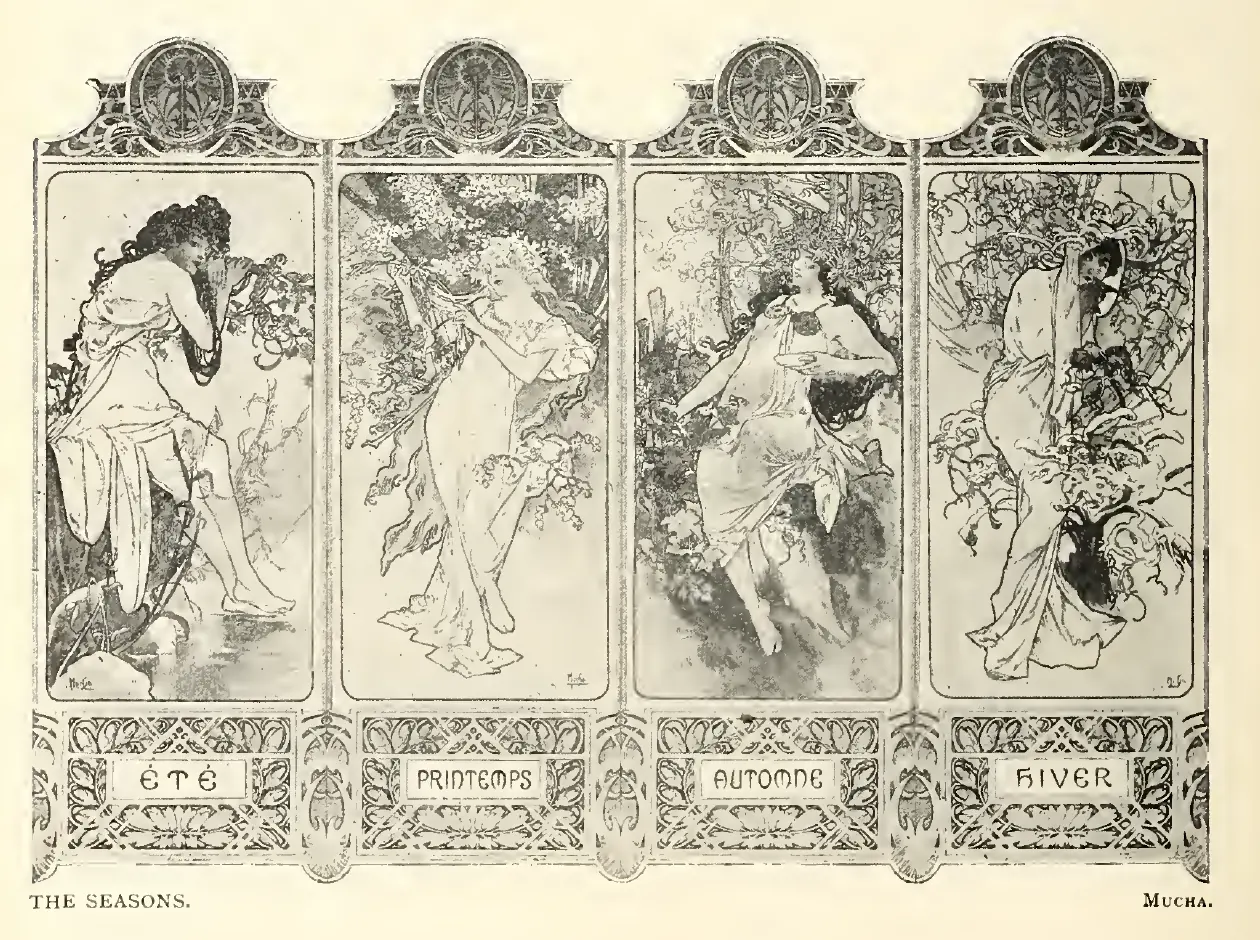
This is a printed illustration, not merely a catalogue title. On the complete source page, the date is visible at the top and the page number at the left. The detail here keeps the artist’s name beneath the group. The source page makes the connection between title, image and publication date checkable without reproducing the surrounding article text here.
Look at how the decorative frame holds the figures together. Rounded crests rise above the panels; narrow divisions prevent the plants and clothing from spilling into neighbouring seasons. Along the bottom, the lettering provides a second rhythm. Removing that surround changes the way the four images read as a group.
The monochrome reproduction cannot establish the colours of an original impression. Nor can its speckled tones reveal whether a mark belongs to the lithograph, the periodical printing, the paper or the later scan. It is useful evidence of a published composition, but not a calibrated colour reference or a ready-made large-print master.
What the publication date establishes
The distinction between making and publishing a work is important. The U.S. Copyright Office’s visual-art guidance explains that display alone does not establish publication; authorised distribution of an original or copies can be relevant. Here, the evidence includes an actual printed illustration and institutional accounts of the commercial panels, rather than an exhibition date substituted for publication.
The Office’s duration circular gives the pre-1931 threshold relevant in 2026 and explains the maximum ninety-five-year term for older works already under statutory protection. The illustrated edition is comfortably earlier. The nineteenth-century printing supports the public-domain assessment for the designs actually shown; it does not establish the first release of every drawing later gathered under the Seasons title.
There is also a useful limit in the neighbouring evidence. Page 57 carries a Champenois permission credit for The Arts, a different four-part series. That credit should not be quoted as an explicit permission statement for the Seasons illustration on page 58. Likewise, an edition size discussed for The Arts must not become a claimed Seasons print run.
The ordinary term is not a worldwide licence
Mucha died in 1939, as the museum biography records. The normal seventy-year posthumous period described in EU guidance and UK guidance is therefore past. The UK’s separate, shorter protection for a published edition’s layout also does not turn an 1899 page into a newly protected layout today.
These are territorial conclusions, not a promise about every jurisdiction or every proposed use. Attribution and integrity concerns can remain relevant, and modern branding or newly added artwork should not be treated as part of Mucha’s expired copyright. Describe an altered version as altered; do not imply that a new commercial product is endorsed by a museum or the artist’s estate.
For a business distributing in several countries, keep the intended territories in the rights record. “Found online” is not a territory, and “public domain” without an identified work leaves too much unstated. Our general public-domain guide explains the distinction in more detail.
The selected scan and its limits
The selected Commons file identifies the UNC-Chapel Hill volume and its Internet Archive source. It marks the scanned publication public domain in the United States through publication before the cutoff. It also displays a warning that non-U.S. works need their source-country status considered. That warning is not concealed here; the historical edition and Mucha’s ordinary term are addressed separately above.
The digital image is a straightforward page reproduction. The Copyright Office’s Compendium, section 909.3(A), distinguishes creative photographic authorship from mere scanning or faithful copying. This supports the U.S. treatment of this scan; it is not a universal ruling about every photograph of old art.
No museum CC0 grant is claimed for the page. No permission attached to a different Mucha poster has been borrowed. The Foundation’s own contemporary photographs and licensing service remain separate sources with separate terms. A public-domain assessment of an old design does not cancel conditions attached to a particular supplied file.
Choose the file for the job
For historical research, keep the complete page so its date, caption and context remain checkable, even if the displayed figure is a clearly labelled detail. For a decorative print, the small reproduced figures may not provide sufficient detail. A technically larger download is not necessarily a better reproduction of the original lithograph.
Save the exact file page, the edition information and a copy of the rights statement alongside any selected download. Record whether you have retained the full sheet, isolated a panel or cropped a detail. If you need a colour reproduction, identify a colour source independently instead of colourising this monochrome page and calling the result original.
The practical answer is therefore specific: the old Seasons designs shown here have a defensible public-domain basis, supported by a visible historical printing. Your chosen reproduction still needs a coherent source, an honest caption and enough genuine image detail for its intended use. The Mucha artist guide gives the wider context without making all of his files interchangeable.
Editorial record
About this article
- Author
- Publisher
- GeMarkt
- Published
- Reviewed
- Internal source & rights check. Conducted by GeMarkt Research Review. This is an internal editorial check—not independent peer review.
- Source standard
- Rights guide source standardSeparates the underlying work from the source file, records the review date, and links the evidence used for the conclusion.
Found a claim that needs checking? Report a factual error.