Is Alphonse Mucha's art public domain? A collector's guide
Mucha rose to fame on 1 January 1895, but entered Europe's public domain only on 1 January 2010. See how two copyright systems now clear his Paris posters.
From the guide to the collection
Explore the Mucha collection → · Shop all art → · Free Mucha wallpapers — the complete paintings at 4K ↓
From the studioMucha prints — 190+ restored works, curated and annotated →
A career that began overnight
In the last days of December 1894, Sarah Bernhardt needed a new poster for Gismonda, the play about to open at her Théâtre de la Renaissance, and she needed it before the New Year. The printing house’s regular artists were away for the holidays, so the commission fell to a thirty-four-year-old Moravian illustrator who happened to be on the premises: Alphonse Mucha, born in the small town of Ivančice in 1860, until then scraping a living from book and magazine work. What he delivered looked like nothing Paris had seen — Bernhardt at nearly life size, a narrow Byzantine column of muted gold and olive in a city of shouting red posters. On the morning of 1 January 1895 it went up on the streets of Paris, and by the time the play opened three days later Mucha was famous. Bernhardt signed him to a six-year contract for posters, sets, and costumes.
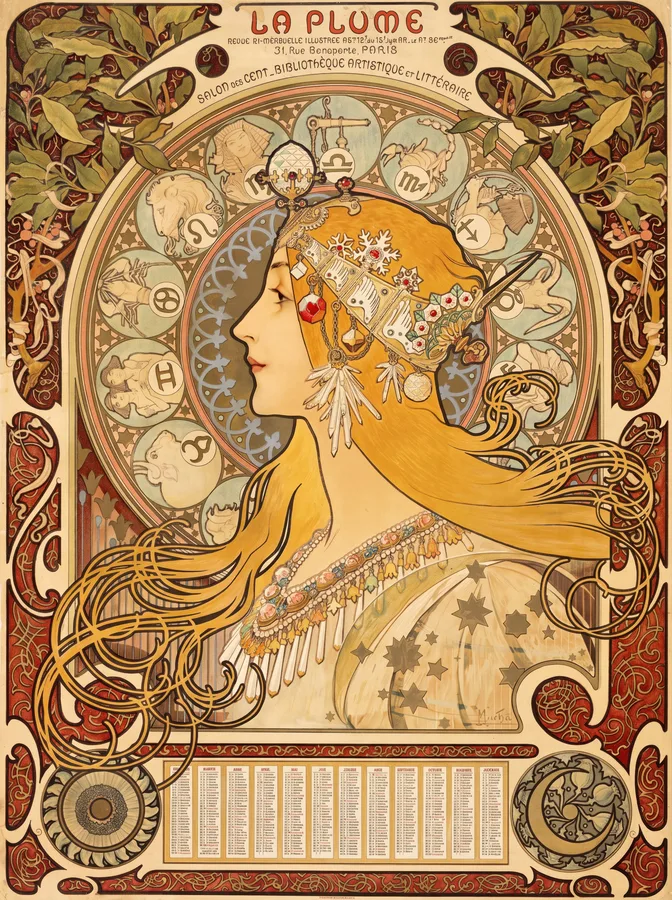
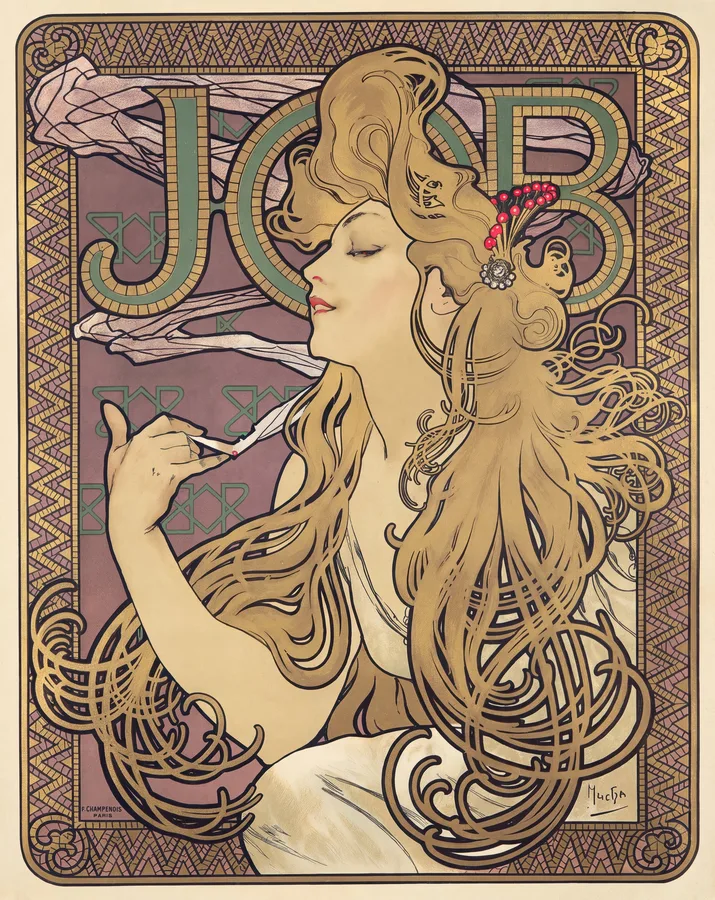
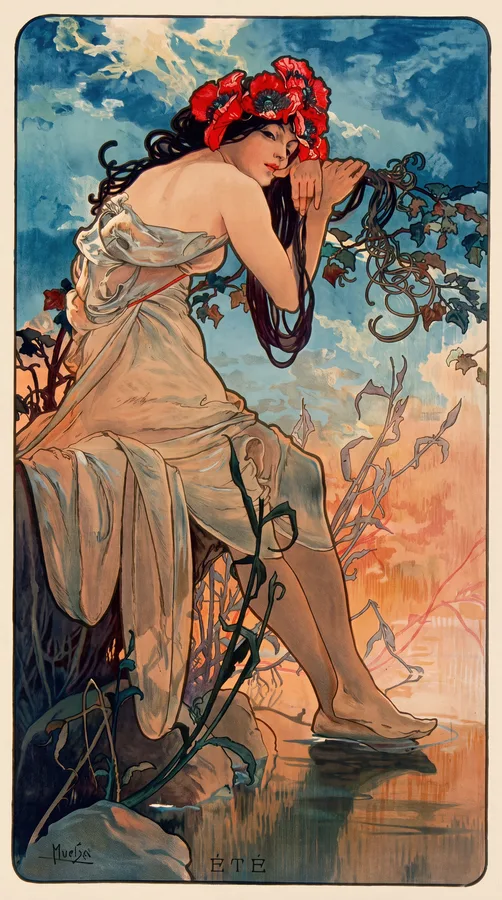
The decade that followed is the one our collection draws from. Working with the printer Champenois, Mucha produced over a hundred poster designs between 1896 and 1904, and along the way effectively invented a new kind of object: the decorative panel, a poster with no product to sell, printed in large runs at modest prices and meant purely for the wall. The Seasons appeared in 1896, the same year as his Zodiac — drawn as a calendar for his printer, then bought up by the review La Plume — and as the JOB cigarette-paper poster whose swirling hair critics nicknamed “macaroni.” The Arts followed in 1898, and in 1899 came Le Pater, his illustrated Lord’s Prayer, printed in just 510 copies and shown at the 1900 Paris World’s Fair; he considered it his printed masterpiece.
Prague, 1939
Mucha never saw himself as a French decorator, and he eventually went home to work on the monumental history cycle he regarded as his life’s purpose. That is where the story turns dark. German troops entered Prague on 15 March 1939, and Mucha — a famous Slav patriot and a Freemason — was among the first people the Gestapo arrested and interrogated. He was released, but the ordeal broke his health; he fell ill with pneumonia and died in Prague on 14 July 1939, ten days short of his seventy-ninth birthday. Despite an official ban, an enormous crowd — estimates run to a hundred thousand — attended his funeral.
That date, July 1939, is not just biography. It is the reason Mucha is the careful case in copyright terms, and the most recent arrival to the public domain among the painters we work with.
Is Mucha’s art public domain?
The answer comes in two parts, because the world runs on two main systems.
Most countries, including the entire European Union, protect a work for the life of the author plus seventy years, counted from the end of the year of death. Mucha died in 1939, so his copyrights ran through the end of 2009, and his works entered the public domain in the EU on 1 January 2010. Compare Van Gogh, whose rights lapsed generations ago: Mucha’s expired within living memory. He is the artist who had to wait for the public domain — and since 2010, in life-plus-seventy countries, the wait is over.
The United States counts differently for older works: not from the artist’s death but from publication, with a term of ninety-five years. As of today, works published before 1931 are in the American public domain. That line comfortably covers the classic Paris period — the Bernhardt posters beginning with Gismonda, the decorative panels, the advertising work — all of it published in the mid-1890s and early 1900s, decades inside the boundary. So the poster-period works at the heart of our collection are public domain under both major systems.
One more thing is worth saying plainly, and with respect. Mucha’s legacy is actively cared for by his descendants: the Mucha Foundation, established by his family in 1992, maintains the family collection, mounts exhibitions, runs a museum in Prague, and protects his name. Public domain status applies to the classic-period artworks themselves; it does not turn the Mucha name into a free label, and it does not settle every question about every object connected to him. That is one reason we verify the rights status of every individual piece before it is listed, rather than treating “Mucha” as a blanket answer.
And the honest caveat: copyright terms vary by country, a few jurisdictions apply unusual rules, and the law changes. This page is general information, not legal advice; if a commercial decision depends on it, ask a lawyer in your jurisdiction.
The artwork is free — not every file of it
A distinction that matters more with Mucha than with almost anyone. The artwork — the lithograph Mucha designed — is public domain. A particular digital file of it is a separate question, because some museums and image libraries assert rights or contractual conditions over their photographs of public-domain works. The strength of such claims varies by country, but the practical lesson does not: the freedom attached to the artwork does not automatically travel with every scan of it circulating online. The provenance of the file matters. The restorations we sell are our own work, which is exactly why we can stand behind them — artwork and source both, checked piece by piece.
Mucha in our collection
Our Mucha collection holds over 190 restored works, centred on the Paris decade that made him. The Zodiac is here with its header and month-grid intact, the twelve sign medallions legible in their grey-blue ring. The JOB poster keeps its gold coils sharp against the violet ground. Summer, the panel that carries his first Seasons set, came back with the deep cobalt sky that most circulating copies have faded to grey. Rêverie holds the ring of pink blossom apart from its teal ground instead of melting into one rose smear, and Dance, the one panel of The Arts caught mid-motion, keeps the small tonal steps its silvers and ochres depend on.
Every piece comes in the same four formats: rolled poster, stretched canvas, framed canvas, and framed paper print — the rolled poster for collectors with a framer they trust, the framed options ready to hang. Mucha designed for the walls of ordinary rooms; more than a century and a quarter later, that is finally, unambiguously, what his work is free to do. Browse the Mucha collection — a selection chosen and annotated by the studio, and a door to the full 190-plus.
Editorial record
About this article
- Publisher
- GeMarkt
- Published
Found a claim that needs checking? Report a factual error.