GeMarkt Blog · Reference
Is The School of Athens by Raphael Public Domain?
Check Raphael’s fresco separately from Giorgio Ghisi’s published 1550 engraving, with exact museum image terms and a guide to identifying partial sheets.

The short answer
Raphael’s historic composition and Giorgio Ghisi’s published 1550 engraving are beyond ordinary copyright terms. The open institutional files used here reproduce the engraving, not a modern photograph of the Vatican fresco.
That last distinction matters. An engraving has its own maker, publication history and visual decisions. Its public-domain status does not authorise downloading an unrelated contemporary museum photograph. This guide, checked on 13 October 2026, identifies the fresco, shows a historical route through which its composition circulated, and keeps each digital image attached to its actual source terms.
If you want the fresco’s present colours, these monochrome sheets will not supply them. If you want to understand how a Renaissance wall painting became a portable image, they are particularly revealing.
A fresco and a published engraving
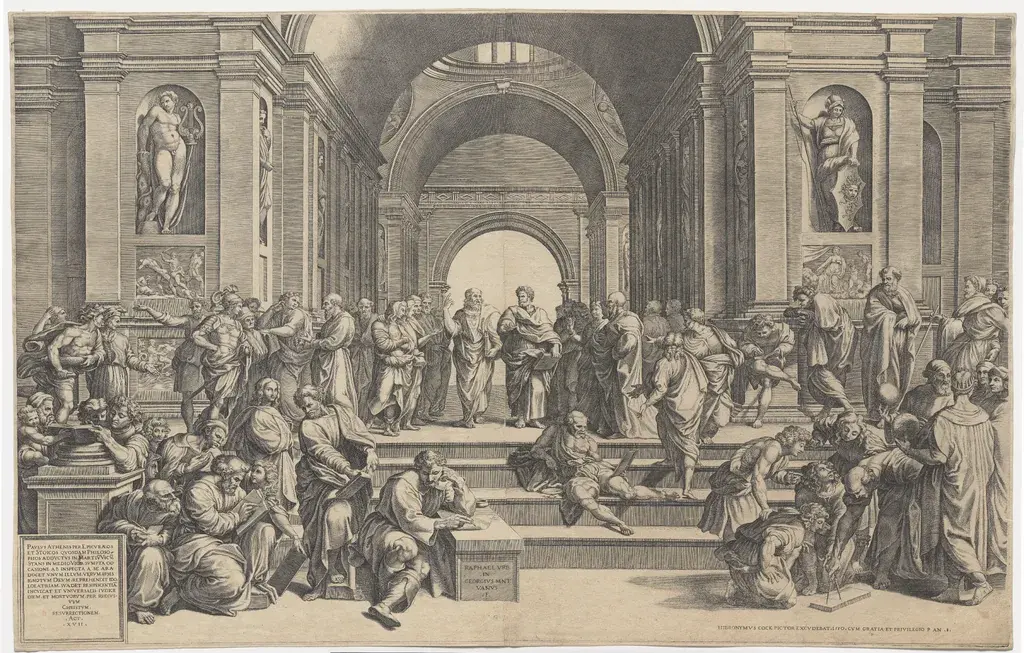
Raphael painted The School of Athens in the Vatican’s Stanza della Segnatura, around 1510–1511. Its gathering of philosophers belongs to the room’s wider intellectual programme. The famous central pair is Plato and Aristotle, surrounded by groups absorbed in argument, demonstration, reading and writing.
The illustrated object is different: Giorgio Ghisi’s 1550 engraving after Raphael. The Städel catalogue identifies copperplate engraving on handmade paper, inventory 23589, with a sheet measuring 51.9 × 81.5 cm. Its digital record uses the identifier 23589D. The lettering names publisher Hieronymus Cock and the year 1550.
A caption that credits this sheet simply to “Raphael, 1511” loses Ghisi’s work and makes the physical object nearly impossible to trace. “After Raphael” is not a dismissive description. It tells the reader that another artist translated an existing composition into another medium.
Two sheets are not two complete pictures
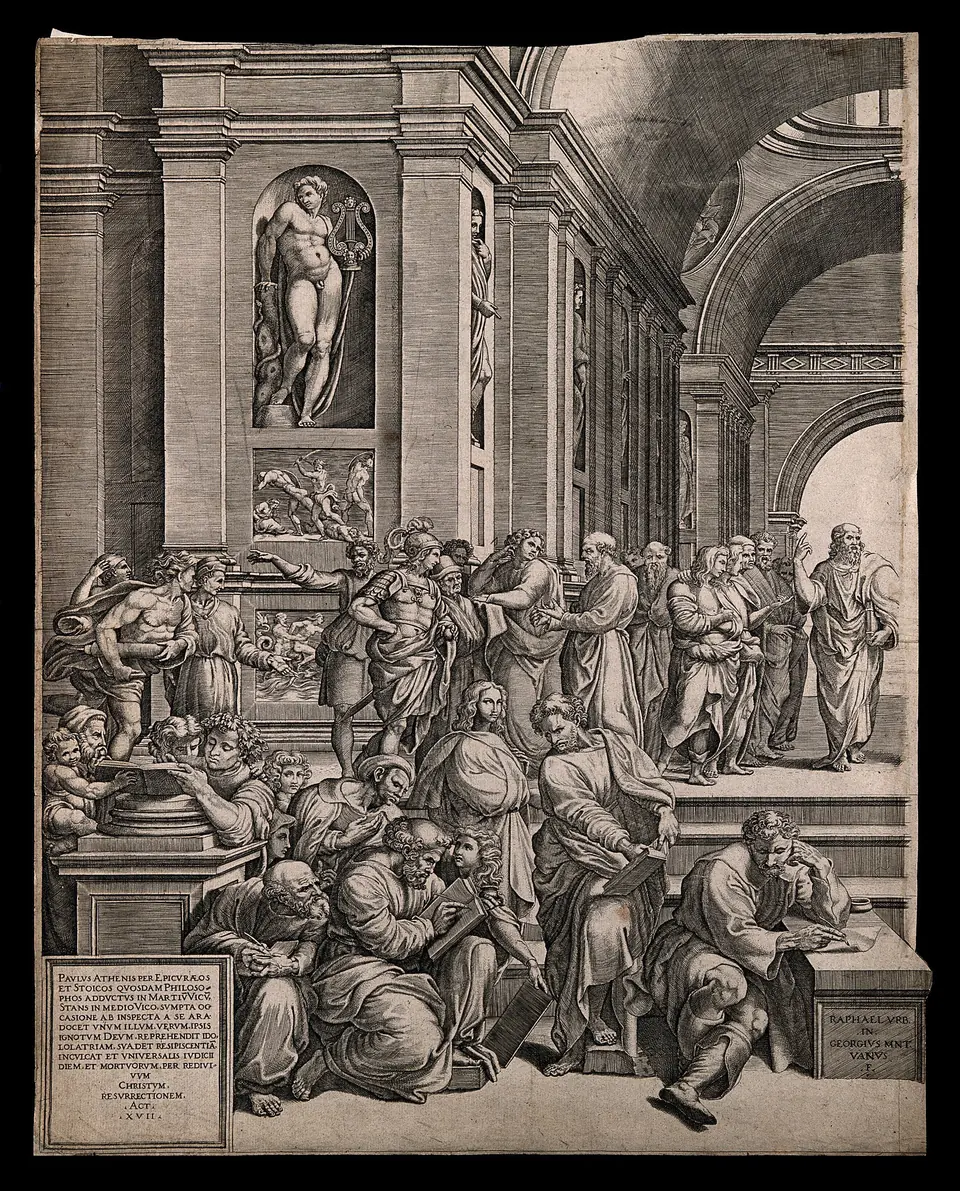
Wellcome’s digitised object, 543311i, is expressly catalogued as the left sheet of a two-sheet engraving. The museum records a platemark of 39.1 × 51.4 cm. It is not a smaller, complete version of the fresco and should not be advertised as one.
The Städel and Wellcome files also represent different physical impressions. Do not join their edges digitally and claim to have reconstructed one original sheet. Differences in paper, margins, ink and wear would then be hidden beneath an invented object history.
This is a practical trap in image searches. A result can have the right title and artist but contain only half the subject. Before downloading, compare the image boundaries and read the catalogue’s notes. Words such as “left sheet,” “detail,” “state” and “after” often matter more than the headline.
Look at the lines and the lettering
The full engraving organises the crowd through the hall’s repeated arches, the broad steps and a strong central opening. In the left sheet, the statue’s niche rises above several overlapping groups. Bent heads, open books and hands addressing one another turn the architecture into a space for activity rather than an empty ceremonial backdrop.
At this scale, the print also makes its medium visible. Parallel lines darken the architectural recesses; curved and crossing strokes describe bodies and drapery. White paper supplies light. These are choices made in a print, not merely a colour photograph converted to grey.
The lower lettering introduces another difference. Wellcome’s record explains that it interprets the gathering through Saint Paul addressing the philosophers of Athens, citing Acts 17. That is the print’s textual framing. It should not replace the Vatican’s identification of the fresco as a gathering of ancient philosophers.
The historical reproduction therefore helps with more than rights research. It shows how an image can acquire new explanations as it moves between locations, audiences and media. A careful caption keeps those layers visible instead of pretending the print is a transparent window onto the wall.
What 1550 does and does not prove
The publisher’s name, date and engraved lettering provide evidence of a produced and issued print. Wellcome catalogues publication in Antwerp by H. Cock in 1550. This is a stronger, more specific record for this edition than the observation that visitors could once see Raphael’s wall painting.
It is not evidence that Raphael, who died in 1520, personally authorised a print issued three decades later. Nor does it prove that every feature of the fresco, every state of the engraving or every modern colour rendition has an identical publication history.
For United States analysis, the Copyright Office’s publication guidance distinguishes distribution of copies from public display. An authorised sale of an original can also matter; a reproduction is not the only possible evidence. Here, the dated printed edition gives a concrete object to examine without equating the fresco’s completion with publication.
The published-work duration rules put this sixteenth-century edition far outside any surviving ninety-five-year term. Our conclusion concerns the historic print and its depicted composition, not a blanket authorisation for every later image supplied by any institution.
Country and file are separate checks
Raphael died in 1520 and Ghisi in 1582, dates recorded by the Städel. Both are far beyond the ordinary life-plus-seventy-year terms described in EU law and UK guidance. That does not eliminate every possible non-copyright condition attached to a particular project.
The exact image evidence here is affirmative. Wellcome labels its selected file Public Domain Mark. The Städel labels its image public domain and its digital-collection policy permits reuse for any purpose. We retain the requested institutional credit.
The Public Domain Mark is a status assessment, not a new copyright licence or a worldwide warranty. These identified institutional releases support the illustrations used in this article. They should not be copied into the metadata of a different photograph simply because it shows the same subject.
A modern Vatican image needs its own terms
The Vatican’s website notice claims rights in its site materials, including images. Its image services are a separate source for reproductions. We do not treat a website’s visibility as permission for commercial reuse.
Conversely, that notice does not revive Raphael’s author copyright. A historical print released by another collection is a different file and object. Identify which source your project actually uses before seeking or asserting permission. Italian state-museum rules should not simply be transferred to Vatican City without checking their applicability.
Caption the object you actually use
For this engraving, retain Ghisi’s name, “after Raphael,” the 1550 date and the holding collection. Say whether the file contains the full composition or a single sheet. For a contemporary photograph, credit its actual photographer and provider instead.
If your purpose is to discuss the fresco’s colours, find an appropriately licensed colour source; do not colourise this engraving and present the result as Raphael’s untouched painting. Our Raphael guide offers the broader artist context. The useful habit is the same: establish the work, the reproduction and the file separately.
Editorial record
About this article
- Author
- Publisher
- GeMarkt
- Published
- Reviewed
- Internal source & rights check. Conducted by GeMarkt Research Review. This is an internal editorial check—not independent peer review.
- Source standard
- Rights guide source standardSeparates the underlying work from the source file, records the review date, and links the evidence used for the conclusion.
Found a claim that needs checking? Report a factual error.