Is Raphael's Art Public Domain? A Practical Guide
Raphael's established works are public domain, but workshop attribution and the rights attached to a particular museum image still need verification.
Rights check · reviewed
The short answer
Yes—for Raphael’s established, long-published paintings, frescoes and drawings. The original art is outside ordinary copyright terms, while the photograph or downloadable file you choose may carry separate terms.
| What is being checked | Result | Why |
|---|---|---|
| European Union & United Kingdom | Public domain | Raphael died in 1520, centuries beyond the ordinary life-plus-70 term for artistic works. |
| United States | Clear for the long-published works covered here | The established examples covered here have documented, long publication histories. A newly discovered or formerly unpublished object still needs its own U.S. history checked. |
| Digital image or scan | Check the source file | The old artwork and a modern photograph, scan, restoration or website download are separate questions. Read the source record and its terms before reuse. |
Raphael ran a major workshop and his designs were widely copied. Confirm that a record says Raphael—not merely workshop of, follower of, after or formerly attributed to Raphael—before making an authorship claim.
This is a documented research summary, not legal advice. Copyright and moral-rights rules can vary by country and by the history of a particular work.
The short legal answer needs a catalogue answer beside it
Raphael died in 1520. His established paintings, drawings and fresco designs are centuries beyond the ordinary life-plus-70 copyright term applied in the European Union and United Kingdom. Familiar, long-published works are also clear under the older-work framework used in the United States.
But two independent questions remain:
- Does a current scholarly record attribute this exact object to Raphael?
- Is the digital image being used openly reusable, or merely a convenient copy found online?
Answering only the first copyright question is how a public-domain archive accumulates mislabeled workshop pictures and files with no durable source trail. Our broader guide, Public domain is not a free-for-all, explains why the historical work and a modern reproduction are separate layers.
Raphael’s workshop makes wording especially important
Raphael led a large and productive workshop. His compositions were completed with assistants, repeated, engraved and copied across Europe. Museum catalogues therefore use qualifiers such as “workshop of Raphael,” “after Raphael,” “follower of Raphael” and “formerly attributed to Raphael.”
Those phrases should survive all the way into a product record. Removing “workshop of” to make a title shorter creates a false claim about authorship. The image may be old enough to be public domain either way, but the label is still inaccurate.
The same rule applies when scholarship changes. A filename created years ago is not evidence. Before GeMarkt publishes a Raphael work, the title and attribution are checked against the institution that currently holds or catalogues the object.
Why a Vatican artwork may still need a different source file
Raphael’s most searched works include The School of Athens and The Transfiguration, both associated with the Vatican Museums. The underlying Renaissance works are outside ordinary copyright terms. Yet the Vatican website publishes terms governing its own material and images.
For production, that means we do not treat a webpage image as reusable merely because its subject is public domain. We can document the artwork from one authoritative record while sourcing the production master from an institution or repository that clearly permits the exact file’s reuse.
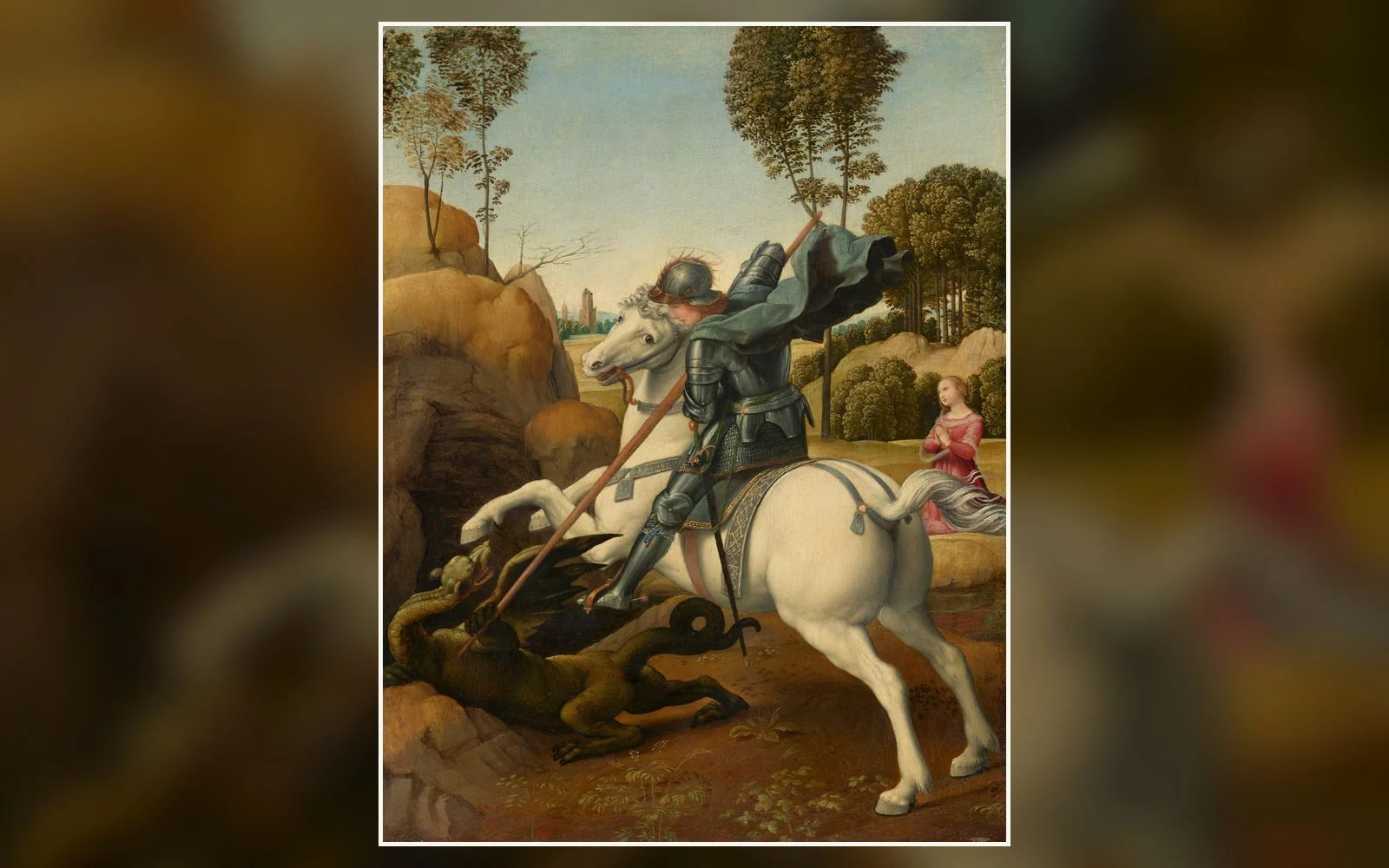
The feature above follows that rule. The National Gallery of Art identifies Saint George and the Dragon as a Raphael painting from about 1506 and supplies public-domain open-access media. The caption links directly to the object record.
What our archive audit found
The GeMarkt production archive contains 142 processed Raphael masters. This is the largest folder in the first Renaissance review group, but it is not automatically the largest publishable set.
We now track four separate facts for every candidate:
- Object: exact title, date, holding institution and permanent record.
- Attribution: Raphael, workshop, follower, after, or another current qualifier.
- Rights: the historical artwork’s status and the exact source file’s status.
- Production: restoration, crop, resolution, duplicate check and final quality review.
Only files complete in all four areas can move into products or free downloads. A folder name or an upload-ready image is not enough.
The safest first Raphael candidates
The National Gallery of Art offers several strong starting points because the object record and open image are documented together:
These do not become products merely because they appear on this list; the GeMarkt master still has to be matched to the official file and pass visual quality control. They are, however, better first candidates than a file whose only provenance is an old download folder.
The source record should retain the object URL, image URL, rights statement, review date, current attribution and every transformation made after download. If a future catalogue update changes the attribution, we can then find every dependent product, wallpaper and article without guessing.
Can Raphael images be sold or adapted?
For an established Raphael work paired with an openly reusable image, ordinary copyright generally permits printing, adaptation and commercial use. That does not erase other obligations. A seller still needs honest attribution, accurate product photography, clear descriptions, and compliance with any applicable local moral-rights, cultural-property or contractual rules.
The most dependable workflow is therefore not “Raphael died long ago, so use every file.” It is: confirm the object, preserve the qualifier, choose an open source, document the file, and then restore it.
Raphael wallpapers will follow that object-by-object review. In the meantime, the existing sets in our free wallpaper library have already passed their release checks.
Sources and review method
We checked the artist chronology against museum records, treated each named jurisdiction separately, and recorded the provider policy for the image set. These sources support the legal framework and artist dates used above; the source file for any individual image still needs its own record.
- Raphael — The National Gallery, London. Museum biography, dates and examples of attribution language used for Raphael and later copies.
- Saint George and the Dragon — National Gallery of Art. Object identity, attribution, date and a downloadable public-domain image.
- Free Images and Open Access — National Gallery of Art. The NGA releases images of public-domain works that it believes are public domain and free of known restrictions.
- Directive 2006/116/EC, Article 1 — EUR-Lex. The EU term for an artistic work is the author’s life plus 70 years.
- How long copyright lasts — UK Government. UK guidance gives 70 years after the author’s death for artistic works.
- Circular 15A: Duration of Copyright — U.S. Copyright Office. The 2026 term table places works published before 1931 outside the maximum 95-year publication term.
- Certain Unpublished, Unregistered Works Enter Public Domain — U.S. Copyright Office. Older unpublished works have a separate U.S. term analysis; discovery and first-publication history can matter.
- Copyright notice: digital images, photographs and the internet — UK Intellectual Property Office. A digital image can require a separate rights and website-terms check even when its subject is old.
Editorial record
About this article
- Publisher
- GeMarkt
- Published
Found a claim that needs checking? Report a factual error.