GeMarkt Blog · Reference
Is Saturn Devouring His Son by Francisco Goya Public Domain?
Check Goya’s original mural, its transfer to canvas, an early illustration record and the separate rights statement for the exact image used here.


The short answer
Goya’s historical composition is beyond its ordinary author copyright term in the UK and Europe. The particular reproduction shown here is marked public domain by Wikimedia Commons. Neither point gives automatic permission to download any modern museum photograph or republish a recent restoration image.
This guide concerns the Prado’s P000763, usually called Saturn Devouring His Son, and a Yorck Project reproduction available through Commons. Checked 12 October 2026, its file page assesses the faithful reproduction as public domain. We have not independently completed the underlying painting’s U.S. publication and authorisation history. An important nineteenth-century illustration reference is identified below, with its limits intact.
Which Saturn this means
The Prado’s collection record dates Saturn to 1820–1823 and identifies it as a wall painting transferred to canvas. It belongs to the fourteen works now known as the Black Paintings, made for rooms in Goya’s Quinta del Sordo. The current object is not an independently painted canvas version of a vanished mural.
That distinction matters when an image caption says “oil on canvas.” It describes the work’s present support incompletely, leaving out the earlier wall and the process that separated the painted surface from it. The Fundación Goya en Aragón catalogue likewise records the transfer and documents the work’s conservation history.
Use the museum, inventory number and complete composition to identify your source. The subject also appears in other artists’ work. A search for “Saturn eating his children” is not enough to establish that a file represents Goya’s painting, rather than a different interpretation, a modern imitation or a cropped detail.
Look at the complete composition
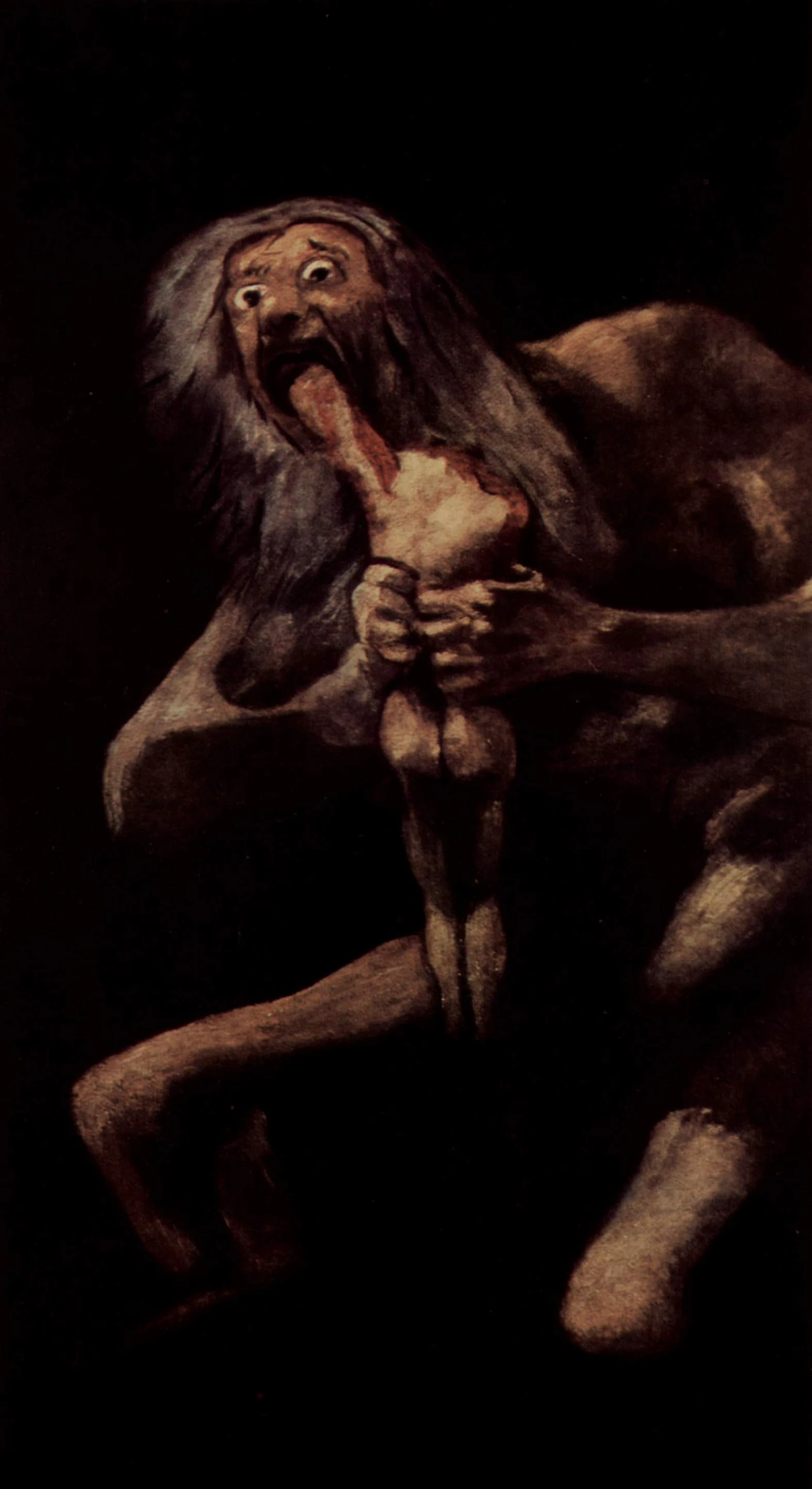
The eyes attract attention first, but the hands hold the picture together. They close around the smaller body near the centre, creating a knot of fingers, pale skin and red. Below that knot, the larger figure’s legs bend outwards. Above it, the face seems caught between darkness and a harsh, uneven light.
There is remarkably little setting to orient us. Darkness does not simply fill a background behind an otherwise complete person; it swallows parts of the body. The smaller figure, meanwhile, supplies the strongest pale vertical shape. This is why a crop limited to Saturn’s face gives such a different account of the painting. It changes a bodily action into something closer to a portrait of terror.
For an explanatory article, show the whole composition before a detail. If a close-up is needed, label it clearly. A brighter digital version may reveal more texture, but it may also make the surrounding blackness less effective. Do not describe a contrast adjustment as the discovery of Goya’s “true colours” without conservation evidence.
Why the wall and the canvas matter
The transfer changed how the painting could travel, be displayed and be photographed. It also means that the image now familiar from books is a record of a surviving, conserved object, not a time machine showing the untouched wall in Goya’s house.
The foundation’s conservation account describes losses and interventions. That does not make the current picture a new composition wholly owned by a restorer. Nor does the age of the original guarantee that every later photograph, reconstruction, colourisation or annotated comparison is freely reusable. Identify what the file actually contains before reasoning about its rights.
A useful comparison might place an early photograph beside today’s canvas. Those are two source objects, however, and need two file checks. Permission or a public-domain assessment for one should never be copied across to the other. This page illustrates only the specified colour reproduction; it does not reproduce an archival photograph of the original wall.
What the European term answer covers
Goya died in 1828. The ordinary life-plus-seventy author term described by UK government guidance has long elapsed. The EU’s general guidance uses the same general term, while national transitional rules still need attention for older works.
Spain is a reason not to treat that shorthand as the whole law. The Biblioteca Nacional de España explains its eighty-year legacy term for authors who died before December 1987. Even that longer author term has long elapsed here. Article 41 of Spain’s copyright statute also requires respect for authorship and integrity when public-domain works are used.
For a reader, the practical distinction is between expired economic rights in Goya’s work and every possible condition attached to a use. An accurate artist credit still matters. A photograph containing a modern installation or other original elements is a different file question. A museum’s delivery contract is not answered merely by calculating the painter’s lifespan.
The U.S. question needs a publication record
The Prado record reports that Charles Yriarte described and illustrated Saturn in his 1867 monograph. This is much more relevant to publication research than the date when Goya painted the wall. It points to a particular book and an image of the composition, rather than simply to public access to the original.
Nevertheless, this guide has not independently inspected that exact plate and completed the associated authorisation analysis. We therefore retain it as an institutional publication reference, not a finished U.S. clearance certificate. The twentieth-century date of a digital source should not be mistaken for the painting’s first publication either.
U.S. law distinguishes distribution from public display. An exhibition or museum acquisition alone does not establish publication. Its term provisions also distinguish older published works from previously unpublished material, including special transition rules. “Painted around 1820” cannot replace that analysis.
The exact reproduction on this page
Our image comes from the Commons file credited to The Yorck Project’s 2002 collection, not from a current Prado download. Commons applies PD-Art and Public Domain Mark 1.0 to this faithful two-dimensional reproduction. The record’s compilation notice should not be confused with a separate copyright claim over Goya’s individual painting.
The Public Domain Mark records an assessment, rather than a new licence granted by the museum. Its own notice warns that jurisdictions and other rights may differ and that no warranty is supplied. We report that assessment without turning it into worldwide commercial clearance.
The full supplied image has been proportionally reduced for this page. It has not been cropped, recoloured, extended or retouched. It is useful for looking and discussion, but it is not represented as a colour-calibrated production master. A clearer modern scan could have a different source and different conditions.
Before using Saturn in your own project
Keep the object identity, exact file page and rights statement together. Record which countries and uses you assessed; do not replace a specific unresolved point with either a universal “yes” or an unsupported “no.” For substantial commercial distribution, resolve the relevant publication question and any supplier conditions before producing stock.
A caption should credit Goya, identify the Prado object and name the reproduction source. If you crop, explain that it is a detail. If you create an adaptation, distinguish your additions from the historical painting and avoid implying museum endorsement.
For Goya’s published print series and their different evidence, continue with the artist rights guide. For another painting-level check, see The Third of May 1808. These are research guides, not individual legal advice.
Editorial record
About this article
- Author
- Publisher
- GeMarkt
- Published
- Reviewed
- Internal source & rights check. Conducted by GeMarkt Research Review. This is an internal editorial check—not independent peer review.
- Source standard
- Rights guide source standardSeparates the underlying work from the source file, records the review date, and links the evidence used for the conclusion.
Found a claim that needs checking? Report a factual error.