GeMarkt Blog · Reference
Is Hiroshige’s Plum Park in Kameido Public Domain?
Hiroshige’s 1857 Plum Park design is public domain. Find a documented open image and distinguish the historical print from Van Gogh’s version.

The short answer
Yes. Hiroshige’s 1857 design Plum Park in Kameido is public domain. For the historical print shown below, Tokyo Fuji Art Museum identifies the underlying work as public domain and offers its digital image under CC0. This gives a documented route to a particular museum impression, not a blanket licence for every modern copy bearing the title.
You may also see the work called Plum Garden at Kameido, Plum Estate at Kameido or Kameido Umeyashiki. The important match is the composition and series. A similar title alone is not enough to identify the image, especially when searching for Hiroshige’s print and Van Gogh’s response together.
Identify the tree and the series
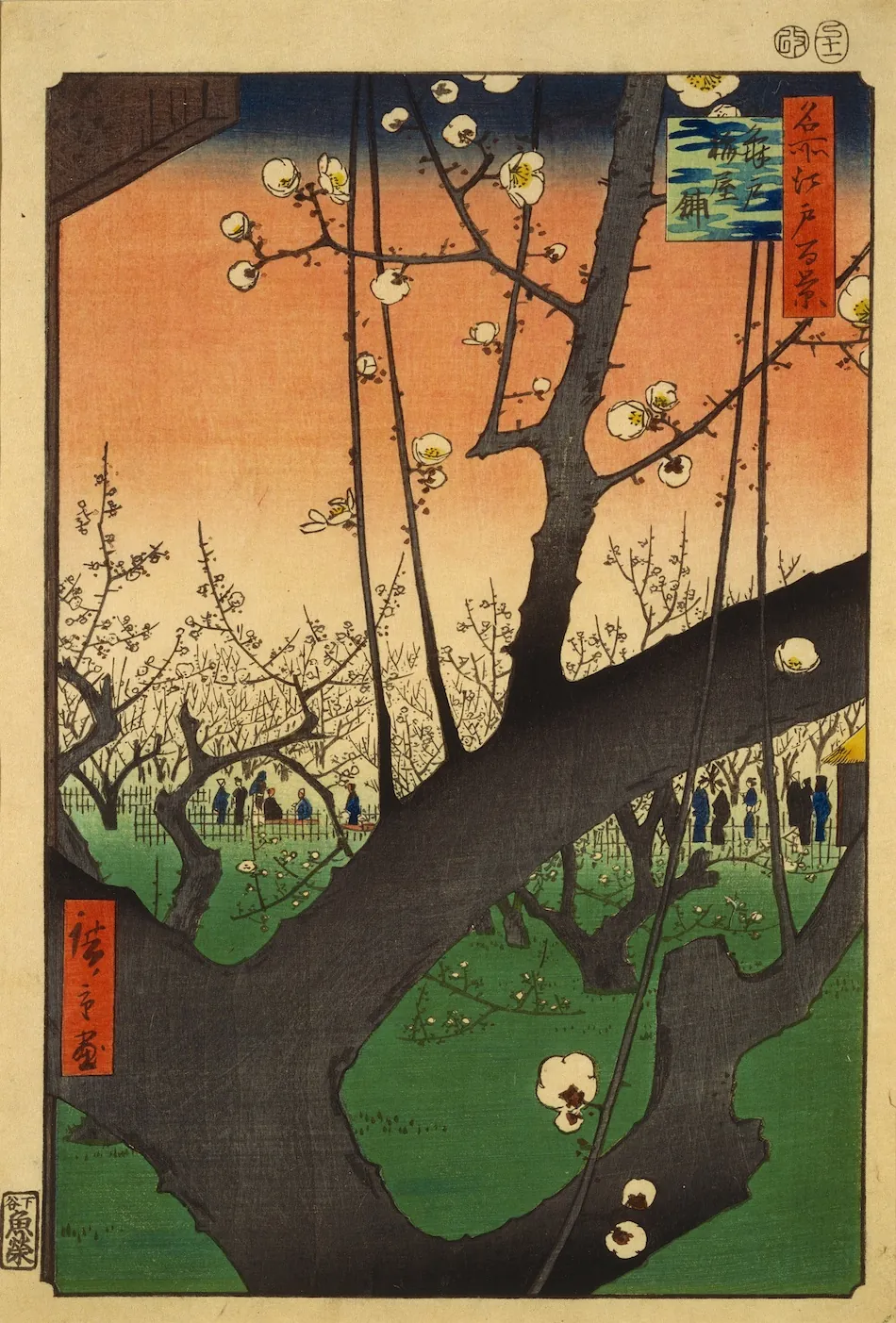
The striking feature is a dark tree trunk placed very close to the viewer. Its branches divide the picture, while visitors appear small in the garden behind it. White blossoms stand out against the sky. That contrast between a large foreground object and a distant scene makes the design easy to recognise even at a small size.
The Tokyo Fuji Art Museum record identifies this sheet as a colour woodblock print on paper, dated 1857, measuring 36.8 × 25.0 cm. Its English series title is One Hundred Scenic Spots of Edo, commonly translated elsewhere as One Hundred Famous Views of Edo. The page’s record identifier is 01171; that is the exact source used above.
Do not confuse Kameido with Plum Garden at Kamata, another Hiroshige design. The Met’s Kamata record names that different place and composition. A search for “Hiroshige plum garden” can retrieve either. Comparing the picture as well as the title prevents the wrong work being attached to an otherwise correct rights statement.
The publication and country checks
For the historical design, there is publisher evidence as well as an old date. The Rijksmuseum’s Kameido record names Hiroshige I and publisher Uoya Eikichi, both identified on its sheet, and dates the work to 1857. This supports the identification of an issued woodblock design. The Rijksmuseum impression is a different physical sheet from the Tokyo Fuji example.
For the United States, that nineteenth-century publication is beyond the maximum term discussed by the Copyright Office. A later museum acquisition or a recent image upload is not a new first publication of the old design. The URAA restoration guidance does not create a fresh term for an old Japanese print simply because it is now available online.
Hiroshige I died in 1858. Japan’s Agency for Cultural Affairs explains that expired rights were not revived by the country’s 2018 extension. The design is also beyond ordinary author-life-plus-70 economic terms in the UK and Türkiye.
These findings concern the old work in those contexts. They do not identify a new recarving, a contemporary artist’s interpretation or an edited commercial download. Those items may contain additional material with a different history.
An open file from Tokyo Fuji
The Tokyo Fuji page separates two layers explicitly: the original work is in the public domain, and the museum’s digital image is made available under CC0. Its usage panel includes educational, non-commercial and commercial uses. This is more useful than a search engine’s generic “free image” label because it comes from the supplying institution and names the object.
Use the collection page’s download link and retain the page URL. The supplied file is 950 × 1403 pixels. That can illustrate a web article, but it should not be mistaken for a high-resolution production scan suitable for every print size. Increasing the pixel dimensions later does not recover detail absent from the supplied image.
The CC0 statement belongs to this museum resource. It does not transfer automatically to a photograph from another museum, a paid image library or a dealer’s catalogue. Nor does it make Tokyo Fuji a sponsor of a product that uses the image. A source credit is a statement of provenance, not endorsement.
Why colours and margins differ
An impression is one sheet printed from the blocks. Different impressions of the same design can have different printing, condition and photographic histories. A dark sky in one file and a lighter sky in another are reasons to inspect the records, not proof that one image is a fake.
Avoid claiming that a colourful download shows the exact appearance of the first printing unless that is supported by the institution’s research. A visually pleasing reproduction can still be an uncertain guide to historical colour. Likewise, “restored” is not a substitute for an explanation of what was changed.
For a faithful illustration, keep the selected impression intact. If a page compares several impressions, give each its own caption and source. Do not borrow one sheet’s accession, another’s dimensions and a third’s image to create a fictional combined object.
Van Gogh’s plum orchard is a separate work
The composition also appears in Van Gogh’s Flowering Plum Orchard (after Hiroshige). The Van Gogh Museum identifies that work as an 1887 oil painting, not a Japanese woodblock impression.
This creates a common search-result trap. A user asks for Hiroshige, downloads Van Gogh’s painted interpretation, and then copies a Japanese print’s museum credit underneath. The image and record no longer match. The fact that Van Gogh took inspiration from Hiroshige does not make their two works one object.
If you want the painting, choose the painting’s own object and file record. If you want the historical Japanese design, keep the Hiroshige impression’s record. The same principle applies to a modern illustration inspired by the tree: name it as an adaptation and clear the specific modern file.
Prepare the image without inventing detail
This composition depends on how the near tree frames the distant garden. A close crop around blossoms may work as a decorative detail, but it removes much of that relationship. Show the full sheet when introducing the work; label a crop as a detail when that is what you need.
Do not stretch the tree to make the image fill a different rectangle. Choose a matching format or preserve empty space around the composition. For large reproductions, find an appropriately documented higher-resolution file rather than presenting automated sharpening as newly recovered historical information.
Keep any modifications separate from the clean source. That makes it easier to explain why a printed version, a website thumbnail and the museum image may look different.
What to save with the download
Retain the artist, title, series, 1857 date, Tokyo Fuji Art Museum collection credit, record 01171, the source URL and CC0 statement. Add your own description of any crop or recolouring; do not silently pass it off as part of the museum image.
For other impressions and later editions, see the Hiroshige rights guide. The broader public-domain introduction explains why an old work and an online file need separate checks. This is general research guidance rather than legal advice for an individual project.
Editorial record
About this article
- Author
- Publisher
- GeMarkt
- Published
- Reviewed
- Internal source & rights check. Conducted by GeMarkt Research Review. This is an internal editorial check—not independent peer review.
- Source standard
- Rights guide source standardSeparates the underlying work from the source file, records the review date, and links the evidence used for the conclusion.
Found a claim that needs checking? Report a factual error.