GeMarkt Blog · Reference
Is American Gothic by Grant Wood Public Domain?
American Gothic entered the US public domain in 1958. Check the painting’s renewal history, the exact Commons file and what a modern adaptation adds.


The short answer
Yes: the Art Institute of Chicago records Grant Wood’s American Gothic as having entered the U.S. public domain in 1958. It did not first become available in 2026. The museum attributes the earlier result to a missed renewal deadline, not simply to the painting’s age.
That answer concerns the 1930 painting, accession 1930.934. A digital reproduction, a photograph recreating the scene and a newly illustrated parody are separate things. The image on this page comes from a particular Commons file marked as a faithful public-domain reproduction; it is not an assertion that every download offered by the museum is an open-access file. Sources and file status were checked on 12 October 2026.
Which American Gothic this means
The museum catalogue identifies the original as oil on Beaver Board, 78 × 65.3 cm. Wood painted it in 1930. The house was inspired by a building in Eldon, Iowa, whose pointed window belongs to the Carpenter Gothic tradition.
The figures are a farmer and his daughter, rather than the married couple often assumed. Wood’s sister and his dentist served as models. Those facts identify his constructed scene; they do not make the picture a documentary photograph of the household that occupied the building.
An object number is useful here because the title has been reused so often. Searching for “American Gothic image” can produce Wood’s painting, a photograph of two people posing with a fork, a cartoon, a film poster or a recent book cover. Their resemblance does not make their copyright histories interchangeable.
The two faces and the house
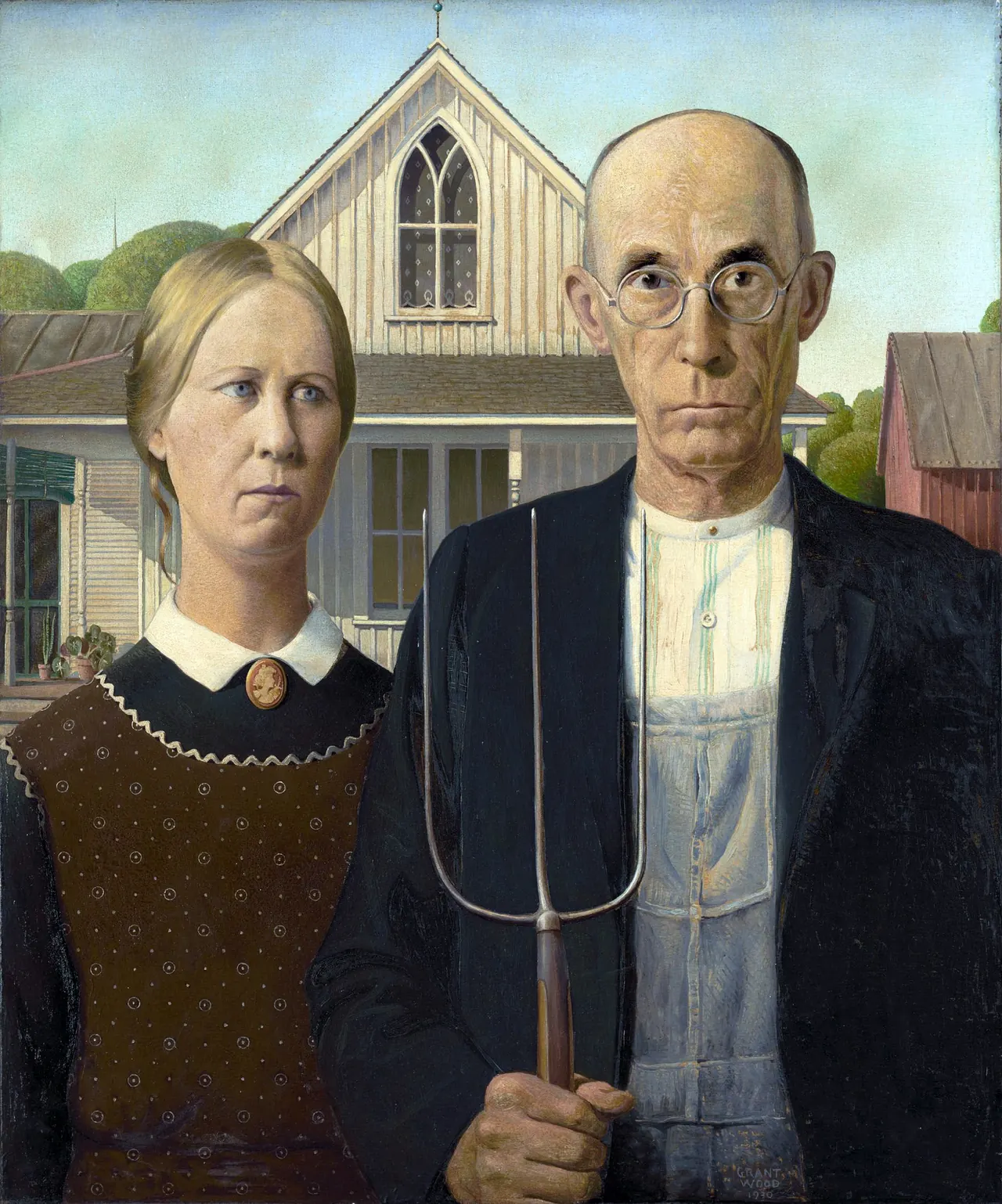
Look past the famous pitchfork. Its three long prongs repeat the upright lines of the man’s overalls, while the sharp window rises between the two heads. These echoes make the arrangement feel almost architectural. The people do not merely stand in front of the house: their clothing, tools and posture help build the picture’s pattern.
Their gazes also differ. The man looks outward, while the woman turns her eyes to the side. Neither expression settles into an easy smile. A viewer can notice that tension without deciding that Wood intended only mockery or only admiration.
This matters when reproducing the image. A close crop of the faces loses the fork and much of the window, making the work read more like a double portrait. A crop of the man alone removes the relationship between the figures. Both can be useful details, but neither should be captioned as though it were the complete painting.
The version shown here preserves the painted composition. It is not presented as a colour-calibrated print master or a promise that a physical reproduction will match the museum object under every light.
Why the US answer is already yes
The strongest evidence is the Art Institute’s specific copyright-history account. It reports publication in 1930, expiry in 1958 and an estate renewal filing in 1980 that arrived too late. Its 1930 exhibition-catalogue record provides a separate bibliographic reference for that early published appearance.
This is more useful than subtracting Wood’s death year from today. Under the historical U.S. system, timely renewal mattered for works from this period. The Copyright Office’s duration guide explains that older framework. We rely on the museum’s work-specific finding here; we are not claiming to have independently reconstructed every registration and renewal entry.
Nor does the conclusion depend on treating a gallery exhibition as publication. Showing a painting to visitors and distributing reproductions are different events. The catalogue and the institution’s express publication account are the relevant evidence.
The familiar 2026 discussion concerns the general maximum term for works published in 1930. It does not erase an earlier lapse. Our American Gothic copyright timeline explains that calendar question in more detail; the practical point here is that the painting was already available.
The file used here and the museum flag
The Commons record for this exact image applies the Public Domain Mark and describes a faithful reproduction of a two-dimensional work. It also displays a public notice that permission correspondence was reviewed by Commons volunteers. We have not inspected that private correspondence and do not represent it as our own legal clearance.
There is a visible complication worth retaining: the Art Institute’s current API returns is_public_domain: false for its object record. We have therefore not treated the museum’s API image as a CC0 download. The illustration here is the separately documented Commons file, already used in our Grant Wood guide, with its source and rights label preserved.
A database flag and a historical copyright account answer different questions; silently deleting one to make the result look simpler would be unhelpful. If you want a different museum-supplied file, check its own terms. This page’s choice does not transfer permission to that other file.
The Public Domain Mark records a status assessment rather than granting a new licence. It also does not supply a warranty or imply endorsement by the artist’s estate, the museum or Commons.
What changes outside the United States
The U.S. renewal result is not a worldwide rule. Wood died in 1942. The ordinary author term described in EU guidance and the UK government’s duration table is life plus seventy years for artistic works. On that ordinary calculation, his author term has also elapsed.
That is a bounded term assessment, not a survey of every national exception or every later work derived from his painting. Moral rights, misleading endorsements and contractual access terms can raise different questions. For a substantial commercial release across several countries, keep the intended markets and exact file in the review rather than relying on a general “old art” label.
A reproduction is not the same as a remake
A straightforward reproduction of the public-domain painting does not require a new copyright licence from Wood’s estate in the United States. But consider three different projects before copying what appears in an image search:
- The painting itself: identify an appropriately documented reproduction and retain its source.
- A staged photograph: a photographer’s lighting, arrangement and photograph may contain new protected authorship even when the pose refers to Wood.
- A recent cartoon or adaptation: newly drawn characters, lettering or other original additions are not automatically free because the underlying composition is familiar.
The Copyright Office’s derivative-work guidance makes the underlying distinction: protection for qualifying new material does not restore ownership of the old public-domain work. It also does not make those new contributions free for someone else to copy.
Keep the source with the image
For this painting, a useful record is short: Grant Wood; American Gothic; 1930; Art Institute of Chicago; accession 1930.934; exact image page; rights statement; date checked. Add a note if your final design crops or otherwise changes the reproduction.
Keep the downloaded file and that record together. A folder called “free paintings” loses the evidence; a saved source page lets an editor distinguish the original painting from a modern remake months later. The answer is therefore not merely yes: it is yes for the historical painting, with a separately documented choice of image file.
Editorial record
About this article
- Author
- Publisher
- GeMarkt
- Published
- Reviewed
- Internal source & rights check. Conducted by GeMarkt Research Review. This is an internal editorial check—not independent peer review.
- Source standard
- Rights guide source standardSeparates the underlying work from the source file, records the review date, and links the evidence used for the conclusion.
Found a claim that needs checking? Report a factual error.