GeMarkt Blog · Reference
American Gothic and Public Domain Day 2026: Why 1958 Matters
American Gothic did not first enter the US public domain in 2026. Follow the Art Institute’s 1958 renewal finding and the separate image-file question.

The short answer
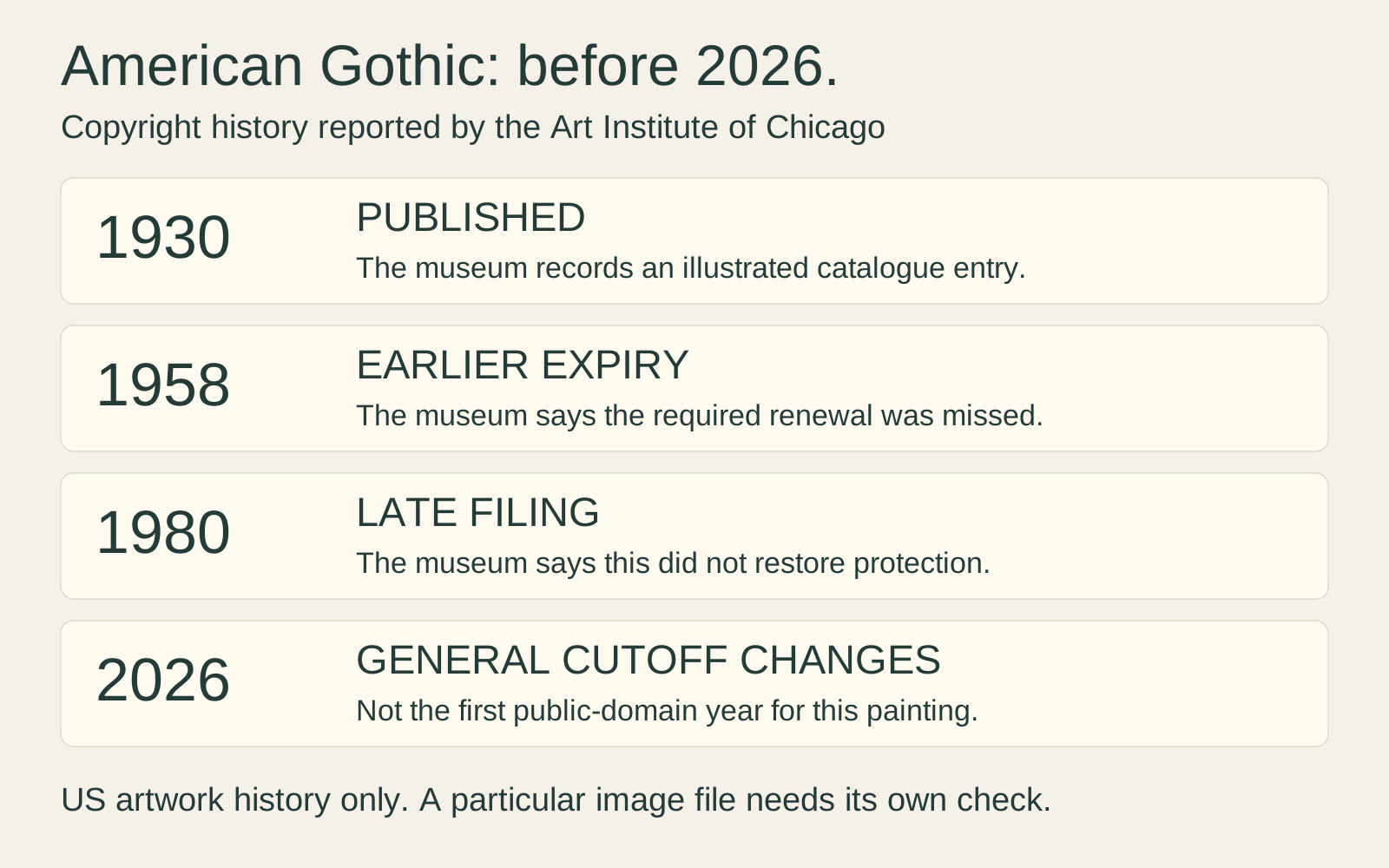
American Gothic is a useful painting to discuss on Public Domain Day 2026, but not because its US copyright first ended that January. The Art Institute of Chicago’s copyright-history record says it entered the US public domain in 1958, after the renewal deadline was missed. A later filing in 1980 did not revive the expired protection.
What changed in 2026 was the broader calendar cutoff. The US Copyright Office now identifies works published in the United States before 1 January 1931 as public domain. Grant Wood’s painting belongs to that older published period, but its own history reached the result much earlier.
That difference matters. A public-domain celebration should explain what actually became available, not simply collect famous works bearing a convenient year.
Begin with the exact painting
The work is Grant Wood’s American Gothic, dated 1930, in the Art Institute of Chicago, accession 1930.934. The museum’s object record and public catalogue API identify the object and its bibliography. These identifiers distinguish it from later adaptations and other works using the same title.
Its publication history includes an illustrated entry, number 207, in the museum’s 1930 annual-exhibition catalogue. There is also a December 1930 bulletin reference. The museum library’s catalogue record independently identifies the 1930 publication and the painting’s accession number.
This is more useful copyright evidence than a bare “1930” on a museum label. One date concerns making the painting; the catalogue record concerns publishing it. In this case, the dates fall in the same year. That coincidence should not become an assumption about other art.
Why the renewal history matters
Under the older US system, a work could lose protection if required formalities were not satisfied. The Art Institute’s exhibition on copyright formalities explains the renewal requirement for works published before 1964 and uses American Gothic as a case study.
The practical lesson is not that every old painting missed its renewal. It is that a maximum copyright term and the actual history of an individual work are different things. A term describes how long protection can last under the applicable rule. Records show what happened to the particular work.
For American Gothic, the museum gives a specific earlier public-domain conclusion. We should preserve that finding rather than replace it with a more fashionable 2026 headline. “Public domain in 2026” and “became public domain in 2026” are not interchangeable statements.
What January 2026 does tell us
The Copyright Office’s duration circular explains the 95-year maximum applicable to many older copyrights. A qualifying copyright from 1930 completing that term runs through the end of 2025. The next calendar year therefore matters to works that remained protected for the full term.
This gives readers a helpful checkpoint for other artworks: look for documented authorised publication, not merely a creation date. A privately retained drawing made in 1930 may follow a different route from a print issued to the public that year.
The Copyright Office’s visual-artist guidance distinguishes publication from public display. A museum opening or exhibition label alone does not establish when copies were distributed. An illustrated periodical, a documented issue of prints or an authorised offering may provide a more relevant research path.
An old work is not every image of that work
The physical painting, Wood’s composition and a particular digital reproduction should be kept separate. You may find a museum photograph, a photographed page from a modern book, a colour-adjusted scan or a contemporary parody. They are not interchangeable source files.
A later adaptation can contain its own original material without taking the old composition out of the public domain. The Copyright Office’s derivative-work guidance limits protection to qualifying new authorship, rather than the underlying public-domain material.
For a reproduction project, save the exact source URL, the institution’s file-specific statement, its access date and any changes you make. Do not use a general copyright conclusion to override an explicit restriction on a downloaded asset without resolving the separate issue.
Why the museum file needs another check
There is an important distinction in the current evidence. On 11 October 2026, the Art Institute’s public API for object 6565 returned is_public_domain: false. The record supplies an image identifier, but that is not an affirmative open-file designation. This sits alongside the museum library’s earlier explanation of the painting’s US public-domain history.
That metadata flag does not explain the discrepancy or, by itself, establish a new copyright in a faithful reproduction. It means we have not verified this particular museum download as an open file.
Those records answer different practical questions, and the difference should remain visible. The library history supports a finding about the artwork; the current API does not provide an affirmative open-file designation for that museum download. Neither should silently be made to overrule the other.
For someone preparing a reproduction, the sensible next step is to obtain a clearly licensed file or clarification for that exact download. It is not to take a visible thumbnail and describe it as cleared. Knowing the painting’s history makes the search easier; it does not finish the separate file check.
This is not a worldwide licence
US public-domain status applies to the United States. Other markets can use different rules. The EU term directive provides an ordinary life-plus-70 framework but preserves certain longer transitional terms and leaves national moral rights separate. The UK government’s guide provides its own starting point for artistic works.
For Grant Wood, whose museum record gives 1942 as his death year, the ordinary life-plus-70 arithmetic points to 2013. That calculation is not a substitute for checking a particular jurisdiction or a later photograph. The US renewal finding should not be copied into a worldwide clearance badge.
Use the anniversary as a research habit
Public Domain Day is a good moment to revisit evidence. It is not a reason to erase earlier expiry, assume all works by an artist share one status or promise unrestricted downloads.
For American Gothic, keep three findings together: its documented 1930 publication, the museum’s account of earlier US expiry and the separate unresolved status of the proposed museum image. If another file is selected, check that file anew.
That approach makes the answer both short and useful: yes, the painting is public domain in the United States, according to the institutional history; no, 2026 was not its first public-domain year; and no, this alone clears every reproduction available online.
Our guide to US publication evidence explains how to apply these distinctions to another artwork without borrowing American Gothic’s result.
Editorial record
About this article
- Author
- Publisher
- GeMarkt
- Published
- Reviewed
- Internal source & rights check. Conducted by GeMarkt Research Review. This is an internal editorial check—not independent peer review.
- Source standard
- Rights guide source standardSeparates the underlying work from the source file, records the review date, and links the evidence used for the conclusion.
Found a claim that needs checking? Report a factual error.