GeMarkt Blog · Practical guide
Horse and Dog Paintings: Bonheur, Marc and More
Choose horse and dog paintings by pose, colour, scale and setting, with Bonheur, Marc and Cassatt examples that offer very different ways to share a wall.

Choose a horse or dog painting by the presence you want in the room, not only by the animal it contains. A full-length hound, a crowded horse market and a small dog asleep on a chair will behave very differently on the same wall. Pose, surrounding space and the animal’s size within the picture matter as much as the species.
You do not need an equestrian interior to enjoy a horse painting, or a room full of dog accessories to make space for a canine portrait. These four examples offer different ways to choose. They are collection images for comparison, not a claim that every work is currently available from our shop.
Choose an animal presence, not only a subject
Start with a distinction: do you want the animal to greet you from across the room, or to be something you discover when looking more closely? A strong silhouette can remain legible at a distance. A small animal within a busy interior may need a nearby viewing position.
Then look at what else the picture asks you to live with. Is it also a hunting scene, a working market, a family interior or an imaginative landscape? The setting is not disposable background. Removing it may change both the composition and what the animal appears to be doing.
For a gift, this matters especially. Liking horses does not necessarily mean liking racing, hunting or military imagery. Choose a specific painting you can explain rather than assuming every animal subject expresses affection in the same way.
Bonheur’s hound holds its ground
Rosa Bonheur’s A Limier Briquet Hound, dated about 1856, gives one dog almost the whole stage. The Met records that it was painted from life and belonged to the Vicomte d’Armaille. This is an individual animal portrait, not a generic illustration of what all dogs of a type should look like. The Met, 87.15.77.
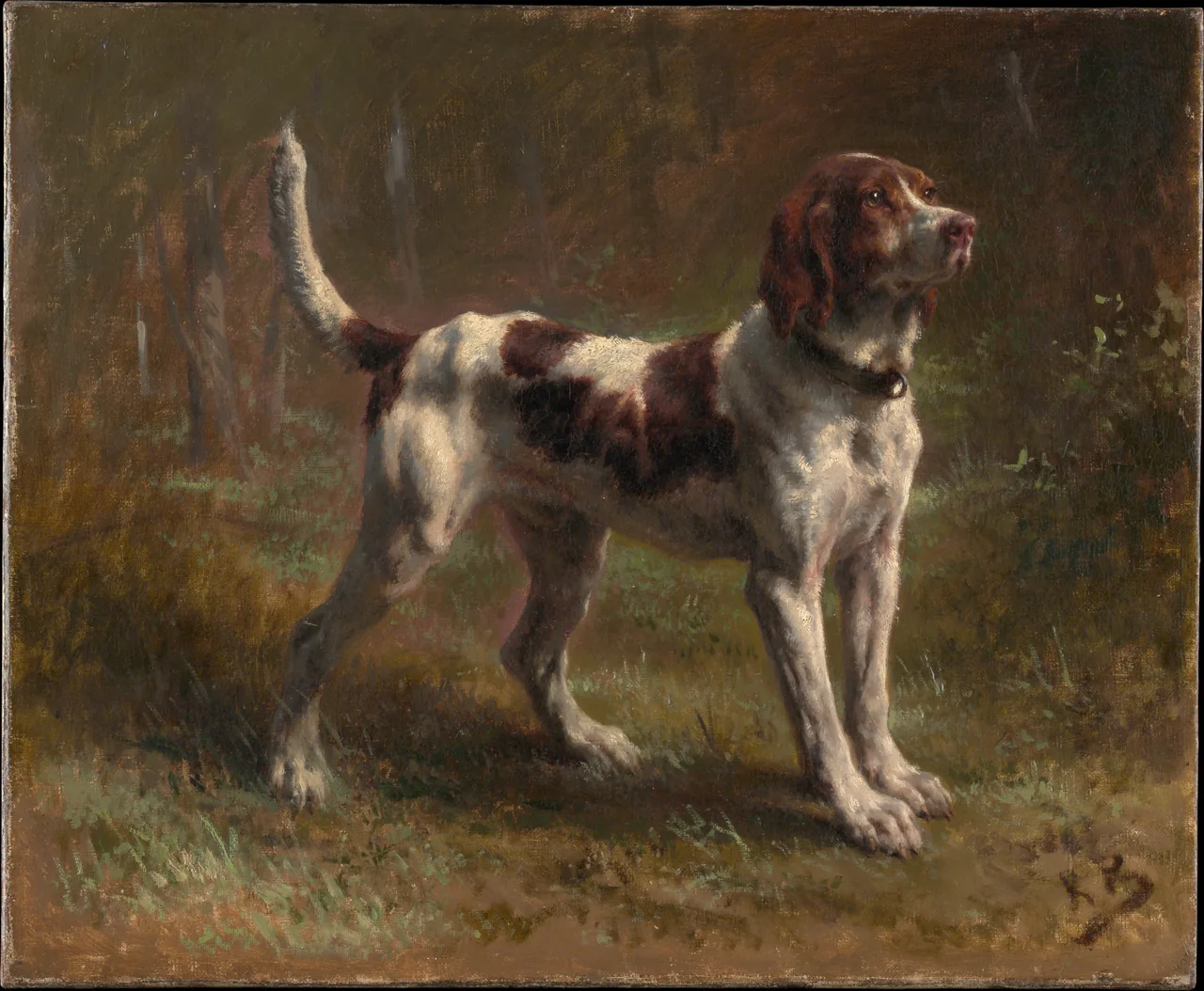
The raised tail and lifted head make the dog attentive rather than inert. Its pale body is set against browns and greens, so the shape is easy to find. That contrast makes the painting worth testing in a reading room or beside a timber cabinet, where its darker surroundings can feel connected to the furniture.
Keep the feet, tail and breathing space around the head. A tight crop that makes the face larger would exchange a whole-body portrait for a detail. Neither is automatically wrong, but the listing should show which you will receive.
The Horse Fair needs room for its movement
Bonheur’s The Horse Fair, painted in 1852–55, is a different proposition. The Met identifies its setting as the horse market on the Boulevard de l’Hôpital in Paris. Horses and handlers fill a broad scene; it is not a gathering of wild animals in an untouched landscape. The Met, 87.25.
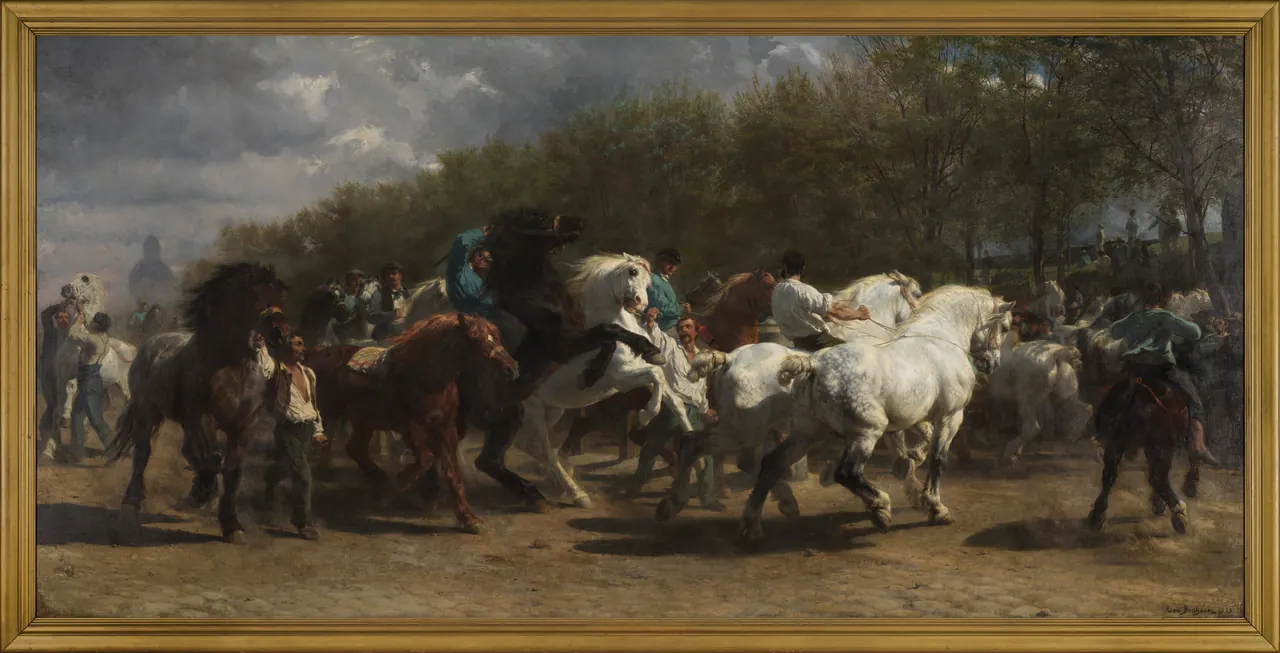
Look at the overlapping bodies and the changing directions of their heads and legs. This is a picture with lateral movement and several points of attention. A broad, relatively clear wall gives you a chance to follow them. A small reproduction squeezed between shelves may leave only a muddle of pale and dark shapes.
Do not expect every detail to survive at every size. If the drama depends on seeing the handlers as well as the horses, judge a preview from the intended viewing distance before ordering. Our guide to one large print or several smaller ones can help with the wall arrangement.
Marc’s blue horse changes the colour question
Franz Marc’s Blue Horse I, or Blaues Pferd I, dates to 1911 and belongs to Munich’s Lenbachhaus. The exact title matters: it is not the same work as a similarly named painting of several blue horses. The museum provides this image under CC0. Lenbachhaus, G 13324.
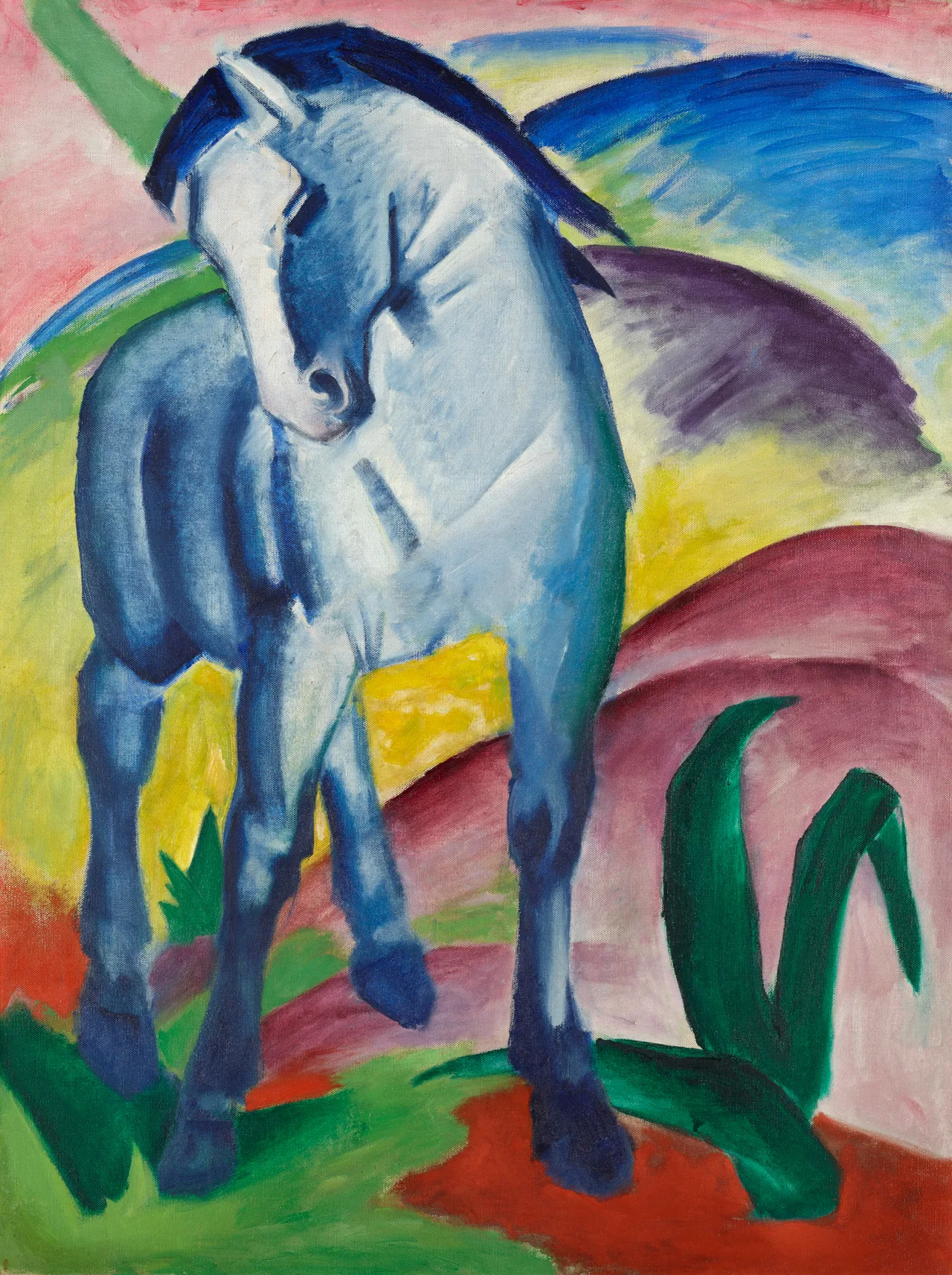
Here the blue is not a naturalistic coat colour. The lowered head and large body give the composition a clear centre, but the pink, yellow and green surroundings are equally important to its effect. Calling it simply a “blue picture” misses much of what will arrive on your wall.
Try it where one assertive colour composition would be welcome. Repeat a small amount of its blue elsewhere if you like, but there is no need to match every shade. Nor should a seller promise that blue will make everyone calm: your response to this picture may be quite different from someone else’s.
Cassatt’s dog rewards a closer look
In Mary Cassatt’s Little Girl in a Blue Armchair, dated 1878, the animal is part of a furnished room rather than the main subject. The National Gallery of Art identifies this particular painting as accession 1983.1.18 and supplies the image through its open-access programme. Collection record.
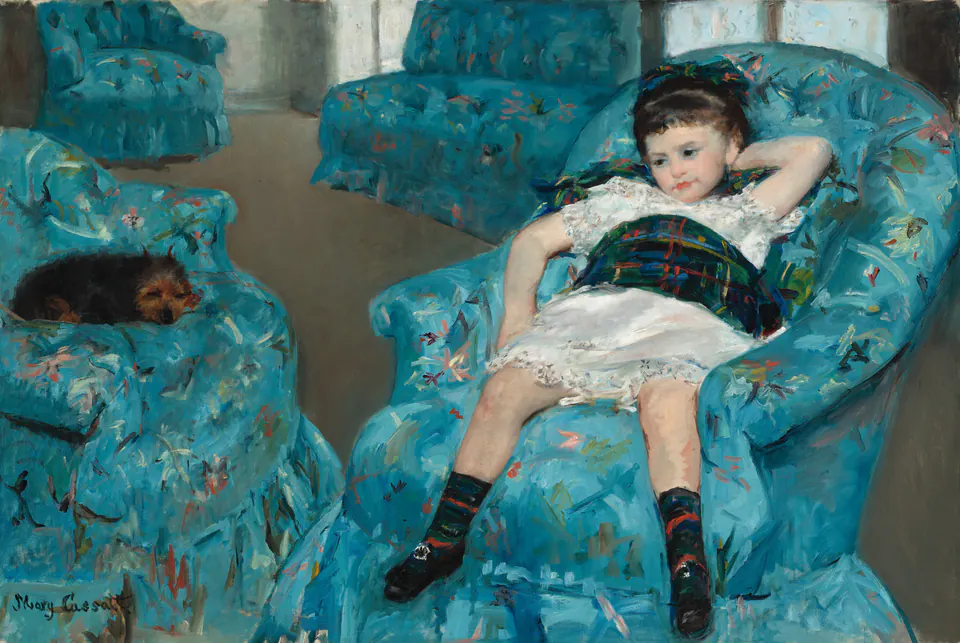
The dog can almost disappear into the surrounding upholstery when the image is small. That makes this a poor choice if your only aim is an unmistakable dog portrait across a large room. It may be a better choice near a seat, where the relationship between child, animal and furniture can unfold gradually.
Notice how a shared colour can organise a busy interior. The chairs repeat blue while their angles differ. You could borrow that idea for a picture group without copying the room or treating the painting as a furniture catalogue.
Match the pose to the wall
Try a paper outline before deciding that a vertical or horizontal picture fits. Marc’s single horse and Bonheur’s long procession need different spaces. A door opening, lamp or bookcase can interrupt the area that seemed clear in a cropped room photograph.
Look at the direction of attention too. An animal looking toward the centre of a group can connect with its neighbours; one looking outward may suggest a deliberate pause. These are compositional options, not rules. Test the actual image rather than reversing a historical painting to make it face the “right” way.
Do not infer safety or suitable fixings from a styled room image. The frame’s weight, wall construction and position still determine how it needs to be hung.
Size the whole picture, not just the animal
A listed print width is not the width of the horse or dog within it. Borders and mats reduce the area occupied by the image, while a large landscape around a small animal reduces its apparent size again. Ask for the actual image dimensions if the animal’s visibility is your priority.
For a hypothetical pair, two outer frames 35 cm wide with a 5 cm gap need 75 cm of wall width. Add any surrounding clearance separately. The calculation helps you plan; it does not establish the best proportions for your room.
Keep file quality separate from size preference. If a face or a tangle of reins looks blurred in a close detail, simply making the reproduction larger will not restore it. Image resolution and print size covers that check.
Build a small group without a theme overload
A pair can share an animal subject while offering contrast: an attentive hound beside a quieter domestic scene, or one strongly coloured horse beside a restrained drawing. Repeat one element—frame finish, spacing or a background tone—rather than requiring every work to match.
If the wall already contains family photographs, consider whether an animal painting should join them or have its own space. One carefully chosen image is enough to acknowledge an interest without turning the room into a display of everything related to it.
Choose the picture you want to keep looking at after the initial recognition has passed. A familiar animal is a good beginning; the surrounding painting is what makes it worth living with.
Editorial record
About this article
- Author
- Publisher
- GeMarkt
- Published
- Reviewed
- Internal source & rights check. Conducted by GeMarkt Research Review. This is an internal editorial check—not independent peer review.
- Source standard
- Buying guide source standardSeparates measured or first-hand evidence from general guidance and keeps practical limits visible.
Found a claim that needs checking? Report a factual error.