GeMarkt Blog · Practical guide
Heat, Humidity and Art: Where Not to Hang
Check radiators, steam, cold walls and changing conditions before hanging art. Choose a suitable location without relying on a universal temperature or humidity rule.

Avoid hanging art where it is directly heated, repeatedly steamed, splashed or pressed against a damp wall. A dry, relatively stable indoor position is a better starting point than a beautiful spot above a working fireplace. A frame does not turn an unsuitable location into a controlled environment.
You do not need identical conditions in every room. You do need to look at the place the picture will occupy, at the times when heating, cooking or bathing changes that place. The temperature displayed by a thermostat elsewhere in the house is not a complete description.
Look for local sources of change
An artwork can contain paper, ink, fabric, wood, adhesives, coatings and glazing. These materials do not all respond in the same way. The Canadian Conservation Institute’s overview of paintings describes how environmental changes can affect an object’s different layers and components.
Start by looking for an obvious source rather than memorising a target number. Is a radiator directly below the intended spot? Does a vent blow across it? Is there a kettle, shower or regularly watered plant nearby? Does the wall show a history of damp or condensation?
Then think about frequency. A room photographed on a cool afternoon may look very different from the same room after the fireplace has been running all evening. A bathroom checked before a shower does not reveal what happens after it.
Keep this assessment separate from the mounting decision. A location with a suitable environment still needs fixings and a frame appropriate to its weight and wall. Neither a dry wall nor a strong hook resolves the other question.
Compare four possible positions
The diagram shows four situations to investigate, not four rated products. Heat, cold surfaces and moisture can create different problems; the quieter interior wall is only a candidate once its conditions have been checked.
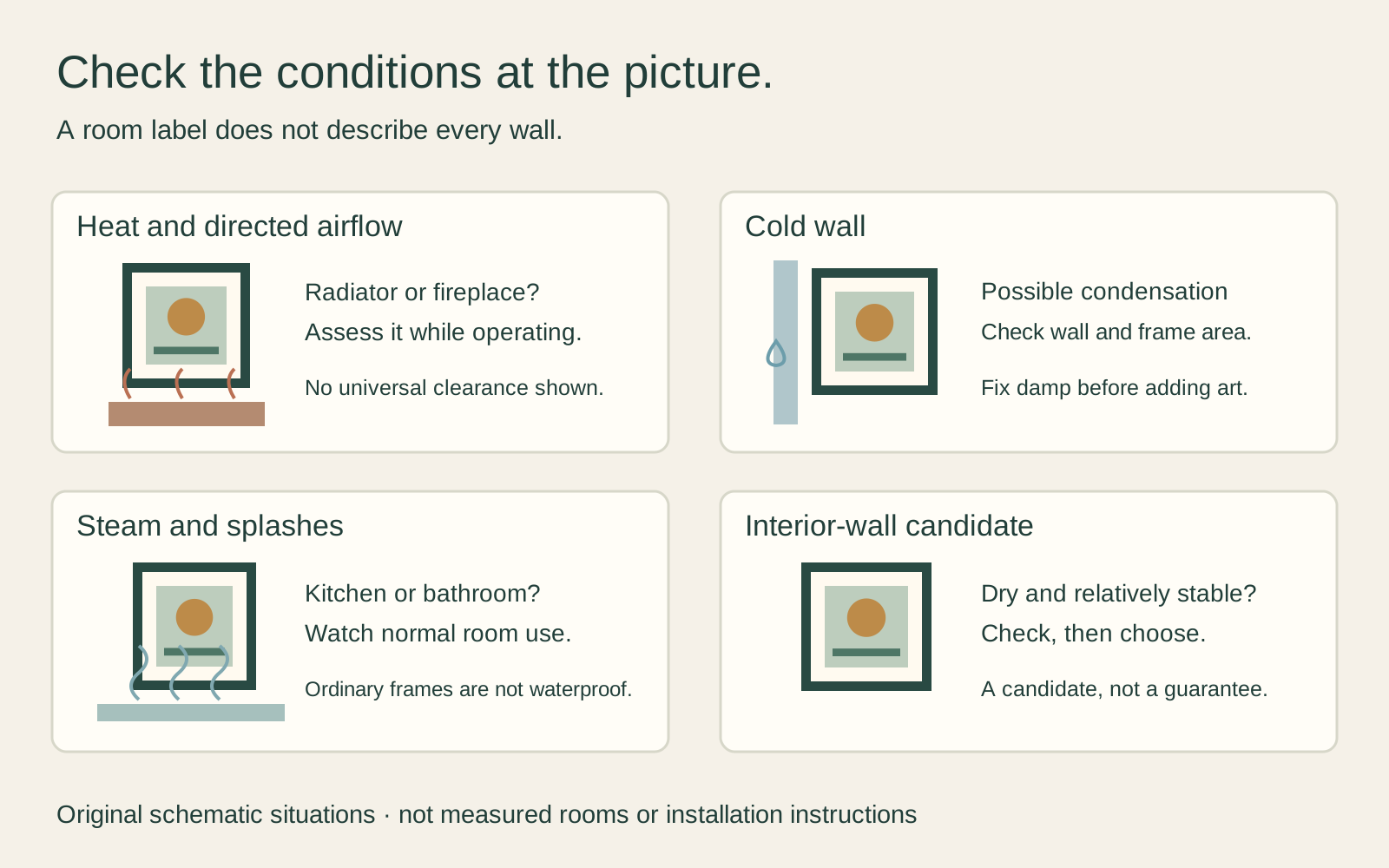
Imagine choosing between a mantelpiece and a side wall in the same living room. The mantelpiece may be the visual centre, but the side wall might avoid the operating heat source. Before changing the artwork or buying special framing, compare those two positions when the room is actually in use.
Moving a picture a little sideways is not a demonstrated solution. The relevant question is whether it still receives the source’s heat, airflow or moisture. There is no distance in this diagram that can be copied into every home.
Reconsider the space above heat
A fireplace is a familiar location for art, which can make it feel automatically appropriate. CCI warns that the area can become hot, dry and sooty. Radiators and heating or cooling outlets can also expose a picture to rapid changes or directed airflow.
For an irreplaceable work, choose another position rather than relying on occasional use of the appliance. With a modern reproduction, consult the producer’s environmental guidance and consider whether the spot is worth the risk of damage or replacement.
Never move a heater, cover a vent or alter required appliance clearances to fit the picture. Follow the appliance’s safety instructions independently. The art should fit an appropriate location; it should not make the room’s equipment less safe to operate.
If you are arranging a whole room, place a paper template in the candidate position first. It lets you consider the appearance without exposing the actual work during your assessment. Planning a gallery wall on paper uses finished frame dimensions for that purpose.
Check cold walls as well as hot ones
Cold is not automatically protective when a wall meets warmer, moist air. CCI’s relative-humidity guidance explains that conditions near a cold exterior wall can differ from those in the room. A frame or cabinet can create its own local situation rather than simply sharing the room’s average.
Inspect the wall and nearby window area for moisture problems. Ask about previous leaks or recurring condensation if you have just moved in. Do not cover a suspicious patch with a picture because the frame happens to conceal it.
An outside wall is not forbidden in every building. Insulation, the building’s condition and the actual environment matter. But if the surface is damp, solve that issue before adding art. A homemade spacer or plastic layer is not proof that the problem is solved.
For a valuable object on a questionable wall, speak with a conservator and the appropriate building professional. Those are different kinds of expertise: one assesses the artwork, the other addresses the source of moisture or building defect.
Treat steam and splashes as separate problems
A picture can avoid a direct splash and still be exposed to repeated humid conditions. Conversely, a generally comfortable room can contain a small splash zone beside a sink or plant. Do not judge the location only by its distance from the floor or by the room’s name.
For a kitchen, watch normal cooking and cleaning before choosing the wall. For a bathroom, consider what happens during and after bathing. Move the proposed display away from repeated steam, water spray and food preparation rather than assuming a glazed frame is waterproof.
Icon’s paper-care guidance stresses a stable environment and cautions about condensation behind framed work. Protective framing can help with particular risks, but it is not a licence to put ordinary paper art into persistently damp conditions.
If the only available position has those problems, choose a different kind of decoration explicitly intended for the conditions, or leave that wall without an image. Changing a famous painting from paper to canvas does not by itself produce a moisture-proof object.
Measure patterns without chasing one number
Relative humidity describes moisture in the air in relation to the temperature. Both location and timing therefore matter. A single reading in the centre of a room may miss a changing environment near the picture.
If you use a temperature and humidity monitor, follow its instructions and record where it sits. Compare readings during ordinary heating or bathing cycles and note the conditions, rather than judging the room from one convenient moment. A consumer reading is useful information, not certification of a safe microclimate behind the frame.
Conservation guidance uses ranges appropriate to particular collections and buildings. CCI’s environmental guidelines for paintings discuss risks and tolerances rather than a magical setting that protects every object. Do not turn a museum specification into a promise for all prints or alter the home’s humidity sharply to chase it.
Match the object to the location
Reserve the more stable display positions for originals, fragile works and irreplaceable personal items. A replaceable reproduction offers a different practical choice, but the producer’s instructions still apply. “Replaceable” does not mean resistant to heat or moisture.
Store the care information with the item and revisit the location after a change in heating, glazing, furniture or room use. A spare bedroom becoming a laundry-drying room is a change in conditions, even if the picture never moves.
Act on warning signs
Condensation inside a frame, new rippling, adhesion, flaking or suspected mould is a reason to pause and obtain advice. Do not flatten the object with pressure, dry it with direct heat, seal a damp item in plastic or clean away the evidence before asking for help.
Choose a different position while the underlying room problem is investigated, using safe handling appropriate to the object’s condition. The aim is not to maintain an impressive number on a meter. It is to give the actual artwork a suitable place to live.
Editorial record
About this article
- Author
- Publisher
- GeMarkt
- Published
- Reviewed
- Internal source & rights check. Conducted by GeMarkt Research Review. This is an internal editorial check—not independent peer review.
- Source standard
- Buying guide source standardSeparates measured or first-hand evidence from general guidance and keeps practical limits visible.
Found a claim that needs checking? Report a factual error.