GeMarkt Blog · Practical guide
Is Félix Vallotton Public Domain? A Print Guide
Yes for the twelve historic Vallotton print designs checked here. Find their publication evidence and CC0 museum files, without confusing a design with a later sheet.
Rights check · reviewed
The short answer
Yes for the twelve historical Vallotton print designs checked here in the EU, UK, Türkiye, and United States. AIC supplies the selected museum files under CC0. The answer rests on documented publication of the designs, not an assumed printing date for every sheet.
| What is being checked | Result | Why |
|---|---|---|
| European Union, United Kingdom & Türkiye | Public domain | Vallotton died in 1925; established works are beyond the ordinary life-plus-70 terms checked here. |
| United States — twelve historical designs | Published designs are public domain | BnF documents The Alarm’s publication in 1895. The 1898 Meier-Graefe catalogue, Intimacies (1898), and Paris intense (1894) document the other eleven designs. This does not date every physical sheet or clear an altered recut. |
| Edition, cancellation, impression, or file | Check the exact record | A block, proof, published impression, cancellation sheet, later printing, institutional file, and modern derivative are different records. |
The Alarm is linked to BnF’s 1895 publication record; the other designs have portfolio or illustrated-catalogue evidence. Later unchanged pulls do not restart the design’s term. New creative alterations and different digital files require their own checks.
This is a documented research summary, not legal advice. Copyright and moral-rights rules can vary by country and by the history of a particular work.

What we’ll look at
Can you reuse a Vallotton print, and how do you identify the particular sheet?
Yes for the twelve historical Vallotton print designs checked here, in the EU, UK, Türkiye, and United States. AIC provides the selected museum files under CC0. This answer covers those published designs and files—not every later alteration or image found online.
Félix Vallotton died in 1925. His established work is beyond the ordinary economic-rights terms in those life-plus-70 markets. The U.S. result rests on the documented nineteenth-century publication of the designs. That is not a claim that every physical sheet shown here was printed in the same year.
The short answer
All twelve examples come from the Art Institute of Chicago. They include woodcuts from Intimacies and other projects, plus two zincographs, prints made using a zinc surface. Each sheet has its own accession number and museum page. AIC gives the selected image files its CC0 Public Domain Designation.
Use those museum records to identify the image you want, then read the publication and reuse note. A later sheet can reproduce an already public-domain design without creating a new copyright in it. A recut with new creative changes, a modern interpretation, or a photograph from another provider needs its own check.
Copyright in the EU, UK, and Türkiye
The EU term directive, UK government guidance, and Article 27 of Türkiye’s Law No. 5846 use ordinary life-plus-70 terms. Vallotton’s 1925 death places his established work beyond those periods.
| Market checked | Ordinary rule applied | Result for Vallotton’s established work |
|---|---|---|
| European Union | author’s life plus 70 years | public domain |
| United Kingdom | 70 years after the creator’s death | public domain |
| Türkiye | life plus 70 years for economic rights | public domain |
This does not resolve moral rights, object ownership, access restrictions, trademarks, or creative modern restoration.
What the early publications establish
Applying the U.S. Copyright Office’s maximum 95-year published-work term to 2026 places works published before 1931 beyond that term. This requires a publication event, such as an issued portfolio or a dated reproduction—not just a museum’s creation date.
For The Alarm, the Bibliothèque nationale de France’s print record supplies the missing link: publication catalogued as [1895], an edition of approximately 100 impressions, and catalogue number Vallotton–Goerg 166. The brackets mark a supplied catalogue date. AIC 1947.462 carries the same catalogue number. BnF separately describes posthumous printings. This supports early publication of the design without assigning AIC’s sheet to an edition that its record does not identify.
The other eleven designs have three identifiable publication anchors:
| Selected designs | Publication evidence |
|---|---|
| Laziness, The Coffin Bearers, The Funeral, Print Fanciers | Reproductions in Meier-Graefe’s illustrated Vallotton catalogue, published in 1898 |
| Five O’Clock, Money, The Other’s Health, The Lie, Getting Ready for a Visit | The Vallotton Foundation / SIK-ISEA identifies publication of Intimacies by La Revue blanche in November 1898 |
| The Shower, Box Office | The same institutional catalogue records Louis Joly’s Paris intense portfolio in 1894; these are zincographs, not similarly titled woodcuts |
These sources establish historical designs, not a universal printing date for the selected sheets. No materially altered recut, cancellation, or new contributor has been identified in these twelve records. That bounded finding supports this guide’s answer; it is not permission to substitute another edition without checking it.
Section 303 keeps unpublished material on another path. A private preparatory drawing cannot borrow the date of a related published woodcut. Conversely, printing an unchanged, already-published design again does not restart its copyright term. Look for a materially different design or a new creative contribution before treating a later edition as a new work.
What are a block, edition, and impression?
The block or matrix carries the cut design. An edition is the organised printing and distribution of sheets. An impression is one physical pull. A cancellation mark or recut can alter what later impressions show. Paper, ink, colour, inscriptions, and publisher can also differ.
Vallotton’s strong black shapes can make reproductions look deceptively interchangeable. Compare the museum accession number as well as the title. Five O’Clock, Money, The Other’s Health, The Lie, and Getting Ready for a Visit are individual Intimacies sheets, each with its own object history and image.
Is The Alarm public domain?
Yes for the historical design, with its 1895 publication documented by BnF, and for the selected AIC file under its CC0 terms. AIC identifies accession 1947.462 as a black woodcut on cream wove paper. Neither the paper description nor the 1895 design date proves exactly when this individual sheet was pulled; that remaining catalogue detail is not itself a new copyright in the unchanged design.
GeMarkt resized the source to 1280 pixels and converted it to WebP without cropping. A photograph in an exhibition catalogue, another impression, or a modern vector tracing is a different asset.
Check the museum image’s terms
The historical print and its modern image are separate questions. The UK IPO’s digital-image notice recommends checking the file as well as the depicted work. AIC’s Open Access policy supplies permission for the selected museum downloads linked here.
Download from the museum page and keep the rights statement with the file. If the link is missing or an image comes from an unidentified source, a visually similar search result cannot supply the missing permission.
Twelve prints to explore
The twelve illustrated records below connect the selected images to their museum pages. Compare the individual Intimacies sheets with The Alarm: in each, the balance of black and white carries much of the image. A tight crop or a traced outline can change those relationships, so describe any substantial alteration when reusing a print.
The cards’ CC0 statements describe AIC’s image files, not a blanket conclusion for every country. The notes identify the publication evidence for the underlying designs. A different painting, a materially changed edition, or a creative reworking needs its own history.
A practical Vallotton reuse checklist
- Record the exact title, medium, date, institution, and accession.
- Identify the block or matrix, edition, publisher, and physical impression where known.
- Keep the design’s publication date separate from the date of the sheet; a later unchanged printing does not reset the design’s term.
- Save the image’s download link and the provider’s current rights statement.
- Document crop, colour, restoration, tracing, compositing, and format changes.
- Check the copyright term in every country where you plan to use it.
- Check attribution, moral rights, trademarks, access, contract, and endorsement separately.
Keep exploring
The museum links provide a starting point for finding the selected images. GeMarkt does not currently offer a Vallotton collection or download room.
For more on print culture around these works, read Posters and Art Nouveau. How to cite art and images explains how to credit the particular edition and file you reproduce.
Rights-checked image ledger
A documented starting set
These files were selected from the holding institutions rather than from search-result copies. Each card keeps the artwork record, exact source file, provider statement and GeMarkt transformation visible as separate facts.
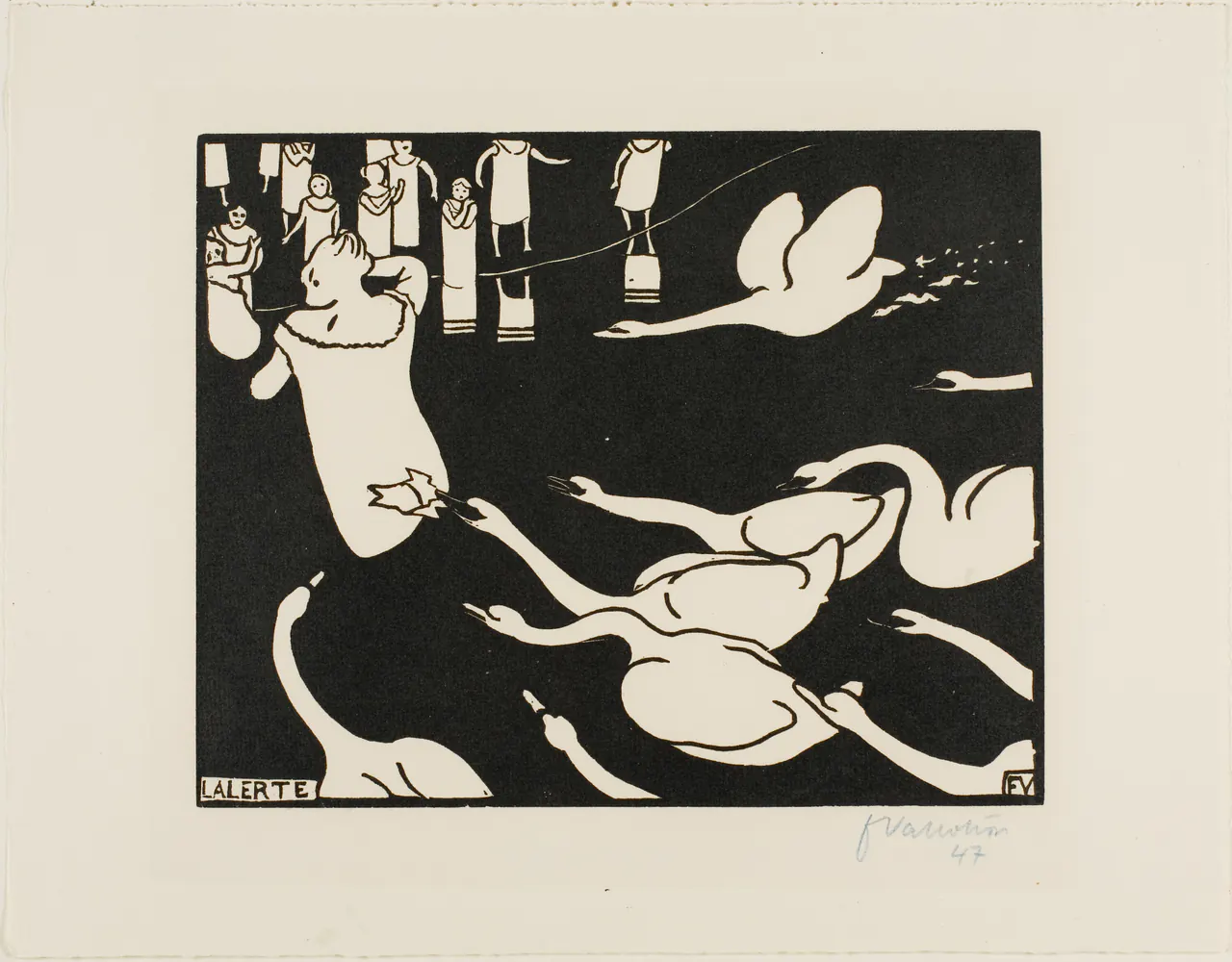
The Alarm
1895 · Art Institute of Chicago · 1947.462
CC0 Public Domain Designation
Reuse check: BnF records publication of The Alarm design in 1895 (Vallotton–Goerg 166), matching AIC’s catalogue reference. Later unchanged pulls do not restart its copyright; this sheet’s edition is not asserted.
Resized to 1280 pixels wide and converted to WebP; no crop.

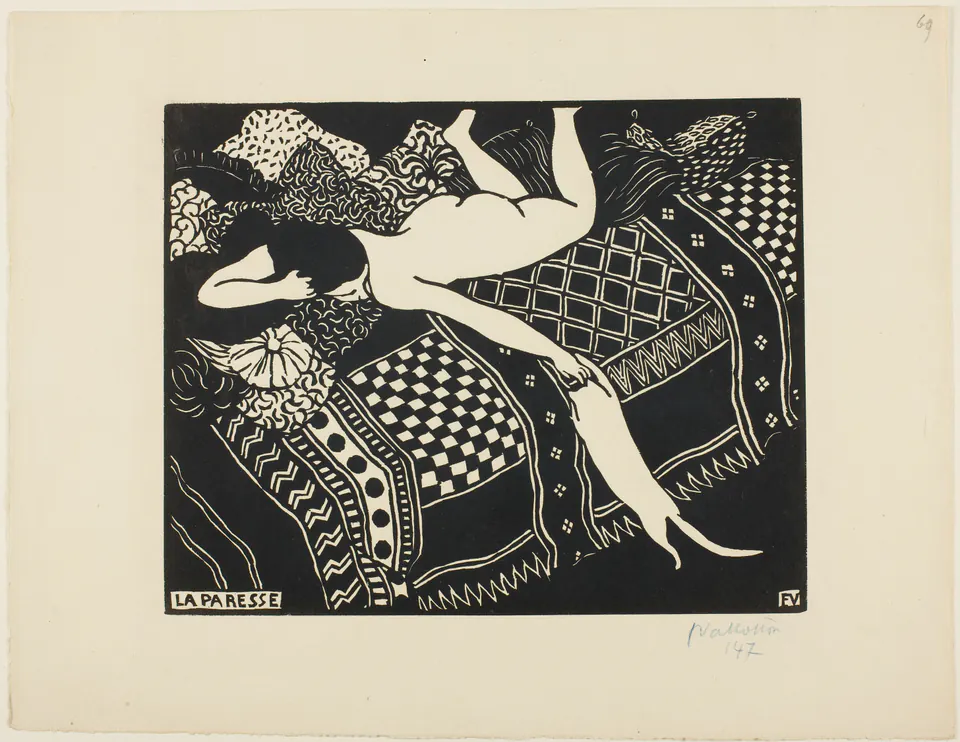
Laziness
1896 · Art Institute of Chicago · 1947.454
CC0 Public Domain Designation
Reuse check: The design is reproduced in the illustrated Meier-Graefe catalogue published in 1898. That publication does not establish the date of this particular sheet.
Resized to 960 pixels wide and converted to WebP; no crop.

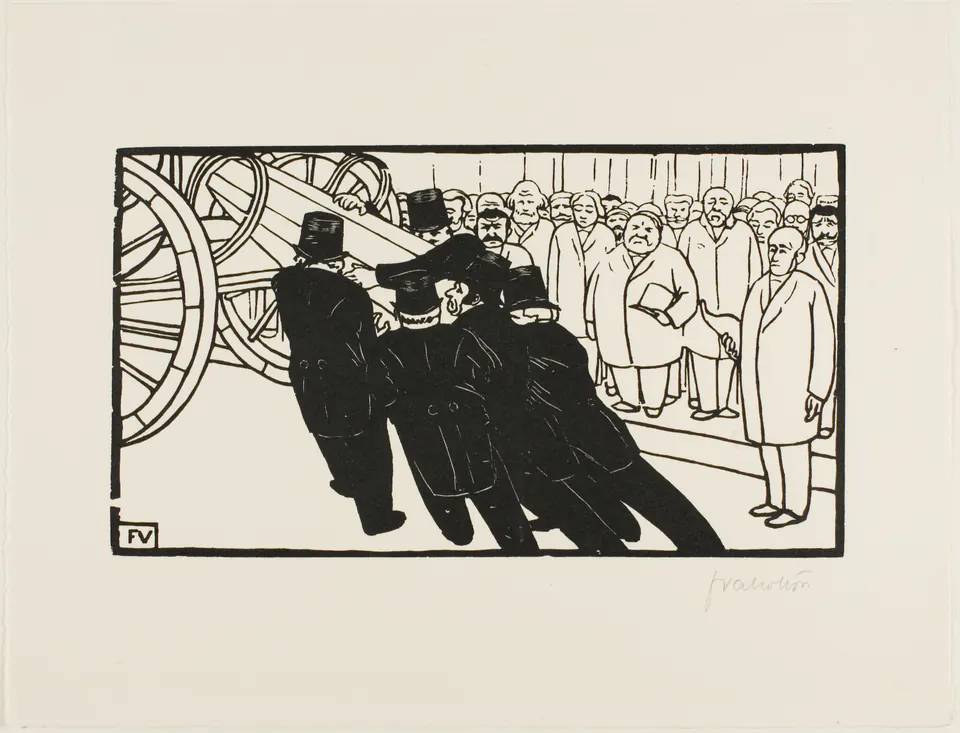
The Coffin Bearers
1892 · Art Institute of Chicago · 1947.455
CC0 Public Domain Designation
Reuse check: The Coffin Bearers design is reproduced in Meier-Graefe’s 1898 catalogue. A later unchanged impression does not restart copyright in the design.
Resized to 960 pixels wide and converted to WebP; no crop.

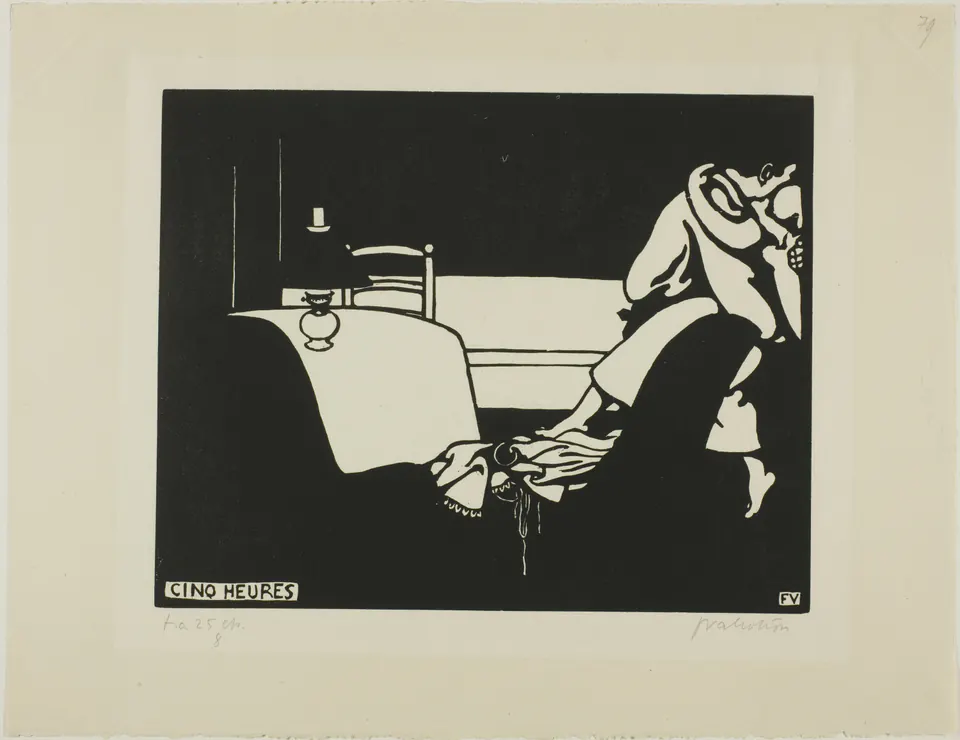
Five O’Clock, from Intimacies
1898 · Art Institute of Chicago · 1948.3.7
CC0 Public Domain Designation
Reuse check: The Intimacies series was published by La Revue blanche in November 1898. This supports the historic design, not an assumed date for every later physical sheet.
Resized to 960 pixels wide and converted to WebP; no crop.

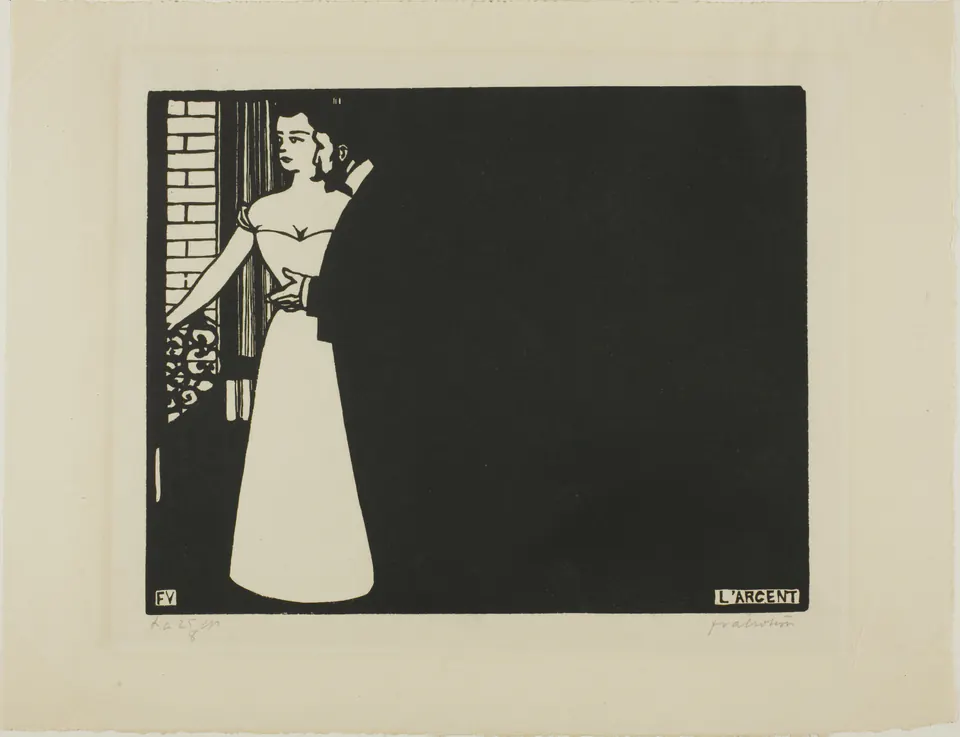
Money, from Intimacies
1898 · Art Institute of Chicago · 1948.3.5
CC0 Public Domain Designation
Reuse check: The Intimacies series was published by La Revue blanche in November 1898. This supports the historic design, not an assumed date for every later physical sheet.
Resized to 960 pixels wide and converted to WebP; no crop.

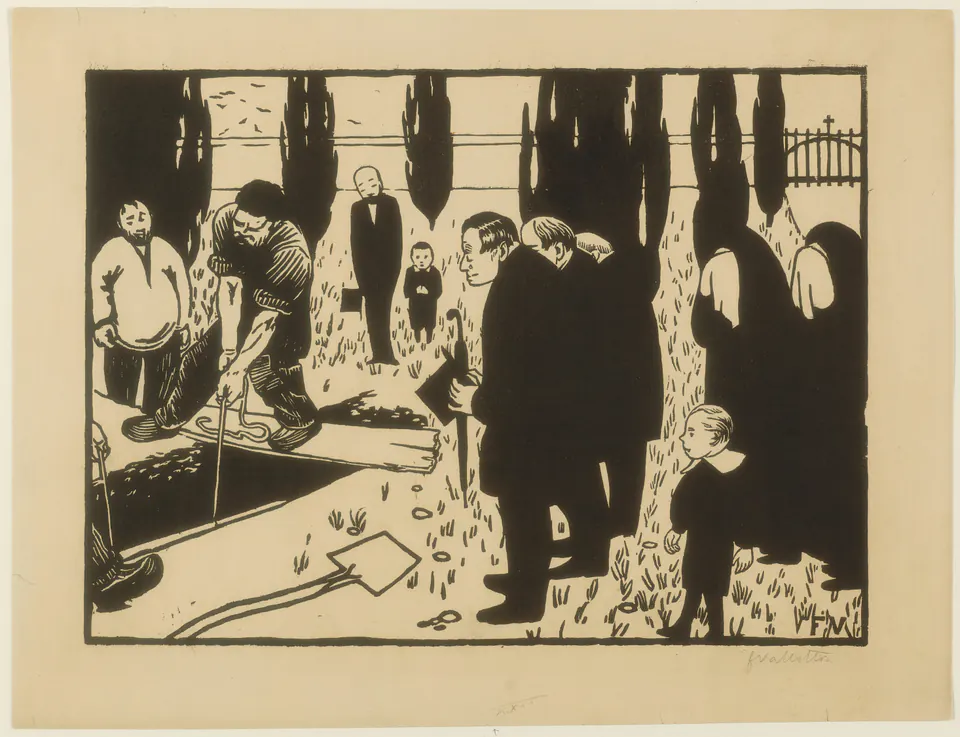
The Funeral
1891 · Art Institute of Chicago · 1956.1067
CC0 Public Domain Designation
Reuse check: The Funeral design is reproduced in Meier-Graefe’s 1898 catalogue. The design’s publication and this paper’s date remain separate facts.
Resized to 960 pixels wide and converted to WebP; no crop.

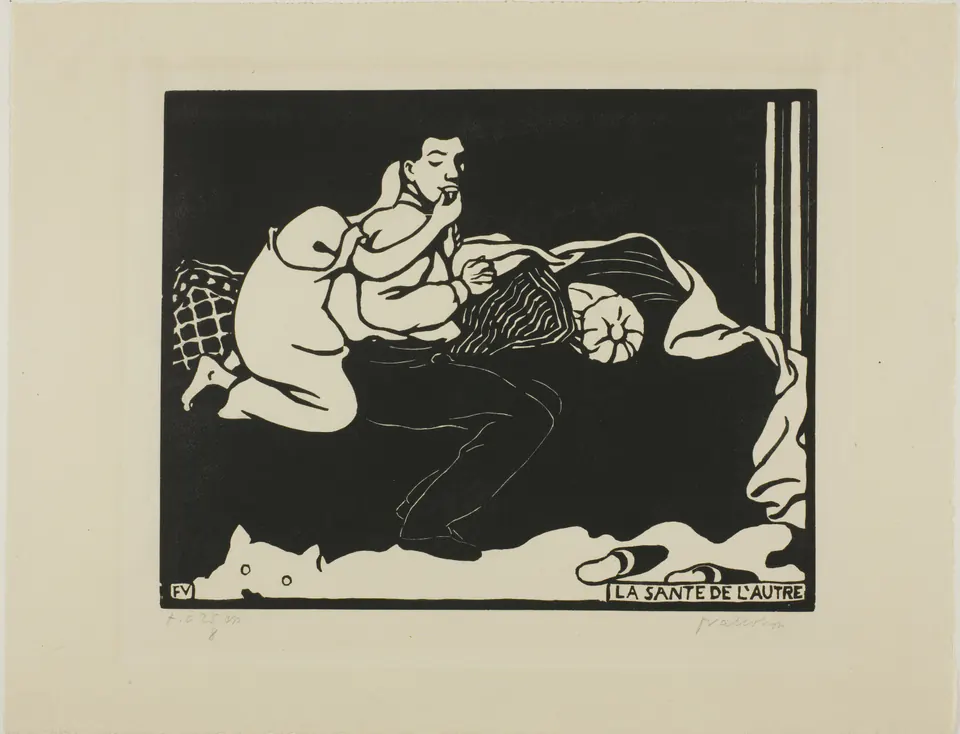
The Other’s Health, from Intimacies
1898 · Art Institute of Chicago · 1948.3.9
CC0 Public Domain Designation
Reuse check: The Intimacies series was published by La Revue blanche in November 1898. This supports the historic design, not an assumed date for every later physical sheet.
Resized to 960 pixels wide and converted to WebP; no crop.

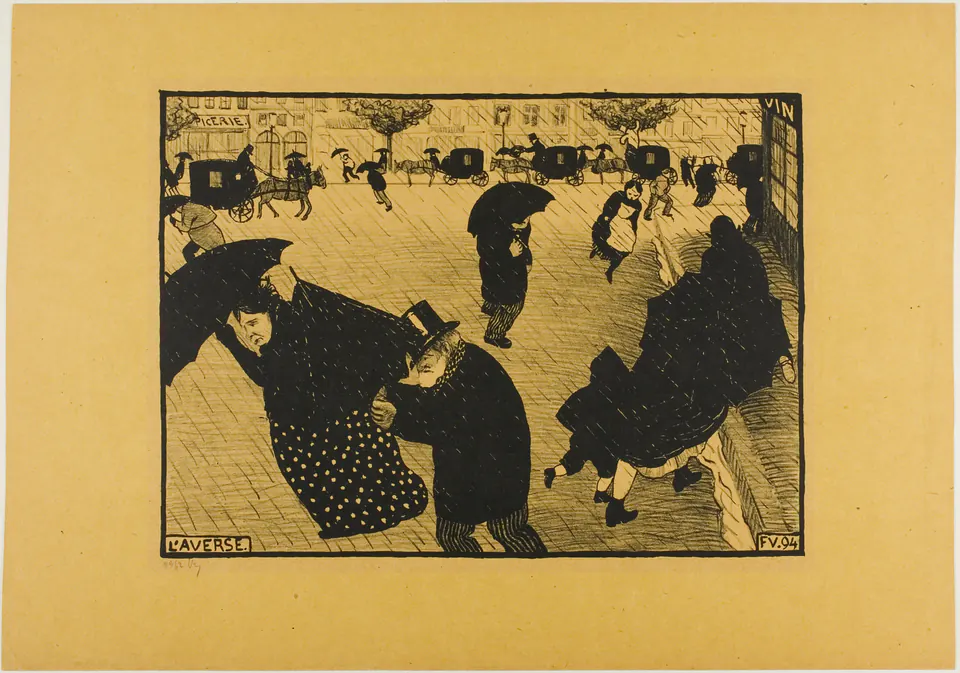
The Shower
1894 · Art Institute of Chicago · 1945.57.8
CC0 Public Domain Designation
Reuse check: The Shower was published in Louis Joly’s Paris intense portfolio in 1894, as recorded by the Vallotton Foundation / SIK-ISEA. This is a zincograph, not a woodcut.
Resized to 960 pixels wide and converted to WebP; no crop.

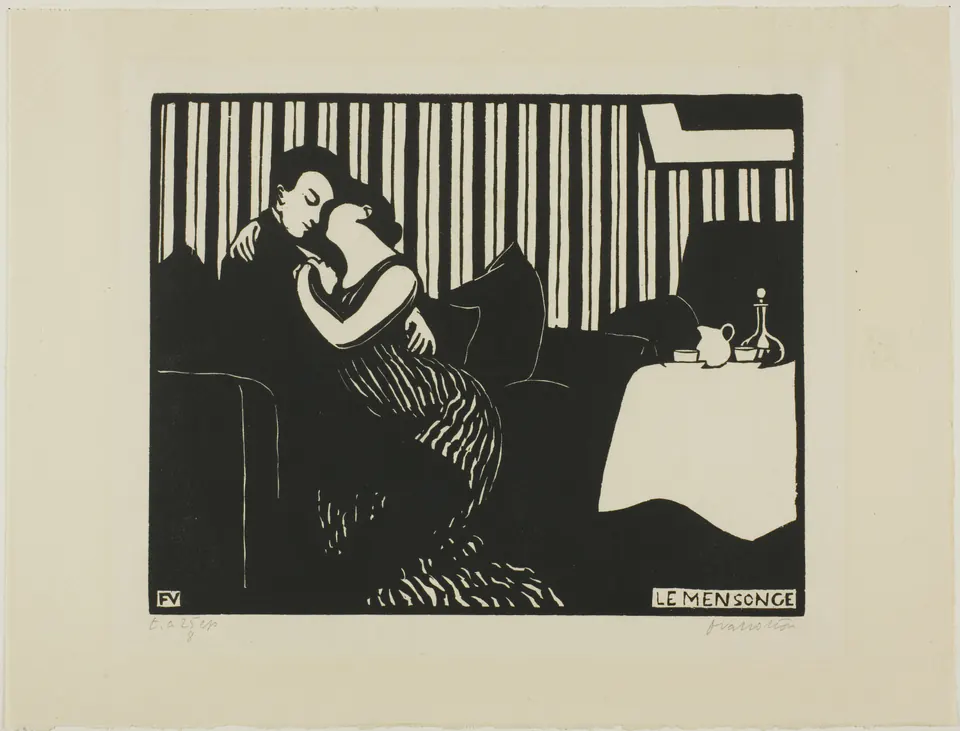
The Lie, from Intimacies
1897 · Art Institute of Chicago · 1948.3.1
CC0 Public Domain Designation
Reuse check: The Lie was designed in 1897 and published with Intimacies in November 1898. Creation and publication are distinct events.
Resized to 960 pixels wide and converted to WebP; no crop.

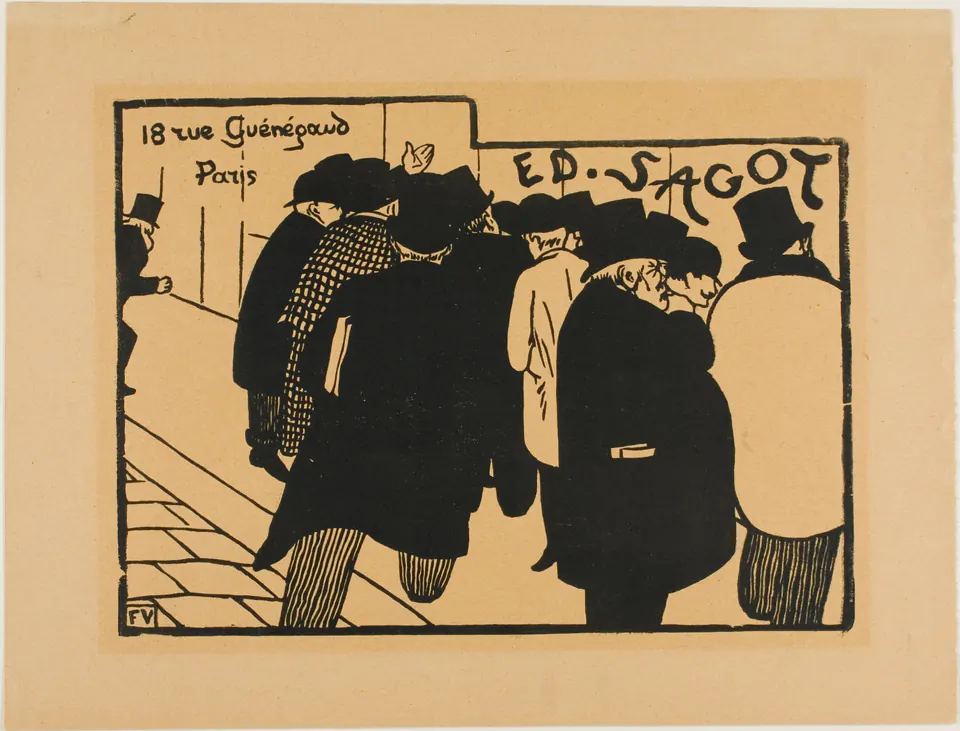
Print Fanciers
1892 · Art Institute of Chicago · 1927.3126
CC0 Public Domain Designation
Reuse check: Print Fanciers is reproduced in Meier-Graefe’s 1898 catalogue. Its published design is distinct from any later creative recut or unrelated scan.
Resized to 960 pixels wide and converted to WebP; no crop.

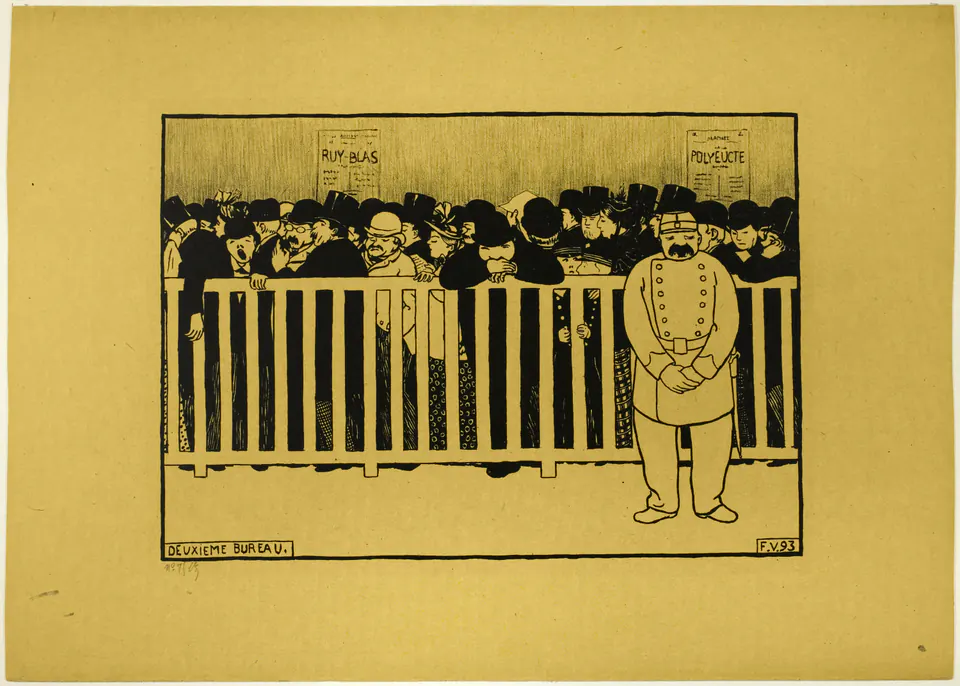
Box Office
1893; published 1894 · Art Institute of Chicago · 1945.57.5
CC0 Public Domain Designation
Reuse check: Box Office was published in Paris intense in 1894, after its 1893 creation. AIC also distinguishes those dates; the print is a zincograph.
Resized to 960 pixels wide and converted to WebP; no crop.

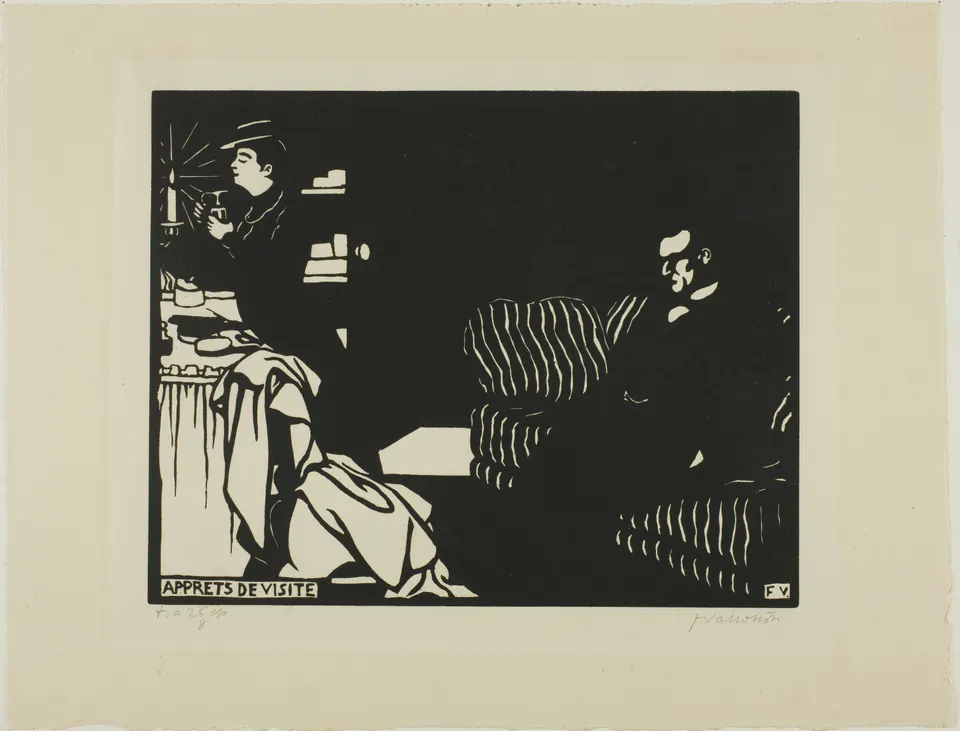
Getting Ready for a Visit, from Intimacies
1898 · Art Institute of Chicago · 1948.3.8
CC0 Public Domain Designation
Reuse check: The Intimacies series was published by La Revue blanche in November 1898. This supports the historic design, not an assumed date for every later physical sheet.
Resized to 960 pixels wide and converted to WebP; no crop.

Sources and review method
We checked the artist chronology against museum records, treated each named jurisdiction separately, and recorded the provider policy for the image set. These sources support the legal framework and artist dates used above; the source file for any individual image still needs its own record.
- The Alarm — Art Institute of Chicago. Feature identity, Vallotton–Goerg 166 design, accession 1947.462, source file, and CC0 status; the exact sheet’s printing date is not established.
- Five O’Clock, from Intimacies — Art Institute of Chicago. Named Intimacies plate, La Revue blanche publisher credit, and exact file.
- The Alarm (Vallotton–Goerg 166) — Bibliothèque nationale de France. Publication catalogued as [1895], approximately 100 early impressions and separately identified posthumous printings. Establishes the design’s publication, not AIC’s sheet edition.
- Félix Vallotton: illustrated catalogue (1898) — The Metropolitan Museum of Art. Meier-Graefe’s illustrated catalogue reproduces Laziness, The Coffin Bearers, The Funeral, and Print Fanciers.
- Vallotton illustrateur: introductory essay — Fondation Félix Vallotton / SIK-ISEA. La Revue blanche published Intimacies in November 1898, including the five selected designs.
- Paris intense — Fondation Félix Vallotton / SIK-ISEA. Louis Joly’s 1894 zincograph portfolio includes The Shower (Vallotton–Goerg 51) and Box Office (48).
- Open Access Images — Art Institute of Chicago. AIC permits reuse of files carrying its CC0 Public Domain Designation.
- Directive 2006/116/EC, Article 1 — EUR-Lex. The EU term for an artistic work is the author’s life plus 70 years.
- How long copyright lasts — UK Government. UK guidance gives 70 years after the author’s death for artistic works.
- Law No. 5846 on Intellectual and Artistic Works, Article 27 — WIPO Lex. The Turkish economic-rights term is the author’s life plus 70 years.
- Circular 15A: Duration of Copyright — U.S. Copyright Office. Applying the maximum 95-year publication term to 2026 places works published before 1931 outside that term.
- 17 U.S.C. Chapter 3, including §303 — U.S. Copyright Office. Section 303 keeps the unpublished-work transition and the 1978–2002 first-publication floor separate.
- Visual Artists: Publication — U.S. Copyright Office. Distribution can publish visual art; public display alone does not establish publication.
- Copyright notice: digital images, photographs and the internet — UK Intellectual Property Office. The old work and the exact modern digital file remain separate checks.
Editorial record
About this article
- Author
- Publisher
- GeMarkt
- Published
- Reviewed
- Internal source & rights check. Conducted by GeMarkt Research Review. This is an internal editorial check—not independent peer review.
- Source standard
- Rights guide source standardSeparates the underlying work from the source file, records the review date, and links the evidence used for the conclusion.
Found a claim that needs checking? Report a factual error.