GeMarkt Blog · Practical guide
Canvas Texture and Stretcher Depth Explained
Understand the difference between canvas texture, front size, support depth and side printing before buying a stretched or framed canvas reproduction.

Canvas texture is the surface you see; stretcher depth is the front-to-back dimension of the support beneath it. Neither tells you how large the image is. Compare the front size, the depth, the side treatment and any outer frame as separate parts of the purchase.
A deeper canvas is not automatically a better print. It changes the object’s profile on the wall. The right choice depends on the image, where you will see its sides, and whether you intend to add a frame.
Separate the fabric from the support
A stretched canvas is fabric held over a supporting structure. In conservation terminology, a stretcher has adjustable corner joints, while a strainer has fixed joints; the Canadian Conservation Institute’s painting-care guidance distinguishes those structures. Retail descriptions do not always make that distinction, so the name alone should not lead you to assume you can adjust the finished product.
The printed surface is a separate specification. Ask about the fabric, printing process and any finish or coating. For example, Printful’s Thin Canvas describes a polyester-and-cotton fabric over a pine base. That is an identified manufacturer’s product, not a definition of every canvas print or a GeMarkt material specification.
An original oil painting and a modern inkjet reproduction may both use canvas, but they are not interchangeable care cases. The reproduction shows an image of the painting; it is not the original paint layer attached to a new piece of fabric.
Understand what depth measures
Depth is measured from front to back, not across the picture. A listing such as 50 × 40 × 2 cm ordinarily gives three dimensions, but ask the seller to confirm their order and what they include. A framed product may quote an outer measurement that differs from the canvas itself.
Specific products illustrate why names such as “thin,” “standard” or “gallery” need numbers. Printful lists its Thin Canvas at 0.75 inch, or 19.05 mm; its separate Canvas (in) product lists a thickness of 1.25 inches, approximately 3.18 cm. These are examples from those pages, not standard depths across the industry.
If you already own an outer frame, send the actual canvas dimensions to the framer before ordering. Knowing only that both items say 50 × 40 cm does not establish that the depth, clearances, fixing method or frame opening will suit the combination.
Compare the front and side views
Consider two hypothetical canvases whose fronts are both 50 cm wide and 40 cm high. One is 2 cm deep; the other is 4 cm deep. The front area is the same: 2,000 square centimetres. The second has twice the depth, not twice the picture area.
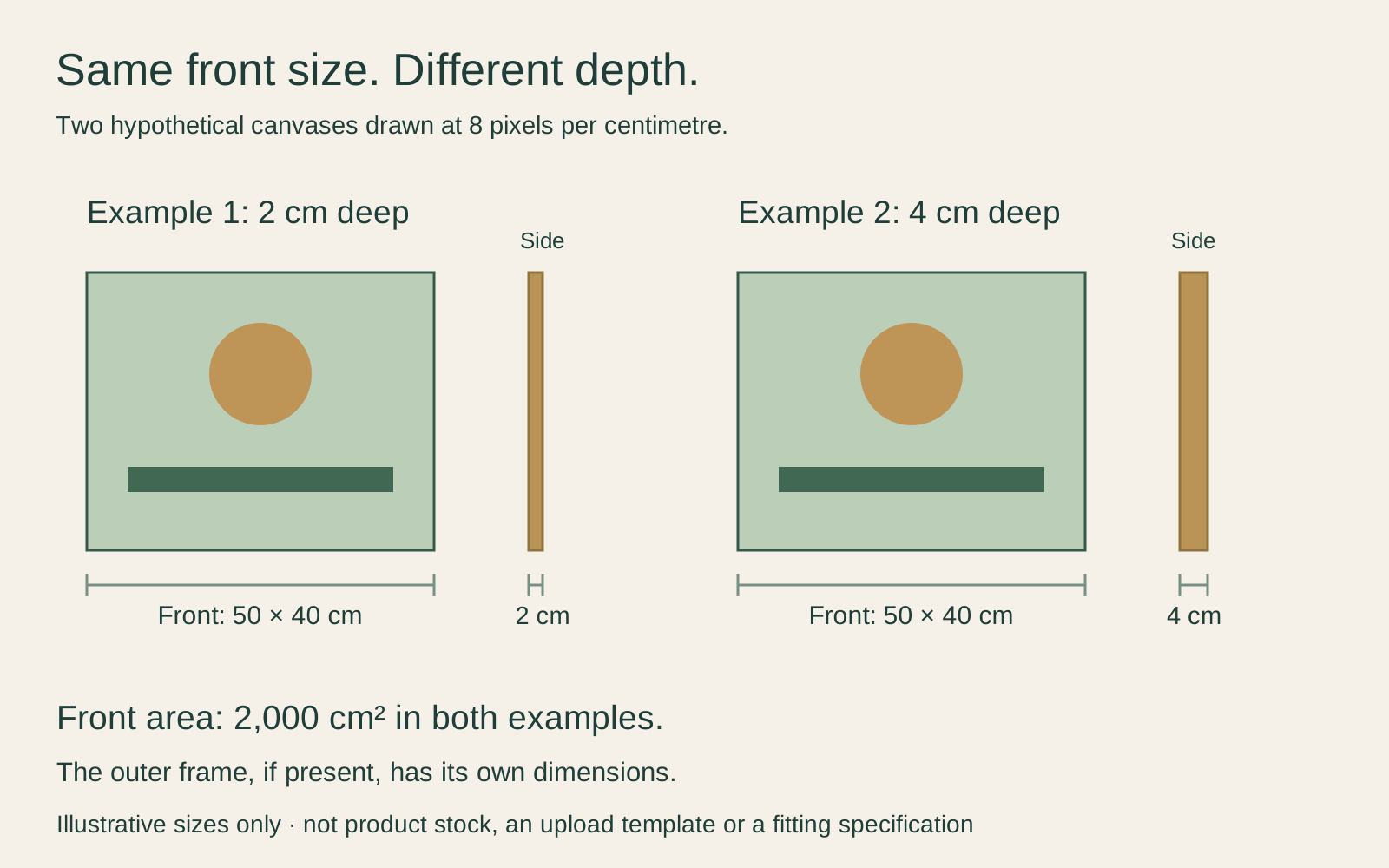
That distinction becomes obvious when you enter a room from the side. Above a sofa viewed mainly straight on, the profile may be a secondary preference. Beside a doorway or along a narrow passage, you may notice the edge before you see the image. Ask for a side photograph as well as a front view.
Do not use a dramatic mockup shadow to estimate depth. Its light angle can make a slim object look substantial. Read the measurements, and compare them with a ruler or a safely placed cardboard profile away from the artwork. This is a visual scale check, not an installation template.
Check what happens at the edges
Depth and image placement meet at the sides. Does part of the image continue around the corner? Are the edge pixels mirrored? Is the side left unprinted or given a separate colour? Those choices can look quite different even when the front dimensions match.
Printify’s documentation distinguishes side printing that extends the print area, mirrored sides that preserve the original print area, and an option to stop side printing. That describes its available technical modes; it does not mean every seller, provider or product offers all three to the buyer.
Look especially at signatures, text, faces and strong straight lines near the boundary. Ask to see the exact selected size and edge treatment, not a generic canvas photograph. A mirrored edge repeats image information; it does not reveal another part of the original artwork. An extended image may move information onto the side, depending on the actual layout.
If preserving the complete composition is essential, confirm the front crop as well. “Mirrored sides” alone does not prove that the file was never cropped to match the chosen front ratio.
Know what the outer frame adds
The wooden support underneath the fabric is not the same thing as a decorative outer frame. A product described as “framed canvas” usually requires you to consider both. Check the visible gap, frame colour, outer dimensions and total weight in the actual listing.
For a hypothetical arrangement, a 50 cm canvas with a visible 0.5 cm gap on each side and a 1 cm visible frame face beyond each gap would measure 53 cm across that front view. That is only arithmetic for the stated arrangement, not a frame-building formula: real frames have their own profiles and fitting allowances.
An outer frame also does not tell you whether there is glass or acrylic over the front. If this matters to the location or your preference, ask explicitly rather than assuming “framed” and “glazed” mean the same thing.
Look at detail without expecting paint relief
When comparing samples, look at an area that matters to your enjoyment: a face, fine lettering, a small boat or a pale sky. View it nearby and from the normal viewing position. Decide whether you like seeing the fabric as part of that image.
Printed highlights and shadows can describe thick brushstrokes in the photographed painting, but that appearance is not proof of raised paint on the reproduction. If a seller offers a textured coating or hand embellishment, it needs its own description and close-up evidence. Do not infer it from the word “canvas.”
The source file remains important whichever support you choose. Our guide to different reproductions of the same painting explains why the underlying image deserves attention before the material menu.
Choose with care and installation in mind
Keep the maker’s care instructions with the order. Do not spray, wet, tighten or re-stretch a print because you have seen someone do it to a different type of canvas. Sagging, lifting ink, damage or uncertainty calls for advice from the maker; original and valuable paintings belong with a conservator.
Use the actual finished weight and supplied fixing guidance when planning installation. Depth alone cannot establish the appropriate hardware or what a wall will support. If the position presents an impact or falling-object risk, resolve that before hanging.
The useful buying sequence is simple: choose the image and front crop, check the fabric and print details, compare depth and sides, then confirm any outer frame. Each answer should describe the product you selected rather than an attractive but unidentified example.
Editorial record
About this article
- Author
- Publisher
- GeMarkt
- Published
- Reviewed
- Internal source & rights check. Conducted by GeMarkt Research Review. This is an internal editorial check—not independent peer review.
- Source standard
- Buying guide source standardSeparates measured or first-hand evidence from general guidance and keeps practical limits visible.
Found a claim that needs checking? Report a factual error.