GeMarkt Blog · Practical guide
Botanical Prints: Redouté, Merian and Haeckel
Choose botanical and natural-history prints by their shapes, margins and detail, with real examples from Redouté, Merian and Haeckel.

Choose a botanical print for the whole page, not just the flower. A slender stem surrounded by pale paper, a pineapple crowded by insects and a dense arrangement of natural forms will occupy a wall differently. Before picking a frame, decide which of those pictures you want to live with.
Redouté and Merian offer useful starting points. Haeckel often appears beside them in decorative selections, but the jellyfish plate below is natural-history art, not botany. The connection is careful looking at living forms, not a claim that all three made the same kind of image. These examples help you choose a modern reproduction; they are not a catalogue of available products.
Choose the plant and the page
Begin with something more specific than “green art”. You might like the shape of a rose, the intricate edges of leaves or the oddness of insects sharing a page with fruit. That preference gives you a reason to keep looking after the print has stopped being new.
Then notice how much of the sheet the subject occupies. A narrow sprig in a large pale field can feel quite spare, while broad leaves reaching towards every edge give a much fuller picture. Two prints sold in the same paper size need not show their plants at the same scale.
Think about the viewing place as well. Beside a reading chair, small veins, lettering and insect legs may be part of the pleasure. Across a dining room, the first impression will come from the main silhouette and larger colour areas. Neither distance is better; choose an image that gives you something at the distance you actually have.
Redouté for a flower you can study up close
Redouté’s Rosa turbinata from Les Roses is a colour stipple engraving, dated 1817–24 in the Met’s record. The largest pink bloom is prominent, but the picture includes buds, turned flowers and a substantial spray of leaves.
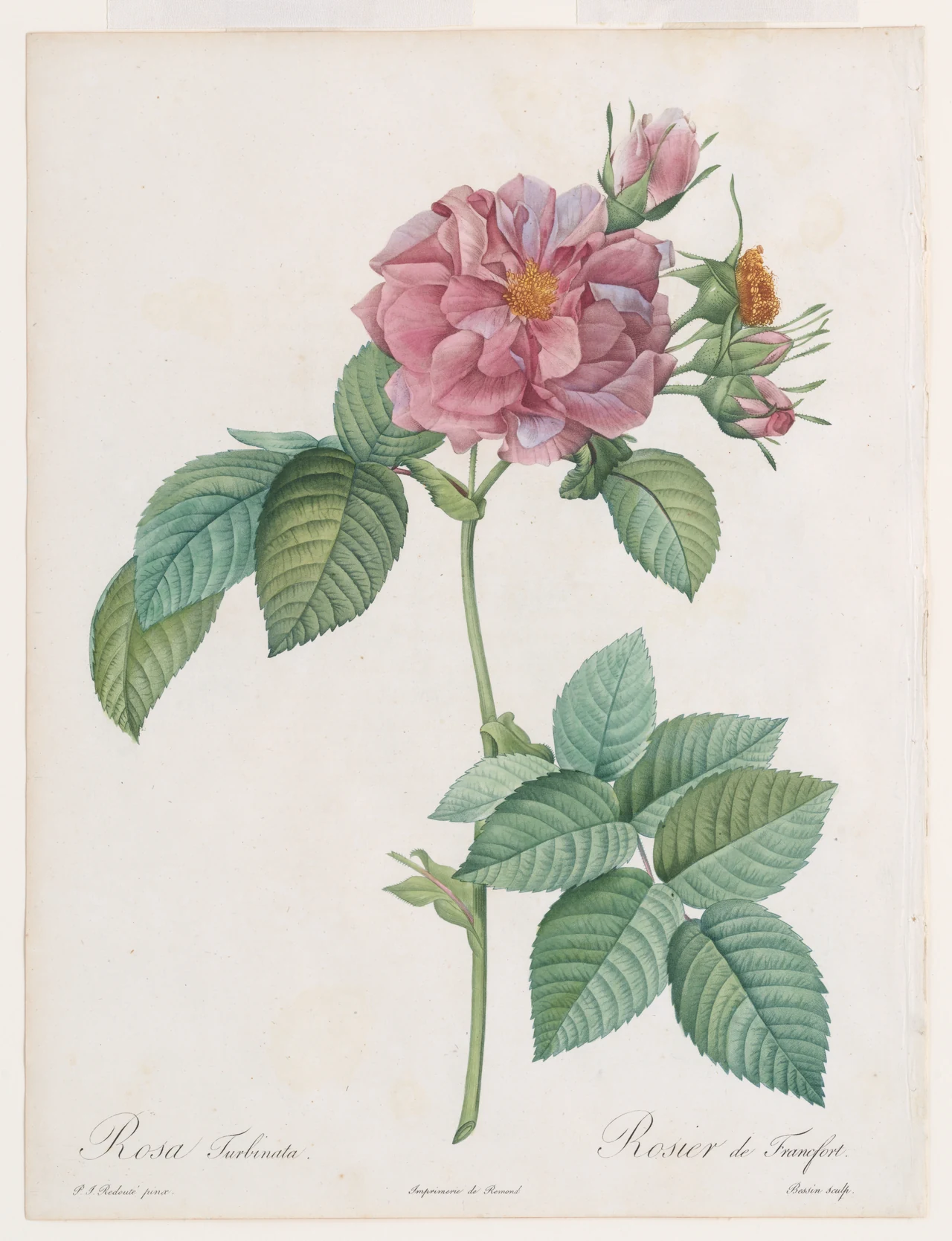
This is a good candidate for a small wall where you can approach the picture. The stem carries the eye down towards the printed name, so cutting away the lower part would change its balance. A pale mat can continue the space around it; a narrow darker frame can give that pale sheet a clear perimeter.
The pink need not match a cushion exactly. Try connecting the green leaves to something already in the room, or let the flower supply the only pink. That usually produces a more interesting choice than buying several unrelated pink objects simply to justify the print.
Merian when you want more than a flower
The first plate of Merian’s Metamorphosis insectorum Surinamensium presents a pineapple with insects around it. The displayed copy belongs to the Basel library’s 1705 edition. Its leaves, fruit and surrounding creatures make a busier, more irregular shape than Redouté’s rose.
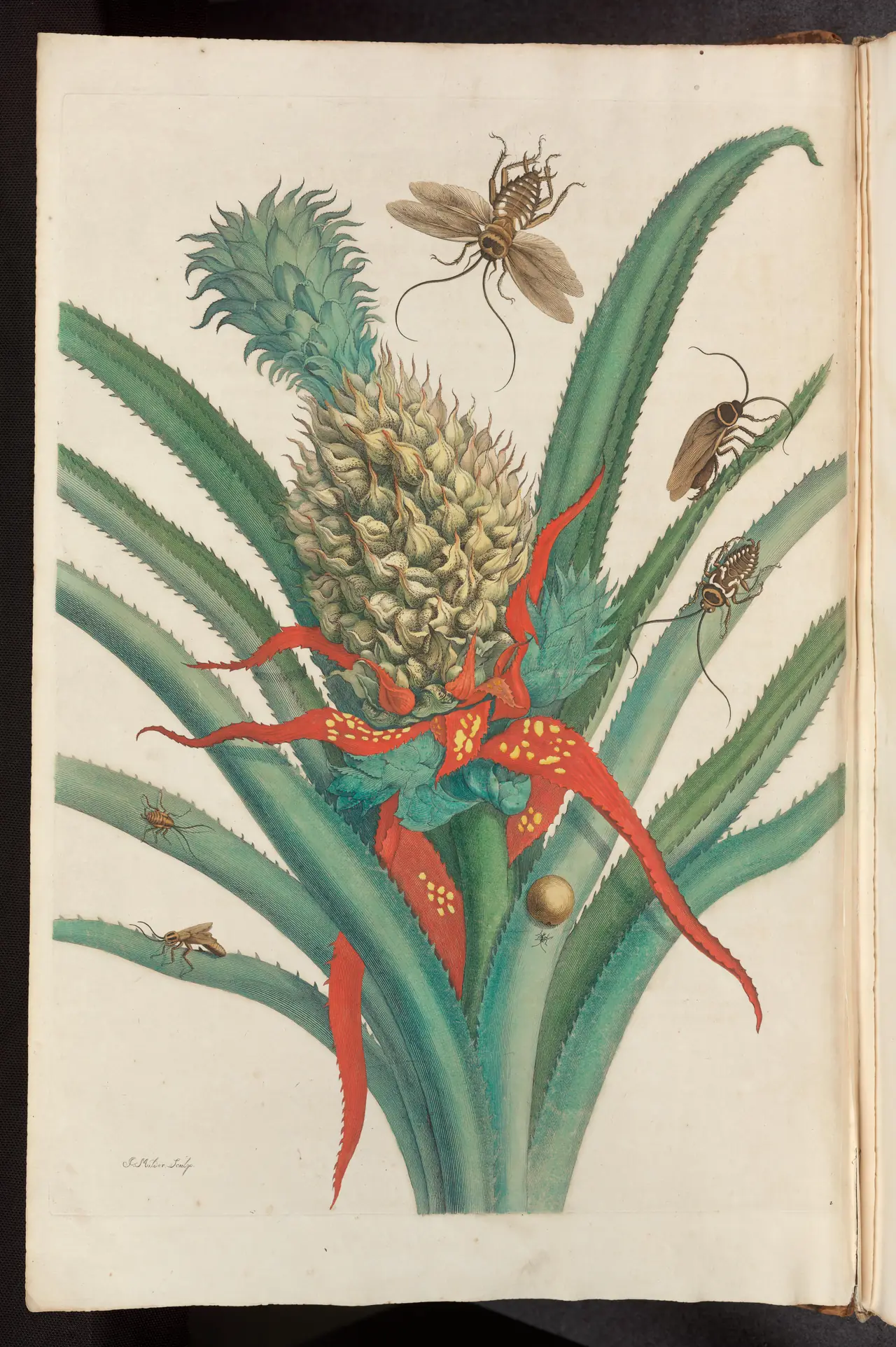
A dining area or study gives you a reason to return to those details. It is worth checking whether everyone sharing the room actually enjoys the insects, rather than assuming that anything botanical will be universally pleasant. The orange-red leaves also make this a stronger colour choice than a thumbnail labelled “vintage green print” suggests.
Keep the insects when judging the composition. Removing them would not merely tidy the background; it would turn this into a different account of the plant. For more about the images themselves, see botanical illustration from Merian to Redouté.
Haeckel belongs to the wider natural history wall
Haeckel’s Desmonema plate shows jellyfish, not flowers. Its place alongside botanical prints is a visual choice: the curling tentacles can echo stems, while the repeated bell shapes give a different rhythm. The ETH library edition of Kunstformen der Natur dates to 1899–1904.
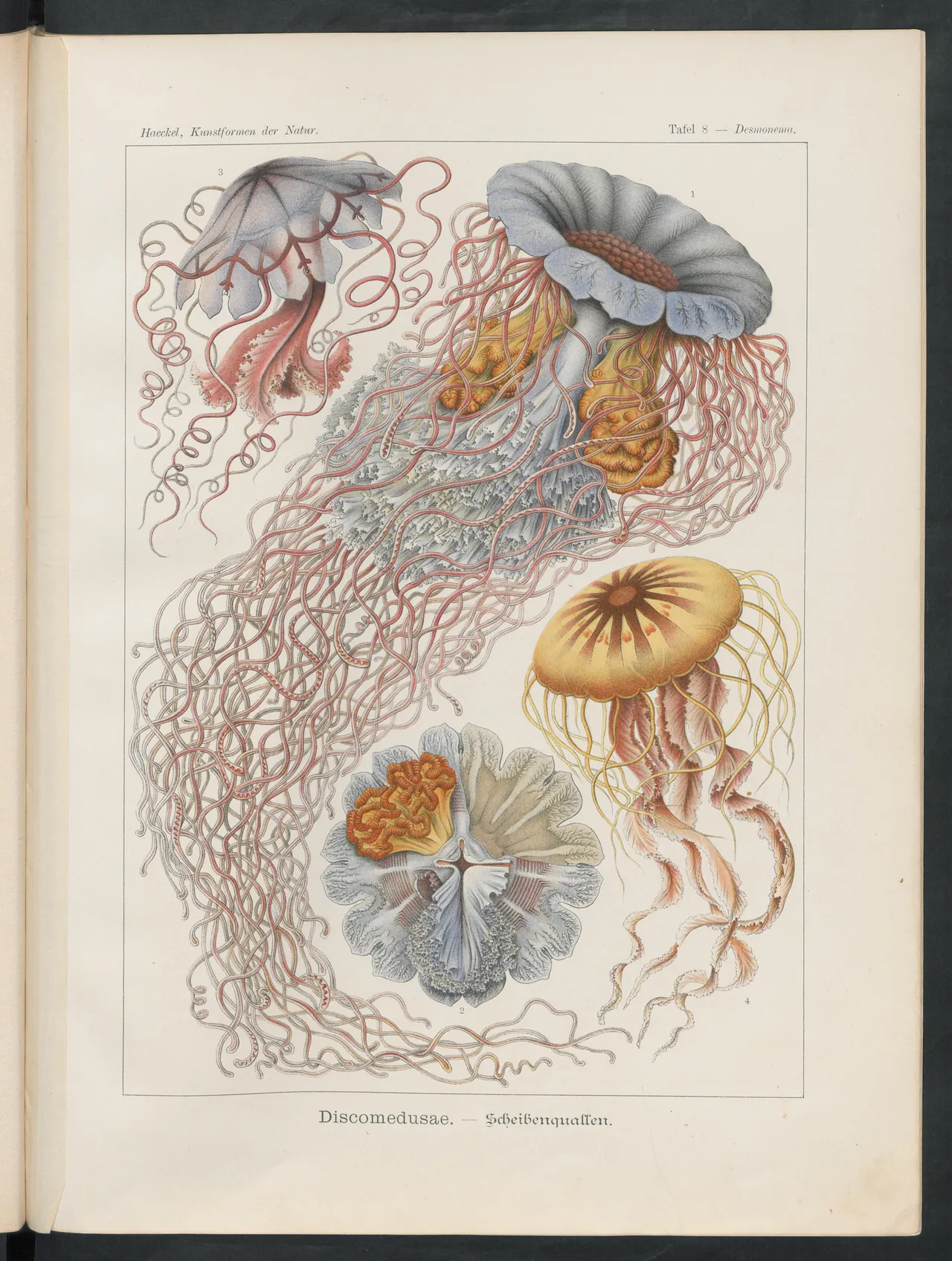
This image rewards a closer position because the fine lines are as important as the broad shapes. If you pair it with the rose, compare the full sheets at the intended print sizes: the jellyfish fill much more of their page. Equal outer frames will not automatically give equal visual weight.
A natural-history grouping can comfortably include plants and animals. Label it accordingly, and retain the individual titles. You do not need to pretend a jellyfish is a botanical specimen to enjoy the relationship.
Make a pair with one clear connection
Choose one connection first: similar pale backgrounds, a related shape, or the same frame finish. Leave room for a difference. Redouté and Merian might share a vertical format while offering a single flowering branch versus a much denser plant. That difference gives the pair a reason to exist.
Avoid making every feature identical by editing the files. Artificially whitening both backgrounds or enlarging every flower to the same diameter can erase the character of the source sheets. Instead, use mat openings and frame sizes to organise the display around the unchanged images.
Measure the group before adding another print. Two frames each 35 cm wide with an 8 cm gap occupy 78 cm across. Those are illustrative outer-frame measurements, not a prescribed spacing. If that width already suits the available wall, a third picture may be unnecessary. Our guide to planning a gallery wall on paper shows how to test the arrangement before hanging.
Keep the margins working for the picture
A scanned page may contain a plate number, a plant name, the edge of the paper and signs of its binding. Decide whether the reproduction includes the whole sheet or a clearly described detail. A close crop can be attractive, but it is not the same product as a full-page reproduction.
Distinguish the original pale paper visible in the image from a new white printing border and a separate mat. These three areas can accumulate. A small plant surrounded by all three may look unexpectedly tiny inside a large frame.
Ask to see the actual print layout, including any border, rather than relying on a cropped shop thumbnail. If the lettering matters to you, check that it remains readable and is not hidden by the mat opening. Let the maker confirm the required overlap for secure framing; do not assume the advertised sheet size is the visible opening.
Choose a place and check the final print
Start with one print where you will see it regularly. Look at a size mock-up from the chair, doorway and other normal viewing positions. Keep the wall’s existing switches, shelves and plants in the picture while deciding; an empty digital wall makes almost every arrangement look simpler.
Keep paper prints away from direct intense light and heat sources, consistent with the Library of Congress’s paper-care guidance. Valuable original sheets need suitable conservation advice, not just a decorative frame. For a new reproduction, follow its maker’s care instructions.
Before ordering, confirm the exact image, visible image size, paper size, frame inclusion and crop. A botanical print works best when you enjoy both the plant and the way the artist has asked you to look at it.
Editorial record
About this article
- Author
- Publisher
- GeMarkt
- Published
- Reviewed
- Internal source & rights check. Conducted by GeMarkt Research Review. This is an internal editorial check—not independent peer review.
- Source standard
- Buying guide source standardSeparates measured or first-hand evidence from general guidance and keeps practical limits visible.
Found a claim that needs checking? Report a factual error.