GeMarkt Blog · Essay
Botanical Illustration: From Merian to Redouté
Read eight botanical images through their leaves, flowers, insects and printed details, from Merian’s Suriname plates to Redouté’s roses.

A botanical illustration asks you to notice more than whether a flower is beautiful. Where do the leaves meet the stem? Which way does the bloom face? What changes between a bud and an open flower? A good picture makes those questions inviting, even before you know the plant’s name.
The eight images below show several ways of doing that. Maria Sibylla Merian places plants among insects. Georg Dionysius Ehret opens flowers to inspection. Pierre-Joseph Redouté gives a rose the presence of a portrait while preserving tiny differences between its parts. They do not form a single movement with one agreed style. They share a demanding problem: how to make a living, changing subject understandable on a still page.
This is a guide to looking, not choosing prints for a room. The observations come from the images shown; the linked institutional records identify their dates, materials and particular sheets.
A plant portrait that helps you notice
Begin with the difference between a flower picture and an illustration that explains a plant. Either can be carefully observed. The botanical image usually invites comparison between features: a leaf edge, an arrangement of petals, a fruit or a separately drawn seed. The empty background can make those details easier to follow. It does not mean the artist had nothing else to show.
Nor is every image a complete identification guide. One drawing may omit roots; another may combine different stages. A historical name may have changed. These pictures are evidence of how plants were represented, not instructions for eating, treating illness with or identifying an unfamiliar wild plant.
Try reading each one twice: first as a whole composition, then as an arrangement of information. Those two readings often lead to different discoveries.
Merian’s pineapple: a plant with company
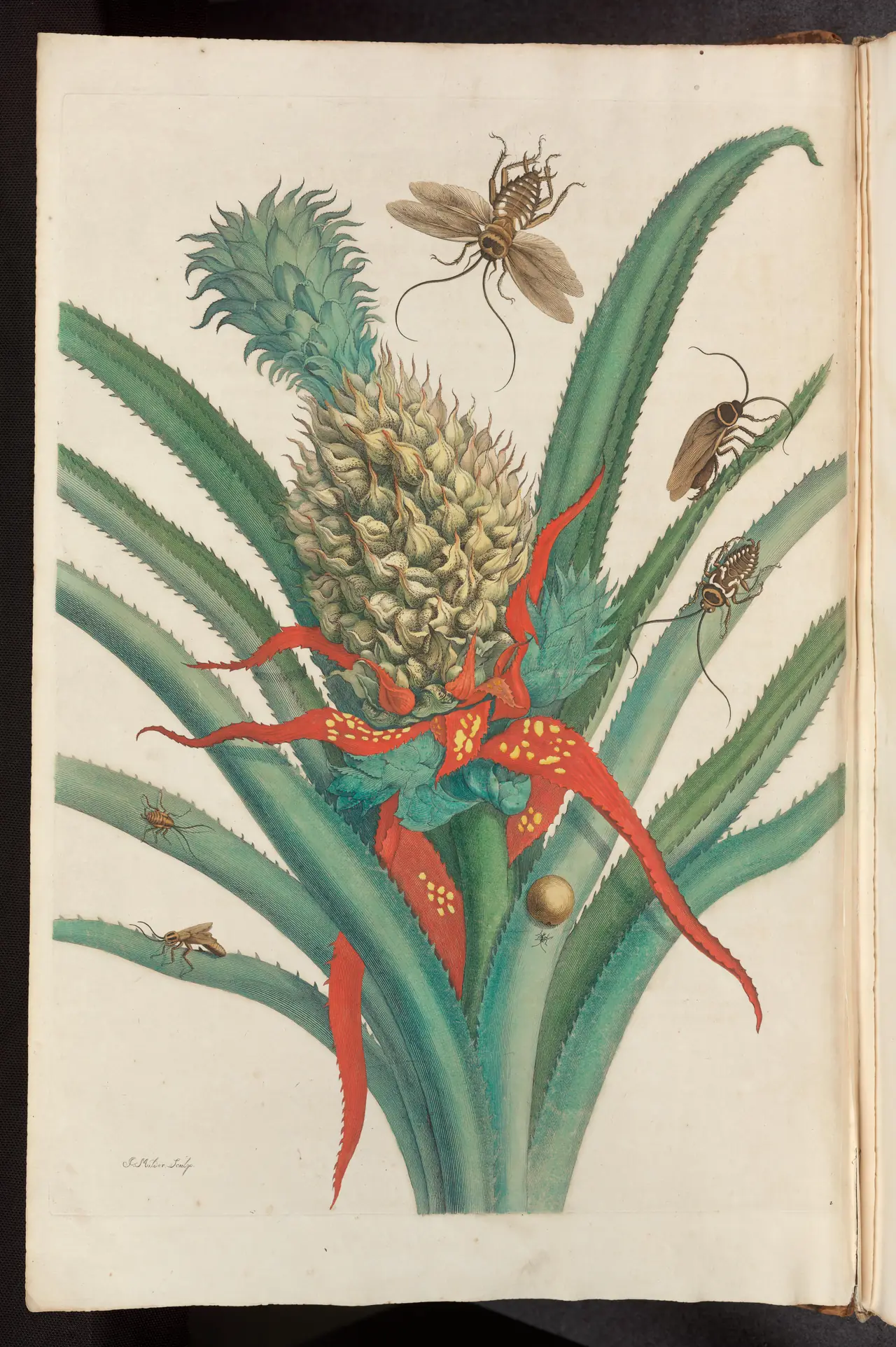
The pineapple rises through a fan of sharp leaves. Red bracts interrupt the green; insects occupy the spaces around them. Follow the largest leaf upward and you encounter another creature rather than a neat stopping point. The plant becomes a place where things happen, not simply a specimen isolated for naming.
The small inscription at lower left credits Joseph Mulder as engraver. That matters: we are looking at a printed plate, not Merian’s original watercolour. The paper edge and binding remain visible in this scan, locating the image inside a particular book rather than an imaginary collection of loose modern posters.
Merian’s plate 7: leaves that have been eaten
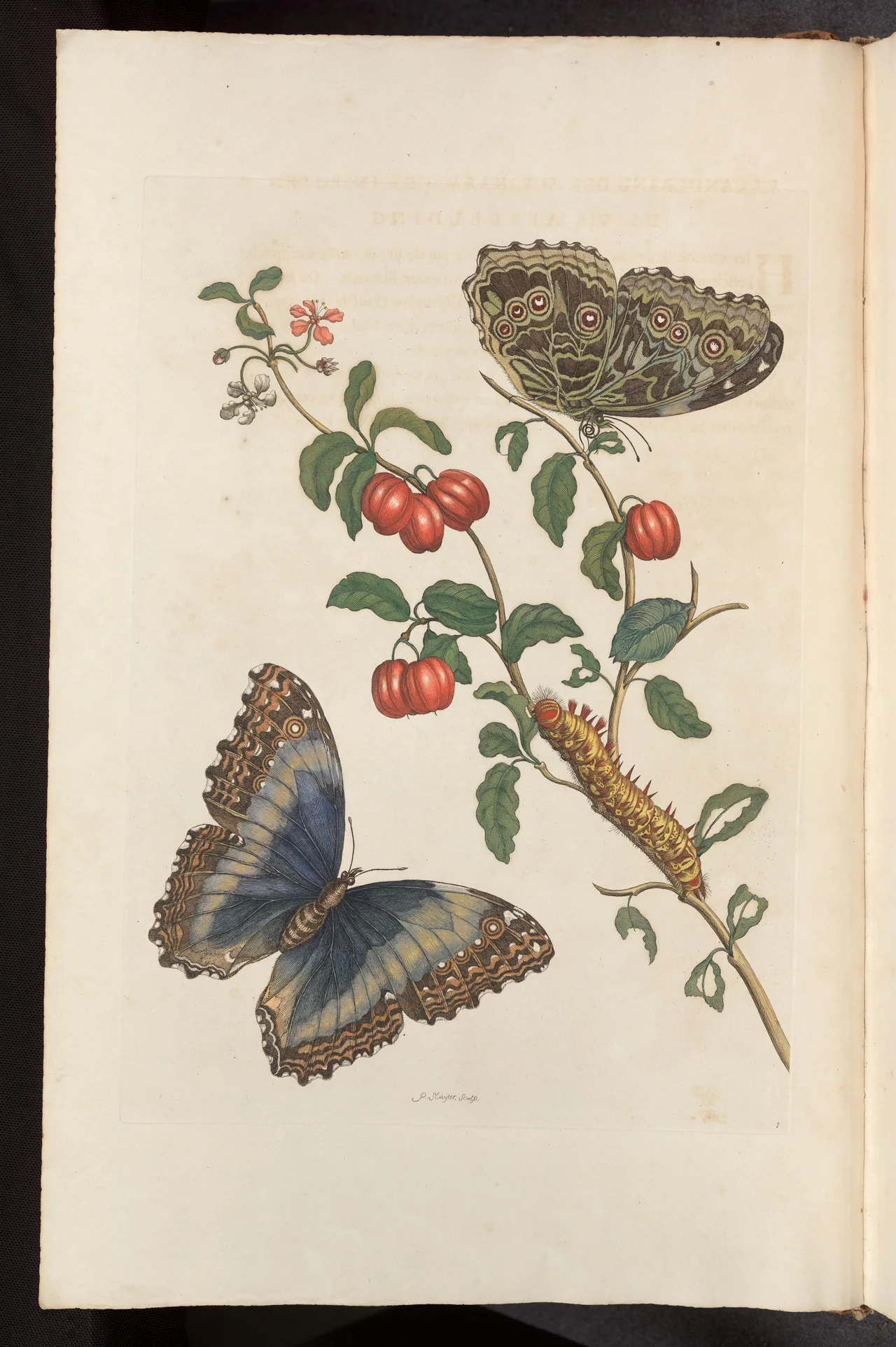
Do not look only at the butterflies. Several leaves have missing edges; a caterpillar grips the branch. Damage is part of the subject rather than a flaw edited away. The upper butterfly shows a patterned underside, while the lower one opens broad blue wings. The page brings different views together without pretending they are a single instant.
Getty’s account places Merian’s research in colonial Suriname and discusses her reports of the mistreatment of enslaved people. The book belongs to that human history as well as insect study. Its vivid surfaces should not make the conditions of collecting disappear.
Ehret’s Pancratium: the flower from two angles
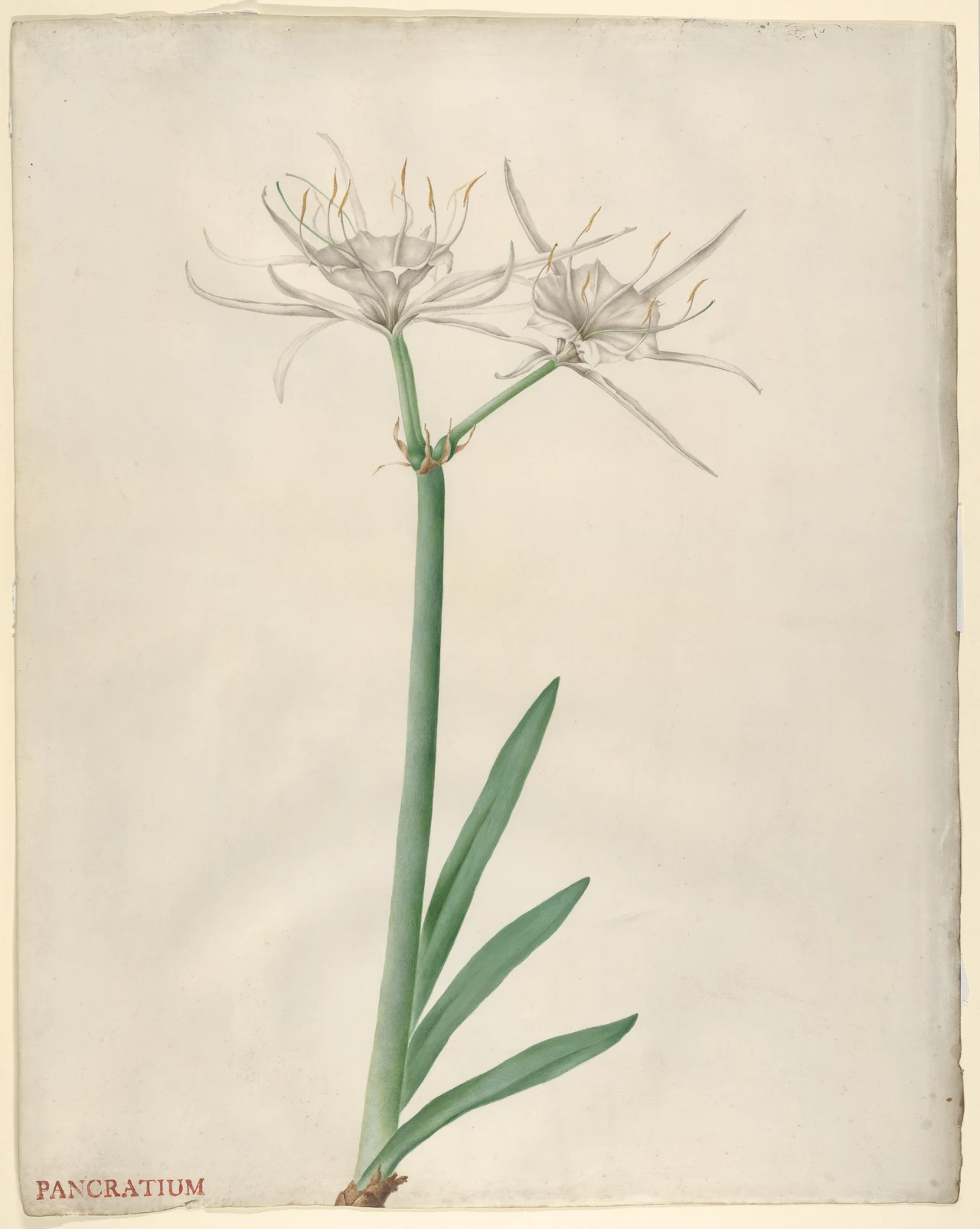
Ehret makes white flowers legible with the faintest shadows. One faces more directly towards us; its neighbour tilts away. Their long, narrow parts spread outward, while the upright stem provides a quiet central support. The differences between the two views are more informative than a perfectly symmetrical arrangement would be.
The Met connects the carefully shown stamens and pistils with the interests of botanist Christoph Jacob Trew, for whose publications Ehret supplied drawings. Here scientific usefulness and elegance are not opposites. The drawing gives difficult structures space to be seen, without a surrounding garden competing for attention.
Haemanthus: a picture with an explanation built in
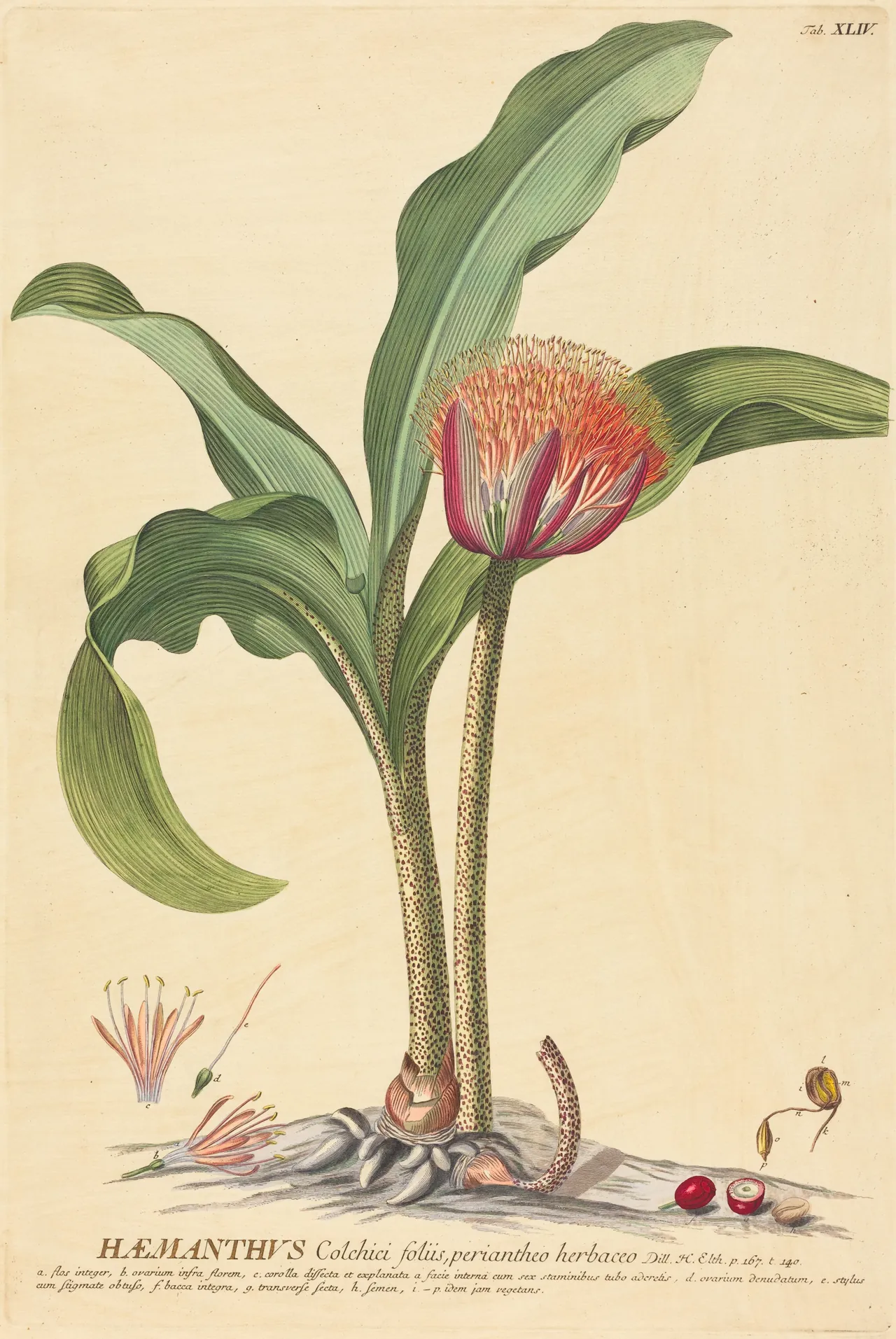
The flowering head catches the eye first. Then the smaller details near the base change how you read the whole sheet. Letters connect separated structures to the explanation underneath. The main plant and its parts are arranged for comparison, not shown as one natural scene.
Look at the relationship between the long leaf lines and the many fine flower stems. Both reward close inspection, but they create very different rhythms. Keeping the lower margin matters here: remove its lettering and text, and an explanatory plate begins to look like a purely decorative plant picture. The image’s beauty survives that crop; some of its purpose does not.
The rose: more than a pink flower
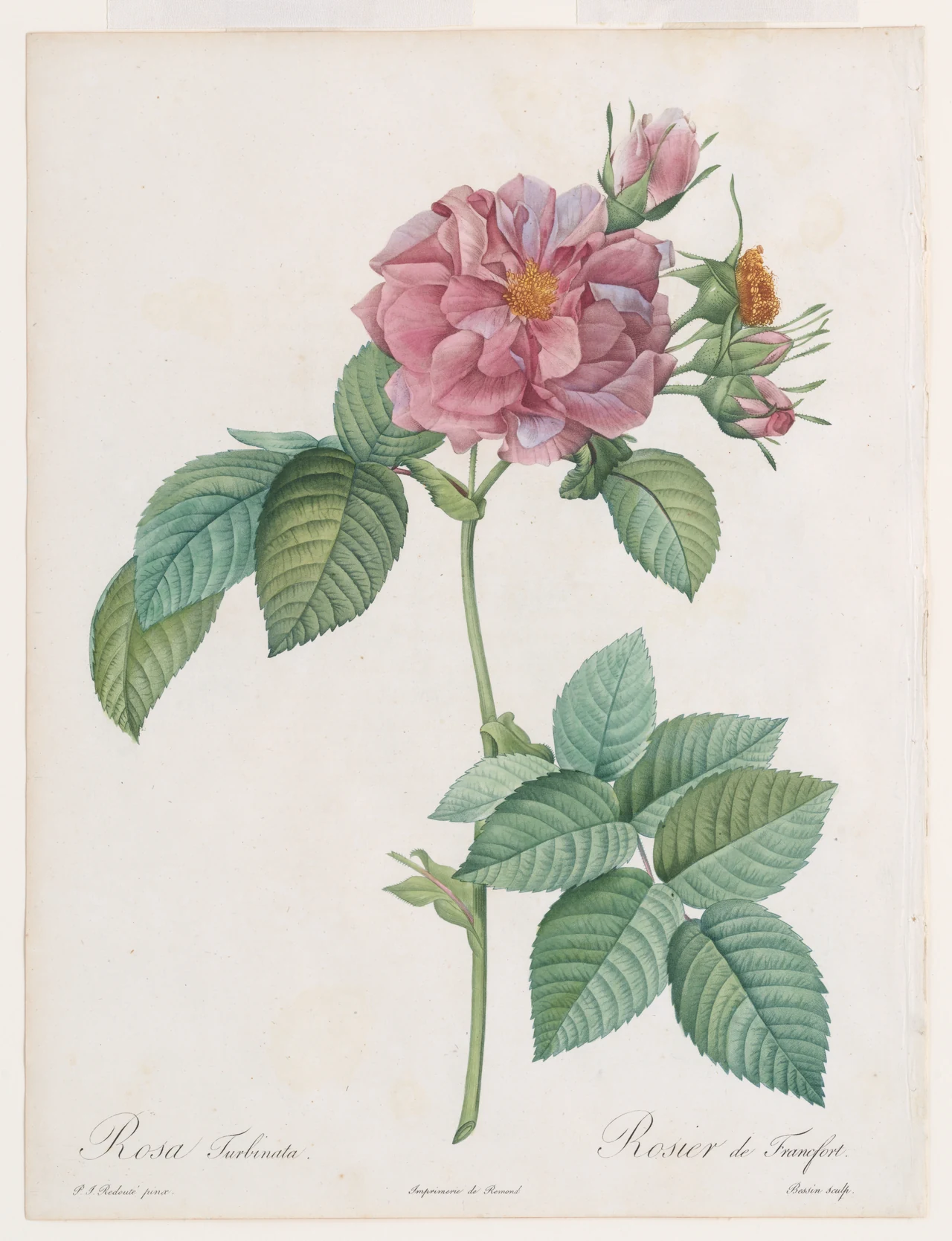
The open flower seems generous and irregular, its pink petals folding around a yellow centre. Smaller blooms turn sideways; buds keep their petals enclosed. Together they prevent “rose” from becoming one standard symbol. The leaves are equally specific, with visible veins, serrated edges and different shades on overlapping surfaces.
Compare this with Merian’s branch. Redouté’s plant has no large insects interrupting its silhouette. Attention rests on the changing forms of the rose itself. Yet the page is not cold or mechanical: the branch leans, leaves overlap, and the largest flower is balanced by smaller forms rather than placed on a rigid central axis.
The crown imperial: turn the flower downward
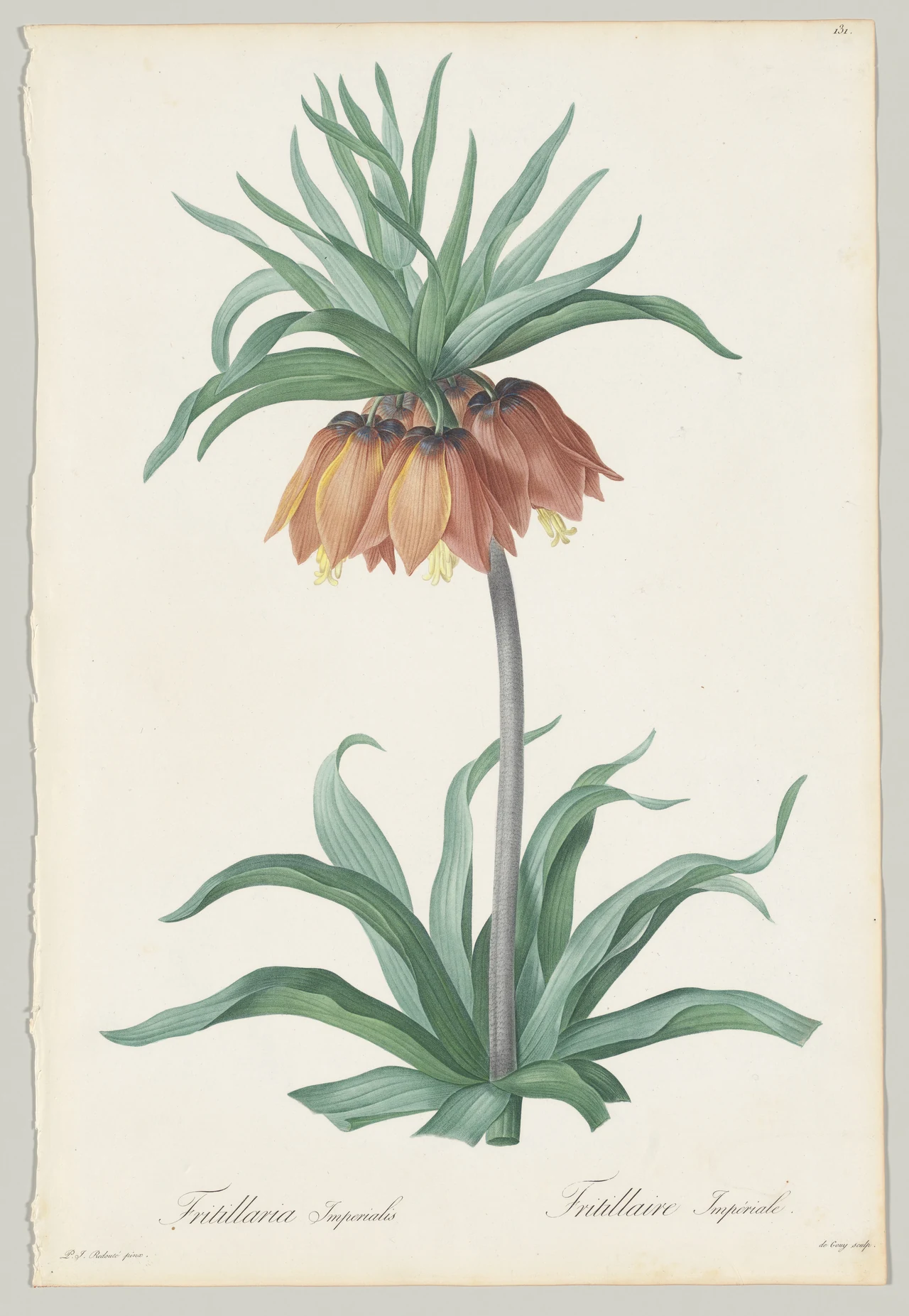
These flowers hang downward. Their pale inner parts emerge below the orange bells, while leaves flare upward above them. The long stem separates this busy upper crown from another spread of foliage near the bottom. That separation helps you understand the plant’s structure before reading its name.
The Met identifies this as plate 131 of Les Liliacées, a publication issued between 1802 and 1816. It is a different project from Les Roses. Calling every Redouté flower a “rose print” loses both the plant and the book. The printed number at upper right is a useful first clue.
Gloriosa: a drawing is not a book plate
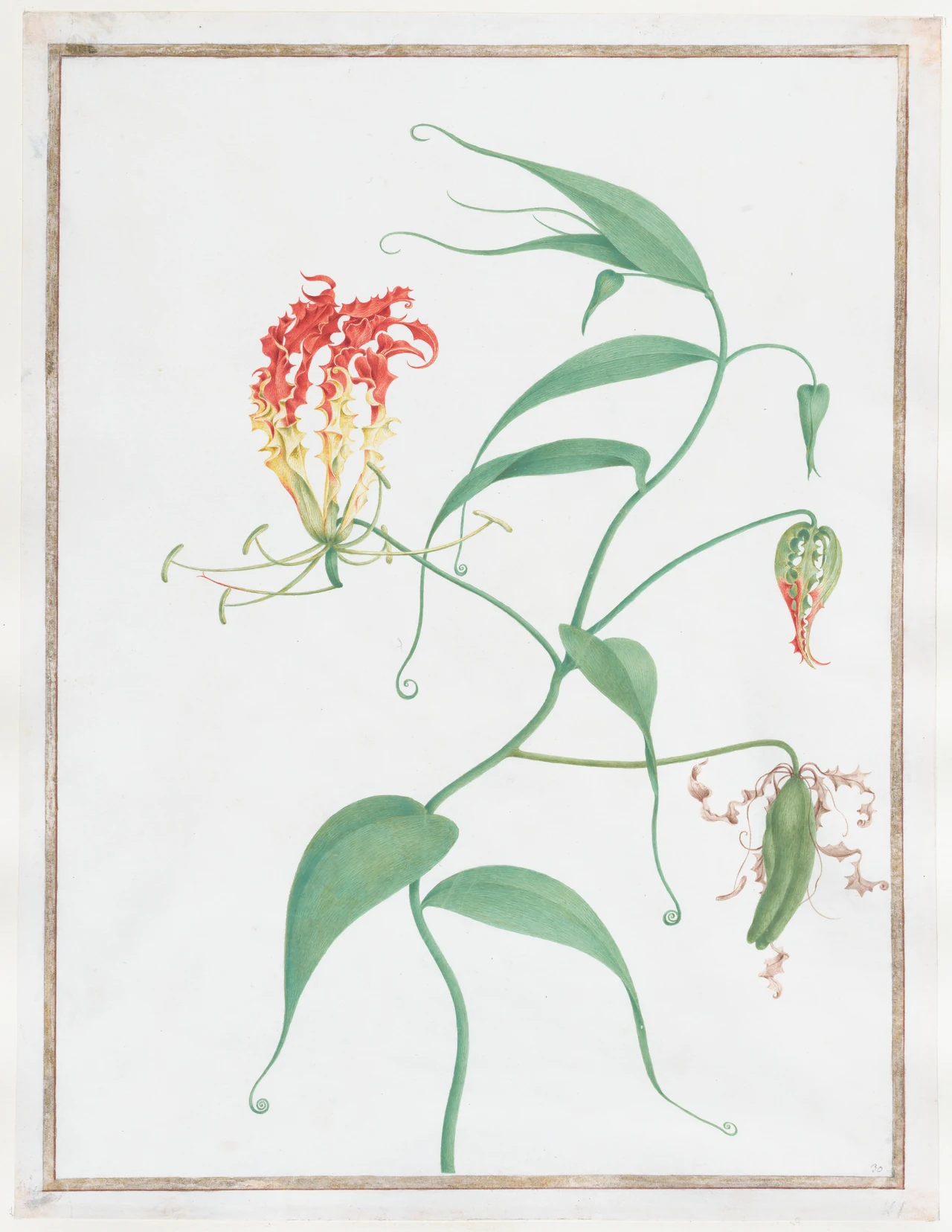
Here curling leaf tips echo the upturned red-and-yellow flower. Follow the branching stem: the plant does not merely fill the page vertically but opens into a broad, irregular shape. Other stages appear at the right, including a hanging form with pale, shrivelled petals. Beauty includes change rather than only the freshest bloom.
This object is a watercolour with gilt on vellum, not an impression of an engraved plate. The fine border reinforces its identity as a carefully presented individual drawing. A screen image can make drawings and prints appear deceptively similar; the museum’s material description restores an important distinction.
Erica: the small details below the branch
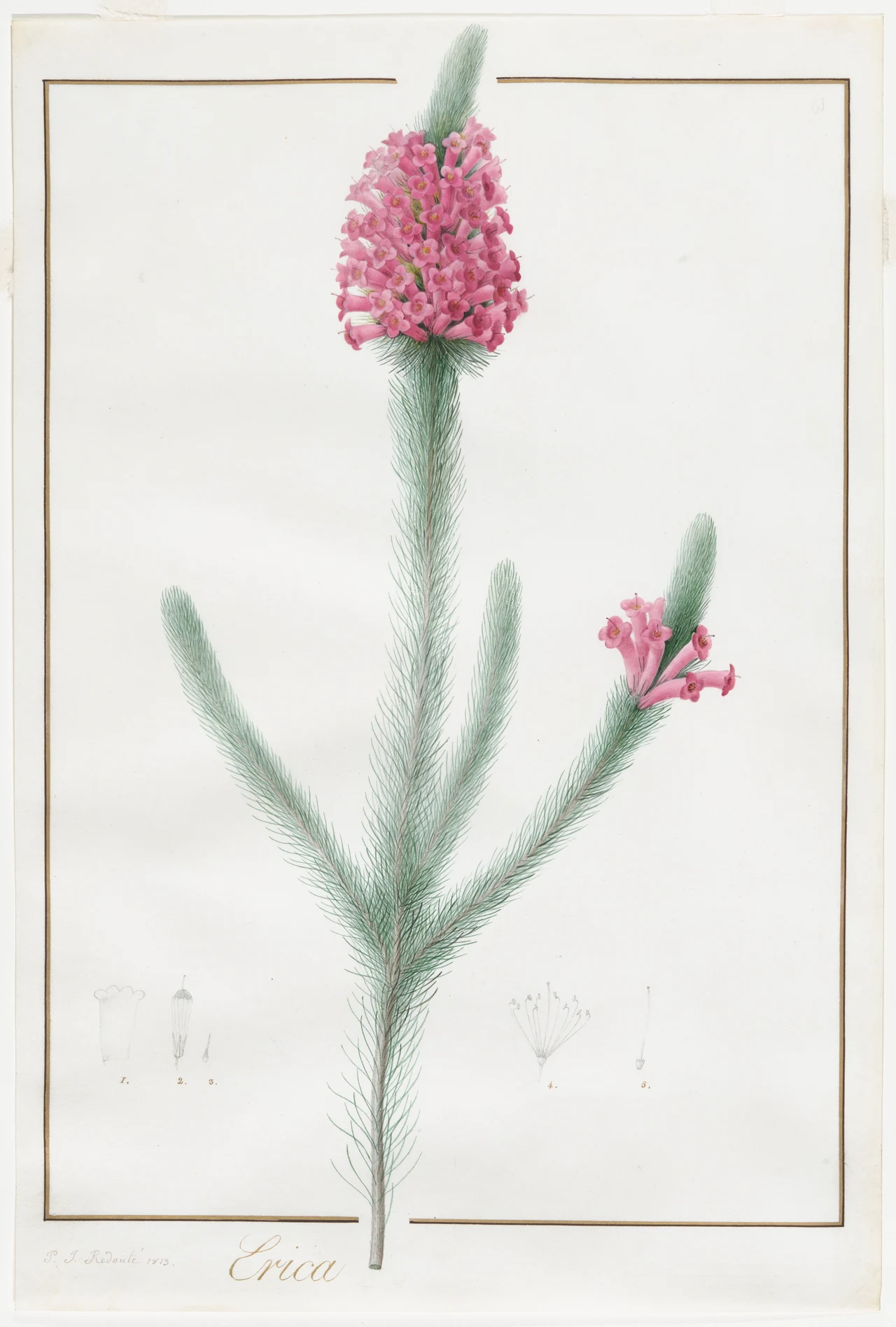
The pink flowers form a dense cluster above extremely fine foliage. Below, five numbered details are drawn so lightly that they are easy to miss. They change the drawing from a pleasing silhouette into something a reader can examine part by part. Zooming towards the flowers alone would miss that second level of information.
The Met cautiously describes this watercolour as apparently the model for plate 61 of Aimé Bonpland’s 1813 Description des plantes rares cultivées à Malmaison et à Navarre. “Apparently” is worth retaining: an attractive resemblance should not become a stronger attribution than the object record supports.
The makers beneath the famous name
Three principal designers organise this selection, but more hands made the images. Merian’s plates name Joseph Mulder and Pieter Sluyter. The NGA’s Haemanthus identifies Johannes Jacob Haid and Johannes Elias Haid after Ehret. These are distinct creative and technical roles, not extra members of a supposed botanical art movement.
The Getty exhibition also places Merian beside her daughters, Johanna Helena and Dorothea Maria. Their place in the wider practice matters without assigning them an undocumented role in either particular plate shown here. Credit should make the production history clearer, not merely lengthen a list of famous names.
How to read the next botanical image
Start with one feature you can trace: a leaf edge, a folded petal or a fruit. Then check what else the page adds—another view, a small dissection, an insect or a caption. Finally, identify whether you are seeing a drawing, a particular printed plate or a later reproduction.
For the books and exact-file questions, continue with our Merian and Redouté guides. The pleasure of these images grows when their information stays attached. You can enjoy the rose immediately, then discover how much more than “a pink flower” its maker has given you.
Editorial record
About this article
- Author
- Publisher
- GeMarkt
- Published
- Reviewed
- Internal source & rights check. Conducted by GeMarkt Research Review. This is an internal editorial check—not independent peer review.
- Source standard
- Art history source standardPrioritises object records and research sources, distinguishes evidence from interpretation, and states material uncertainty.
Found a claim that needs checking? Report a factual error.