GeMarkt Blog · Practical guide
Is Pierre-Joseph Redouté’s Art Public Domain? Roses, Prints and Files
Check Redouté’s published botanical prints, original watercolours and exact image files, with two Met Open Access plates and twelve research records.
Rights check · reviewed
The short answer
Yes for Redouté’s ordinary EU author term and the two illustrated, historically published botanical prints. The Met offers the exact selected files under CC0. Unpublished drawing histories and modern editions are separate checks.
| What is being checked | Result | Why |
|---|---|---|
| European Union — ordinary author term | Named artist’s own term expired | Redouté died in 1840; the ordinary life-plus-70 economic term has elapsed. This is not a ruling on every later contributor, publication right or national moral-rights rule. |
| United States — identified historic published illustrations | Historic publication identified | The illustrated Rosa turbinata belongs to Les Roses, 1817–24; the illustrated Fritillaria Imperialis belongs to Les Liliacées, 1802–16. These published illustrations are beyond the maximum ordinary publication term; this row does not decide the publication history of unrelated original drawings or later additions. |
| Selected digital files | Exact open institutional sources | Met objects 762055 and 828288 are marked isPublicDomain: true and offer exact original files through the museum’s CC0 Open Access programme. No other provider’s scan is licensed by this statement. |
| Other works, countries and modern editions | Separate evidence needed | No worldwide or whole-catalogue clearance. Modern writing, translations, creative adaptations and other providers’ photographs need their own terms. Undisplayed research records are not an approved download set. |
Two Met images are illustrated. Ten further research records include unavailable files and original watercolours whose U.S. publication history is not independently established here. A missing API image is not a ruling that the historic artwork remains copyrighted.
This is a documented research summary, not legal advice. Copyright and moral-rights rules can vary by country and by the history of a particular work.

What we’ll look at
Is your Redouté image a published botanical plate, an original drawing or a modern adaptation?
Short answer: Yes for Redouté’s own work under the ordinary EU author term. The two nineteenth-century printed plates illustrated here also have historic publication evidence and specific Met Open Access files. Do not extend that answer automatically to an original drawing with unverified publication history, a modern botanical book or a seller’s redesigned digital image.
Pierre-Joseph Redouté, who lived from 1759 to 1840, is associated with flowers presented against open paper: a rose, a lily or a single flowering stem that has room to be studied. The empty background makes these pictures inviting to live with. It also exposes every change made to the image. Removing a bud, deepening a petal’s colour or replacing the paper background can alter a design that seems simple at first glance.
A printed plate is not the original watercolour
The Met’s record for a crown imperial identifies a hand-coloured stipple engraving from Les Liliacées. Stipple engraving builds tone through small marks rather than relying only on continuous outlines. The resulting print can carry delicate shading that looks painted when seen on a screen.
Look along the bottom of a complete sheet. Redouté’s name may identify the painter of the model, while another name identifies the engraver. Those are different jobs. Cropping away this area can erase the information that distinguishes a published print from a unique drawing.
Nor are all Redouté flowers from Les Roses. Les Liliacées appeared in parts between 1802 and 1816; Les Roses followed in 1817–24. A collection description that calls every botanical sheet a “rose illustration” is not enough to identify the work. Use the plant name together with the publication title and, when present, the printed plate number.
The original plant labels are also historical. A museum may retain a name printed on the sheet even when a modern botanical reference uses another name. Preserve the historical title in your source record rather than silently replacing it with a guess from the flower’s appearance.
Two open plates, two different compositions
The opening image is ‘Empress Josephine’ or Frankfort Rose (Rosa turbinata), accession 2018.587.1, from Les Roses. Its large flower is slightly off-centre. Buds lead the eye upward; the cluster of leaves below balances the blossom without forming a bouquet.
The Met dates this print to 1817–24 and identifies Claude-Antoine Thory in the publication title. That is a useful, limited claim: the catalogue connects this composition to an early issued book. It does not mean every painting of this rose, every later impression or every contemporary edited edition is this same object.
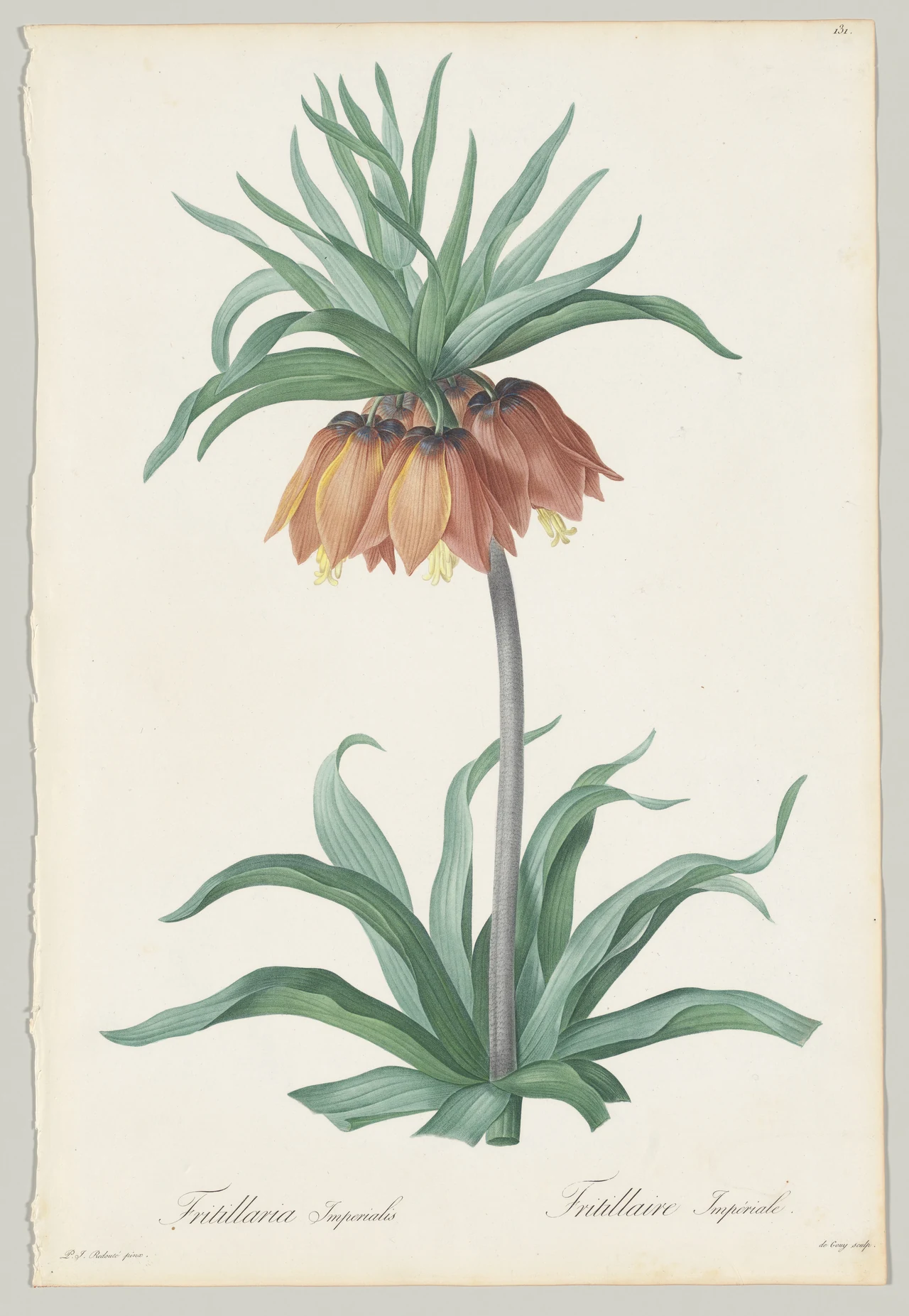
Pierre-Joseph Redouté, plate 131, Fritillaria Imperialis, from Les Liliacées, 1802–16. The Metropolitan Museum of Art, Bequest of Mrs. Charles Wrightsman, 2019, 2019.282.43. Object record. Public Domain / Open Access (CC0).
The crown imperial holds its flowers beneath a tuft of leaves, rather than pointing them toward the viewer. Its tall stem makes the page strongly vertical. Plate number 131 remains at the top; both the Latin and French names remain below. A small tear at the paper’s left edge belongs to this surviving sheet, not to the plant or the original engraved composition.
The museum holds another impression of the crown imperial, accession 2018.587.2. It is a separate object record, not a second species or another original composition. Keeping the accession with the file prevents accidental mixing of one sheet’s credit and another sheet’s photograph.
Twelve records to research, not twelve promised downloads
The following selection includes published prints and original drawings. The two illustrated files are ready for the limited use described here. The rest are research links; availability and publication evidence differ.
| Work and Met record | What the record identifies | Image/publication limit |
|---|---|---|
| Rosa turbinata | Les Roses, 1817–24 | Illustrated Met CC0 file. |
| Fritillaria Imperialis, plate 131 | Les Liliacées, 1802–16 | Illustrated Met CC0 file. |
| Canna Gigantea, plate 331 | Les Liliacées, 1802–16 | No image offered by the checked API record. |
| Koempferia Longa, plate 49 | Les Liliacées, 1802–16 | No image offered by the checked API record. |
| Cyrtanthus Obliquus, plate 381 | Les Liliacées, 1802–16 | No image offered by the checked API record. |
| Scilla Peruviana, plate 167 | Les Liliacées, 1802–16 | No image offered by the checked API record. |
| Iris Suziana, plate 18 | Les Liliacées, 1802–16 | No image offered by the checked API record. |
| Iris Lutescens, plate 263 | Les Liliacées, 1802–16 | No image offered by the checked API record. |
| Gloriosa Superba | Watercolour and gilt on vellum, about 1810 | Met marks its file public domain; drawing’s publication chain not established here. |
| Erica Fulgida | Watercolour and graphite on vellum, 1813 | Met marks its file public domain; drawing’s publication chain not established here. |
| A Stag Beetle | Watercolour heightened with white on vellum; undated in the checked record | Met marks its file public domain; no publication history asserted here. |
| Histoire des Plantes Grasses | Colour stipple engraving, catalogued n.d. [1799] | Bibliographic/object lead; no image offered by the checked API record. |
“No image offered” is not the same statement as “the nineteenth-century print is copyrighted.” It tells you that this record does not currently supply the file and designation needed for our illustrated example. It is not a reason to copy a thumbnail from an unrelated seller.
What the rights evidence actually says
Redouté’s own economic copyright is beyond the ordinary EU life-plus-70 term. The illustrated book plates were issued well before the maximum ordinary U.S. publication term could still be running; see Copyright Office Circular 15A.
A privately held drawing is a different research problem. Its early creation date is not necessarily a publication date. Section 303 contains special rules for certain old, formerly unpublished works. We have not independently established the first-publication history of the three original drawings listed above. Their museum labels are reported as museum labels, not silently converted into new legal findings.
For the two displayed prints, the Met identifies the images as Public Domain and supplies them through its CC0 Open Access programme. That permission is tied to the designated museum files. It does not license another photographer’s installation picture, a new illustrated cover or a modern publisher’s explanatory writing.
Keep the source with the flower
Save the accession, book title, plate number, download URL and rights statement alongside the image. Keep an untouched source copy even if you prepare another version for layout. A note saying only “Redouté—public domain” will not tell you which rose, which impression or which digital file you used.
When comparing files, check the leaf tips, fine stipple shading and complete captions. A heavily cleaned image can look crisp while having lost small details. Do not describe a newly coloured or reconstructed file as the museum’s untouched scan.
The practical answer is therefore encouraging but specific: begin with the two clearly identified open prints, and investigate another object on its own evidence. This guide is general information, not clearance for every Redouté image or every jurisdiction.
Sources and review method
We checked the artist chronology against museum records, treated each named jurisdiction separately, and recorded the provider policy for the image set. These sources support the legal framework and artist dates used above; the source file for any individual image still needs its own record.
- Rosa turbinata, 2018.587.1 — The Metropolitan Museum of Art. Exact print, publication dates, credit and Public Domain designation for the feature file.
- Plate 131, Fritillaria Imperialis, 2019.282.43 — The Metropolitan Museum of Art. Second illustrated print, original book context, dates, medium, accession and Public Domain designation.
- Open Access at The Met — The Metropolitan Museum of Art. CC0 applies to the specifically designated public-domain image files; the research matrix preserves exact API object IDs and filenames.
- Directive 2006/116/EC, Articles 1, 4, 8 and 9 — EUR-Lex. Ordinary author-life-plus-70 term; later first-publication rights and national moral rights are separate questions.
- Circular 15A: Duration of Copyright — U.S. Copyright Office. Historic published illustrations versus later works and the maximum ordinary publication term.
- 17 U.S.C. Chapter 3, including section 303 — U.S. Copyright Office. Formerly unpublished older works have a separate analysis; an early creation date does not alone establish publication.
Editorial record
About this article
- Author
- Publisher
- GeMarkt
- Published
- Reviewed
- Internal source & rights check. Conducted by GeMarkt Research Review. This is an internal editorial check—not independent peer review.
- Source standard
- Rights guide source standardSeparates the underlying work from the source file, records the review date, and links the evidence used for the conclusion.
Found a claim that needs checking? Report a factual error.