GeMarkt Blog · Essay
Bosch vs Bruegel
Compare Bosch's Adoration with Bruegel's Harvesters, then discover why a Bruegel print carries Bosch's name. Look beyond the familiar stereotypes.

Hieronymus Bosch gets remembered for impossible creatures; Pieter Bruegel the Elder for villages, harvests and crowded scenes. The distinction is a useful first clue, but a poor stopping point. Bosch could paint a quiet religious gathering. Bruegel could design a fish large enough to contain a whole disaster of smaller fish.
The more revealing comparison is how they organise people within a world. In the paintings below, Bosch draws a varied company towards one sacred encounter, while Bruegel spreads human activity through an extensive landscape. A third image shows how closely Bruegel’s inventions could be associated with Bosch’s reputation.
First separate the generations
These artists were not competing neighbours. Bosch died in 1516; Bruegel was born around 1525 and died in 1569. The dates attached to the Met’s Bosch and Bruegel records place them in successive generations. “The Elder” distinguishes this Pieter Bruegel from later members of the artistic family.
Both are associated with the Low Countries, a region that does not map neatly onto one present-day national border. Neither name should serve as shorthand for every northern European painting full of small figures. The particular subject, date and object still matter.
Our pair is separated by about ninety years. That makes it especially important not to describe Bruegel as simply repainting Bosch with different costumes. The comparison asks what their arrangements make visible, not whether one picture directly caused the other.
A sacred gathering and a working landscape
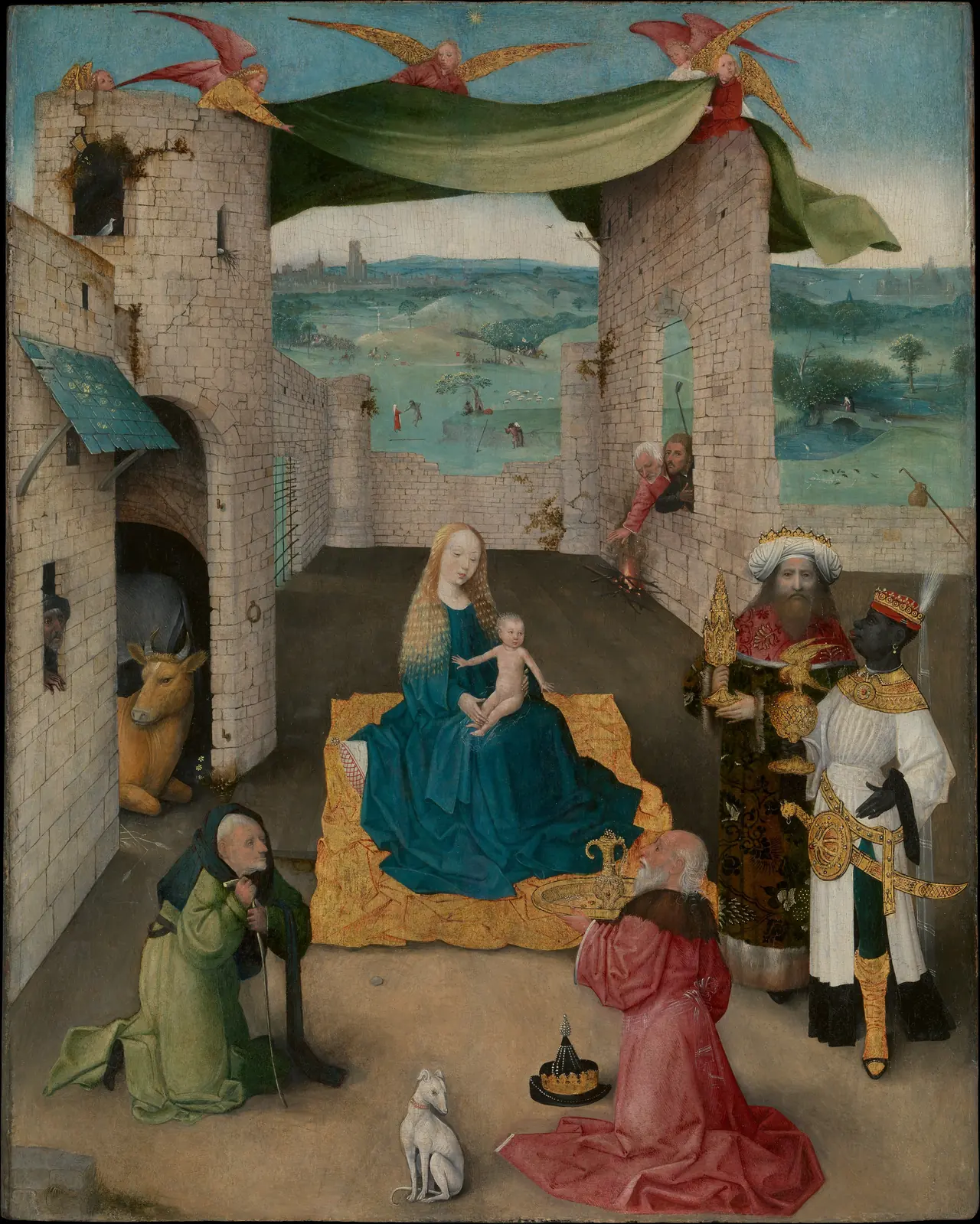
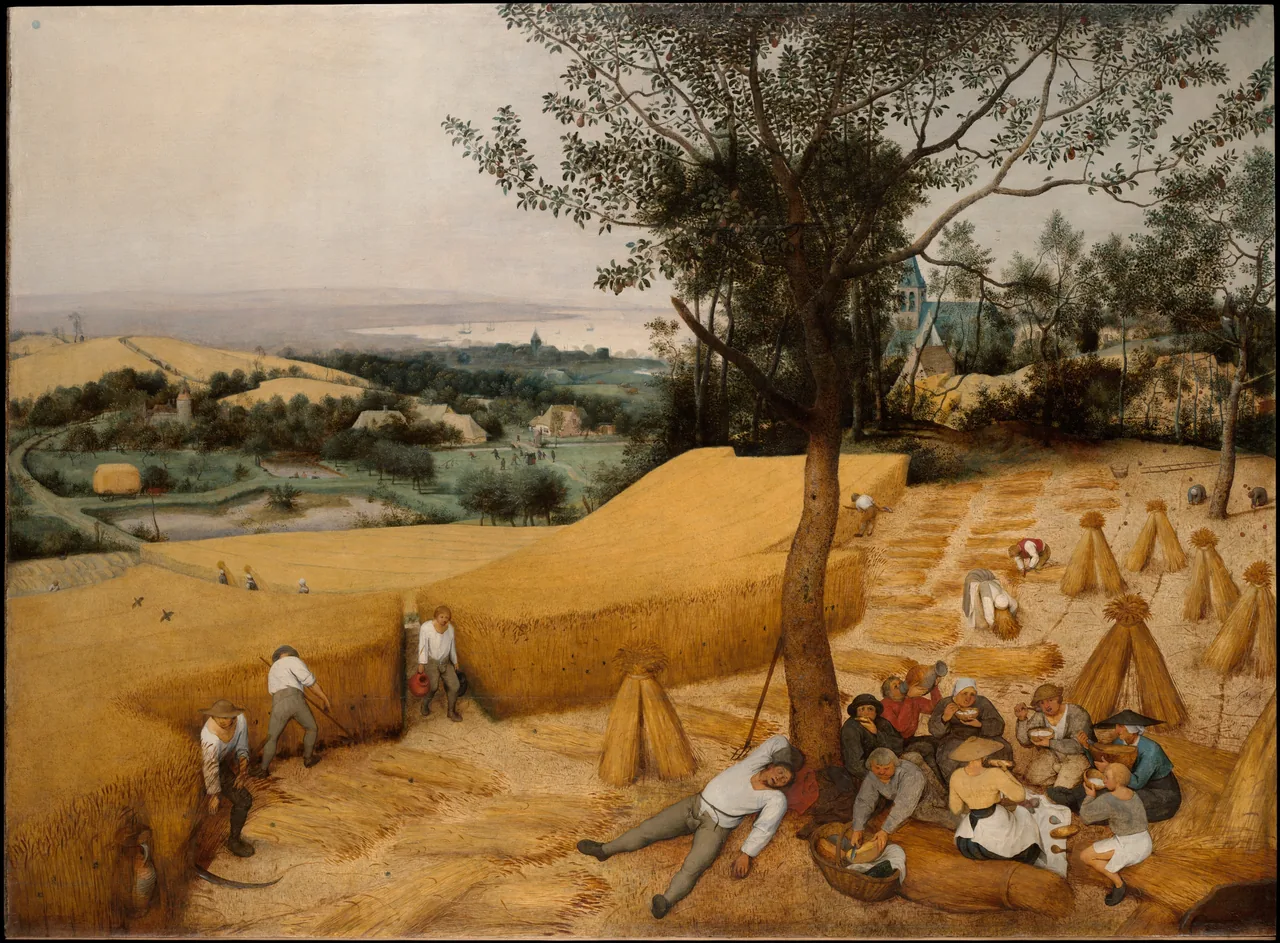
One picture rises vertically around a clustered encounter. The other extends sideways, carrying your attention from foreground bodies into distant fields. Both contain more than you register at first, but they offer different routes through that detail.
Bosch organises attention around a child
The Adoration of the Magi represents visitors honouring the infant Jesus. Find Mary in blue near the centre, then follow the kneeling visitor’s posture towards the child. Standing figures gather around that exchange. Their varied clothes, headgear and directions of looking do not make them interchangeable members of a crowd.
Above them, angels hold up a green curtain. Ruined stonework frames the group, while openings admit views of people and landscape beyond. The Met suggests that the stage-like arrangement may reflect religious plays in Bosch’s hometown. That is a possible connection, not evidence that this is a record of one particular performance.
Look at how the central action survives all the surrounding detail. A curved back, a lowered head and an offered gift establish relationships without needing a caption beside every person. The background invites further exploration, but the foreground gathering provides a strong place to begin.
This is an important Bosch to know precisely because it does not supply a parade of monsters. The distinct faces, objects and setting are doing narrative work in a comparatively calm image. Strangeness is not his only way of holding attention.
Bruegel distributes attention across a day
In The Harvesters, the tree makes an immediate division. Around its base, people eat or rest. To the left, standing and bending bodies work through the wheat. The white shirt of the reclining man catches the eye, but he is not the single hero on whom every gesture converges.
Trace the edges of the fields instead. They carry the gaze away from the large foreground figures towards smaller activities and distant buildings. A person becomes a coloured mark at one distance and a recognisable posture at another. The scale of human life changes as you travel across the panel.
The Met’s catalogue identifies this as part of a six-picture seasonal cycle made for an Antwerp merchant’s country-house dining room. It links the scene with July or August and reads its agricultural plenty as an idealised view shaped partly by a wealthy patron’s expectations.
That context prevents a tempting mistake. This is not a transparent photograph of rural working conditions, nor an unfiltered statement by “the peasants” themselves. You can appreciate the weight and weariness of individual poses while recognising that the larger scene has been carefully selected and composed.
Why the background is not just background
Cover the lower half of each image for a moment. Bosch’s openings still offer a world beyond the gathering; Bruegel’s fields still connect the foreground to settlements and water. The landscapes are not interchangeable scenery pasted behind figures.
Now uncover the bodies. Bosch’s layered architecture makes the encounter feel close, framed and accessible. Bruegel’s high viewpoint places you above a broader pattern of work and rest. These effects come from how space is arranged, not simply from whether the artist chose a religious or everyday subject.
The comparison also benefits from resisting a detail hunt. Finding every tiny figure can be enjoyable, but first ask what holds the whole painting together. In these two works, the answer is not the same: concentrated attention around a child versus an expanding network of activities.
The print with the wrong artist’s name
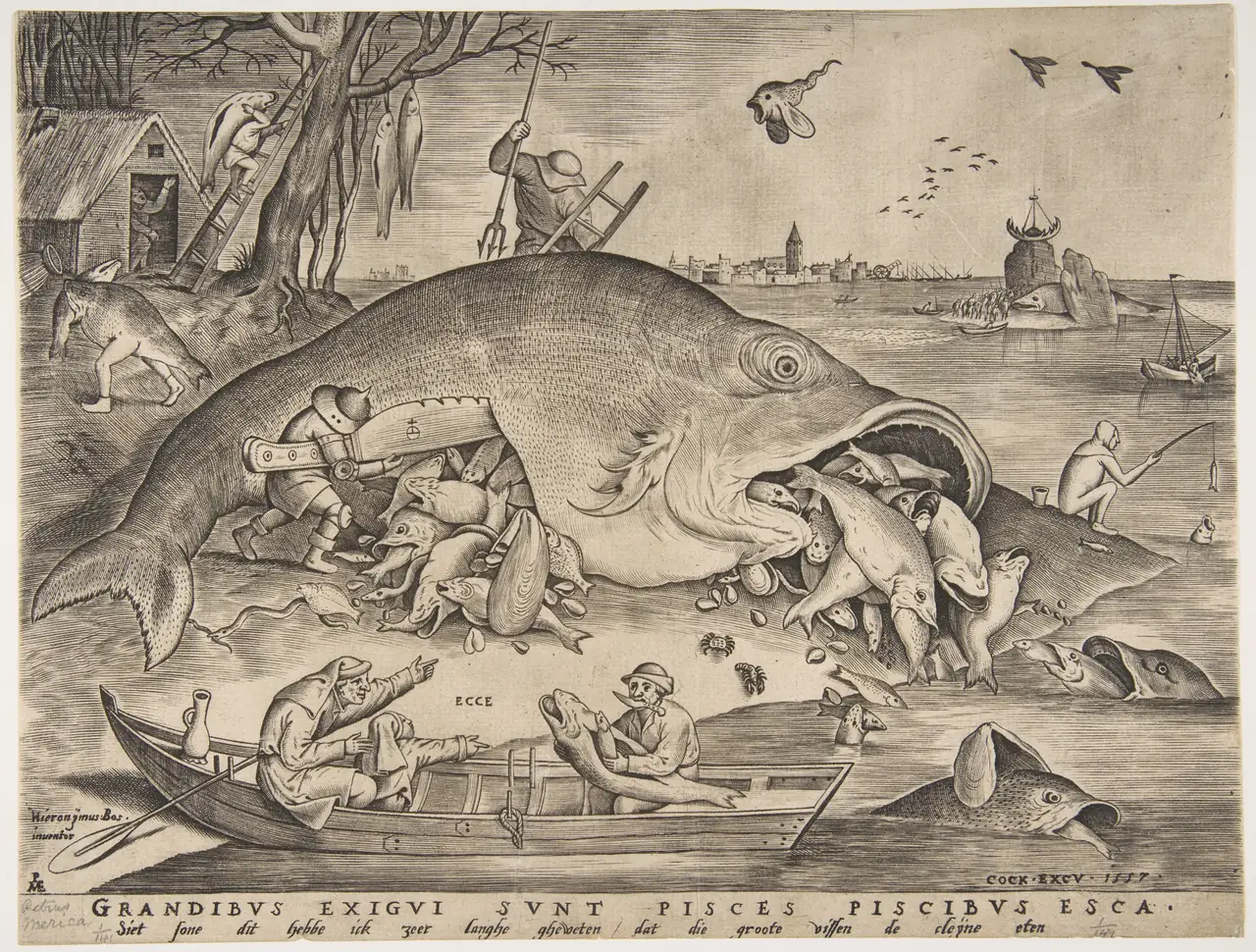
Here is the complication in miniature. The giant fish contains smaller fish, which themselves contain still smaller creatures. Elsewhere, fish acquire legs or appear in improbable situations. Repetition makes consumption look like a rule governing the whole scene.
The Met’s print record identifies Bruegel’s 1556 drawing as the source for this 1557 engraving. Yet the printed inscription names Bosch as the inventor. The museum suggests that the publisher probably substituted the more famous name to make the print easier to sell. The commercial motive remains a reasoned explanation, not a documented confession.
Three roles should stay separate: Bruegel designed the image, Pieter van der Heyden engraved it and Hieronymus Cock published it. Bosch’s printed name does not prove he designed this work. The sheet shows how a reputation could shape the reception of another artist’s invention.
Monsters and peasants are not the whole story
Bosch’s fantastic imagery still matters. The Prado’s Garden of Earthly Delights entry places that triptych within religious questions about humanity, pleasure and sin. Treating it simply as an early collection of surreal jokes would remove much of its historical setting.
But the Adoration reminds us not to expect the same tone from every Bosch. Likewise, Big Fish shows that the painter of The Harvesters could construct an impossible world. The two artists overlap more interestingly than a monster-versus-peasant label permits.
How to tell them apart without a shortcut
Begin with a securely identified object. Then ask where your eye enters, whether attention collects around one event or travels among many, and what kind of world the surrounding details create. Finally, read the full attribution: an engraving after an artist is not automatically a painting by that artist.
The Bosch and Bruegel artist guides provide further object-level starting points. Keep the three images here in mind: a sacred gathering, a working landscape and a monstrous fish. Together they make the difference between these artists clearer without making either one smaller.
Editorial record
About this article
- Author
- Publisher
- GeMarkt
- Published
- Reviewed
- Internal source & rights check. Conducted by GeMarkt Research Review. This is an internal editorial check—not independent peer review.
- Source standard
- Art history source standardPrioritises object records and research sources, distinguishes evidence from interpretation, and states material uncertainty.
Found a claim that needs checking? Report a factual error.