GeMarkt Blog · Practical guide
Bathroom Art: What Survives Humidity
Choose bathroom art by the actual room conditions and the complete product, not a waterproof-sounding label. Check glazing, backing, placement and mounting.

An ordinary paper print or canvas is not automatically suitable for a humid bathroom. The answer depends on the complete product, where you put it and how the room behaves. A little-used cloakroom without a shower is a different setting from a small room that fills with steam every morning.
Choose a product whose maker explicitly supports the intended conditions, or place the art in a drier room. A glass front, a coated surface or the word “canvas” is not enough evidence by itself. Valuable originals and irreplaceable photographs are poor candidates for finding out by trial and error.
Start with the bathroom you actually have
Look at the room after normal use, not only when it is freshly cleaned and dry. Where does water splash? Which surfaces remain wet? Does the mirror clear promptly or stay misted? These observations help you describe the proposed location to a seller or framer; they are not a precise humidity measurement.
A wall beyond the basin may avoid direct splashes while still sharing the room’s moist air. Moving a picture a little further from the shower does not prove the new spot is suitable. If moisture problems persist, address the room’s ventilation or building issue with an appropriate professional before adding vulnerable objects.
Avoid turning one reassuring observation into a guarantee. “The wall feels dry now” says little about what happens during the next long shower. If you use a humidity monitor, look at changes over time rather than treating one number as approval for every print material.
Understand why paper needs care
Paper takes up moisture. The Canadian Conservation Institute explains that high relative humidity can make it expand and become wavy, while prolonged exposure increases deterioration and mould risk. It describes protective enclosures as offering limited buffering, not permanent protection from an unsuitable environment. CCI paper-care guidance.
Do not assume that buying thicker or more expensive paper removes this concern. The intended room still matters. A sentimental drawing behind an attractive mat remains a drawing you cannot replace.
Printed canvas is not a universal escape route either. Ask about the actual ink, coating, stretcher, backing and frame, not simply the fabric name. This guide cannot declare every supplier’s canvas suitable or unsuitable without those details. When specifications are unclear, keeping it outside the bathroom is a reasonable decision rather than an overly cautious failure to decorate.
Glazing is only one part of a frame
A front sheet covers the face of an image; the finished frame also has edges, joints, backing and hanging parts. Do not infer a sealed enclosure from seeing glass or acrylic in a product photograph.
The diagram separates those layers so you can ask clearer questions. It is not an instruction to build a moisture barrier, and the exaggerated spacing does not represent an actual frame. Whether a particular assembly protects a particular print needs the maker’s specification or a framer’s assessment.
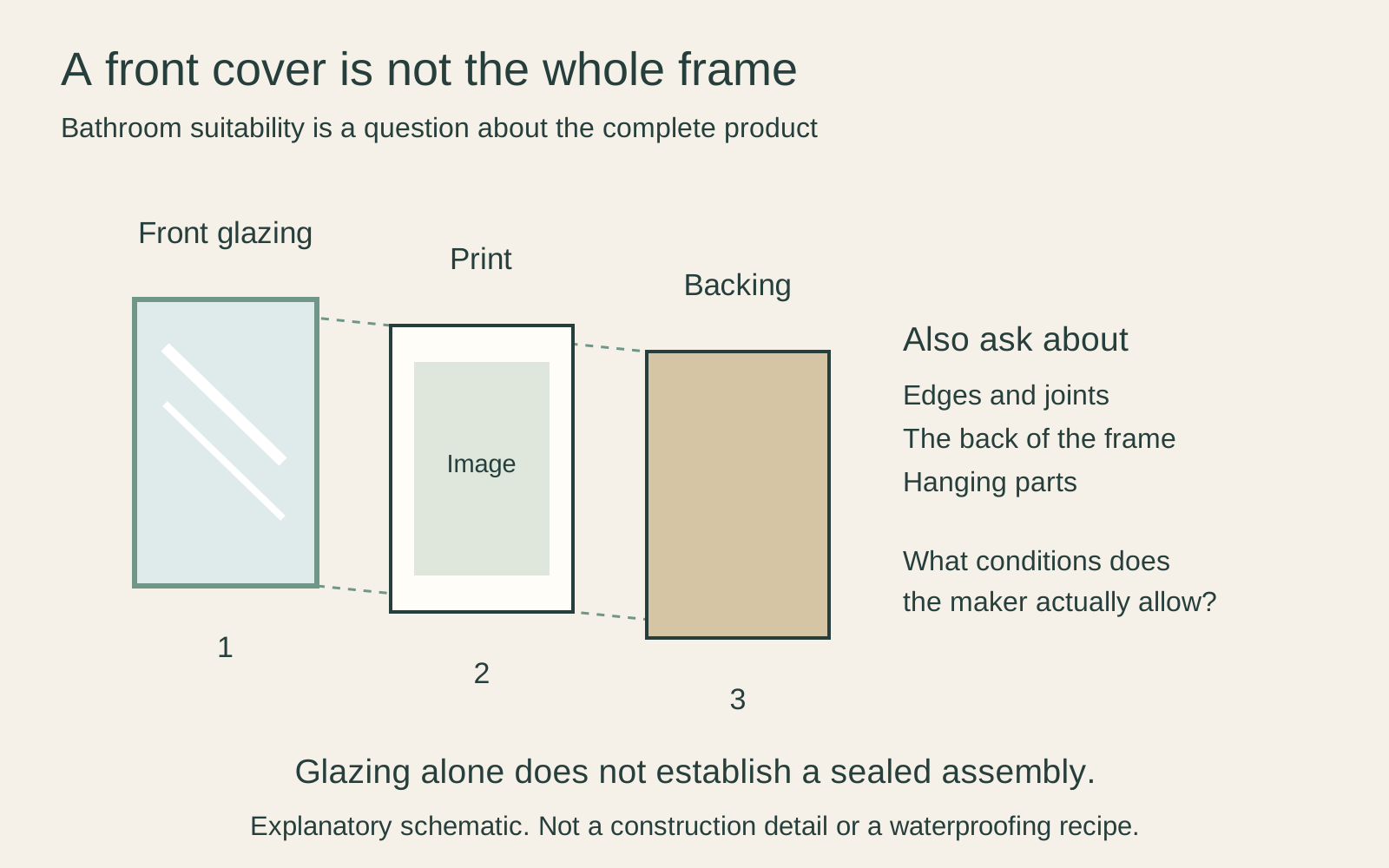
Choosing acrylic rather than glass may change other properties of the frame, but it does not answer all these questions. Likewise, a promise about UV filtering concerns light, not every form of moisture exposure. Avoid combining separate marketing claims into a protection guarantee the seller never made.
Read the whole product description
If you are considering a print on metal, an acrylic panel or another non-paper product, read the exact specification. The support is only part of the object; the image layer, finishing and fixings still need to suit the location.
Send the seller a short description of the real setting: for example, “a small shower room, on the wall opposite the basin, with no intended direct spray.” Then ask:
- Is this complete product intended for that kind of humid room?
- Are direct splashes or spray excluded?
- What care and cleaning instructions apply to the surface, edges and back?
- Does the supplied hanging system suit the environment and my wall?
Keep the answer with the order information. If the listing says only “water-resistant,” ask which component that describes and under what conditions. Resistance to an occasional wipe is not necessarily permission to put the object beside a shower.
Choose a view without blocking the room
Once suitability is established, think about what you want to see. A landscape can be a pleasing view from the doorway; a simple botanical image may work in a narrow space beside a mirror. You do not need a sea, bath or spa theme unless you enjoy it.
Use a paper template cut to the outside dimensions. Check the mirror cabinet, towel rail and door through their full movements. The art should not occupy the space you need to reach toiletries or hang a towel, and a projecting frame should not become an obstacle beside a cramped route.
Check the lighting from normal positions. A strong reflection may hide an image even when the frame fits neatly. Try another position before concluding you need a different picture. Leave useful empty wall where access or everyday cleaning matters more than display.
Check the hanging system separately
Bathroom suitability for the image does not automatically extend to the fixing. Manufacturer instructions must cover the exact product, wall surface, object weight and environment.
For example, Command distinguishes its water-resistant Bath products from ordinary hooks and picture-hanging strips, which may perform less well in humid conditions. That is guidance about its specific hanging products, not certification of any artwork attached to them. Command product FAQs.
Do not multiply a stated capacity by adding arbitrary strips or substitute a similar-looking adhesive. If mounting would involve drilling near concealed services, tiles or waterproofing, get appropriate installation advice. A decorating article cannot identify those layers from the room’s appearance.
Know when to move the picture
Once displayed, include the frame in an occasional visual check. New waviness, moisture inside the glazing, changes to the backing or a loose fixing are reasons to stop treating the position as satisfactory. Deal with the room or mounting problem as well as the object.
Do not try to dry a damp artwork with a hairdryer, press it flat or scrub a suspect patch. Seek a conservator’s advice for a valuable or affected work. Our guide to heat, humidity and art explains why choosing the environment comes before trying to repair damage.
Decide before you buy
Make three separate decisions: whether the finished artwork suits the room, whether the exact hanging method suits the wall and conditions, and whether you like the picture in that position. A convincing answer to only the third is not enough.
If no suitable place remains, use the image in the hallway outside the bathroom instead. Art does not have to sit inside every room to contribute to how a home feels. A well-chosen picture you can keep in good condition is more useful than a bathroom accessory bought on an untested promise.
Editorial record
About this article
- Author
- Publisher
- GeMarkt
- Published
- Reviewed
- Internal source & rights check. Conducted by GeMarkt Research Review. This is an internal editorial check—not independent peer review.
- Source standard
- Buying guide source standardSeparates measured or first-hand evidence from general guidance and keeps practical limits visible.
Found a claim that needs checking? Report a factual error.