GeMarkt Blog · Practical guide
Art for the Living Room: What Works Above a Sofa
Choose art above a sofa by testing the finished frame size, seating clearance and real views of the room, without treating a proportion rule as a requirement.

Good art above a sofa looks connected to the seating area without getting in the way of using it. Choose a picture you want to see every day, then test the outside dimensions of its frame against the sofa and the usable wall. A proportion such as “two-thirds of the sofa” can start a sketch, but it cannot decide the right size or hanging height for your room.
Begin with the sofa and the usable wall
Measure the sofa’s overall width, including its arms. Then measure the wall area that is genuinely available. Curtains, shelves, a wall lamp or a door can make that area narrower than the sofa. Sketch these features before searching for a particular print size.
Decide what the picture belongs to. Over a freestanding sofa on a long wall, centring on the sofa may look more intentional than centring between the room’s corners. With a sectional, try aligning the art with the back of the main seating run rather than assuming the chaise defines its centre. These are alternatives to compare on the wall, not obligations.
Look from the place where you enter the room and from the seat opposite. Those views may reveal different problems: a frame that seems small from the doorway can feel quite present across a compact seating area.
Choose something you want to live with
The picture does not need to reproduce the colours of every cushion. It can pick up one colour already in the room, introduce a contrast or remain visually independent. Start with the work itself, then decide whether its frame and surroundings help you enjoy it.
A landscape can give the eye a long route across the wall. A portrait or close-up can create a more concentrated point of attention. A detailed print may invite someone to walk closer, whereas a simpler composition can be easier to recognise at a distance. None of these effects makes one subject correct for every living room.
Check the actual image in the selected format. A panorama, a square and a portrait cannot all fill the same rectangle without borders or cropping. Do not choose an artwork for its composition and then overlook a product preview that removes an important part of it.
Test the finished width
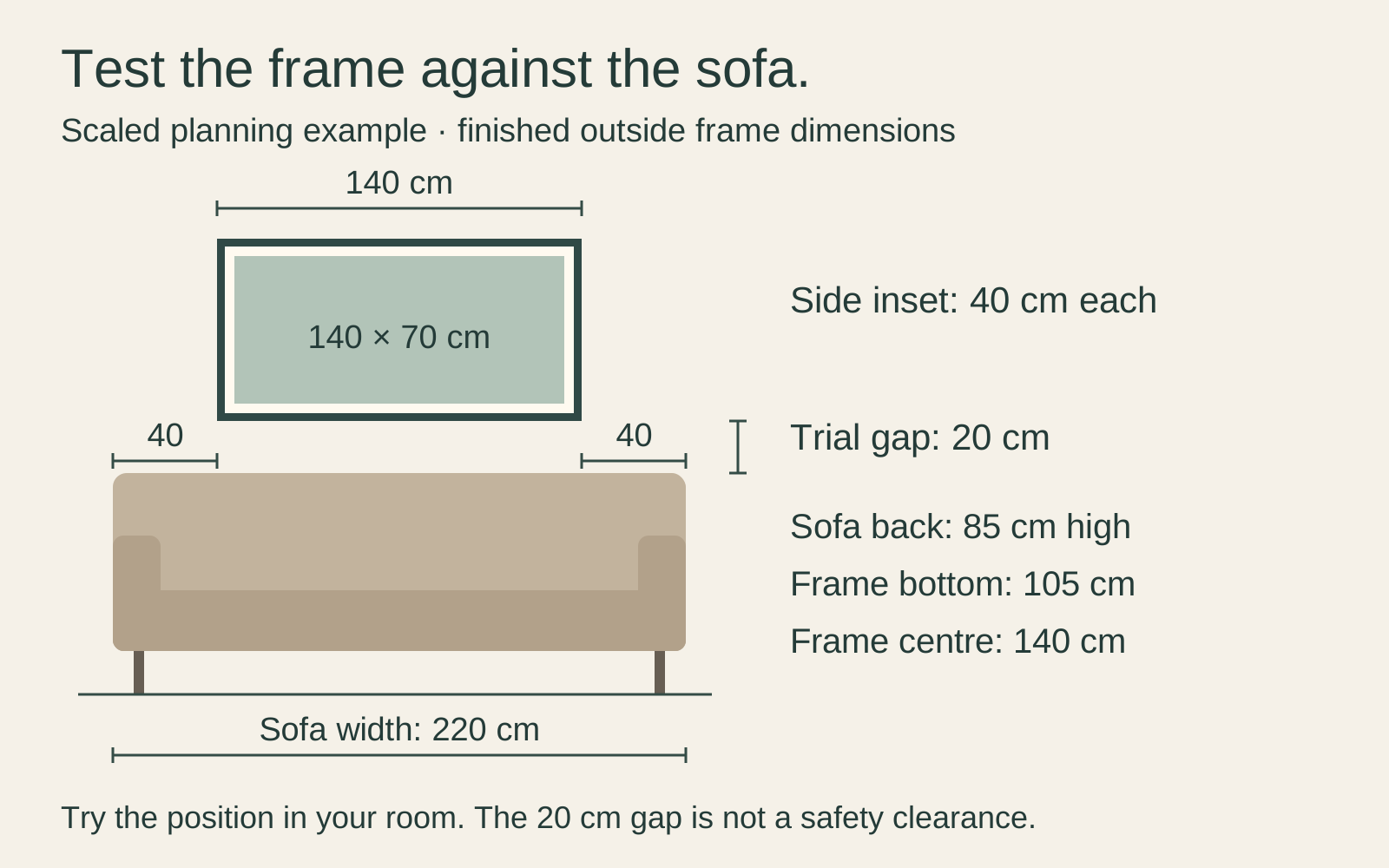
For a sofa 220 cm wide, consider a frame with outside dimensions of 140 by 70 cm. Centred above the sofa, it leaves 40 cm of sofa width on each side: (220 − 140) ÷ 2. Its width is about 64% of the sofa’s width. That describes this arrangement; it does not certify that the arrangement is right.
Try a narrower and a wider paper version. A wide mat or heavy-looking frame can make the same image feel more substantial. A pale image in a fine frame may read differently. Compare the finished outside dimensions, not a “140 cm print” whose frame adds an unknown amount.
Find the height in your own room
Start from the top of the sofa back, including cushions in their usual position. Move a paper template up and down until the art and sofa feel connected. Sit, lean back and stand up normally. If someone could knock the frame, change the position or choose another wall; a good-looking gap is not enough.
In the illustrated example, an 85 cm back plus a trial 20 cm gap puts the bottom at 105 cm. Add half the 70 cm frame height and the centre is 140 cm from the floor. A taller sofa or deeper cushions changes the calculation. There is no reason to force this centre height onto different furniture.
The top edge matters too. Check its relationship with the ceiling, shelves and any other art visible nearby. If a frame can only fit by squeezing tightly between the sofa and ceiling, a different height or arrangement may be more comfortable.
Compare a single picture with a group
One picture keeps attention on one composition. A pair can work if you enjoy the relationship between the images. To compare them fairly, use the complete span: two frames each 65 cm wide with a 10 cm gap occupy the same 140 cm width as our single frame.
The two options will not feel identical, and their heights may differ. Keep the gap within the group in your plan rather than measuring each frame as if it were alone. Our one large print or several small ones guide develops this comparison without assuming that a group is automatically more decorative or cheaper.
Check light, reflections and fixings
Look at the wall in daylight and with the lamps you actually use. Reflections can hide part of a glazed image from a favourite seat. Changing the position may help more than buying a larger print.
For paper prints, the Canadian Conservation Institute advises avoiding sunlight and nearby heat sources. Consider that before treating the brightest wall as the obvious display location. No framing choice makes an unsuitable location harmless.
Have the complete framed weight and wall construction checked before choosing fixings. The Institute’s hanging guidance emphasises supports suited to the load. Follow the frame and fixing manufacturers’ instructions; use an experienced installer if the wall or weight is uncertain. A paper template tests appearance, not structural safety.
Make a full-size paper test
Mark the outside frame shape on inexpensive paper and place it with a wall-safe temporary method appropriate to your surface. IKEA’s picture-wall guide also recommends paper templates before hanging. Leave your version long enough to see it during normal use of the room.
If the art still feels too high, crowded or disconnected, adjust the paper before committing to a size. The useful result is not a wall that satisfies a formula. It is a picture you can see clearly, positioned so the sofa remains comfortable to use.
Editorial record
About this article
- Author
- Publisher
- GeMarkt
- Published
- Reviewed
- Internal source & rights check. Conducted by GeMarkt Research Review. This is an internal editorial check—not independent peer review.
- Source standard
- Buying guide source standardSeparates measured or first-hand evidence from general guidance and keeps practical limits visible.
Found a claim that needs checking? Report a factual error.