GeMarkt Blog · Practical guide
Art for Sloped Ceilings and Awkward Corners
Find a usable vertical wall below a sloping ceiling. Test level frames, check the lowest clearance across their width and avoid forcing art into every corner.

Start with the vertical wall beneath or beside a sloping ceiling, not the angled surface overhead. One level picture on that wall can work better than a row forced to follow every change in the roofline. First check where the complete frame fits; then check whether you can actually enjoy seeing it there.
An awkward corner does not need its own artwork. You may get a better result by placing a picture on the adjoining wall, relating it to a chair or desk, and leaving the tightest part of the corner alone.
Separate the vertical wall from the ceiling
There are two different situations. A gable or end wall can be vertical even though its top edge slopes with the roof. A frame on that surface is still on a wall. The angled ceiling surface itself is a different mounting situation.
This guide’s examples use the first: a vertical wall with a sloping top outline. They do not show a picture fixed to a tilted ceiling. If your idea requires an overhead or inclined installation, ask a qualified installer to specify an appropriate system for the object and construction. Ordinary picture-hanging advice is not enough to establish that arrangement.
Stand beside the proposed wall and identify which surface you mean before buying. In a photograph, a roof slope and a triangular wall can be surprisingly easy to confuse. A simple side-view sketch can make the distinction clear to a framer or installer.
Measure across the whole frame
The space above the centre of a picture is not the only measurement that matters. Where the ceiling slopes down, the upper corner of a wide frame may be much closer to it than the centre is.
Take a hypothetical wall 300 cm wide, with a straight roofline descending from 240 cm high on the left to 120 cm on the right. Its height falls by 40 cm for each 100 cm travelled right. Real rooms may have beams or irregular slopes, so measure rather than assuming this shape.
In position A, an 80 × 60 cm outside frame runs from 40 to 120 cm along the wall, with its top 145 cm above the floor. The roofline above its right edge is 192 cm high, leaving 47 cm. In position B, a 70 × 50 cm frame runs from 170 to 240 cm, with its top at 105 cm. The roofline above its right edge is 144 cm high, leaving 39 cm.
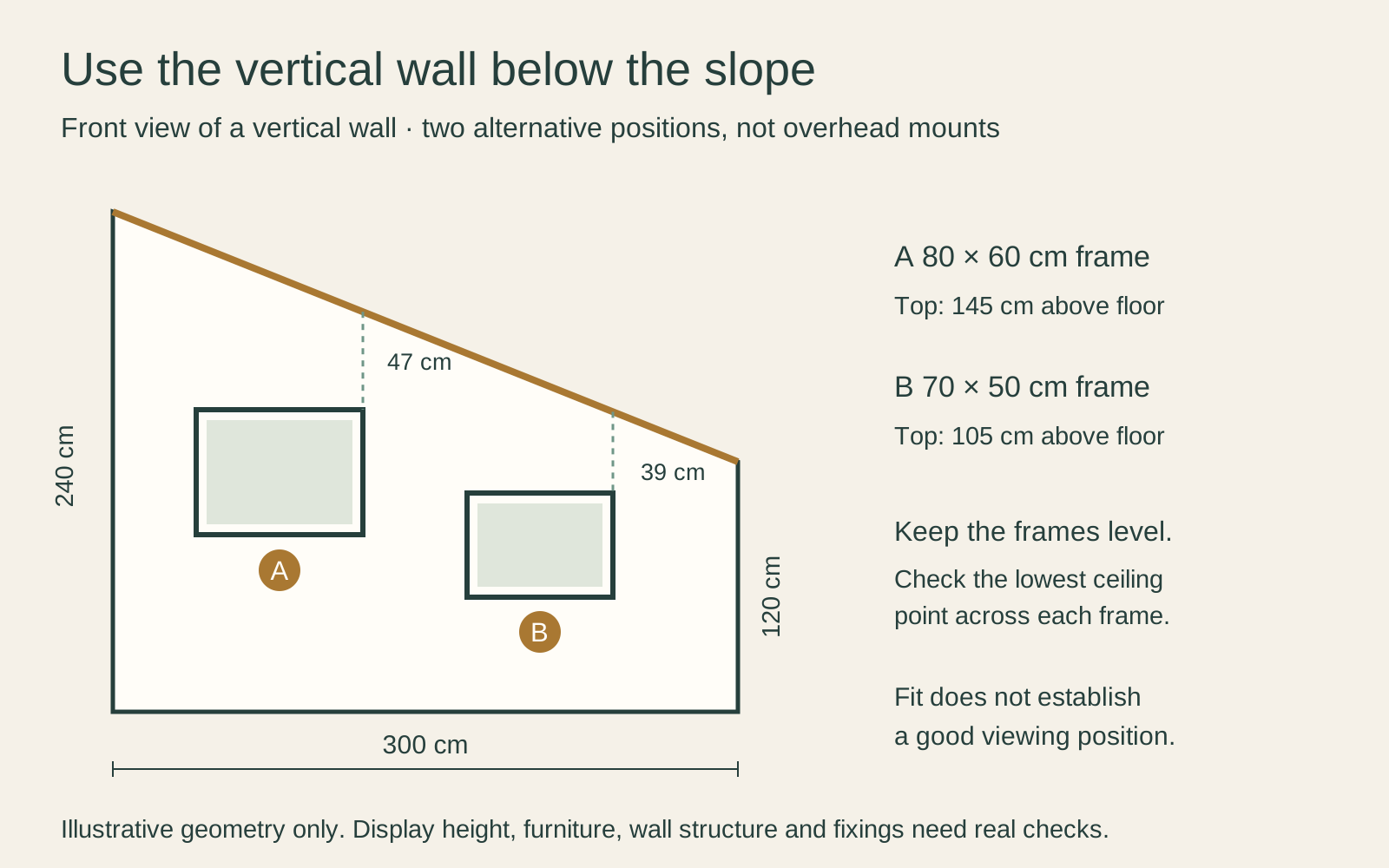
Both fit geometrically; either could still be wrong for the furniture, viewing position or mounting. The examples are alternatives to compare, not a prescription to hang both or to place pictures this low.
Keep the picture level
Start with the frame’s top and bottom level, even when the ceiling above it is not. Tilting the artwork to match the roof changes how you read the image and can make the entire arrangement look accidental.
Try the frame against the vertical edge of a door, the top of a desk or a level line on your sketch. These give you a different reference from the roof. You do not have to reproduce the room’s diagonal inside every decorative decision.
If several pictures are involved, compare a level row with a smaller compact group. A staircase of frames may look busy when the ceiling already provides a strong diagonal. That is a visual preference to test, not a rule that every sloped room must have the same arrangement.
Use the view from the furniture
Sit at the desk, lie back on the sofa or stand at the doorway. A low wall can give a picture a useful place beside a reading chair while putting the same picture below your normal standing view elsewhere.
Position the template in relation to that activity. A print above a low cabinet might be seen often; one tucked behind a chair’s back may disappear when the room is in use. Check lamps, the open laptop and objects normally left on the furniture rather than evaluating an artificially empty room.
Our small-space art guide uses the same principle: judge the image from actual viewing positions before deciding how much wall to fill. A constrained room rewards clear choices, not necessarily smaller pictures everywhere.
Let an awkward corner stay partly empty
A frame does not need to touch both sides of the available space. Leave visible wall around it and compare whether the image feels comfortably placed or wedged in. A mat can give the image internal breathing room, but it does not create more wall outside the frame.
For a tight corner, try one image on one adjoining wall before adding a matching image around the turn. You may enjoy one coherent view more than two pictures that cannot be seen together from anywhere useful.
Avoid stacking decorative objects below the frame just to explain its position. A narrow floor area can quickly become difficult to use. Keep doors, storage access and the routes people need separate from your desire to complete a composition.
Watch roof windows and room conditions
A good fit under the roofline may still be a poor display location. The Canadian Conservation Institute warns against sunlight from windows or skylights for works on paper and against attic conditions with fluctuating temperature and humidity. A finished loft should be assessed for its actual conditions, not assumed suitable or unsuitable from its name alone. CCI paper-care guidance.
Look at where sunlight falls at different times and consider seasonal changes. A place that avoids it during one afternoon check may receive it at another time. Do not assume a small roof window is harmless because it occupies little wall area.
If the room has dampness, leaks or significant temperature swings, deal with those issues before choosing a valuable work for the space. A decorative solution cannot repair the room’s environment.
Plan the mounting without guessing
The wall’s shape does not tell you what is behind its surface. Identify the construction and the full framed weight before selecting hardware. A fixing suitable for one wall cannot be approved for another from a photograph alone.
Manufacturer guidance is product-specific. Command, for example, tells users to check the stated weight and surface requirements and warns that adding more strips does not necessarily raise the limit. That guidance does not establish suitability for an angled or overhead installation. Command FAQs.
Where the construction, concealed services or fixing arrangement is uncertain, get qualified installation advice. Keep the distinction clear: the diagram proves its arithmetic, not your wall’s capacity.
Test the idea at full size
Cut a template to the outside frame dimensions and mark the image area. Check the entire upper edge against the slope, then use the room normally with the template in view. Compare a higher, narrower option with a lower, wider one if both are practical candidates.
Take a photograph from your normal viewing position, but also judge it in person. The photograph can hide how low the frame feels or how a corner interrupts the view.
Choose the arrangement that makes the picture easy to enjoy without forcing the room to accommodate it. Sometimes that means one well-placed work; sometimes it means using a different wall and leaving the slope alone.
Editorial record
About this article
- Author
- Publisher
- GeMarkt
- Published
- Reviewed
- Internal source & rights check. Conducted by GeMarkt Research Review. This is an internal editorial check—not independent peer review.
- Source standard
- Buying guide source standardSeparates measured or first-hand evidence from general guidance and keeps practical limits visible.
Found a claim that needs checking? Report a factual error.