GeMarkt Blog · Practical guide
Art for Cafés, Offices and Waiting Rooms
Choose art for shared spaces around visitors, sightlines and daily operations. Check physical display, image permissions, access, mounting and care separately.

Art in a café, office or waiting room has to share space with other people’s tasks. Visitors may be ordering, finding a reception desk, working or waiting without much choice about where to sit. Start by deciding what each wall is for, then choose pictures that can be enjoyed without making the room harder to use.
You do not need a coordinated set for every blank surface. One well-placed work can be a better start than a full order of matching prints. Make the first decision small enough to test, and check permissions, installation and daily care before expanding it.
Give each wall a job
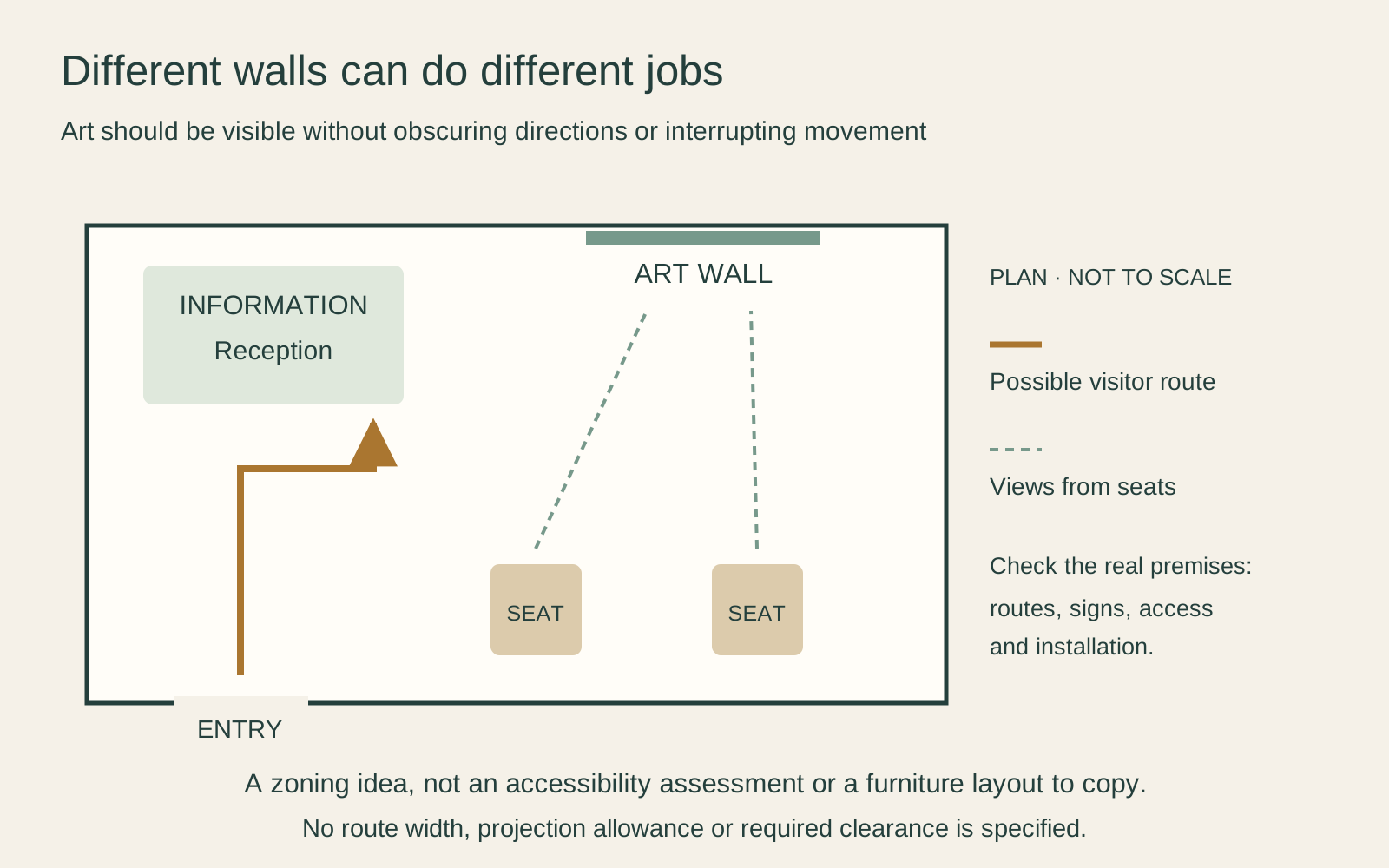
Walk in as a first-time visitor. Where do you need to go, and what information helps you get there? A menu, reception sign or directional notice should not have to compete with a dense gallery of pictures. Give essential information a distinct place, then look for walls where people can choose to look at art.
In a café, that might mean keeping the ordering point visually clear and placing a picture near seated customers. In an office, it may be the view beside a discussion table rather than behind a busy noticeboard. In a waiting room, a side wall visible from several chairs may work better than the space directly above their occupants.
The schematic separates information, art and circulation. It is not a measured floor plan or an accessibility approval. Use the idea to ask questions about your own premises, not to copy furniture positions or passage widths.
Choose for the people who share the room
Identify who spends time there, including staff. A founder’s favourite image may be a welcome personal choice in one business and an uncomfortable compulsory view in another. Ask the people who use the room what they would enjoy, particularly where visitors may be distressed or unable to move freely.
Do not assume that one landscape, colour or style will calm everyone, improve productivity or increase sales. Treat those as claims requiring evidence, not as reasons to buy a print. Instead, describe the choice plainly: a local view gives people something recognisable to discuss; a detailed botanical image offers small things to look at; an abstract work contributes a particular rhythm or colour.
In sensitive settings, review subject matter with the responsible team. What is amusing in a private studio may be inappropriate in a family waiting area. This does not require bland art everywhere; it requires knowing whose space you are furnishing.
Read the picture from real viewpoints
Sit in the chairs, stand where people queue and look from the entrance. A tiny image behind a large table may be visible as a frame but unreadable as a picture. Conversely, a detailed print beside a chair may reward looking without needing to dominate the whole room.
For a simple scale trial, compare a 60 × 80 cm outer-frame template with a 40 × 50 cm one in the same position. These are alternatives, not minimum sizes. Photograph both for discussion, but also look in person; a wide-angle room photo can make the pictures appear smaller than they feel from a chair.
Check reflections under working lights, not only before opening. Ask whether a picture remains visible when chairs are occupied and when doors are open. A proposed frame directly behind someone’s head may appear prominently in promotional photography while providing almost no enjoyment to the person sitting there.
Separate physical display from image reuse
Buying a physical print, printing a digital file and putting that image in an advertisement are different acts. Keep a record of what you acquired and which permissions apply. Do not assume a purchase transfers copyright or that a file offered for personal use can be printed for business use without checking its terms.
One jurisdiction-specific example: US copyright law, section 109(c) permits the owner of a particular lawfully made copy, or someone authorised by that owner, to display that copy to people present where it is located. That provision does not grant a general right to make new prints or reuse the image online. Check the law and terms relevant to your actual use and country; uncertain cases need qualified advice. See the US Copyright Office’s text of section 109.
If a wall will feature prominently in advertising or video, assess that proposed use separately. For file labels and permissions, our public domain, Creative Commons and royalty-free guide explains why those terms are not interchangeable.
Preserve routes, signs and access
A frame is a physical projection, not just an image on a plan. Check what happens when a visitor walks beside it, uses a mobility aid or carries a tray. Keep exit information, controls and necessary notices visible, and do not create a display that relies on people stepping around a leaning frame.
Where US ADA standards apply, the Access Board’s guide to protruding objects explains that projection requirements concern circulation paths throughout rooms, not only named corridors or accessible routes. Other jurisdictions have their own requirements. Have the responsible premises professional check the actual arrangement; the drawing here is not a compliance design.
Measure the complete assembly’s depth as well as its width and height. Thick frames, ledges and projecting lights need attention that a flat paper template cannot provide. A visual trial is only one part of choosing a position.
Specify the object and its installation
Record the exact picture, outside dimensions, materials, complete weight and intended location before ordering installation. The installer needs to assess the wall and the appropriate fixings for that assembly and setting. Do not transfer a claimed capacity from a packet of hooks to a different wall construction.
Discuss glazing and breakage risks for the location with the supplier and responsible premises team. An unglazed canvas is not automatically easier to clean, and acrylic is not an automatic answer for every work or safety requirement. The choice involves the image surface, enclosure, position and maintenance together.
If the business rents its premises, establish what alterations are permitted before drilling or commissioning a display system. A removable arrangement may still have restrictions. Keep the agreed method with the purchase record so the next person does not improvise when a picture needs moving.
Make care someone’s job
Find out who cleans the room and how. A print near food preparation, splashes or spray-cleaned surfaces may face conditions that do not appear in the listing photograph. Move the proposed display if its care needs conflict with the work carried out there.
The Library of Congress advises keeping paper away from food and drink, intense light and heat sources such as radiators and vents. Its paper-care guidance supports choosing the position carefully rather than assuming that a frame makes any location suitable.
Ask for care instructions for the actual surface and enclosure. Do not invent a cleaning routine from the word “canvas” or “archival.” Assign someone to notice damage, loose components or changes in the surrounding room and to arrange appropriate advice. Include the display in normal premises checks rather than treating installation day as the end of the job.
Test one area before ordering a set
Choose one wall with a clear purpose, then trial the image and full outer dimensions. Ask staff to look at it during the workday, not just in an empty room. Check visibility from occupied seats, interaction with signs and whether the proposed position complicates cleaning or movement.
Keep a short purchase record: artwork and source, exact file or physical item, permission notes, finished measurements, installation decision and care instructions. Add any separate approval needed for promotional photography. This is practical continuity for the business, not proof that every legal question has been resolved.
Expand only once that first arrangement works in daily use. The next picture can relate to it without duplicating its size or subject. A shared room feels considered when its art belongs to the way people use it, not when every wall has been filled.
Editorial record
About this article
- Author
- Publisher
- GeMarkt
- Published
- Reviewed
- Internal source & rights check. Conducted by GeMarkt Research Review. This is an internal editorial check—not independent peer review.
- Source standard
- Buying guide source standardSeparates measured or first-hand evidence from general guidance and keeps practical limits visible.
Found a claim that needs checking? Report a factual error.