GeMarkt Blog · Practical guide
Art Above a TV: Balancing Screen and Picture
Compare art above and beside a TV without moving the screen to suit the picture. Test the whole arrangement from your seat, with the TV on and off.

Art above a TV can work, but it is not the only way to make a television wall feel finished. First keep the screen in the position that works for watching. Then compare a picture above it with a picture beside it. If the first arrangement makes the art feel stranded near the ceiling, the second may give it a much better place in the room.
The useful test is not whether two rectangles line up in a photograph. It is whether you like the wall from the sofa, with the television both on and off, while the equipment still works as intended.
Keep the screen where it works
Start from your normal seat, not from the middle of the room holding a phone. Note the screen position you currently find comfortable and any practical problem that already needs attention. Adding a painting should not become a reason to raise a satisfactory TV position or squeeze the television into a decorative frame of objects.
Look above the screen from that seat. Can you actually enjoy a picture there, or would you have to keep looking up to see it? Check the other seats too. An armchair at an angle may have a better view of a side wall than of anything directly above the TV.
If the TV itself needs relocating, solve that as a separate equipment and installation decision. You can plan the art once the screen position is settled; there is no need to make one purchase compensate for the other.
Compare above with beside
A centred picture above the screen gives the wall a clear vertical relationship. A picture beside it gives the eye another place to go. Neither requires the artwork to match the TV’s width. A narrow portrait or vertical landscape may be easier to enjoy beside a wide screen than directly over it.
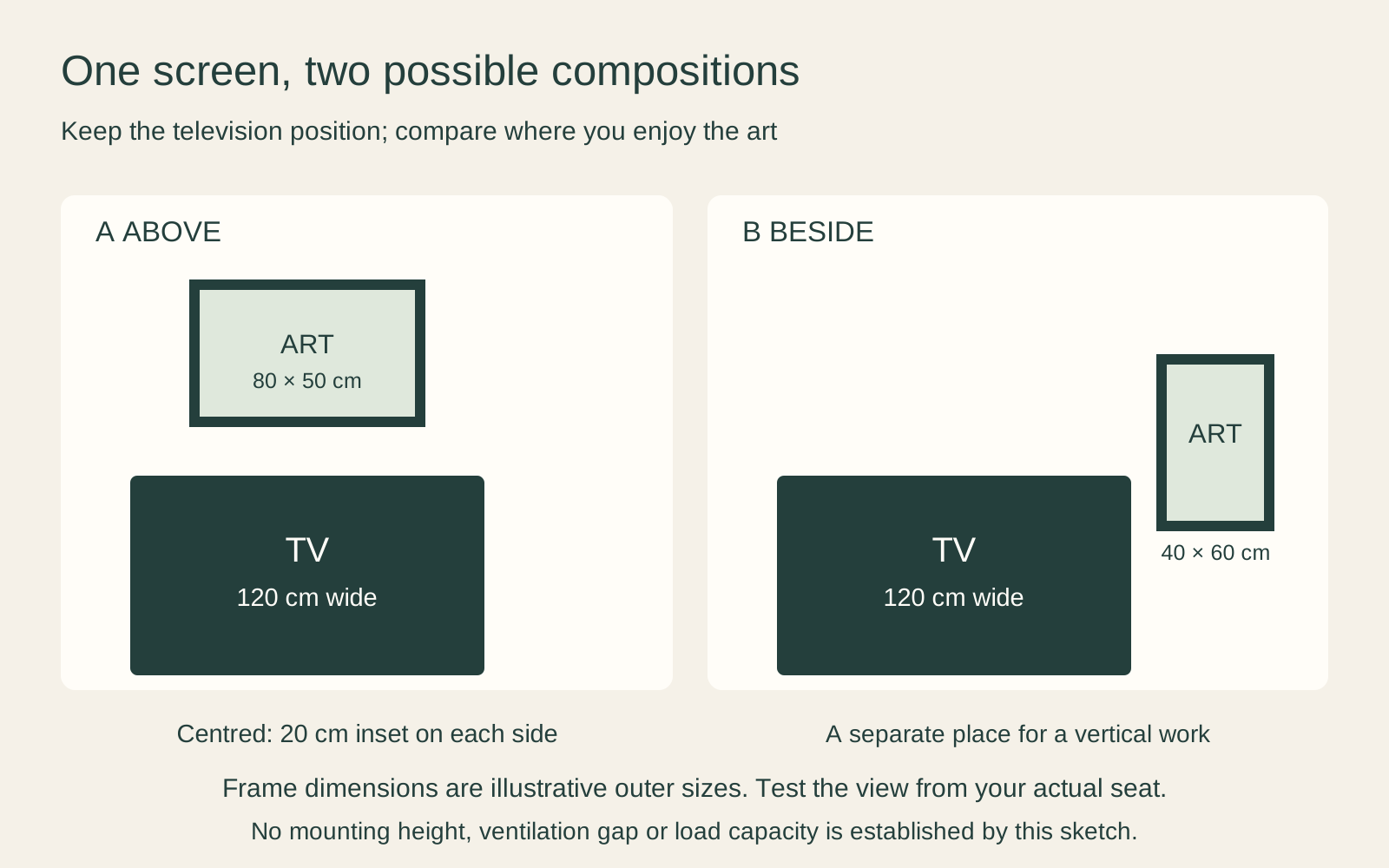
The drawing holds the television in the same position in both alternatives. In A, an 80 × 50 cm outer frame is centred above a 120 cm-wide TV. In B, a 40 × 60 cm outer frame sits beside it. These are composition examples, not mounting instructions. Use templates on your actual wall; the drawing cannot decide equipment clearances or viewing height for your room.
Measure the finished arrangement
Measure the outside of the frame, not just the paper size. In example A, the centred 80 cm frame leaves 20 cm of the TV’s width extending beyond it on each side: (120 − 80) ÷ 2. That number describes horizontal alignment only. It does not tell you how much vertical space to leave above the equipment.
Cut a template to that full outer size. Mark the visible image opening inside it if a wide mat will make the artwork substantially smaller. You may like the large frame as an object but find that the image itself is too small to read from the sofa.
For two pictures, add both outside widths and the intended gap before judging the group. Keep their complete footprint within the part of the wall you actually want to use, rather than filling every spare centimetre. Our print-size guide separates paper, image and frame measurements.
Choose how much attention the art asks for
A TV changes constantly; a print stays still. Decide whether you want the artwork to be another strong presence or a quieter part of the surrounding room. This is a preference, not a rule that television walls need pale art.
A bold poster with large shapes may hold its own beside a dark screen. A fine engraving with small details may be more rewarding on a nearby wall where you can approach it. If a picture matters to you because of a face, inscription or tiny scene, judge that detail at the actual viewing distance before ordering.
You can repeat one colour from the rest of the room without matching the artwork to a streaming-service thumbnail. Equally, do not reject a favourite image because it is more colourful than the furniture. Test the whole picture rather than choosing from colour swatches alone.
Look with the TV on and off
Review the arrangement in daylight and in your normal evening lighting. A black screen, a bright programme and a paused menu create different neighbours for the artwork. A wall that looks balanced when everything is switched off may feel crowded during a film.
Check the proposed glazing from each seat. A reflection of a window or lamp can obscure a print even when the frame position is otherwise good. Moving a lamp, choosing another wall or discussing glazing with a framer may be more useful than buying a larger picture.
Do not use a phone photograph as the only evidence: automatic exposure can make the screen and wall look different from what you see in person. Take a photograph for comparison, then return to the sofa and look normally. Give yourself permission to leave the space above the screen empty if that is the version you prefer.
Keep equipment and access in the plan
Art should not cover ventilation openings or make routine access awkward. Sony’s ventilation guidance warns against blocking openings and directs owners to the instructions for their particular model. Use those instructions rather than a decorative spacing rule from a room photograph.
Include the soundbar, speakers, cables and any arm that lets the TV move. Check the equipment through its intended range before deciding where a frame belongs; do not let a swing-out screen collide with it. Leave necessary controls and service access usable.
Avoid solving a composition problem by hanging a picture over a socket, cable route or access panel without checking what is behind it. If new drilling is involved, an appropriate installer should assess the wall and hidden services. A pleasing gap is not evidence that a fixing position is suitable.
Install each item for its own job
Treat the TV, furniture and artwork as separate installations. The US Consumer Product Safety Commission’s Anchor It guidance recommends furniture designed for televisions, securing TVs against tip-over and following the manufacturer’s instructions. Do not assume a television becomes secure because decorative objects sit around it.
For its TVs, Sony strongly recommends qualified professional wall installation. A picture-hanging hook is not a TV mount, and a TV bracket is not an invitation to hang a frame from the equipment. The artwork also needs a fixing appropriate to its complete weight and the actual wall.
Keep these checks separate from the visual experiment. Paper templates can help you choose a composition; they cannot approve hardware, wall strength or an installation above people and equipment.
Try one picture before building a gallery
Begin with the smallest complete decision: one picture, one proposed position, one checked outer size. Try it above and beside the TV before buying a group. If you later want several works, keep the first picture only if it still belongs in that arrangement.
A gallery wall does not have to disguise the television. It can simply give the room other things to look at. Our six gallery-wall layouts offer different ways to group pictures without treating every wall as the same grid.
Choose the version you enjoy using, not just photographing. If the TV remains easy to watch, the art is visible from a real seat and the equipment checks are satisfied, you have a stronger starting point than a perfectly filled rectangle of wall.
Editorial record
About this article
- Author
- Publisher
- GeMarkt
- Published
- Reviewed
- Internal source & rights check. Conducted by GeMarkt Research Review. This is an internal editorial check—not independent peer review.
- Source standard
- Buying guide source standardSeparates measured or first-hand evidence from general guidance and keeps practical limits visible.
Found a claim that needs checking? Report a factual error.