GeMarkt Blog · Practical guide
Art Above a Fireplace or Mantel
Decide whether a fireplace wall suits your artwork before choosing its size. Separate appliance clearances from heat risk, then compare nearby positions.

A picture above a mantel can give a room a clear centre, but first decide whether that location is suitable for the object you want to hang. An active fireplace, an unused fireplace and a purely decorative surround are different situations. Their similar appearance in a photograph tells you very little about heat, installation requirements or the artwork’s needs.
If those questions are unresolved, choose another wall for now. There is no universal distance above a mantel that makes every painting, paper print, frame and fireplace combination safe. The visual arrangement comes after the practical checks, not instead of them.
Find out what kind of fireplace you have
Identify the appliance and how the fireplace is used. Is it a working wood fire, gas appliance, electric unit or a surround with no operational fire? Do not assume that a fireplace is permanently inactive because it has not been used since you moved in. Ask the owner or responsible installer when its status is unclear.
For an appliance, find the exact model and its installation and operating information. Heat & Glo’s manual finder, for example, retrieves documents by model name or number. Use the equivalent source for your own appliance, with an appropriate installer where needed. A mantel in a showroom photo may belong to a different installation altogether.
If the manual does not answer the proposed arrangement, ask the manufacturer or qualified installer. Do not infer permission from the absence of a sentence specifically mentioning paintings, and do not borrow a clearance from another model.
Separate clearance from artwork protection
There are two questions. First, does the proposed location and installation satisfy the fireplace’s requirements and applicable rules? Second, is it a suitable environment for this particular artwork and complete frame? Passing the first check does not automatically answer the second.
The Canadian Conservation Institute identifies working fireplaces among the local conditions that can trigger humidity fluctuations around paintings; it also explains how paintings’ different materials respond to environmental changes. That is a reason to take the location seriously, not a formula for calculating a universally safe hanging height. See its care guidance for paintings.
A valuable original, fragile surface or older work deserves advice from an appropriate conservator. For a new print, identify its actual materials and ask the maker or framer about the proposed environment. Touching the wall once, or finding that it feels cool while the fire is off, does not settle either question.
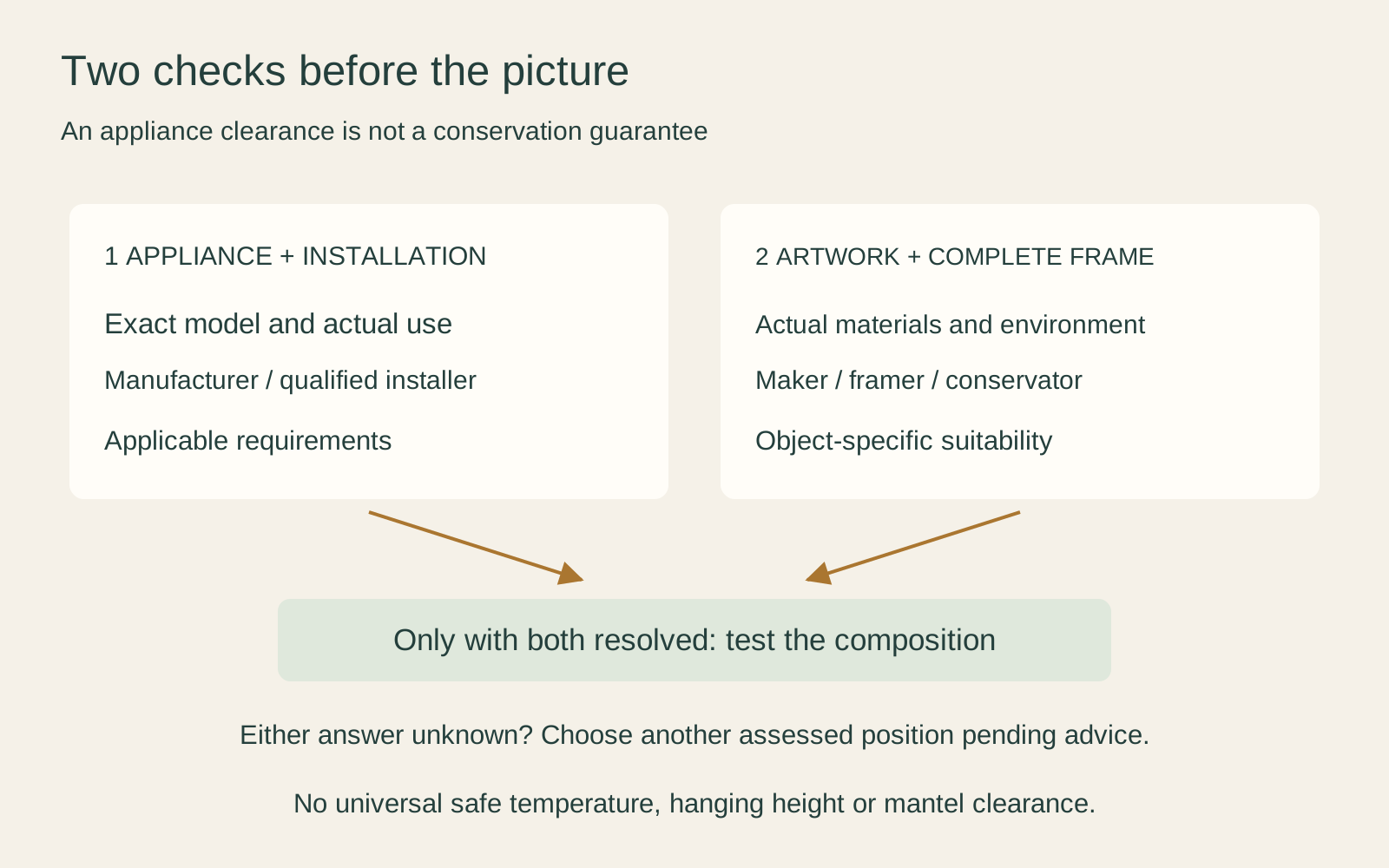
Choose another wall when the answer is uncertain
The mantel does not have to carry the room’s main artwork. A side wall, a wall opposite the seating or a position nearer the entrance may offer a better view and a less complicated environment. Assess that position too: “beside the fireplace” is not automatically an approved location.
Imagine a small living room where the only painting you own is a family watercolour. Rather than using it to complete a symmetrical mantel photograph, try its outline on the wall you see from the armchair. The fireplace can remain the architectural centre while the watercolour becomes the picture you can approach and enjoy.
Choosing a replaceable print instead does not remove installation or fire-safety requirements. Lower financial value changes what you might be willing to lose; it does not make a material suitable for heat. Nor does putting the picture behind glass turn the whole assembly into a fire-resistant object.
Measure the mantel composition after the checks
Once a location has been assessed as suitable, measure the outer frame and the visible architectural features around it. The fireplace opening, surround, mantel shelf and available wall may have different widths. Decide which of those you want the picture to relate to; there is no requirement to align with all of them.
For a purely illustrative composition, an 80 cm-wide outer frame centred over a 140 cm-wide mantel leaves 30 cm on each side: (140 − 80) ÷ 2. That is horizontal arithmetic, not a recommended frame size or a vertical clearance. A narrower picture can work, as can an intentionally off-centre composition in an asymmetric room.
Use the finished frame dimensions, including a mat if present. A large pale mat can give a small image substantial presence, while a heavy dark frame may appear visually larger than another frame with the same measurements. Compare full-size outlines before placing an order.
Try the picture from the seating area
Stand at the entrance, then sit where you normally spend time. Is the proposed picture visible without looking sharply upward? Does a pendant light interrupt it? Can you appreciate the details that made you choose the work?
A picture can look beautifully centred over a mantel but be too distant for the way you want to use it. A finely detailed print may be more satisfying on a wall where you can stand close. A simpler composition may remain legible from across the room, but this is a viewing choice rather than a rule about which subjects belong above fireplaces.
Include existing lamps and objects in the trial. If they hide the lower part of the artwork, edit the arrangement rather than raising the picture indefinitely. Removing an object from the shelf can sometimes resolve the composition without buying anything or making another hole.
Consider the whole frame, not just the image
Ask what the object consists of: paper or canvas, printing process, mount, backing, glazing and frame. The suitability of one component does not establish the suitability of the assembled object. Avoid broad assumptions such as “canvas tolerates heat” or “an archival print will be fine.”
For paper, the Library of Congress recommends avoiding direct or intense light and keeping works away from radiators and vents. Its paper-care guidance reinforces the need to choose the environment, not just a premium-sounding product label.
Once the location question is resolved, choose a frame that supports the image visually. Echoing the mantel material is optional; a contrast can work too. Our frame colour and material guide explains how to compare samples without treating colour as evidence of construction quality.
Plan the installation without improvising
Do not assume that a chimney breast is an ordinary blank wall. Before any fixing, an appropriate installer needs to establish the construction, relevant hidden services and a suitable method for the actual object and position. This guide cannot approve drilling into a surround or appliance enclosure.
A picture resting on a mantel still needs a considered installation; leaning it does not answer questions about slipping, falling or its proximity to heat. Do not improvise with objects wedged behind it, or suspend it from a feature whose purpose and capacity are unknown.
Keep the proposal simple enough to explain: the exact appliance, the complete frame dimensions and weight, the proposed location, and how the fireplace is used. That gives the responsible professional a real arrangement to assess rather than a vague request to “hang something over the fire.”
Revisit the choice when the room changes
An arrangement suitable for a decorative surround may need reassessment if a fire is brought back into use. A new appliance, new mantel or different artwork can also change the decision. Do not let an old photograph of the room become the authority for a new installation.
Keep the relevant instructions and the artwork’s material information with your household records. If you notice a change in the picture or frame, seek appropriate advice rather than experimenting with heat, moisture or adhesives to correct it.
The aim is a room you enjoy, not a filled space above every mantel. A picture on another wall can still belong to the fireplace seating area—and may be the one you look at more often.
Editorial record
About this article
- Author
- Publisher
- GeMarkt
- Published
- Reviewed
- Internal source & rights check. Conducted by GeMarkt Research Review. This is an internal editorial check—not independent peer review.
- Source standard
- Buying guide source standardSeparates measured or first-hand evidence from general guidance and keeps practical limits visible.
Found a claim that needs checking? Report a factual error.