GeMarkt Blog · Practical guide
Where Are Monet's Water Lilies?
Monet's Water Lilies are many separate paintings held by museums worldwide. Find representative works in Paris, London, New York and beyond.

Monet’s Water Lilies are not one painting in one museum. The name refers to a large body of separate canvases and multi-panel works based on his garden at Giverny. A purpose-built permanent ensemble is at the Musée de l’Orangerie in Paris, while other examples belong to museums in Paris, London, New York, Washington, Chicago, Cleveland, Saint Louis, Kansas City and many other cities.
A museum owning a painting does not always mean that the painting is on view. Treat the locations below as collection locations, not guarantees of access. Check the museum’s live object page before planning a visit, and check opening or closure information even for the permanent Orangerie installation.
Water Lilies is a series, not a single canvas
Monet bought land beside his Giverny home in 1893 and developed the pond, plants and Japanese-style bridge that became his subject. The National Gallery in London describes about 250 paintings of the water garden, around 200 of which show water lilies. Counts can vary with the boundary a catalogue places around the broader water-garden project, so “about 250” is more responsible than pretending there is one universally numbered set.
The paintings also changed over time. In the 1890s, the bridge and surrounding plants often orient the scene. In later works, the bank and horizon disappear, leaving lilies, sky and trees visible through reflection. During Monet’s final years, the same pond expanded across canvases roughly two metres high and several metres wide.
The French title Nymphéas means water lilies. Museums use Nymphéas, Water Lilies, The Water-Lily Pond and more specific titles for different objects. A title without a date, dimensions and museum record is therefore not enough to identify one painting.
Paris: the Musée de l’Orangerie ensemble
If someone says “the Monet Water Lilies rooms,” they usually mean the Musée de l’Orangerie installation in the Tuileries Garden. It contains eight large compositions assembled from 22 panels and arranged across two oval rooms. The museum says the ensemble has been displayed there since 1927, after Monet worked with architect Camille Lefèvre on the setting and Georges Clemenceau helped realise the gift to the French state.
This is not just a room containing several unrelated easel paintings—portable, self-contained pictures intended to be viewed as framed objects. The curving walls, east–west orientation and overhead natural light were developed as part of the encounter. The museum’s architectural history gives a total span of 91 metres for the eight compositions. Their nearly continuous fields of water, cloud and willow surround the viewer rather than presenting one framed view at a time.
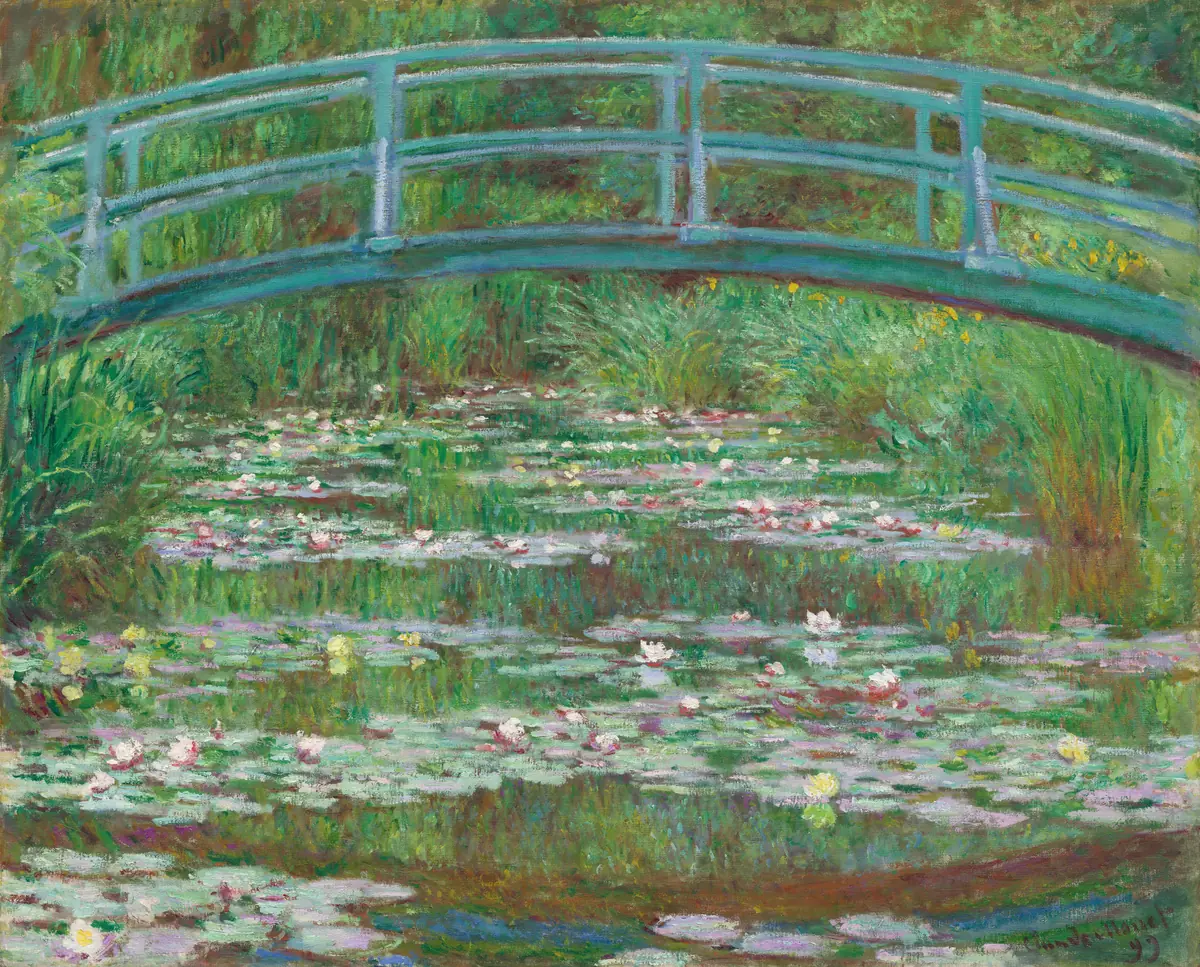
London, New York and Washington: the bridge paintings of 1899
Three museums hold useful comparisons from the early bridge phase:
- The National Gallery in London owns The Water-Lily Pond, an 1899 canvas in which the arched bridge crosses dense green planting and reflected water.
- The Metropolitan Museum of Art in New York owns Bridge over a Pond of Water Lilies, also from 1899. Its vertical format gives unusual prominence to the lilies and reflection beneath the bridge.
- The National Gallery of Art in Washington owns The Japanese Footbridge, another 1899 view made from the same general vantage point.
The Met describes an 1899 group of eighteen bridge views, twelve of them completed that summer. The three paintings above are therefore not alternative names for the same object. Compare their formats, crops and colour relationships and the series becomes concrete: Monet kept the motif stable enough to recognise while changing what the canvas asks us to notice.
Paris and Chicago: the pond becomes a field of reflection
The Musée Marmottan Monet in Paris owns a Nymphéas of 1903. The museum places it in the group Monet called “water landscapes.” Bank and bridge have disappeared; reflected clouds and vegetation make the water feel less like a bounded pond and more like floating space.
The Art Institute of Chicago owns Water Lilies (1906), another nearly square oil painting focused on the pond’s surface. The museum says technical examination revealed many significant changes made while the painting was in progress, evidence that an image of changing light could be built through sustained revision rather than one untouched instant. These more intimate canvases matter beside the famous late murals. They show that Monet spread the motif across the whole canvas before he adopted a monumental scale.
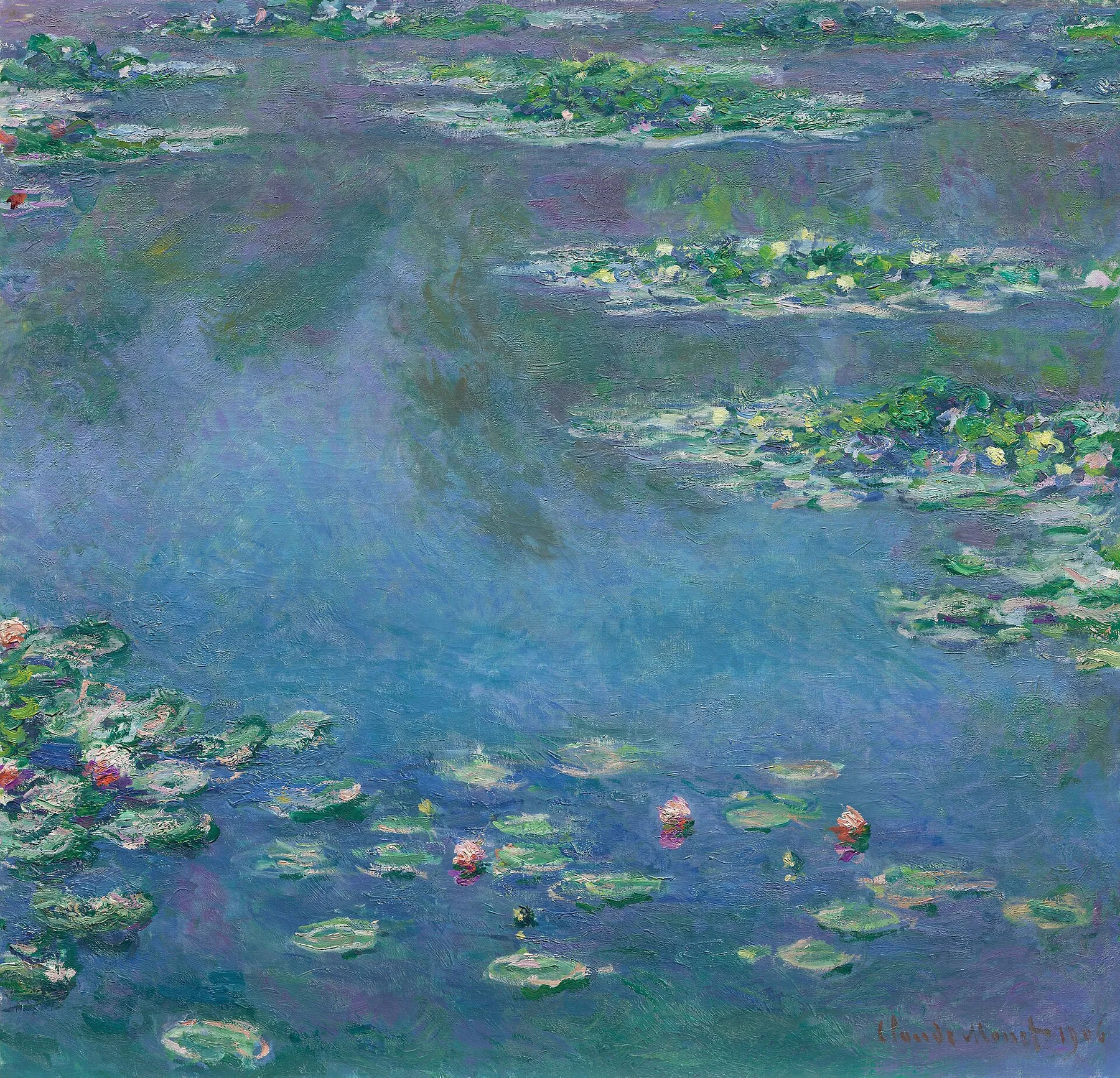

Collection records establish where these objects belong. They do not guarantee that either one occupies a gallery on the day of a visit. Loans, conservation and rotations can change display status even when ownership does not change.
New York: MoMA’s late triptych
The Museum of Modern Art owns Water Lilies (1914–26), an oil painting made from three panels. A triptych is a work composed of three sections. Together, MoMA’s panels stretch more than 12.7 metres across.
MoMA explains that Monet produced and repeatedly reworked about forty large panels from 1914 until his death in 1926. In this triptych there is no firm horizon or bank. Thickly worked passages and changing areas of colour make water, sky and vegetation difficult to separate. The object belongs to the same long water-garden project as the compact 1899 paintings, but its scale turns looking into a bodily experience.
MoMA’s object page may show a current gallery number, but that is live visitor information, not a permanent fact about the painting. Check it again close to a planned visit.
One late triptych, three US cities
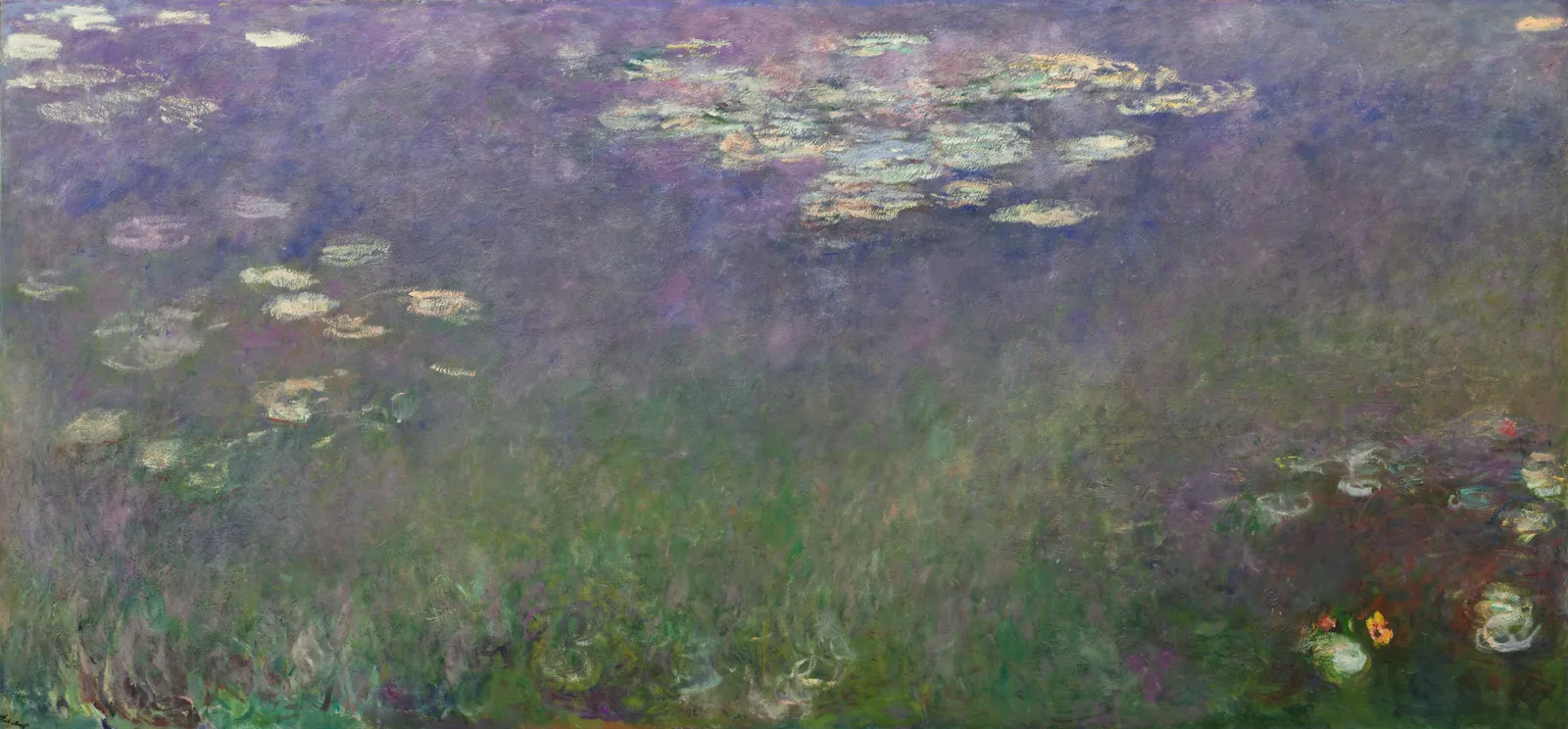
A different late ensemble reveals why “where is it?” can have more than one correct answer. Three canvases once formed the work often called the Agapanthus triptych. The panels were separated in the 1950s and now belong to:
- the Cleveland Museum of Art, which holds the left panel;
- the Saint Louis Art Museum, which holds the centre panel;
- the Nelson-Atkins Museum of Art in Kansas City, which holds the right panel.
The Saint Louis Museum’s close-looking guide records the centre panel’s arrival there in 1956, the right panel’s acquisition by the Nelson-Atkins in 1957 and the left panel’s acquisition by Cleveland in 1960. The three canvases have occasionally been reunited for exhibitions, but their collection homes remain distinct. Do not assume that seeing one panel means the complete triptych is assembled there.
A selected location guide
| City | Museum | Exact work or group | What it helps show |
|---|---|---|---|
| Paris | Musée de l’Orangerie | Eight Nymphéas compositions, installed 1927 | The purpose-built late ensemble |
| London | National Gallery | The Water-Lily Pond, 1899 | Bridge, pond and garden together |
| New York | Metropolitan Museum of Art | Bridge over a Pond of Water Lilies, 1899 | A vertical bridge-series canvas |
| Washington, DC | National Gallery of Art | The Japanese Footbridge, 1899 | One of the related bridge views |
| Paris | Musée Marmottan Monet | Nymphéas, 1903 | The bankless “water landscape” phase |
| Chicago | Art Institute of Chicago | Water Lilies, 1906 | An easel painting centred on surface and reflection |
| New York | Museum of Modern Art | Water Lilies, 1914–26, three panels | Monumental late scale |
| Cleveland / Saint Louis / Kansas City | Three museum collections | The separated Agapanthus triptych, about 1915–26 | One ensemble divided across three cities |
This is a route through representative works, not a complete catalogue. Other Water Lilies paintings are held by museums and collections across Europe, North America and Asia.
How to check whether a Water Lilies painting is on view
Start from the museum’s exact object record, not an image-search caption. Confirm the title, artist, date, dimensions and accession number—the museum’s unique identifier for the object. Then look for a current “on view,” gallery or location field and note when you checked it. If the visit depends on one object, contact the museum: a live label can change because of a loan, gallery rotation, conservation work or an unexpected closure.
Also check whether the record describes one canvas, a panel within a larger work or a complete multi-panel ensemble. That distinction is the difference between visiting the Orangerie’s two-room installation, MoMA’s three-panel work and a single separated Agapanthus panel.
For questions about copying or reusing a digital image, consult the separate guide to Water Lilies and the public domain. Artwork location and digital-image permission are different questions; this article answers the first one.
Editorial record
About this article
- Author
- Publisher
- GeMarkt
- Published
- Reviewed
- Internal source & rights check. Conducted by GeMarkt Research Review. This is an internal editorial check—not independent peer review.
- Source standard
- Art history source standardPrioritises object records and research sources, distinguishes evidence from interpretation, and states material uncertainty.
Found a claim that needs checking? Report a factual error.