GeMarkt Blog · Essay
Van Gogh vs Gauguin: The Yellow House Months
Compare Van Gogh and Gauguin in Arles through two paintings of local women: colour, touch, imagination and what their brief shared studio actually changed.

Two painters share a house. They visit the same city streets, discuss the same pictures and sometimes work from the same people. Yet what they make is strikingly different. In Arles, Vincent van Gogh turns a seated café proprietor into a strong encounter between yellow, green and dark blue. Paul Gauguin turns a nearby public garden into an uneasy arrangement of women, barriers and strange shapes.
Their difference was not simply emotion versus thought. Both organised their paintings carefully. They disagreed about how much a picture should begin with something seen, and how freely it could be rebuilt through memory and imagination. The short-lived Yellow House studio put that disagreement into daily practice.
What the Yellow House was meant to be
Van Gogh hoped to make Arles, in southern France, a base where artists could live and work together. The Yellow House was meant to reduce isolation, not become the setting for a famous quarrel. Theo van Gogh helped support the project, including Gauguin’s journey south. The Van Gogh Museum’s account of Arles places this practical hope at the centre of the story.
Gauguin arrived on 23 October 1888. For roughly two months, meals, work and arguments happened within the same small domestic world. The joint Art Institute and Van Gogh Museum exhibition describes shared subjects alongside sharply different approaches. Agreement was never a condition of the experiment; learning from proximity was its possibility.
Two paintings of women in Arles
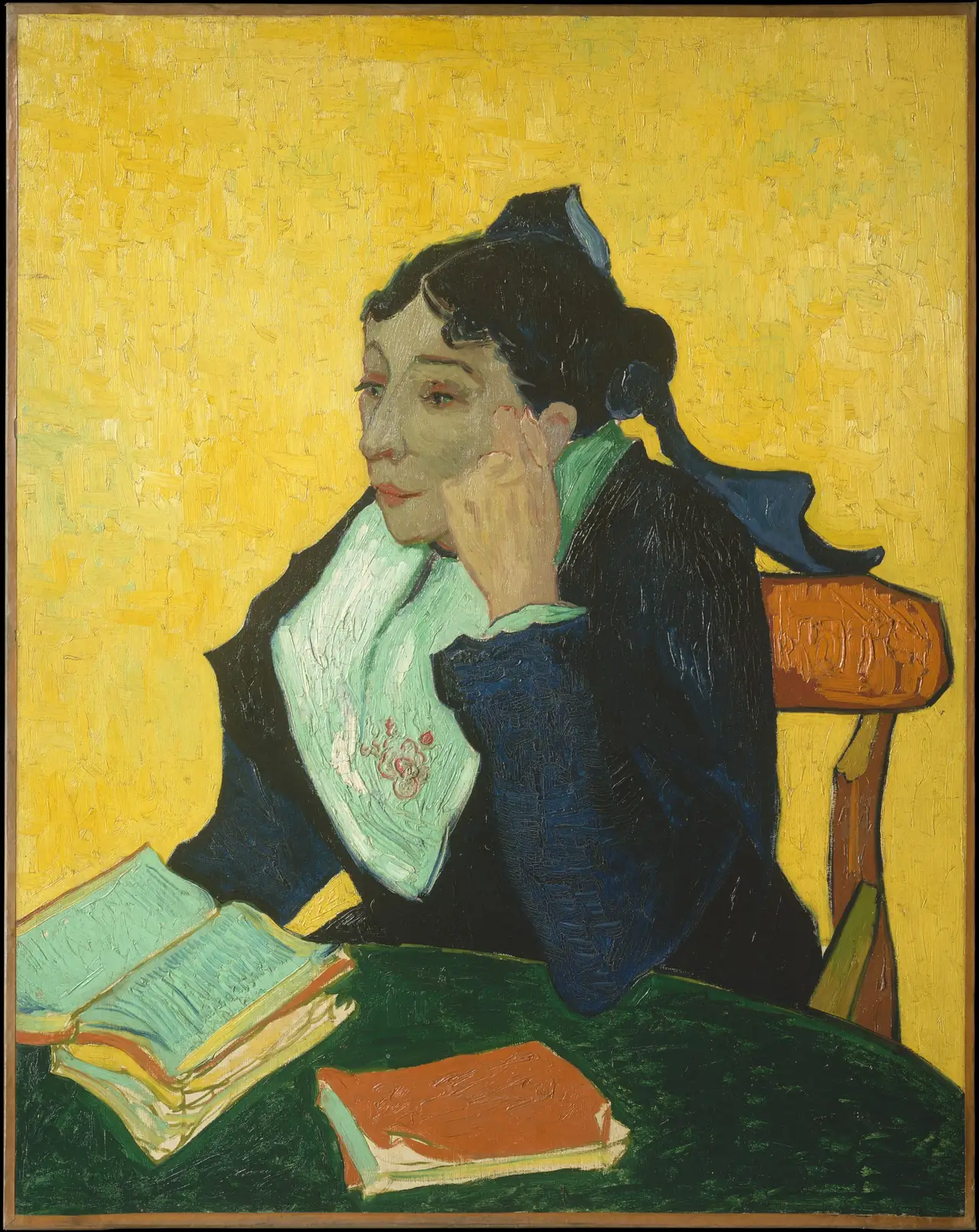
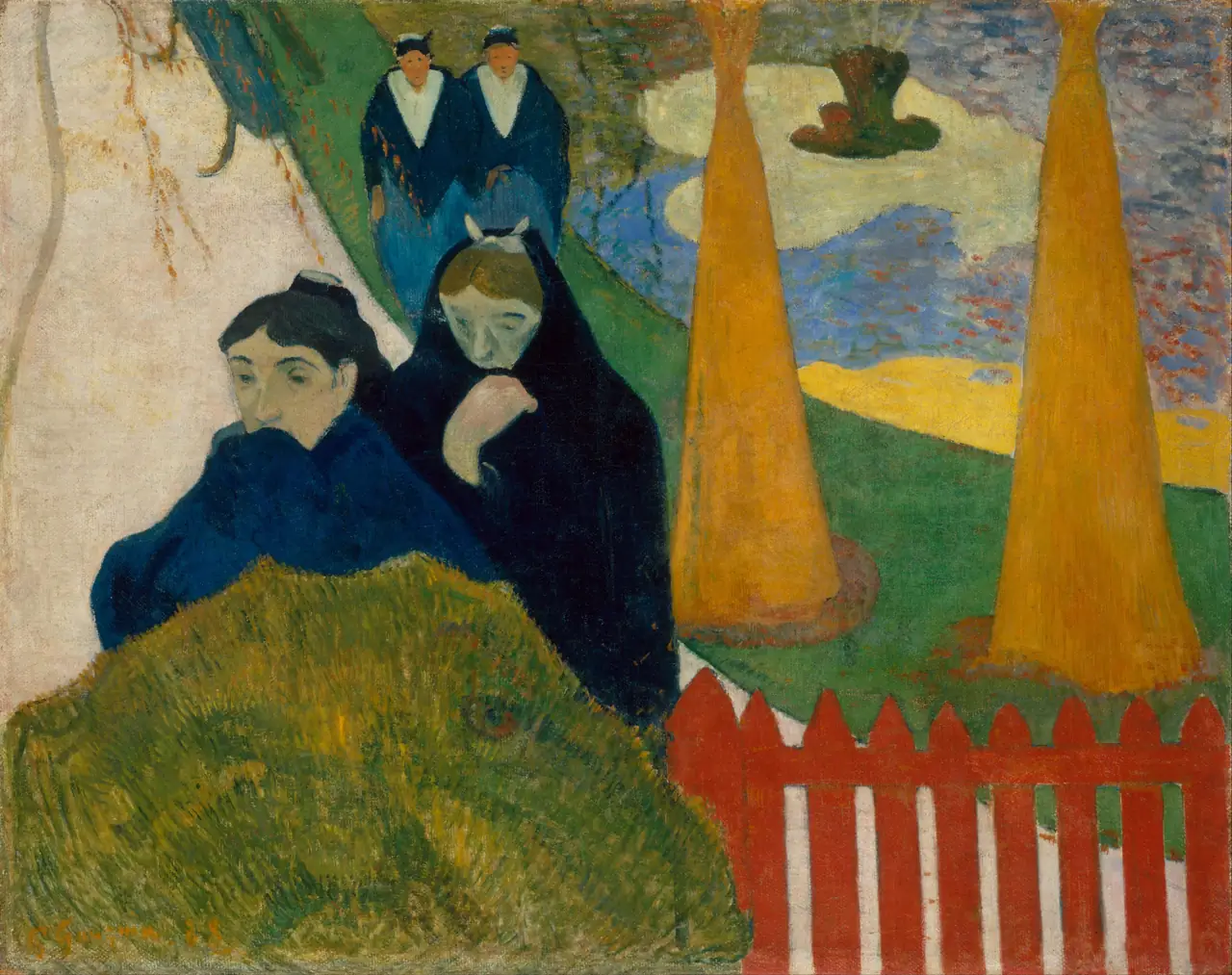

These are different subjects, not a competition painted from one sitting. Gauguin’s garden belongs to his 1888 stay. The Met dates this version of Van Gogh’s portrait to 1888–89; it should not be confused with the earlier version now in the Musée d’Orsay, which has a parasol and gloves on the table rather than books. The Met identifies the sitter as Marie Ginoux, proprietor of the Café de la Gare.
Van Gogh brings one person close
Start with the hand beneath Ginoux’s cheek. It makes a small bridge between head and table, holding the figure within a compact triangle. The books project towards us while the chair shows at the right. We have enough furniture to understand a seated person, but little room to wander away from her.
Now cover the face with a fingertip on the screen. The portrait still has force: a dark body, a pale green-white shape at the chest, and yellow surrounding them. Colour is carrying the composition before we read an expression. Restore the face and the same arrangement becomes personal.
Her resting gesture may suggest thoughtfulness or fatigue to a viewer. It does not tell us exactly what she felt during a sitting. A painted pose is evidence of the artist’s presentation, not access to someone’s private thoughts.
Gauguin makes the garden hard to enter
Gauguin offers several people but less immediate contact. The closest women are partly blocked by a bush; a red fence closes the lower-right corner. A pale path curls away behind them. Your eye can follow it, but there is no simple invitation to step into the scene.
The two tall orange forms complicate it further. They rhyme with upright human bodies without becoming people. The Art Institute’s description suggests they are probably protective coverings for plants, rather than treating that identification as certain. It also identifies a face deliberately placed within the bush.
Look back at the actual women after finding that face. The garden now seems to watch as well as contain them. That is an effect of the composition; it is not proof that every detail encodes a specific event in the two painters’ relationship.
Follow the paint as well as the colour
In Van Gogh’s background, yellow is not a blank digital fill. Short strokes change direction and leave ridges. The green tabletop and dark sleeve are worked surfaces too. Following those marks makes a still pose feel actively constructed.
Gauguin’s red fence reads more quickly as a single shape. The broad green ground and orange cones also encourage the eye to collect larger areas before noticing individual touches. Yet the bush contains plenty of small marks. “Van Gogh uses strokes, Gauguin uses flat colour” is a starting observation, not a complete description.
Both paintings use strong boundaries. Ginoux’s shoulder is sharply separated from the yellow; Gauguin’s shawls interrupt the pale path. Compare where an outline gathers a shape together, then where paint within it makes the surface less settled.
Nature and memory were not separate camps
Gauguin encouraged Van Gogh to work beyond immediate observation. Van Gogh did try compositions made from memory, including Memory of the Garden at Etten. The Van Gogh Museum’s detailed catalogue traces that exchange through their paintings and correspondence.
This matters because the familiar opposition can become misleading. Van Gogh was not a camera recording whatever stood before him. He chose, exaggerated and rearranged. Gauguin did not invent everything without looking; remembered motifs, earlier studies and actual surroundings fed his work.
The useful question is therefore smaller: what has each artist kept recognisable, and what has he changed to make the picture work? Ginoux remains an identifiable sitter within an emphatic colour structure. Gauguin’s garden remains a walkable place in principle, but its arrangement makes ordinary movement feel strangely obstructed.
What happened in December
The shared studio ended during Van Gogh’s severe crisis in December. The Art Institute’s chronology records his admission to hospital on 24 December and Gauguin’s departure the following day.
The ear injury is part of that history, but a dramatic reconstruction of the preceding argument should not replace it. Nor can brushstrokes diagnose an illness or establish that an artistic disagreement caused one. The paintings deserve to be understood as work, not treated as medical symptoms or clues in a detective story.
The conversation outlasted the house
Separation did not erase their exchange. The exhibition’s account of the years after Arles describes continued letters and sketches, and Gauguin’s lasting interest in Van Gogh’s sunflowers. The experiment failed as shared accommodation, but not as an encounter that affected what they considered possible in painting.
That makes the ending less neat and more useful. Artists can reject a colleague’s advice while still having their own choices sharpened by it. Influence need not produce agreement or a matching style.
How to recognise the difference
Return to the pair and follow three things: the largest colour area, the route into the space, and the boundary around a face. Van Gogh concentrates this portrait around one nearby person and the pressure of surrounding colour. Gauguin distributes attention among people, obstacles and a garden that refuses to stay ordinary.
For another Van Gogh painting in which observation and invention work together, continue with the story behind The Starry Night. The valuable comparison is not which artist was more sincere. It is how differently a picture can transform the world its maker knew.
Editorial record
About this article
- Author
- Publisher
- GeMarkt
- Published
- Reviewed
- Internal source & rights check. Conducted by GeMarkt Research Review. This is an internal editorial check—not independent peer review.
- Source standard
- Art history source standardPrioritises object records and research sources, distinguishes evidence from interpretation, and states material uncertainty.
Found a claim that needs checking? Report a factual error.