GeMarkt Blog · Essay
The Story Behind Van Gogh's Starry Night
How Van Gogh turned a predawn view, remembered landscapes, and bold studio invention into one of art's most familiar night skies.


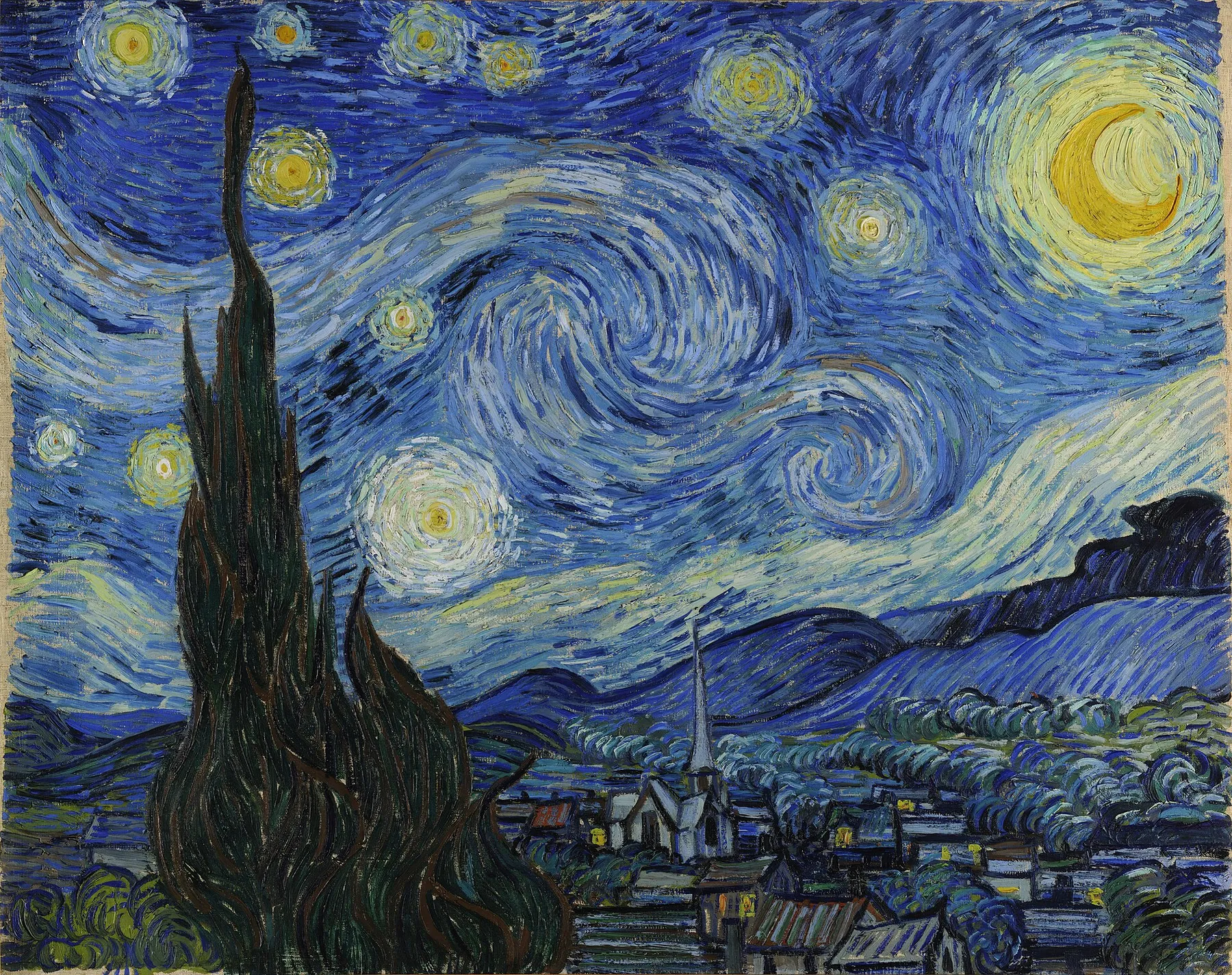
The first thing that stops many viewers is not a star. It is the cypress: a dark, flame-shaped tree that rises from the bottom of the canvas and nearly touches the top. It joins a quiet village to a sky that seems to roll, flare, and breathe.
Vincent van Gogh painted The Starry Night at Saint-Rémy in June 1889. The Museum of Modern Art’s object record gives its size as 73.7 by 92.1 centimetres—large enough to surround the eye, but still a painting made for close looking. Its fame can make it feel inevitable. The real story is more unsettled: Van Gogh combined what he had seen with what he remembered and what he decided to invent.
The night began before sunrise
In late May or early June 1889, Van Gogh wrote to his brother Theo about looking from his window well before dawn. He had seen the countryside and a very bright “morning star.” The editors of letter 777 identify that object as Venus.
Venus appears in the painting just left of centre, glowing low above the horizon. This is one of the firmest links between the picture and an observed sky. But it does not turn the canvas into an astronomical record. The moon is reshaped into a brilliant crescent, and the other lights are arranged for the needs of the composition rather than mapped like a chart.
That distinction matters. Van Gogh started with looking, but he did not stop there.
The window was a starting point
Van Gogh had voluntarily entered the Saint-Paul-de-Mausole psychiatric hospital in May 1889. According to the Van Gogh Museum’s account of this period, he had a separate room to use as a studio and could work outdoors when his health allowed. His bedroom window faced the surrounding landscape.
The view helped supply the hills and the broad structure of the countryside, but The Starry Night is not a literal copy of that window. The village was not visible from it. The cypress has been pulled close and enlarged. The church, clustered houses, hills, moon, and stars have been organised into a scene that never existed in exactly this form.
Art historian Richard Thomson describes the painting in his MoMA study as a paysage composé—a composed landscape. Van Gogh could draw on recent studies of cypresses, earlier views of the hills, local architecture, and memory, then bring those pieces together in the studio. MoMA notes that he painted it in daylight over several sessions. It is a night reconstructed after night had passed.
A sky made to move
The village is built from comparatively short, steady shapes. Roofs form a low band, and a narrow spire points upward. Above them, almost nothing holds still.
Van Gogh set blues against yellow and white, then bent his brushstrokes around the stars. Some marks form halos. Others gather into a great pale current across the middle of the sky. The paint does not simply describe light; its direction gives light a path. The cypress repeats the same rising and curling energy in a darker register, so land and sky feel connected without becoming alike.
Scientific images have encouraged people to see galaxies, turbulence, or particular nebulae in these patterns. Such comparisons can be visually suggestive, but there is no direct evidence that Van Gogh was copying a specific astronomical image. The safer and more revealing point is visible on the surface: he exaggerated scale, colour, and rhythm to make a still canvas feel active.
The painting is not a diagnosis
Because Van Gogh made the picture while receiving psychiatric care, The Starry Night is often described as if it were a direct picture of mental illness. That shortcut confuses biography with diagnosis.
Van Gogh did experience severe mental-health crises, and they shaped the conditions of his life. Yet he often could not work during the worst episodes. This canvas required selection, revision, and technical control. Its swirling forms tell us what he did with paint; they cannot tell us a modern clinical diagnosis, and they are not symptoms that a viewer can read from the image.
The context is important without becoming a master key. He was an artist working through a difficult year, not an illness holding a brush.
Symbols without a secret code
Cypresses grew throughout the region and were associated with cemeteries. As evergreens, they could also suggest endurance or eternal life. The church spire may remind some viewers of northern European villages, while the immense sky can feel spiritual. These are reasonable associations, not settled translations.
Van Gogh’s letters do not provide a single religious programme for the painting. In letter 782, written soon after the work was made, he connected his new study of a starry sky with a freer use of colour and drawing. In the same passage, he resisted the idea that this meant a return to conventional religious imagery.
The painting leaves room for consolation, dread, wonder, or distance because it does not reduce those feelings to a code. Its power lies partly in the tension between the small, sleeping village and the enormous activity above it.
Van Gogh was not sure about it
Today, The Starry Night is often treated as Van Gogh’s unquestioned masterpiece. His own response was less simple.
In September 1889, he told Theo that the night scene and two other landscapes pushed their arrangements beyond direct observation, with twisting lines reminiscent of old woodcuts. Two months later, writing to Émile Bernard, he questioned the oversized stars—a passage the letter’s editors tentatively connect with The Starry Night. That is not the same as saying he hated the painting or declared the entire work a failure. It shows an artist testing a new direction and doubting whether he had pushed it too far.
That uncertainty makes the picture more interesting. The features later viewers celebrate—oversized stars, insistent curves, the departure from direct observation—were also the risks Van Gogh was measuring.
Why the night still feels alive
The painting works through oppositions: observed planet and invented sky, still village and moving paint, near-black tree and bright celestial rings. Van Gogh did not ask viewers to choose between nature and imagination. He made them depend on each other.
Look again at Venus. It began as a light noticed before sunrise. On the canvas it becomes one part of a larger structure, balanced against the moon, threaded into the sky’s current, and held above a village that was never outside the window. A real point of light survives inside an invented night.
For the work’s public-domain status and the exact image file used here, see GeMarkt’s The Starry Night rights guide. The Van Gogh public-domain guide gives broader reuse context for the artist’s work.
Editorial record
About this article
- Author
- Publisher
- GeMarkt
- Published
- Reviewed
- Internal source & rights check. Conducted by GeMarkt Research Review. This is an internal editorial check—not independent peer review.
- Source standard
- Art history source standardPrioritises object records and research sources, distinguishes evidence from interpretation, and states material uncertainty.
Found a claim that needs checking? Report a factual error.