GeMarkt Blog · Reference
Trademarks on Public Domain Art: Mucha’s Job, Morris & Co. and More
An old artwork and a current brand are different things. Learn how JOB posters and Morris patterns illustrate copyright, image permissions and trademark questions.

The short answer
Public-domain copyright status does not make an old brand name yours to use as a brand. Equally, a surviving trademark does not automatically prohibit every reproduction or historical discussion of an old artwork. The question is what the name or symbol does in your particular use, for which goods and in which country.
A nineteenth-century advertisement can contain both an artwork and a manufacturer’s identity. A historic textile pattern can share its designer’s name with a present-day business. Clearing the artwork’s copyright does not settle whether your packaging suggests that business made, licensed or approved your product.
This guide uses JOB and Morris & Co. to explain the distinction, not to certify a product launch. It is general research information checked on 13 October 2026, with US guidance and a specific UK statutory example. No comprehensive trademark-register search or individual legal clearance is claimed.
What a trademark protects
The US Patent and Trademark Office explains trademarks as words, symbols or other signs that identify the source of goods or services. Protection is connected to the goods or services concerned; it is not ownership of a word in every conversation or context. In the US, rights can also arise through use without a federal registration.
Copyright asks a different question: whether someone controls copying a particular creative work. A public-domain drawing does not acquire a new copyright merely because it depicts a brand. But using its lettering as your shop logo raises a different question from showing the complete drawing in an art-history article.
This is why “the artist died long ago” is not a sufficient trademark answer. Nor does an absent registration symbol prove that a name is available. Start with the actual use you intend, rather than trying to attach a single permanent permission label to the picture.
JOB: the brand is inside the picture
In Mucha’s 1898 JOB poster, the large letters stretch across the top while smaller monograms repeat behind the figure. The packet in her hand carries the name too. Removing the headline alone would not remove the advertising identity, and would alter the composition you set out to reproduce.
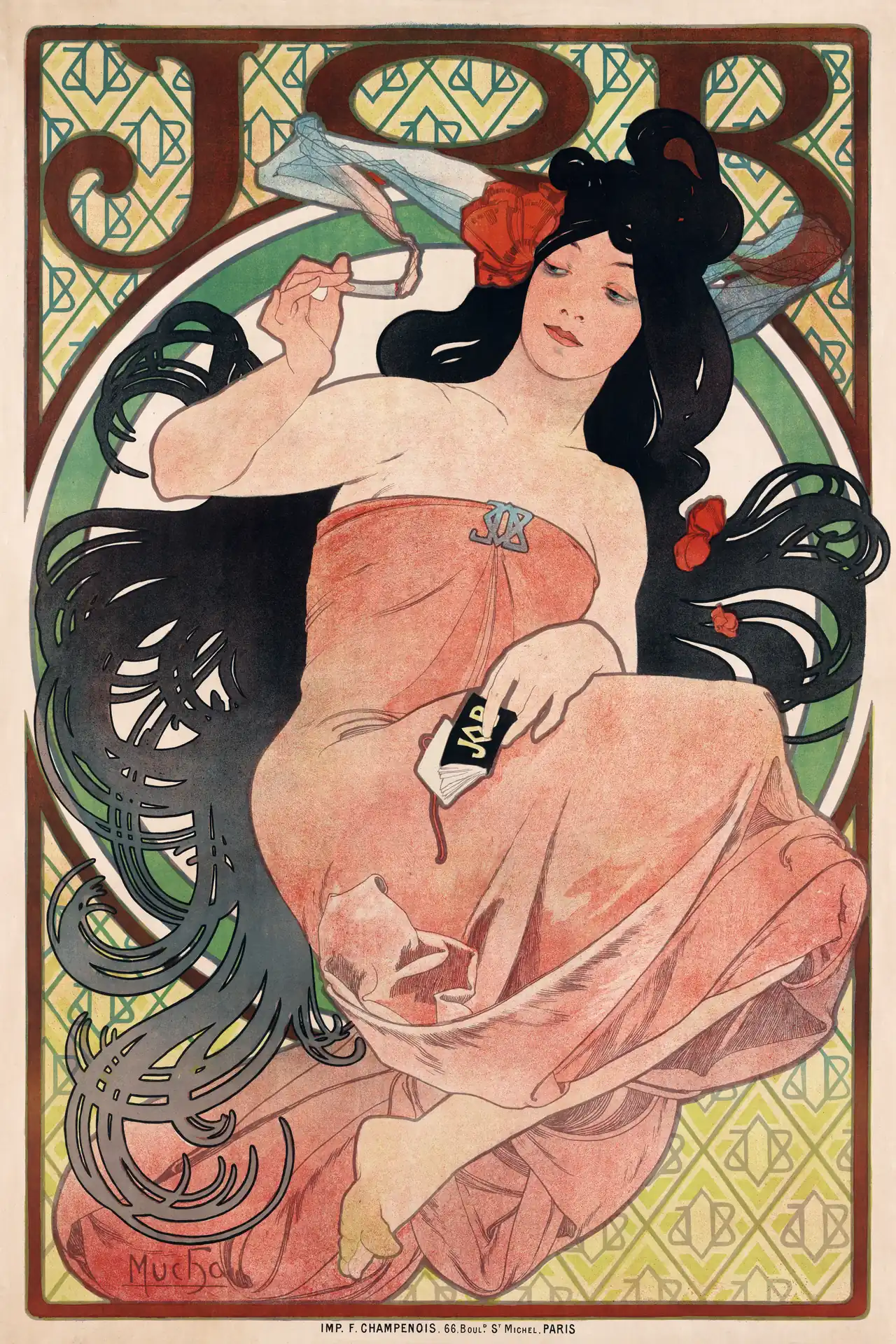

The Museum für Kunst und Gewerbe Hamburg identifies the 1898 design and production, printer F. Champenois and commissioning company Pierre Bardou-JOB. That establishes a historical commercial context; it is not a current trademark search. Separately, Republic Brands includes JOB among its present-day brands. A company portfolio is evidence of current brand use, not proof of the precise scope of every registration worldwide.
A listing headed “Reproduction of Alphonse Mucha’s JOB poster, 1898” describes an artwork. A newly designed package presenting JOB as the maker of your goods does something else. Those examples illustrate the issue, not an automatic safe harbour for every poster listing. The detailed JOB copyright check addresses the particular poster and source file; it does not grant use of the brand for a new business.
Morris: a pattern is not a seller
Strawberry Thief offers a different case. Its paired birds and strawberries form a repeating design; there is no large manufacturer headline inside this detail. The Art Institute of Chicago record dates the design to 1883 and its historic textile to 1883–1917, distinguishing William Morris as designer from Morris & Co. as producer.
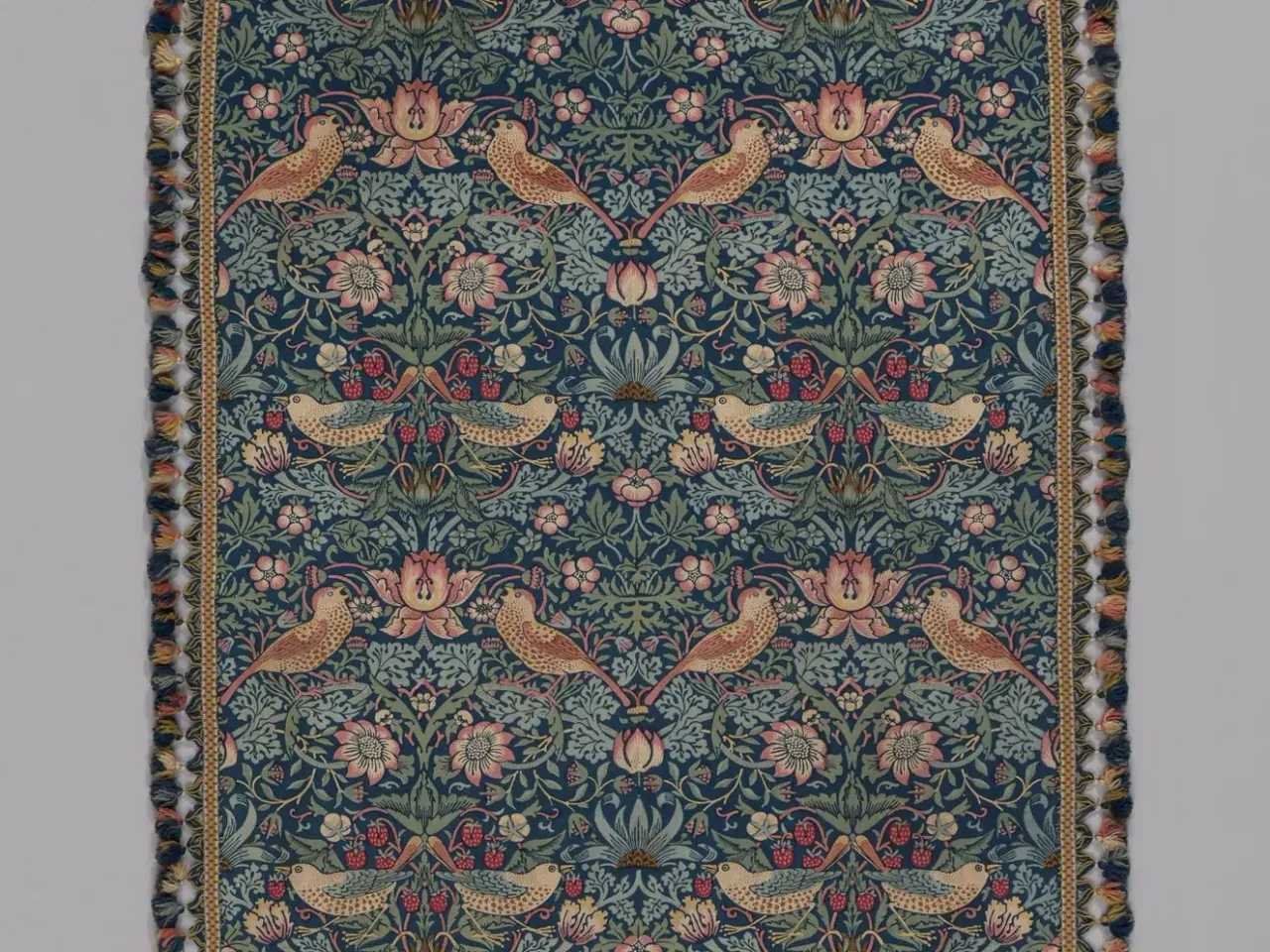
The name also has a continuing commercial history. Sanderson Design Group’s account records Sanderson’s 1940 purchase of the Morris & Co. wallpaper business, including rights to its company name. The current Morris & Co. website terms identify Morris & Co. as a trading name of Sanderson Design Group Brands Limited.
Those facts do not mean the current business owns copyright in every historic Morris design. They do explain why “after William Morris” and “made by Morris & Co.” are not interchangeable descriptions. If you manufacture a reproduction, identify your business as its maker. Do not describe it as an original period textile or a product supplied by the contemporary brand unless that is true.
Describing an artwork or branding a product
Consider the whole presentation: title, maker field, packaging, shop name, badges and advertising. A correct artist credit in a paragraph cannot necessarily repair a prominent “official collection” badge that falsely suggests approval. Conversely, accurately naming the subject of a critical article is not the same act as adopting that subject’s logo for your store.
The USPTO’s infringement guidance centres on likely confusion about source or sponsorship, considering matters such as similar marks, related goods and sales channels. It also explains that famous marks can have dilution protection without likely confusion. “Nobody will confuse it” is therefore not a complete answer to every trademark concern.
There are jurisdiction-specific limits too. In the UK, section 11 of the Trade Marks Act 1994 includes certain descriptive and referential uses, subject to honest practices in industrial or commercial matters. That is not a blanket exemption for anything described as decorative, educational or inspired by an old master.
Check the market, not just the word
Before choosing a product or shop name, search beyond one exact spelling. The USPTO’s clearance guidance covers similar marks, related goods, registered and pending applications, and possible rights outside the federal register.
Write down what you plan to sell and where. A historical poster illustration, a clothing label and a new wallpaper range do not present identical facts. Check the relevant country’s records and actual marketplace use. A registration in one territory does not itself establish the same protection elsewhere, while finding nothing in one database does not prove the name is unclaimed.
For a significant launch, a contested name or branding close to an existing supplier’s, obtain advice on that specific proposal. This article does not determine whether either example brand is registered for your chosen goods or whether your intended use would infringe.
The image file still needs its own check
Trademark care cannot rescue an unsuitable photograph. Our illustrations use an identified historic poster scan and the AIC-designated open image, not photographs lifted from a current retailer’s catalogue. Their source credits describe those files; they do not authorise copying the retailer’s layouts, contemporary photography or newly adapted patterns.
CC0 explicitly leaves trademark rights unaffected and warns against implying endorsement. A public-domain image label is therefore not a brand licence. Our Strawberry Thief rights guide explains the historic work and exact image separately.
Before you publish a listing
Read your proposed page as a customer would. Is it clear which artwork is reproduced, who made the new object and who is selling it? Do the photographs show your product, rather than imply a relationship with a museum or modern manufacturer? Have you kept the source-file conditions and country-specific research alongside the listing?
Use accurate artist and artwork names where needed; do not invent partnerships or approval. A disclaimer can explain a real distinction, but it is not permission and cannot guarantee that misleading overall branding becomes acceptable. The useful outcome is a truthful product description backed by separate artwork, file and trademark checks—not a claim that either “public domain” or “trademark” settles everything.
Editorial record
About this article
- Author
- Publisher
- GeMarkt
- Published
- Reviewed
- Internal source & rights check. Conducted by GeMarkt Research Review. This is an internal editorial check—not independent peer review.
- Source standard
- Rights guide source standardSeparates the underlying work from the source file, records the review date, and links the evidence used for the conclusion.
Found a claim that needs checking? Report a factual error.