GeMarkt Blog · Reference
Is JOB by Alphonse Mucha Public Domain?
Check Mucha’s 1898 JOB poster, its published print and exact image source, and why an old advertisement does not make its brand yours to use.


The short answer
Mucha’s published 1898 JOB poster has an expired U.S. copyright term, and its ordinary UK author term has also expired. That does not give you ownership of the JOB brand or permission to use any supplier’s image. This guide uses a traceable reproduction from the Library of Congress through Wikimedia Commons.
The check is dated 12 October 2026. It concerns the seated woman with a large circular backdrop, LC-DIG-ppmsca-10089. The legal position of a brand name, a newly designed product label and a museum photograph must not be collapsed into the copyright status of this old printed advertisement.
Which JOB poster this page checks
The Library of Congress record identifies a colour poster published in Paris by Imprimerie F. Champenois, [1898], advertising cigarette papers. The digital reproduction number identifies a file made from the original print, rather than the separate colour-transparency copy also listed.
An independent institutional record at Hamburg’s MK&G dates both design and production to 1898. It names Mucha as designer and Champenois as producer. The Hamburg sheet is another collection object, not the physical print scanned for our illustration.
Mucha made more than one JOB design. A title search should therefore include the year and image source, not just “Mucha smoking woman.” The Mucha Foundation’s earlier JOB record concerns the 1896 design. This page illustrates the later seated figure, not that earlier composition.
Keep that distinction when downloading a file or describing a reproduction. A modern seller’s generic title may be adequate for browsing, but it is not an edition record. Nor does the presence of Mucha’s signature guarantee that a file preserves the complete historical poster.
Look at how the advertisement works
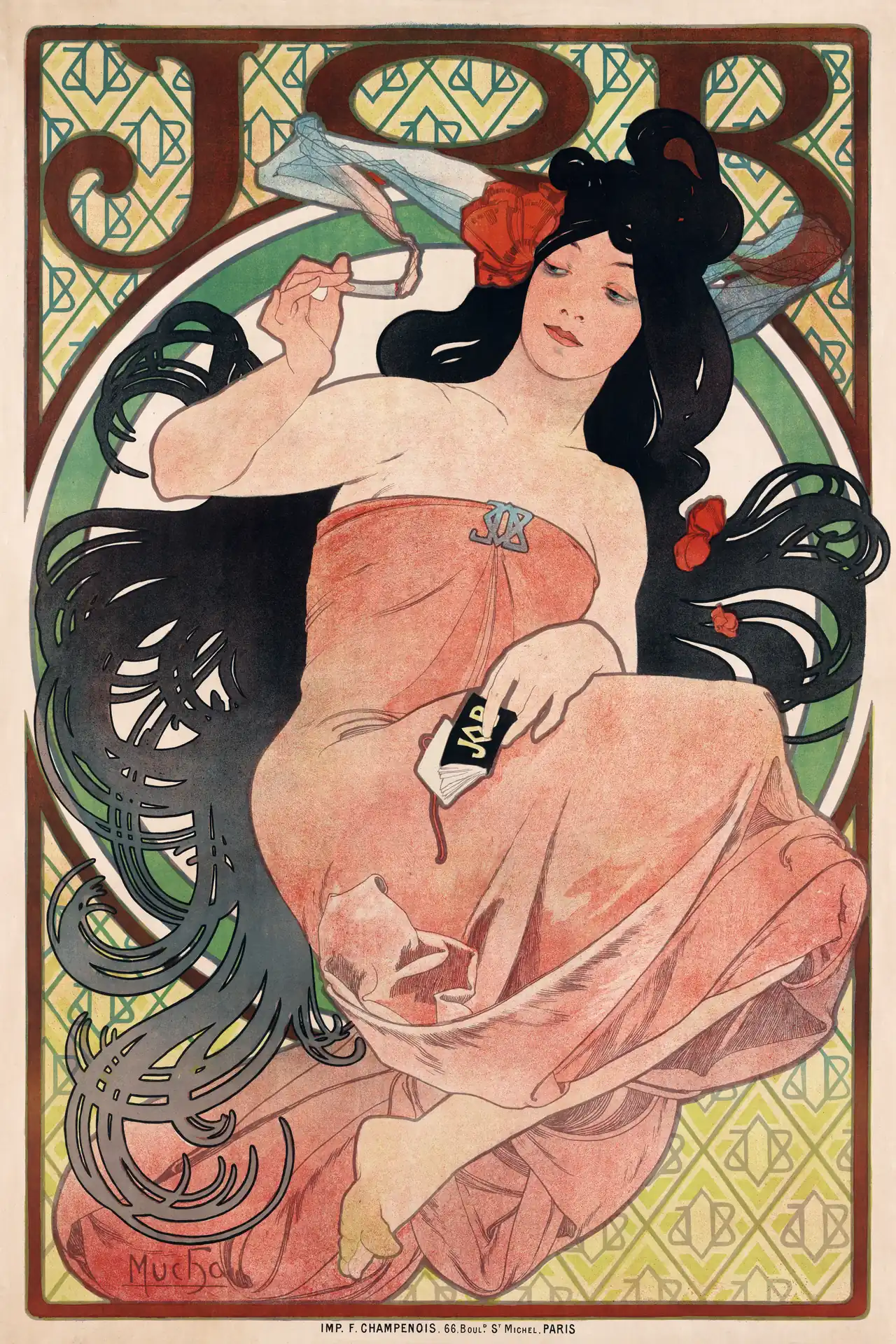
The lettering is impossible to miss, but the small packet does a different job. It connects the decorative figure to an actual product. Repeated monograms fill the pale background, and another appears on the fastening of her dress. The advertisement remains branded even if the largest letters disappear from a crop.
Dark hair curls around the figure in broad loops, almost becoming a border of its own. Smoke follows another curved path near the top. Against those dark shapes, the warm dress and pale skin remain easy to read. The design does not depend on realistic depth: its sweeping lines hold the surface together.
The printer’s line survives along the bottom edge. That small strip is useful historical information, not merely spare paper to remove automatically. A face-only crop can be beautiful, but it no longer explains how the whole advertisement works. If the purpose is to discuss poster design, the complete composition gives readers considerably more to examine.
A publication record rather than just a date
For this poster, the Library of Congress supplies an actual created/published statement with a named Paris printer. That is stronger evidence than a painting’s creation year or a museum exhibition date. Our U.S. conclusion follows the identified nineteenth-century published poster and the older-work term provisions in U.S. copyright law, not the assumption that every image dated before 1931 is automatically clear.
Mucha died in 1939. The UK’s ordinary life-plus-seventy rule also places his original contribution outside the ordinary author term there. Different countries and special rules can require separate consideration; this is not a worldwide permission slip for everything carrying his name.
The publication finding belongs to the historical design identified here. It does not date a contemporary redraw, an animated version, a new translation or a commercial layout incorporating the image. A new contributor may have rights in their own added material without acquiring ownership of the old poster underneath it.
The source file and its limits
The selected Commons file record traces the image to the Library of Congress and then to a version shared through Flickr. It describes the file as a faithful reproduction and applies PD-Art and Public Domain Mark 1.0, with an explicit pre-1931 U.S. publication assessment.
The Library’s own item record states “No known restrictions on publication.” It also explains that the Library does not generally own rights in collection material and cannot provide a blanket permission on behalf of other rightsholders. The advisory is useful evidence; it is not a guarantee covering every possible use.
Our copy has been reduced proportionally from the identified file. It has not been repainted, recoloured or given an invented paper texture. The old print’s surface and the source reproduction’s appearance remain visible. This is an editorial illustration, not a promise that a newly manufactured print will match the original sheet’s colour exactly.
If you choose another download, repeat the file check. A museum’s recent photograph, a commercial scan or a designer’s restored version can arrive under different conditions even when all three show the same woman. The historical publication evidence does not transfer a supplier’s permission from one file to another.
Copyright is not the JOB brand
The USPTO explains that trademarks identify the source of goods or services. That is a different function from copyright’s protection of a creative work. Its infringement guidance focuses on likely confusion about commercial source.
An article identifying a historical JOB advertisement and a new business using JOB as its own packaging identity raise different questions. Do not assume that an expired poster copyright authorises a new cigarette-paper label, a shop logo or an “official JOB” range. This guide has not performed a current trademark-register or market-specific clearance search.
Equally, the appearance of a brand inside an artwork does not make every historical discussion of it forbidden. The point is to describe the use accurately and investigate the actual commercial context. Removing the largest letters is not a universal solution: the repeated motif and packet remain, and the overall presentation may still suggest an association.
What about the Mucha Foundation?
The Mucha Foundation’s image-licensing page describes a high-resolution image library and commercial licensing activity, including brand and trademark matters. We have not copied a Foundation image or treated its online gallery as an open download collection.
A separately documented Library of Congress reproduction is not the same file as an image supplied under a Foundation agreement. Conversely, using an old public-domain design does not permit a claim that your product is authorised by the Foundation. The source and the endorsement question remain separate.
Using the poster as art without rebranding it
Preserve the artist, date, printer and exact source in your working record. Credit the Library of Congress reproduction and link the chosen file’s rights page. That makes it possible for another editor to retrace the decision rather than starting from an anonymous image saved months earlier.
For a room print or article layout, decide whether you are showing the full advertisement or a detail. Describe a detail as such, and do not hide changes behind the word “original.” Keep the unaltered source separately from the working version.
Our Mucha guide covers the broader artist question. Here the answer is deliberately more precise: the identified 1898 poster is an old published work, this reproduction has traceable public-domain evidence, and the JOB name is not thereby available for anyone to adopt as their own brand.
Editorial record
About this article
- Author
- Publisher
- GeMarkt
- Published
- Reviewed
- Internal source & rights check. Conducted by GeMarkt Research Review. This is an internal editorial check—not independent peer review.
- Source standard
- Rights guide source standardSeparates the underlying work from the source file, records the review date, and links the evidence used for the conclusion.
Found a claim that needs checking? Report a factual error.