GeMarkt Blog · Essay
The Story Behind Vermeer's Girl with a Pearl Earring
Why Vermeer's famous girl is better understood as a tronie, how a few precise strokes create her earring, and which mysteries remain unsolved.


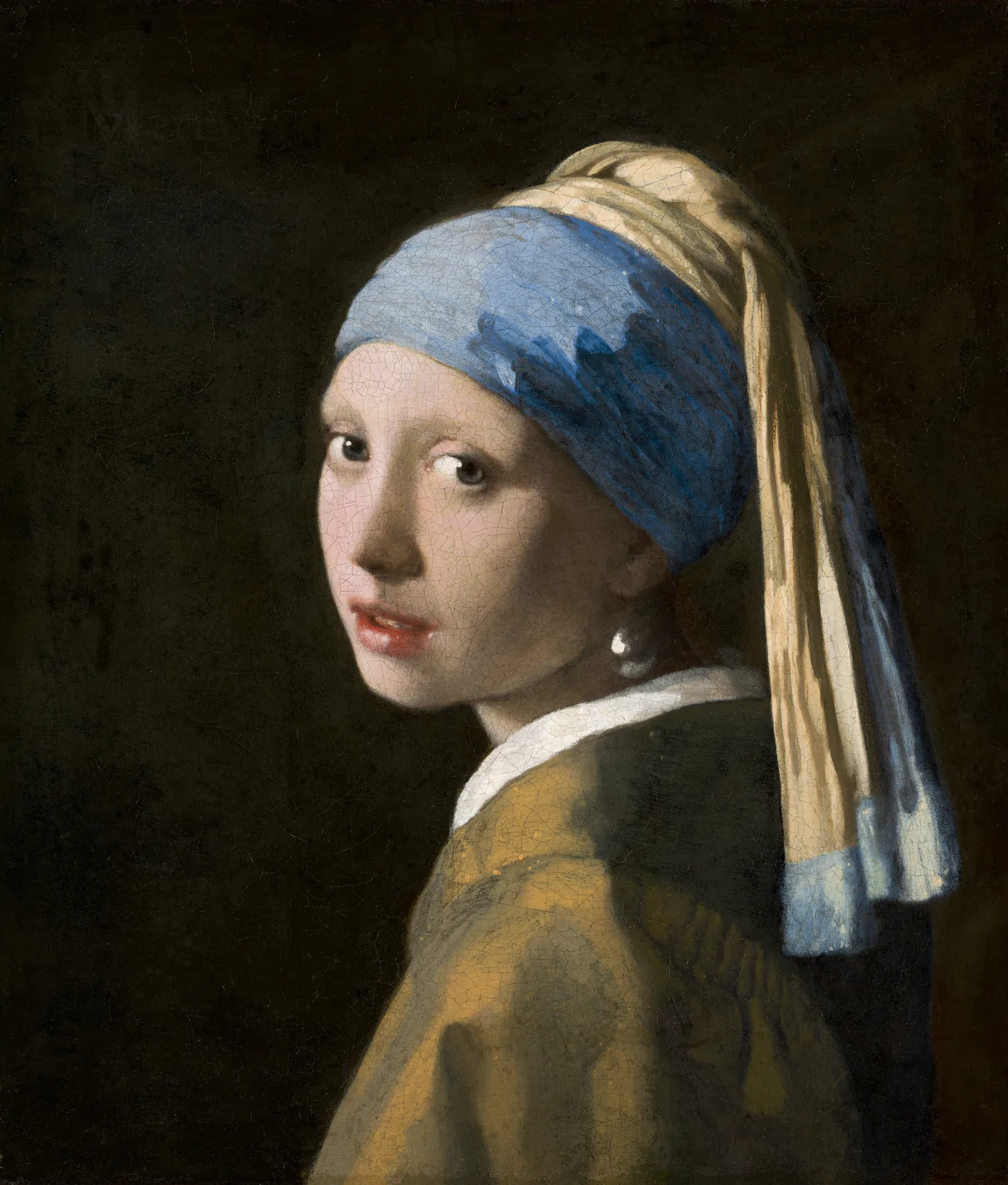
The famous earring is barely an earring at all. There is no clearly painted hook connecting it to the girl’s ear. A bright stroke at the top catches the light; a softer mark below reflects the white collar. Between them, Vermeer lets the viewer imagine a smooth, heavy jewel.
That small illusion is a good way into the whole painting. Johannes Vermeer’s Girl with a Pearl Earring, made around 1665, looks immediate and intimate, yet almost everything viewers want to know about the person remains out of reach. The Mauritshuis object record identifies the work as an oil painting on canvas, just 44.5 by 39 centimetres. It is signed, but not dated. The girl is not named.
An earring made from light
The jewel appears enormous beside the girl’s face. A natural pearl of that size would be exceptionally rare. The Mauritshuis suggests that it might be a glass drop coated to imitate a pearl, or simply a jewel invented by Vermeer. It is safest to call it a pearl earring because that is the painting’s established title, not because its material has been proved.
Vermeer needed very little paint to make the effect convincing. The upper highlight is firm; the lower one is blurred by reflected light. The dark space between them becomes volume in the viewer’s mind. That economy continues across the image: moisture at the lips, a bright point in each eye, and a few shifts of tone along the headscarf make the figure feel present without describing every detail.
A tronie, not an identifying portrait
The most important fact about the painting is also the easiest to miss. It was not intended as a conventional portrait of a known client. The Mauritshuis classifies it as a tronie, a type of image popular in the seventeenth-century Dutch Republic.
A tronie is a study of a face, expression, costume, or character. An artist might use a real model, but the purpose was not to preserve that person’s social identity in the way a commissioned family portrait would. The unusual turn of the head and parted lips let Vermeer explore a fleeting expression. The headscarf and jewel remove the figure from ordinary local dress.
This distinction does not solve the sitter question. A person may have posed, or Vermeer may have combined observation and invention. No document securely identifies her. The museum’s account of the painting’s fame distinguishes what we know from the later novel and film. “Griet,” the character created by novelist Tracy Chevalier, is fiction rather than an established historical identity.
Costume without a biography
The blue-and-yellow head covering is often called a turban. Seventeenth-century Dutch girls did not normally dress this way, which is precisely why it works in a tronie: it places the figure outside an everyday scene and gives Vermeer folds, colours, and reflected light to paint.
The costume should not be used to guess the model’s ethnicity or life story. It is a studio construction, not a passport. Even the blue carries a wider history than the girl can tell us. Technical examination found extensive use of natural ultramarine, made from lapis lazuli that travelled from the region of present-day Afghanistan. The pigment was costly, yet Vermeer used it generously in the headscarf and in subtler mixtures elsewhere.
That material journey is real. A biography invented from the costume is not.
The background was not always black
The girl now emerges from what looks like an empty dark field. Research suggests that Vermeer intended something more specific.
During the Mauritshuis’s 2018 technical study, researchers found colour differences and diagonal lines beneath the aged surface. As the museum explains in Closer to Vermeer and the Girl, the evidence points to a folded green curtain painted over a dark underlayer. The green glaze has changed over time, leaving the background almost black.
The discovery changes how we imagine the original effect. The girl’s outline would have been held against a deep, varied green rather than a flat void.
What technical study can and cannot reveal
Modern imaging lets researchers follow parts of Vermeer’s process. He worked broadly from background toward foreground. He adjusted the ear, the upper edge of the headscarf, and the back of the neck. Microscopic inspection found tiny eyelashes around the eyes. Analysis also identified the pigments and the sequence of some paint layers.
These details bring us close to the making of the picture, not to the name of the model. They show decisions: a contour moved, a highlight added, a costly blue placed over an underlayer.
Technical evidence is most valuable here when it answers questions paint can answer: how the surface was built, which materials changed, and where the artist revised his design.
A small purchase and a second life
The painting’s history before the late nineteenth century is uncertain. In 1881, the collector Arnoldus Andries des Tombe bought it at auction for two guilders and thirty cents including the buyer’s premium. He later left it to the Mauritshuis, where it entered the collection in 1903.
Stories say that the art official Victor de Stuers recognised the dirty, overlooked picture as a Vermeer before the sale. The Mauritshuis catalogue account treats that account as a tradition and notes that another version says the signature emerged only after cleaning. The secure facts are less dramatic but still remarkable: Des Tombe made the purchase, the price was tiny, and the work eventually became the museum’s best-known painting.
Its modern title also encourages the eye to return to the jewel, although the image’s effect depends just as much on the turn of the head and direct glance.
The mystery that remains
It is tempting to think that every technical discovery will finally identify the girl. So far, research has made the painting more concrete—green curtain, imported pigment, shifted contours, two quick strokes of light—while leaving its central human question open.
That gap is not a flaw in the story. Because this is a tronie rather than an identifying portrait, anonymity was likely built into its original purpose. Vermeer gives us a person-like presence without a recoverable biography. She turns as if we have just entered the room, but the meeting lasts only as long as the painted glance.
For the difference between an old painting’s copyright status and the rights attached to a particular digital file, see GeMarkt’s Vermeer public-domain guide. The image credit on this page identifies our particular source; it is not a worldwide permission statement for other files or uses.
Editorial record
About this article
- Author
- Publisher
- GeMarkt
- Published
- Reviewed
- Internal source & rights check. Conducted by GeMarkt Research Review. This is an internal editorial check—not independent peer review.
- Source standard
- Art history source standardPrioritises object records and research sources, distinguishes evidence from interpretation, and states material uncertainty.
Found a claim that needs checking? Report a factual error.