GeMarkt Blog · Essay
The Nabis: Vallotton and Bonnard’s Flat Colour
Eight works by five Nabis artists reveal how flat colour, bold cropping and decorative surfaces changed prints, portraits, park scenes and domestic life.

In a Vallotton print, a room can turn almost entirely black while a white dress tells you exactly where to look. In a Bonnard lithograph, a baby’s head can be scarcely more than pale paper against green. Both pictures describe people, but neither needs to pretend that its surface has disappeared.
That is a useful way into the Nabis, a loosely connected group active around Paris in the late nineteenth century. Their work makes colour, pattern and the edges of shapes carry more of the meaning. Sometimes the result feels intimate; sometimes it is comic, unsettling or difficult to disentangle. These eight works by five members show why “flat colour” is an opening clue, not a complete description of their art.
A group with more than one direction
The group formed in 1888 around students including Pierre Bonnard and Maurice Denis. Paul Sérusier brought back ideas developed with Paul Gauguin at Pont-Aven; his small painting The Talisman became a shared point of reference. Gauguin was an influence, not simply another member of the Paris group. The Met’s history of the Nabis follows their interest in Japanese prints and work beyond the conventional easel picture, including screens and decorative interiors.
There was no single prescribed Nabi finish. The five artists illustrated here—Bonnard, Félix Vallotton, Édouard Vuillard, Denis and Ker-Xavier Roussel—could make a strong shape through a hard border, a shifting patch of paint or an abrupt interruption at the picture’s edge. A painting could remain textured even when its space was deliberately shallow.
Vallotton: The Alarm
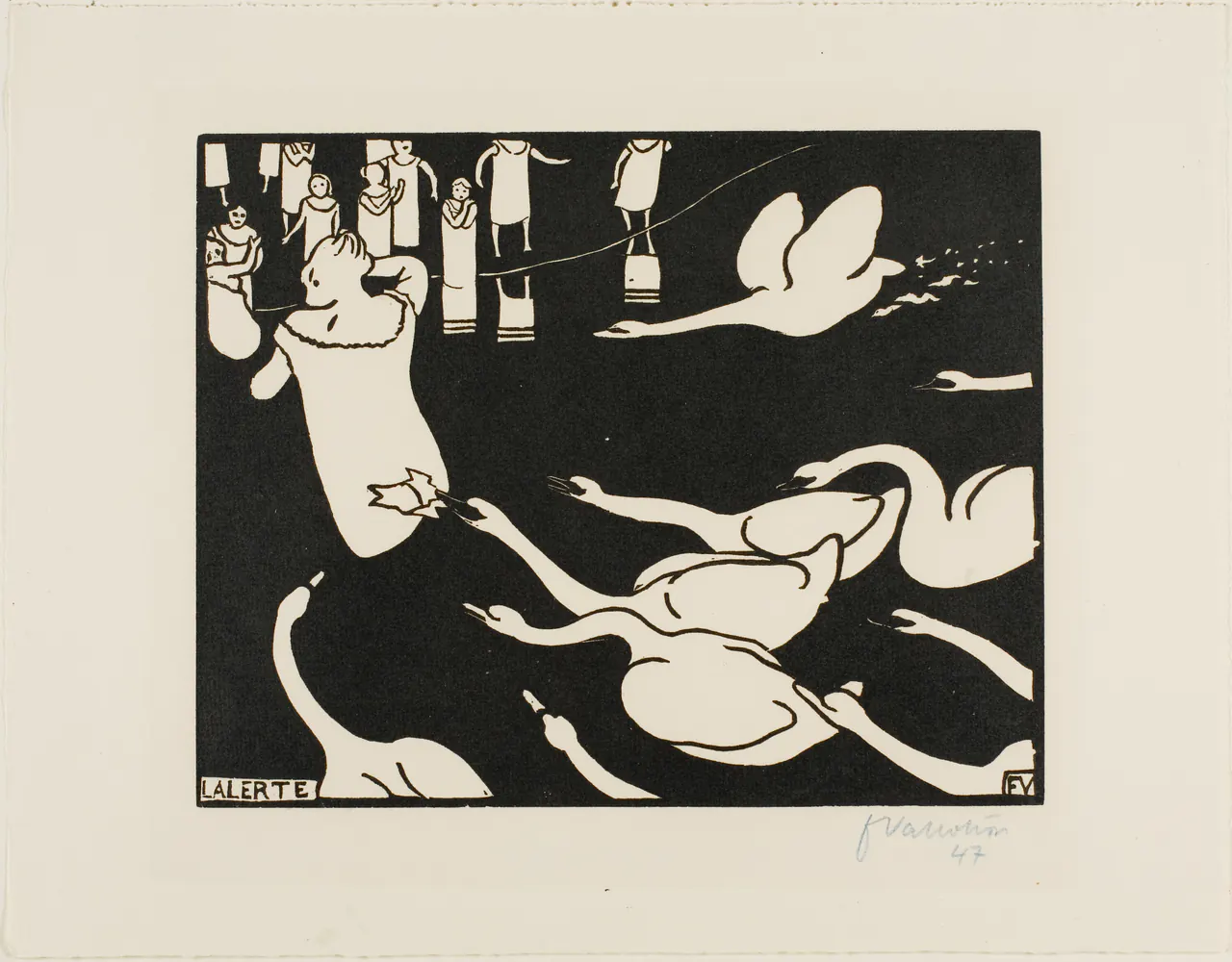
The child’s backward turn and the birds’ reaching necks make the action immediately legible. Yet there is remarkably little modelling of bodies. Pale shapes seem cut from the black field, with just enough line inside them to distinguish a wing, a hand or a garment.
Chicago identifies this as an 1895 woodcut. Black is not merely the colour of a particular thing: it joins much of the setting into one large area. This lets the birds near us feel startlingly large beside the spectators behind. The scene is funny and threatening at once, and it needs neither a carefully receding floor nor smoothly shaded volume to achieve that mixture. Try covering the title and following only the directions of the faces and necks; the alarm is already present in their arrangement.
Bonnard: Family Scene
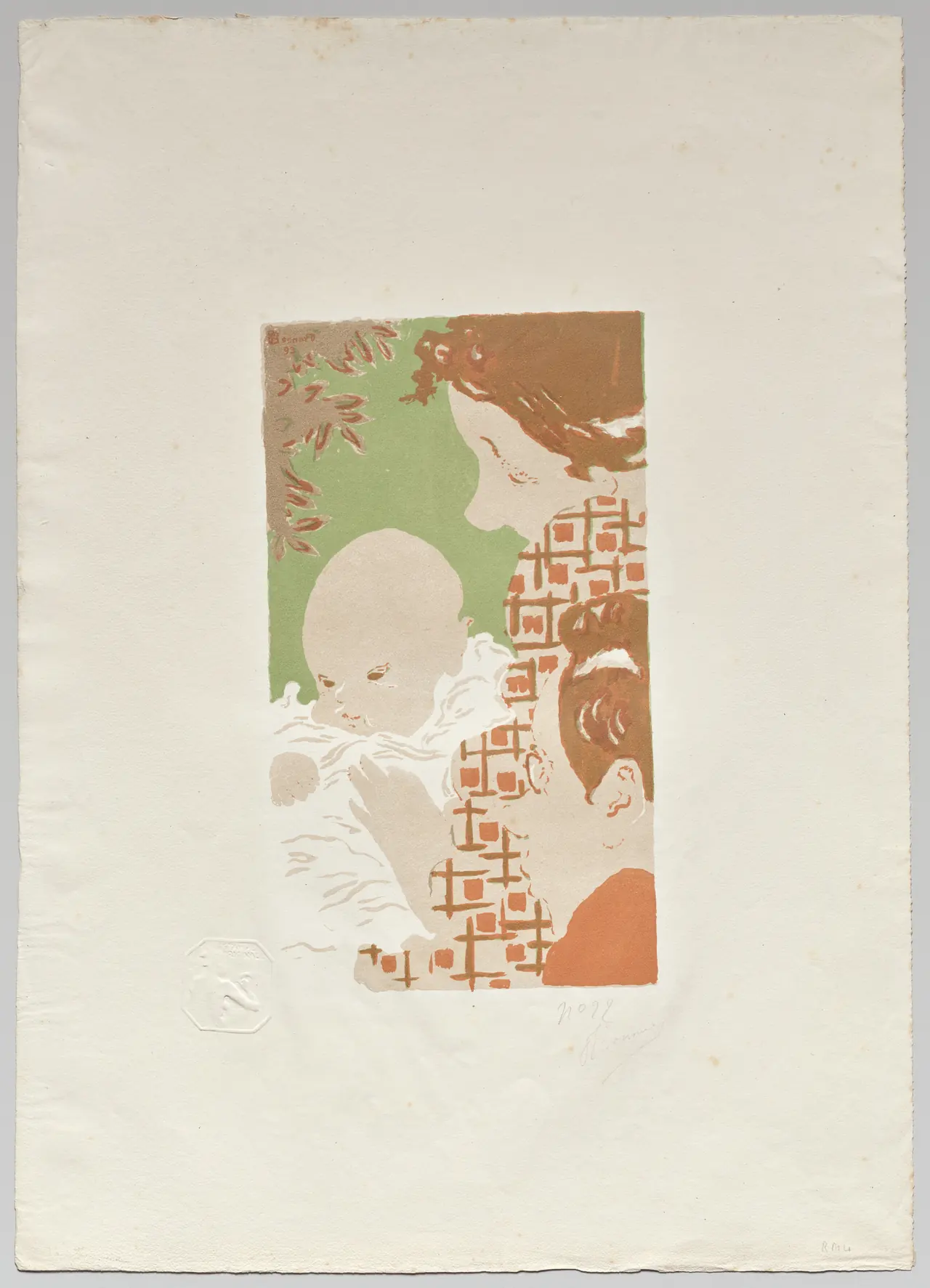
The image sits within a much larger sheet, so distinguish the print’s physical margins from the artist’s tight composition. Inside the picture, adults are cut off while the baby remains prominent. Beige paper participates in the faces and clothing instead of behaving like empty background.
Cleveland identifies Bonnard’s sister Andrée and her son Jean, with the artist himself at the lower right. It relates the cropped figures and flat areas to Japanese woodblock prints. The family resemblance is not the only intimacy here: the viewpoint puts us too close to take in everyone comfortably. A few colours and repeated marks make the gathering feel remembered and selected, not comprehensively reported. Compare the baby’s rounded pale head with the checked garment behind; the pattern makes the simplest shape stand out.
Bonnard: Nursemaids’ Promenade
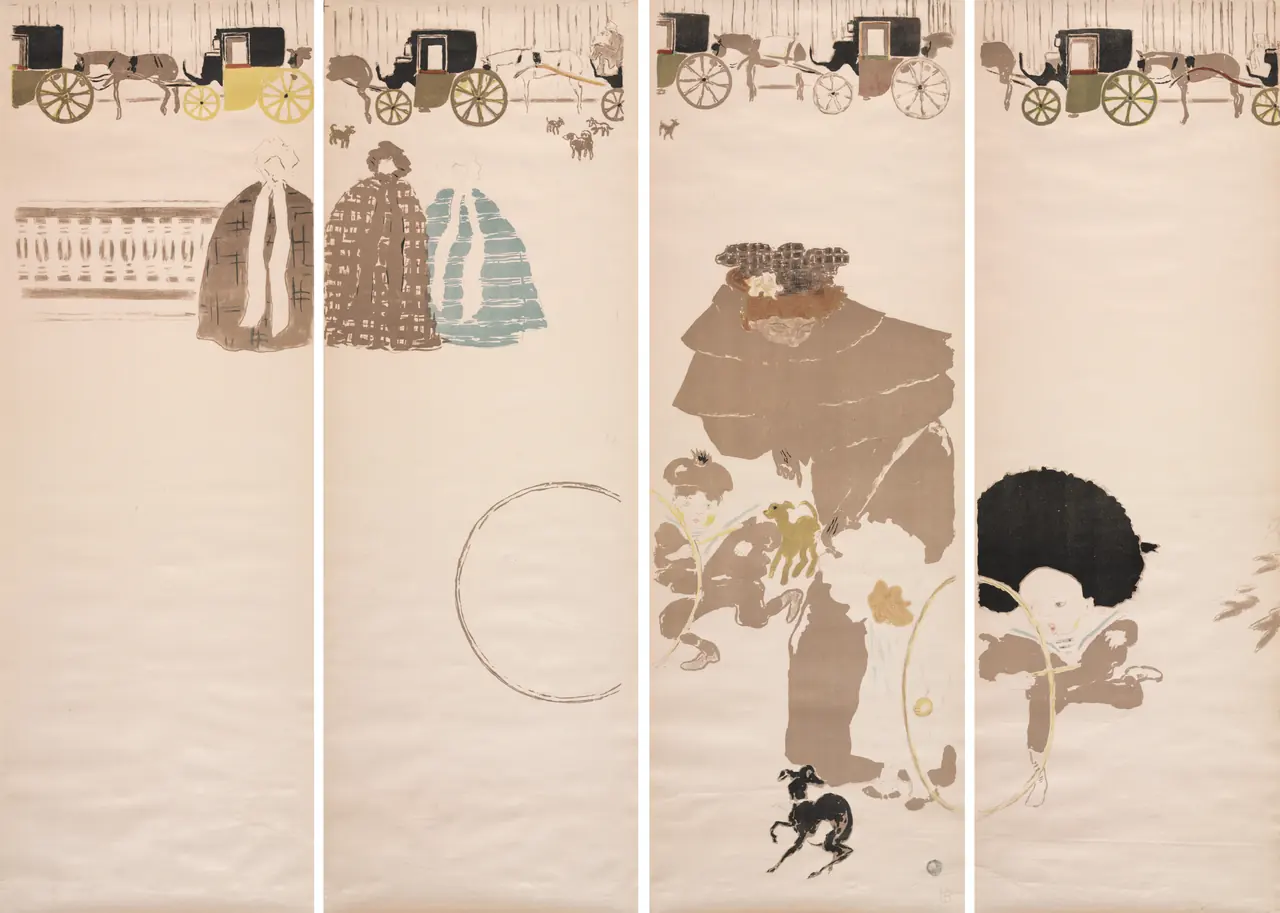
The carriages make a strip across the top. Below them, enormous intervals of pale paper separate the figures; a child’s hoop can carry almost as much visual weight as a person. The scene moves sideways rather than inviting us down a carefully measured street.
This was not simply a long picture subsequently divided for decoration. Cleveland describes four printed panels intended as a folding screen, which Bonnard exhibited in his first solo show in 1896. The format makes the relationship between art and furnishing tangible. On a screen, the breaks and the viewer’s changing position are part of the encounter. Even in a flat reproduction, follow the carriage wheels across the divisions: repeating shapes hold together a composition that also welcomes surprisingly large gaps.
Vuillard: Under the Trees
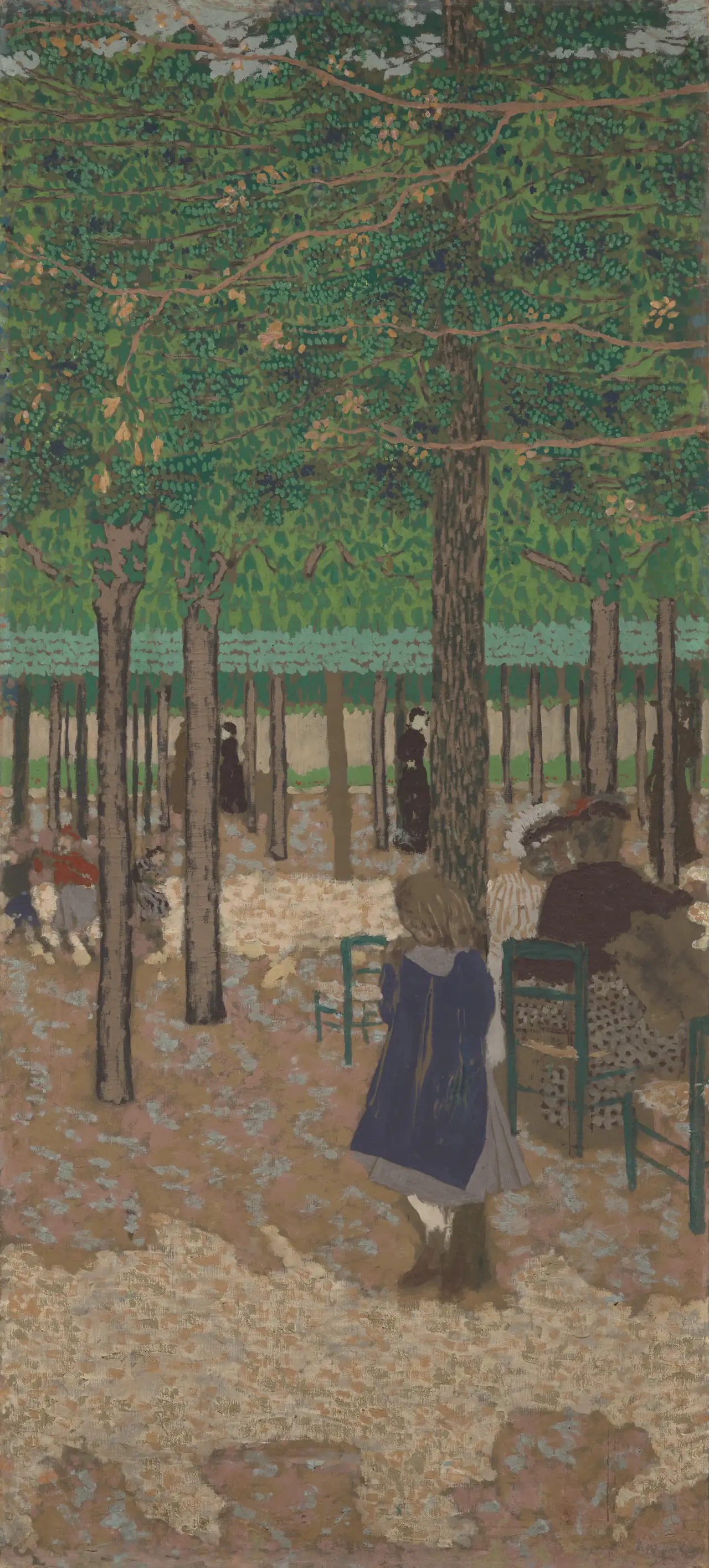
This tall panel almost turns foliage into a hanging fabric of coloured marks. The trees still make a park, and figures occupy different distances, but the canopy has a strong life as a patterned surface. The eye moves between reading a place and enjoying an arrangement of colour.
The Cleveland panel belongs to a nine-part decorative series showing children in Parisian parks. At more than two metres high, it is not a miniature domestic vignette. Notice the contrast between children in motion and seated adults, then the thin trunks that interrupt both. “Flat” here cannot mean smooth, empty or without depth. Vuillard gives us overlapping space while repeatedly bringing attention back to the material surface. The distant view and the dense marks compete rather than cancelling one another.
Denis: Eva Meurier in a Green Dress
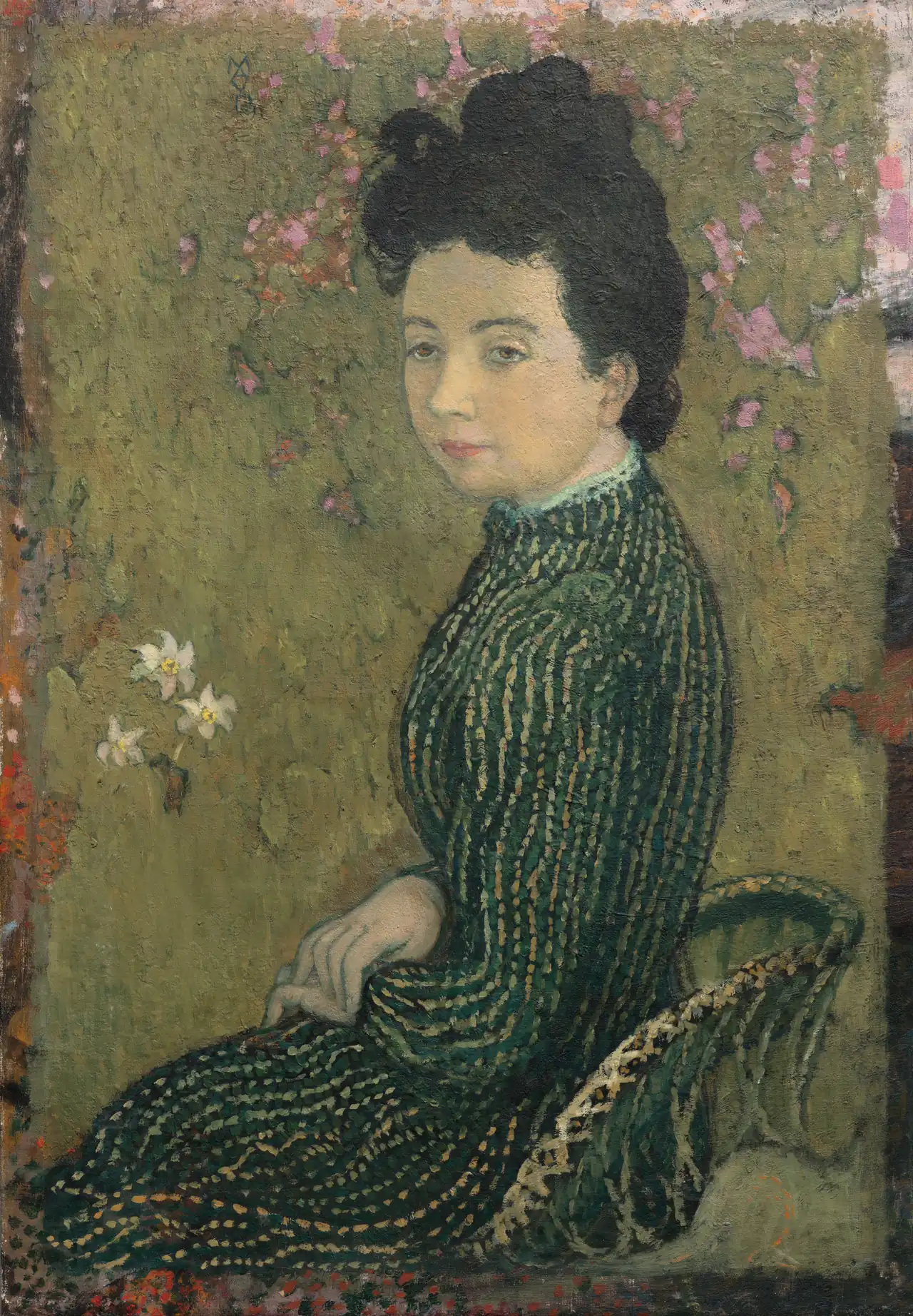
Eva’s face emerges from a field of related greens. The pattern of her dress describes folds, but also links her to the vegetation around her. Look at the curve from shoulder to sleeve and then at the small, carefully folded hands: a broad silhouette and a delicate gesture share the job of holding attention.
Cleveland identifies the sitter as the artist’s pianist sister-in-law and explains that he painted on part of an abandoned picture, traces of which remain around the edges. The unusual border is therefore not merely an ornamental frame added around a finished portrait. It reminds us that the painting is a worked surface with a history. Denis does not eliminate the individual in favour of pattern; he lets the two remain closely entangled.
Roussel: Women Meeting in the Shade
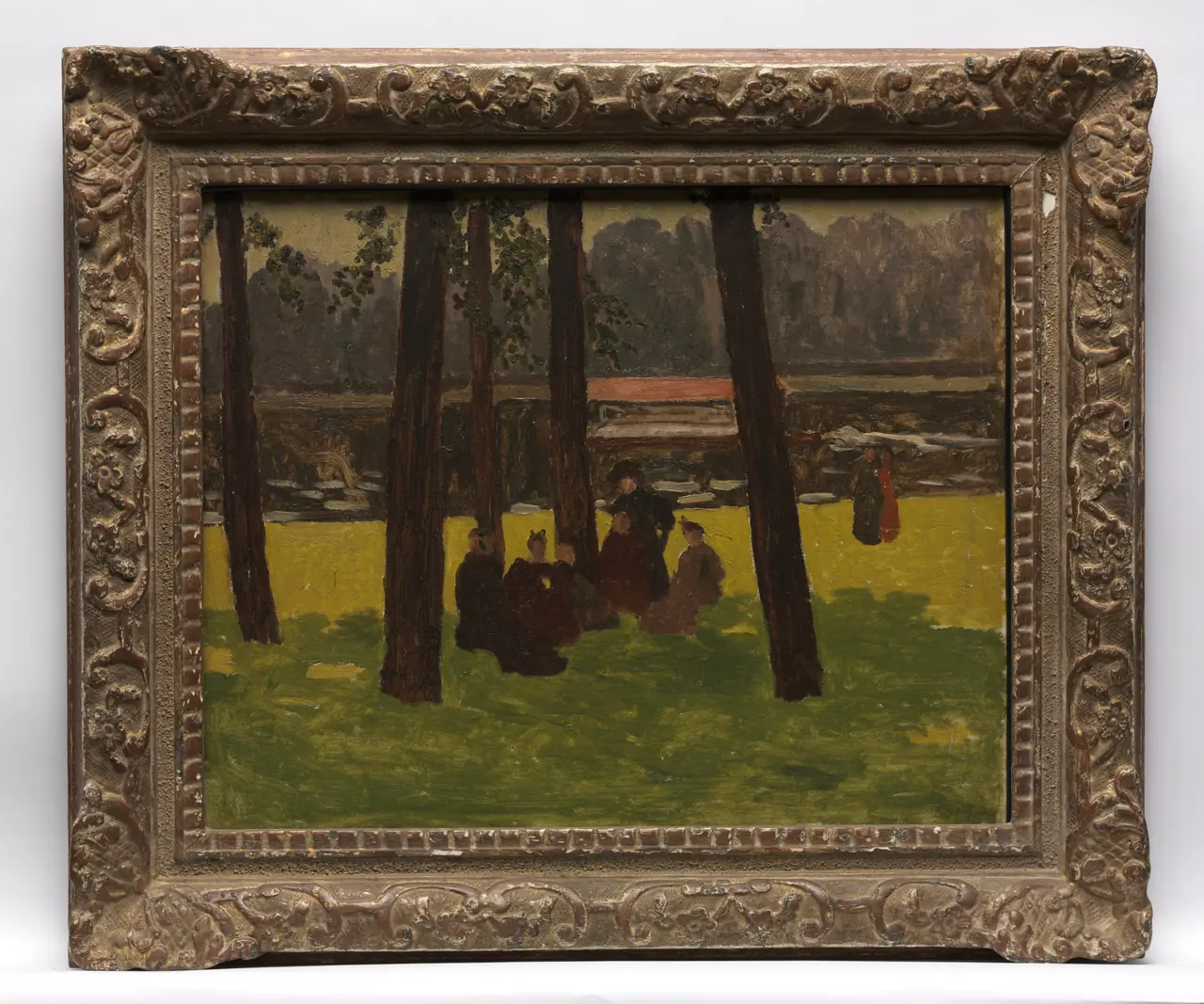
Several trunks divide the field into unequal strips. The seated group is difficult to separate at first because its clothes share the shadow’s darkness. Behind it, brighter grass and water establish a more open distance. Roussel does not give every face an equal claim on us.
The museum identifies Roussel as a founding Nabi and describes the central gathering cautiously as presumably two women and four children. That uncertainty matters: the painting is not a clearly labelled anecdote with a recoverable script. Stay with what its arrangement makes available—the enclosure of the group, the strong verticals and the contrast between shade and light. Compared with Vuillard’s park, the forms are broader and more subdued, yet the scene is similarly organised through decorative colour.
Vuillard: Luncheon
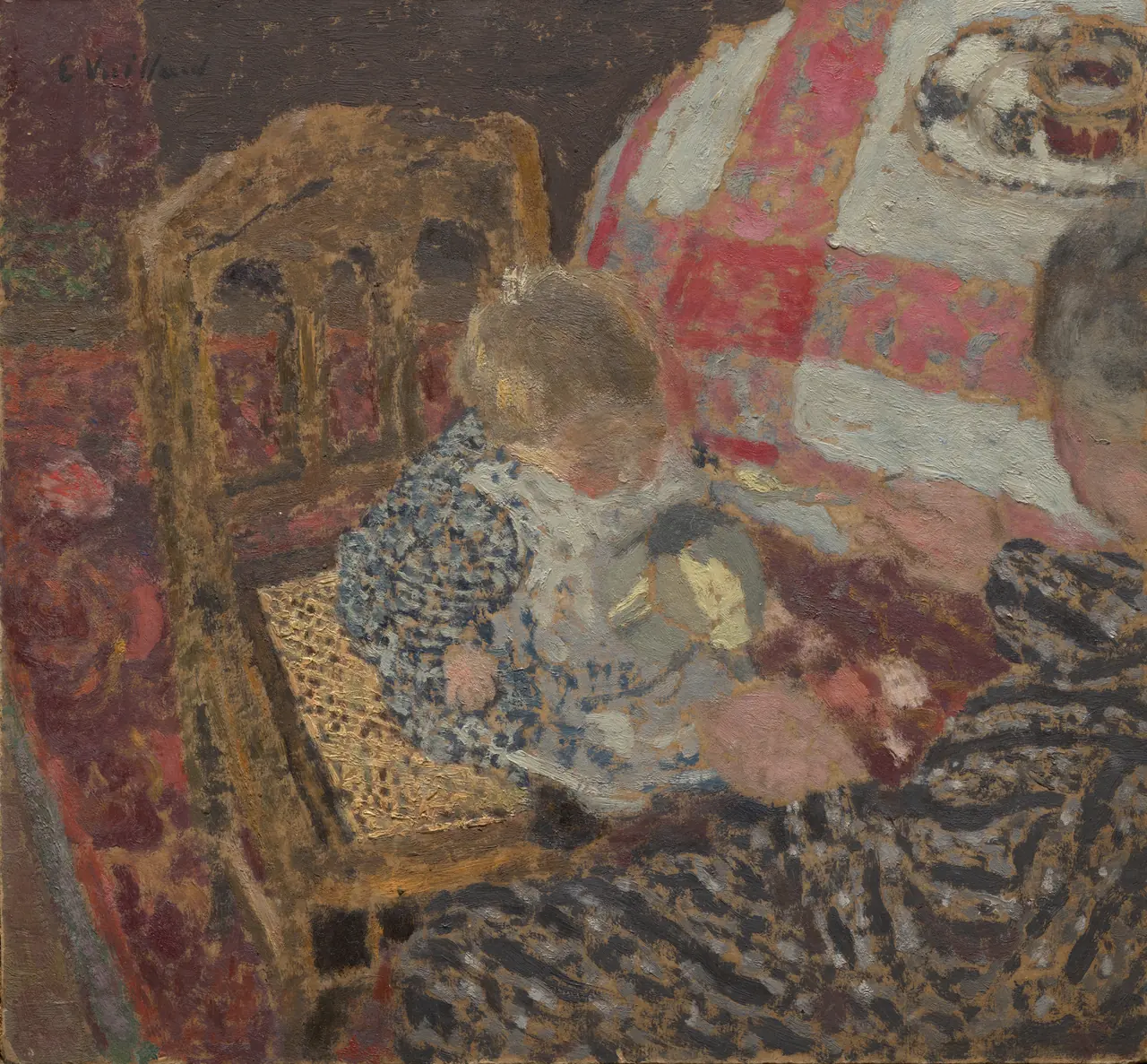
The steep downward view puts patterned surfaces almost everywhere: carpet, dress, chair and tablecloth. The child’s pale bib and the adult’s hand provide small clear places where the action becomes readable. You need a moment to separate person from furnishing.
Cleveland identifies the adult as Marie Vuillard, the artist’s mother, feeding her granddaughter Annette Roussel. The picture’s intimacy comes not only from those family relationships but from the closeness of its viewpoint. We seem to be looking over a shoulder, not surveying an orderly room from outside. Beside Under the Trees, this modest board shows that a similar play of pattern can operate at very different scales. The garden panel surrounds the viewer; the small meal draws the viewer towards a private action.
Vallotton: Money
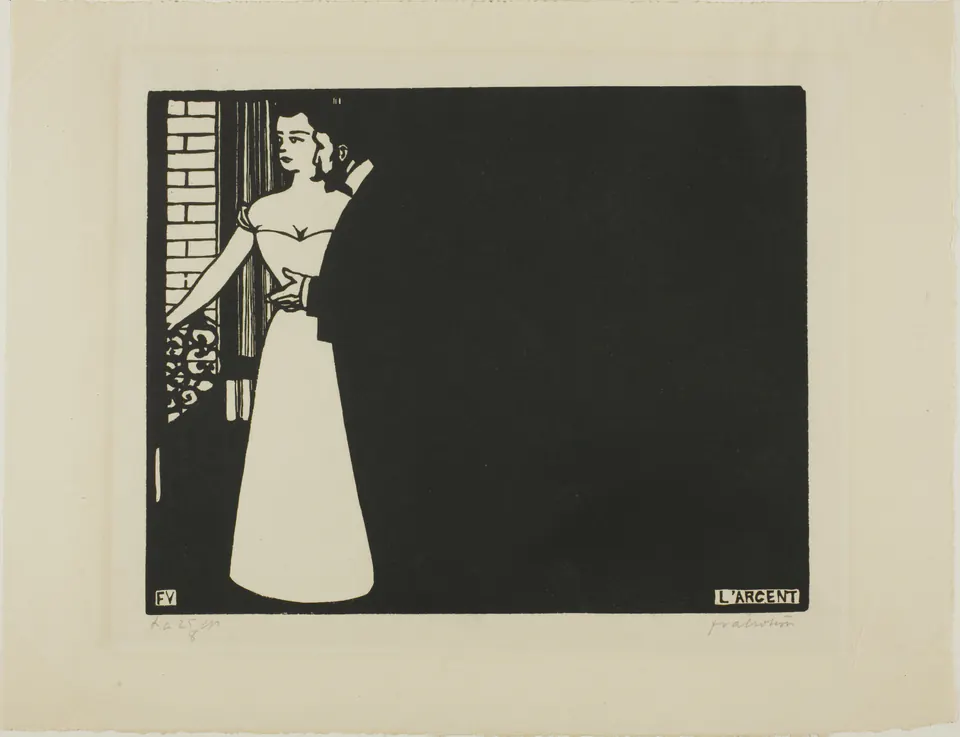
The woman’s light dress is unmistakable; the man almost disappears into the black area that occupies most of the sheet. The small window gives a grid against which the bodies become more ambiguous. Their proximity is clear, but their conversation is not.
The title supplies pressure without supplying a complete plot. Chicago places the woodcut in the 1898 Intimacies series. It would be easy to invent an exact bargain, betrayal or private history, but the image leaves those possibilities open. What we can see is how unequally the two figures emerge from the setting. After Vuillard’s family meal, this is a useful corrective: a Nabi interior need not promise domestic comfort. Simplification can conceal as forcefully as it reveals.
How to recognise a Nabi picture
Look for a relationship, not a checklist. A patterned dress may merge with its surroundings; a background may become an active colour shape; the edge may interrupt a figure you expect to see whole. Bonnard’s paper margins, Roussel’s frame and Vuillard’s tall panel also remind us that format matters. These are objects of different kinds, not interchangeable digital rectangles.
The same features occur outside the group, so resemblance alone cannot establish membership. Nor does every later Bonnard or Vuillard painting belong to the Nabis’ shared 1890s activity. Keep the artist, date and medium beside the visual impression.
Five artists and where to go next
Return to Bonnard for off-centre encounters, Vuillard for figures absorbed into pattern, Denis for the close relationship between portrait and decorated surface, Roussel for broad landscape shapes, and Vallotton for the expressive force of black and white. These are starting comparisons, not limits on their careers.
The Vallotton artist guide continues into print and image-file questions. For the broader group, Cleveland’s Private Lives introduction is a useful next reading. There is no dedicated Nabis collection here: the existing collection directory is a separate browsing route, not a claim that these eight works are offered as products.
Editorial record
About this article
- Author
- Publisher
- GeMarkt
- Published
- Reviewed
- Internal source & rights check. Conducted by GeMarkt Research Review. This is an internal editorial check—not independent peer review.
- Source standard
- Art history source standardPrioritises object records and research sources, distinguishes evidence from interpretation, and states material uncertainty.
Found a claim that needs checking? Report a factual error.