GeMarkt Blog · Essay
Symbolism vs Surrealism
Compare Redon’s smiling cyclops with Pierre Roy’s unexpected Venus to see how Symbolism and Surrealism differ without reducing either to dream pictures.

A smiling cyclops and a lock of hair tied with blue ribbon do not look like obvious neighbours. Put them beside each other, however, and both make familiar things difficult to explain. We recognise an eye, teeth, hair, eggs and a shell. We cannot turn that recognition into an ordinary scene.
Symbolism and Surrealism both reach beyond straightforward description, but they belong to different historical projects. Symbolism gives visible form to ideas, emotions and inward experiences. Surrealism makes unconscious thought, unexpected associations and challenges to rational control central to its programme. Neither can be identified simply by counting strange objects.
The short difference
Symbolism developed across late nineteenth-century art and literature. The Met’s account places its literary manifesto in 1886, while recognising earlier painters whose work helped shape the tendency. Suggestion mattered more than providing a complete explanation of an observable event. Different artists could pursue that aim with very different surfaces and subjects.
Surrealism emerged as a movement in the early twentieth century, with André Breton’s manifesto appearing in Paris in 1924. Its interest in unconscious thought was influenced by Freud, and its ambitions extended beyond painting to literature, politics and ways of living. The Met’s introduction to Surrealism also describes its debt to Dada. It was not simply a new name for every older fantastic image.
That distinction gives us a starting question: what is the strangeness doing, and within which historical setting? Appearance helps, but it cannot answer the second half alone.
Two unsettling images side by side
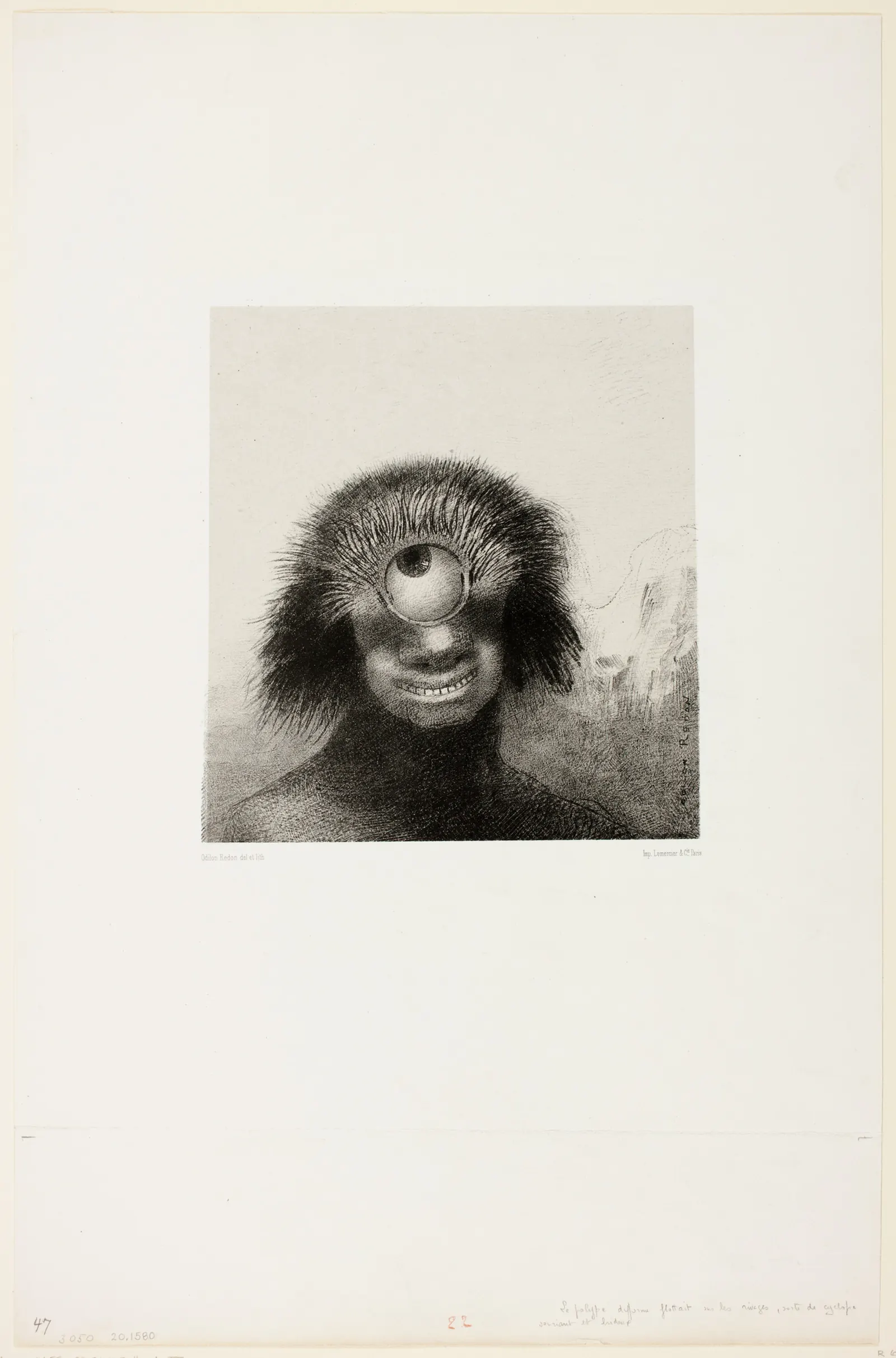
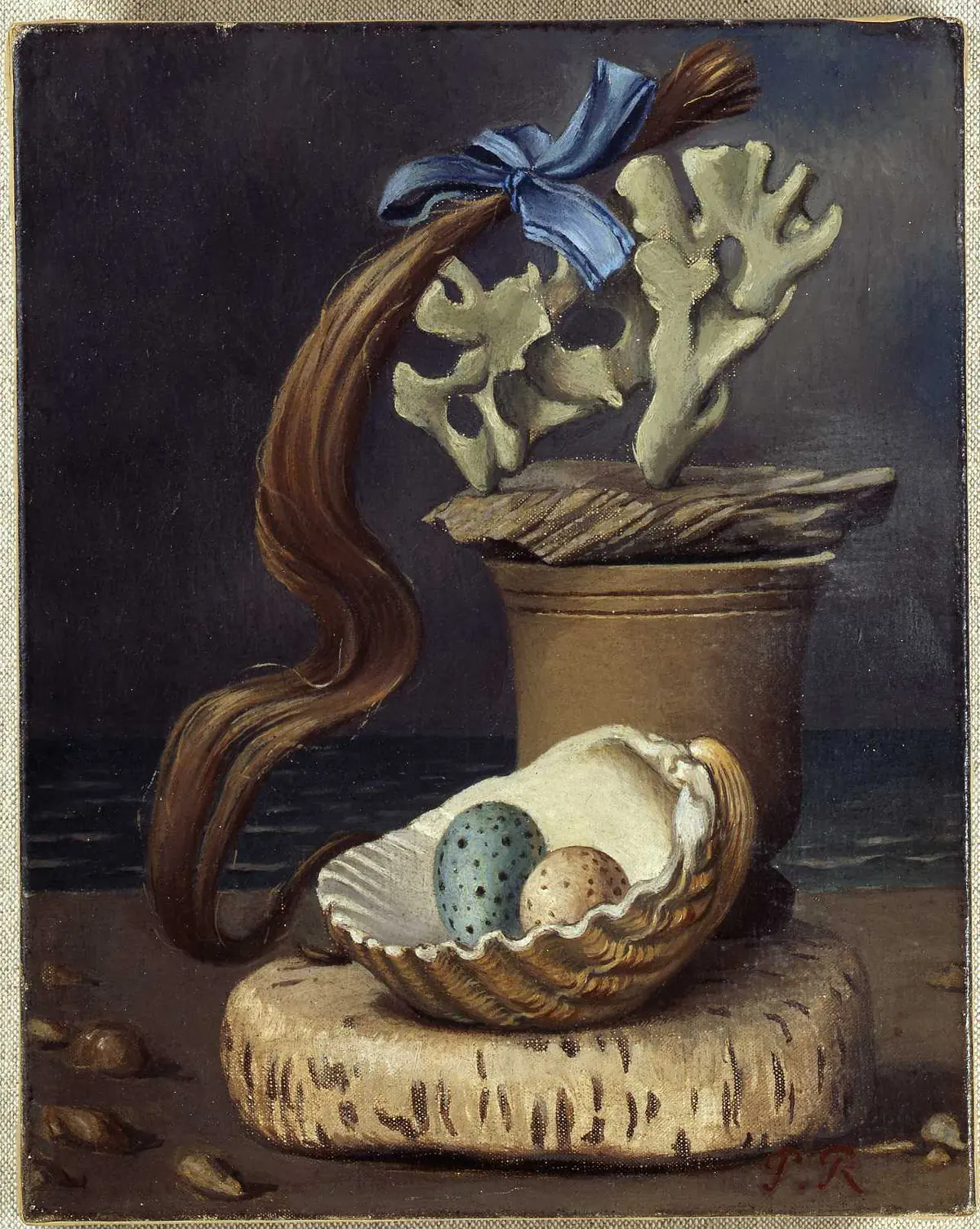
The pair places an 1883 lithograph beside a small 1926 painting. They were not made as a debate between the artists. Redon’s sheet includes wide paper margins; Roy’s photograph shows the painted surface and its edges. Their similar height on a screen does not mean the physical objects are the same size.
Start by looking before reading their titles. Redon’s creature seems impossible immediately. Roy’s individual objects are more believable, yet their combination feels no less difficult to place. The difference is not simply fantasy on one side and realism on the other.
Redon makes a creature hard to read
The mouth is what makes this cyclops especially disconcerting. It appears to smile, showing small teeth under the huge eye. Dark shading gives the cheek a softly rounded surface. Then the upright hair spreads around the head like a prickly halo, interrupting any comfortable recognition of a human face.
Try covering the title and describing its expression. Friendly, foolish, radiant and alarming are all plausible responses to different parts of the same image. None cancels the others. That unstable response matters more than deciding whether this creature could really exist.
The Art Institute’s record identifies a lithograph in black on thin China paper mounted on a larger white sheet. The dark, grainy passages and lightly worked edges give the head somewhere to emerge from. This is not a clean anatomical diagram of an invented animal.
The long title itself keeps two reactions together: smiling and hideous. Redon does not resolve that tension for us. Looking becomes an encounter with something we recognise emotionally without being able to describe it as an ordinary person or animal. More examples in our Symbolism guide show why this inward emphasis need not always involve a monster.
Roy removes Venus but keeps the associations
Roy’s painting has no goddess standing in its shell. Instead, two speckled eggs occupy the foreground. Above them, a long lock of brown hair curves down from a blue bow. The pale branching forms behind it remain separate objects, not limbs belonging to an imaginary creature.
Notice how carefully the objects have been given weight. The shell rests on a cushion-like support, shadows gather below its edge, and the ribbon folds catch light. These small assurances of solidity make the arrangement stranger: the things seem convincing, but their relationship is not self-explanatory.
The Berlin museum’s interpretation connects the title with Botticelli’s famous Venus and reads the tied hair as the kind of souvenir kept from a past love. That is a useful association, not a command to assign every object one fixed meaning. The absent body is part of what we notice.
Follow the hair from bow to foreground and then return to the eggs. The painting redirects attention between a fragment associated with a person and objects that suggest beginnings. It can feel intimate and faintly comic at once. These are responses to the arrangement, not a claim that we know Roy’s private dream or can diagnose his state of mind.
Why the dates matter
Redon’s print predates the 1886 literary manifesto. That does not remove him from Symbolism: the movement’s history includes artists whose earlier practice helped make its ideas possible. A manifesto records an argument at a particular moment; it is not an invention date for imagination.
Roy, by contrast, worked in the setting of the Surrealist movement. Berlin’s object account links him through Giorgio de Chirico to Breton’s circle. His presence here therefore rests on historical association as well as an unusual picture. We are not relabelling a much earlier artist because a modern viewer finds the image surreal.
In everyday speech, “surreal” can describe an improbable meeting or a peculiar afternoon. In art history, Surrealism names a movement with people, publications and disagreements. Keeping those meanings separate makes comparison more accurate without making the pictures less enjoyable.
A dream image is not the same as an automatic process
Surrealism did not require one finish. The Met distinguishes automatic approaches from meticulously illusionistic ones. Automatism aimed to reduce deliberate control while writing or drawing, letting unexpected connections emerge. Carefully painted objects could also become unsettling through their placement and relationships.
Roy’s clear outlines should not therefore disqualify the painting. Nor do those outlines tell us exactly how he planned it. A finished surface is not a recording of the working process. We can describe what looks carefully modelled without inventing whether the artist began with a dream, a sketch, a collected object or a rehearsed arrangement.
The same caution applies to Redon. Soft darkness may feel spontaneous, but that feeling does not establish automatic drawing. Technique, intention and our experience of the finished picture are related questions, not interchangeable answers.
Neither movement is a secret code
It is tempting to say that Symbolism hides a message whereas Surrealism has no meaning. This pair resists both shortcuts. Redon’s title offers language without settling the expression. Roy’s title supplies a mythological reference without explaining why all these objects belong together.
Use an interpretation as a way to look again. Does it explain something visible, such as the smile’s uneasy relation to the eye, or the absent goddess’s relation to the shell? Does it leave room for another response? A reading becomes weaker when it depends on details that are not actually there.
A useful comparison can remain open-ended while still being precise. “Both are mysterious” is true but thin. “Redon makes a single creature’s expression unstable; Roy makes a group of recognisable objects resist an ordinary relationship” gives you something to test with your eyes.
How to compare an unfamiliar picture
Begin with the things you can see, then ask how they have been changed or arranged. Keep the artist, date and documented context beside that observation. Finally, separate what a museum or artist says from what you infer yourself.
For this pair, remember a smile that never settles and a Venus whose body has disappeared. Symbolism and Surrealism overlap in their refusal to leave visible reality alone. Their difference lies in the historical questions and methods behind that refusal—not in a simple contest over which picture looks stranger.
Editorial record
About this article
- Author
- Publisher
- GeMarkt
- Published
- Reviewed
- Internal source & rights check. Conducted by GeMarkt Research Review. This is an internal editorial check—not independent peer review.
- Source standard
- Art history source standardPrioritises object records and research sources, distinguishes evidence from interpretation, and states material uncertainty.
Found a claim that needs checking? Report a factual error.